Level 0 Diploma in Enter Title Here
© 2013 City and Guilds of London Institute. All rights reserved. 1 of 10
Level 1 Diploma in Bricklaying
PowerPointpresentation
Materials
Unit 102: Contribute to setting out and building
masonry structures up to damp proof course
Level 0 Diploma in Enter Title Here
© 2013 City and Guilds of London Institute. All rights reserved. 2 of 10
Level 1 Diploma in Bricklaying
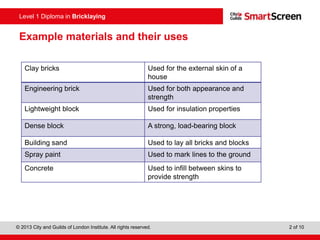
Example materials and their uses
Clay bricks Used for the external skin of a
house
Engineering brick Used for both appearance and
strength
Lightweight block Used for insulation properties
Dense block A strong, load-bearing block
Building sand Used to lay all bricks and blocks
Spray paint Used to mark lines to the ground
Concrete Used to infill between skins to
provide strength
Level 0 Diploma in Enter Title Here
© 2013 City and Guilds of London Institute. All rights reserved. 3 of 10
Level 1 Diploma in Bricklaying
Spray paint
Spray paint comes in
tins as shown here.
The spray paint is used
to transfer the ranging
line position to the
ground or concrete.
Level 0 Diploma in Enter Title Here
© 2013 City and Guilds of London Institute. All rights reserved. 4 of 10
Level 1 Diploma in Bricklaying
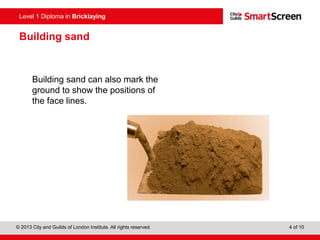
Building sand
Building sand can also mark the
ground to show the positions of
the face lines.
Level 0 Diploma in Enter Title Here
© 2013 City and Guilds of London Institute. All rights reserved. 5 of 10
Level 1 Diploma in Bricklaying
Bricks
Bricks for building below
ground level must be a
strong, engineering brick.
These bricks have
perforations, usually three
as shown below.
Soft clay bricks
such as the brick
above are used
above damp proof
course level.
Level 0 Diploma in Enter Title Here
© 2013 City and Guilds of London Institute. All rights reserved. 6 of 10
Level 1 Diploma in Bricklaying
Blocks
Internal skins on dwellings
are made from different
blocks.
• Lightweight are used for
insulation properties.
• Dense are used for
strength.
Level 0 Diploma in Enter Title Here
© 2013 City and Guilds of London Institute. All rights reserved. 7 of 10
Level 1 Diploma in Bricklaying
Concrete
Concrete is used between the
two skins of a cavity wall to
add strength.
This concrete is called fine fill.
It is made from a low strength
concrete, and also stops the
two skins pushing together
when the back fill is applied.
Level 0 Diploma in Enter Title Here
© 2013 City and Guilds of London Institute. All rights reserved. 8 of 10
Level 1 Diploma in Bricklaying
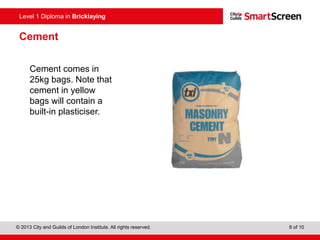
Cement
Cement comes in
25kg bags. Note that
cement in yellow
bags will contain a
built-in plasticiser.
Level 0 Diploma in Enter Title Here
© 2013 City and Guilds of London Institute. All rights reserved. 9 of 10
Level 1 Diploma in Bricklaying
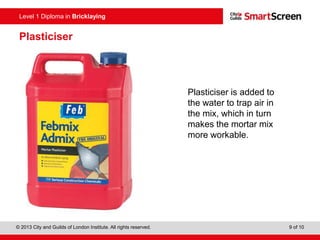
Plasticiser
Plasticiser is added to
the water to trap air in
the mix, which in turn
makes the mortar mix
more workable.
Level 0 Diploma in Enter Title Here
© 2013 City and Guilds of London Institute. All rights reserved. 10 of 10
Level 1 Diploma in Bricklaying
Any questions?

Materials

  • 1.
    Level 0 Diplomain Enter Title Here © 2013 City and Guilds of London Institute. All rights reserved. 1 of 10 Level 1 Diploma in Bricklaying PowerPointpresentation Materials Unit 102: Contribute to setting out and building masonry structures up to damp proof course
  • 2.
    Level 0 Diplomain Enter Title Here © 2013 City and Guilds of London Institute. All rights reserved. 2 of 10 Level 1 Diploma in Bricklaying Example materials and their uses Clay bricks Used for the external skin of a house Engineering brick Used for both appearance and strength Lightweight block Used for insulation properties Dense block A strong, load-bearing block Building sand Used to lay all bricks and blocks Spray paint Used to mark lines to the ground Concrete Used to infill between skins to provide strength
  • 3.
    Level 0 Diplomain Enter Title Here © 2013 City and Guilds of London Institute. All rights reserved. 3 of 10 Level 1 Diploma in Bricklaying Spray paint Spray paint comes in tins as shown here. The spray paint is used to transfer the ranging line position to the ground or concrete.
  • 4.
    Level 0 Diplomain Enter Title Here © 2013 City and Guilds of London Institute. All rights reserved. 4 of 10 Level 1 Diploma in Bricklaying Building sand Building sand can also mark the ground to show the positions of the face lines.
  • 5.
    Level 0 Diplomain Enter Title Here © 2013 City and Guilds of London Institute. All rights reserved. 5 of 10 Level 1 Diploma in Bricklaying Bricks Bricks for building below ground level must be a strong, engineering brick. These bricks have perforations, usually three as shown below. Soft clay bricks such as the brick above are used above damp proof course level.
  • 6.
    Level 0 Diplomain Enter Title Here © 2013 City and Guilds of London Institute. All rights reserved. 6 of 10 Level 1 Diploma in Bricklaying Blocks Internal skins on dwellings are made from different blocks. • Lightweight are used for insulation properties. • Dense are used for strength.
  • 7.
    Level 0 Diplomain Enter Title Here © 2013 City and Guilds of London Institute. All rights reserved. 7 of 10 Level 1 Diploma in Bricklaying Concrete Concrete is used between the two skins of a cavity wall to add strength. This concrete is called fine fill. It is made from a low strength concrete, and also stops the two skins pushing together when the back fill is applied.
  • 8.
    Level 0 Diplomain Enter Title Here © 2013 City and Guilds of London Institute. All rights reserved. 8 of 10 Level 1 Diploma in Bricklaying Cement Cement comes in 25kg bags. Note that cement in yellow bags will contain a built-in plasticiser.
  • 9.
    Level 0 Diplomain Enter Title Here © 2013 City and Guilds of London Institute. All rights reserved. 9 of 10 Level 1 Diploma in Bricklaying Plasticiser Plasticiser is added to the water to trap air in the mix, which in turn makes the mortar mix more workable.
  • 10.
    Level 0 Diplomain Enter Title Here © 2013 City and Guilds of London Institute. All rights reserved. 10 of 10 Level 1 Diploma in Bricklaying Any questions?