Setting Product Strategy
and
Creating Brand Equity
 Distinguish the good of one producer
from those of another
Brand Equity
 The consumers evaluate the product based on
• how it is branded ?
• through past experience
• need satisfaction
• The brand name can be protected through registered trademarks
• Manufacturing can be protected through registered patents
• Packaging can be protected through copyrights and proprietary designs
The role of brands
 Brand differences can be create through
• Continuous innovation
• Competitive advantage
• Marketer can apply branding to
• A physical good
• A service
• A store
• A person
• A place
• An organization
• An idea
The Scope of Branding
 Improved perception of product performance
 Less vulnerability to competitive marketing actions
 Less vulnerability to marketing crises
 Larger margins
 More inelastic consumer response to price increases
 More elastic consumer response to price decreases
Marketing Advantages of Strong Brand
 Greater trade cooperation and support
 Increased marketing communications effectiveness
 Possible licensing opportunities
 Improved employee recruiting and retention
 Greater financial market returns
Marketing Advantages of Strong Brand
 Customer Based Brand Equity
• Positive
• Negative
 Arises from differences in consumer response
 Differences in response are a result of consumer’s brand knowledge
 It reflected in perceptions, preferences, and behavior
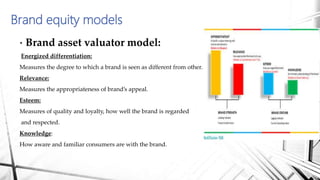
• Brand asset valuator model:
Energized differentiation:
Measures the degree to which a brand is seen as different from other.
Relevance:
Measures the appropriateness of brand’s appeal.
Esteem:
Measures of quality and loyalty, how well the brand is regarded
and respected.
Knowledge:
How aware and familiar consumers are with the brand.
Brand equity models
• Strong and new brands show higher level of differentiation and energy
than relevance, where as both esteem and knowledge are lower still.
leadership brands show high levels on all stages.
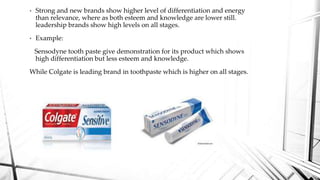
• Example:
Sensodyne tooth paste give demonstration for its product which shows
high differentiation but less esteem and knowledge.
While Colgate is leading brand in toothpaste which is higher on all stages.
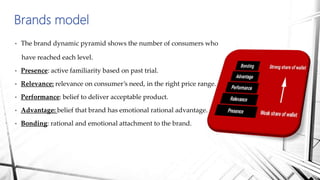
• The brand dynamic pyramid shows the number of consumers who
have reached each level.
• Presence: active familiarity based on past trial.
• Relevance: relevance on consumer’s need, in the right price range.
• Performance: belief to deliver acceptable product.
• Advantage: belief that brand has emotional rational advantage.
• Bonding: rational and emotional attachment to the brand.
Brands model
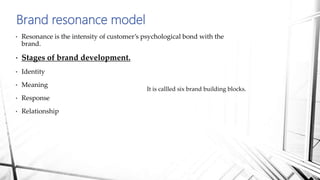
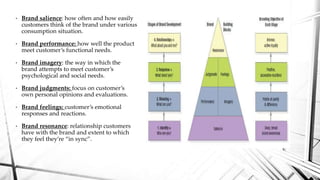
• Resonance is the intensity of customer’s psychological bond with the
brand.
• Stages of brand development.
• Identity
• Meaning
• Response
• Relationship
Brand resonance model
It is callled six brand building blocks.
• Brand salience: how often and how easily
customers think of the brand under various
consumption situation.
• Brand performance: how well the product
meet customer’s functional needs.
• Brand imagery: the way in which the
brand attempts to meet customer’s
psychological and social needs.
• Brand judgments: focus on customer’s
own personal opinions and evaluations.
• Brand feelings: customer’s emotional
responses and reactions.
• Brand resonance: relationship customers
have with the brand and extent to which
they feel they’re “in sync”.
BUILDING BRAND EQUITY
• BRAND EQUITY DRIVERS:
1) The initial choices for the brand elements or identifies making up the
brand:
• brand name
• URLs
• Logos
• Symbols
• Characters
• Slogans
• Jingle
E.g.: AIRTEL recently
changed its logo so that “a”
represents AIR and the
deeper red color conveys
positive meaning.
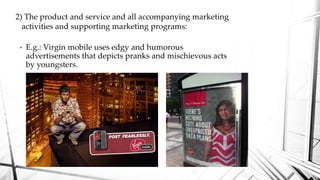
• E.g.: Virgin mobile uses edgy and humorous
advertisements that depicts pranks and mischievous acts
by youngsters.
2) The product and service and all accompanying marketing
activities and supporting marketing programs:
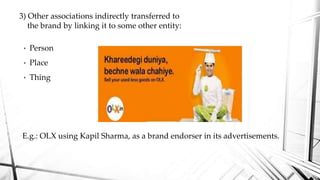
• Person
• Place
• Thing
E.g.: OLX using Kapil Sharma, as a brand endorser in its advertisements.
3) Other associations indirectly transferred to
the brand by linking it to some other entity:
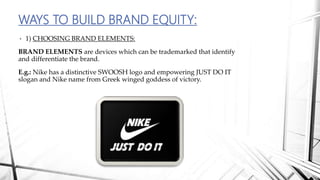
• 1) CHOOSING BRAND ELEMENTS:
BRAND ELEMENTS are devices which can be trademarked that identify
and differentiate the brand.
E.g.: Nike has a distinctive SWOOSH logo and empowering JUST DO IT
slogan and Nike name from Greek winged goddess of victory.
WAYS TO BUILD BRAND EQUITY:
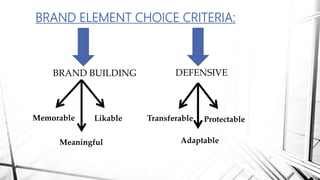
BRAND ELEMENT CHOICE CRITERIA:
BRAND BUILDING DEFENSIVE
Memorable
Meaningful
Likable Transferable Protectable
Adaptable
• E.g.: Life Insurance Corporation of India uses the symbols of
the flame of an enveloped by two hands folded in a Namaste,
symbolizing PROTECTION & SECURITY.
1) Developing Brand Elements:
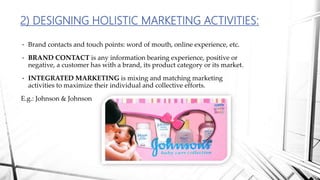
• Brand contacts and touch points: word of mouth, online experience, etc.
• BRAND CONTACT is any information bearing experience, positive or
negative, a customer has with a brand, its product category or its market.
• INTEGRATED MARKETING is mixing and matching marketing
activities to maximize their individual and collective efforts.
E.g.: Johnson & Johnson
2) DESIGNING HOLISTIC MARKETING ACTIVITIES:
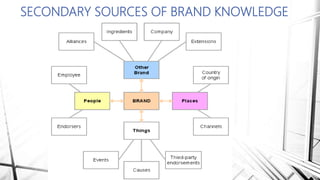
• It links the brand to sources like company itself, Characters,
channels of distribution, Events, Countries and Other party
sources.
• INTERNAL BRANDING consists of activities and processes
that help, inform and inspire employees about brands. Its
principles are:
1. CHOOSE THE RIGHT MOMENT
2. LINK INTERNAL AND EXTERNAL MARKETING
3. BRING THE BRAND ALIVE FOR EMPLOYEES
3)LEVERAGING SECONDARY ASSOCIATIONS:
SECONDARY SOURCES OF BRAND KNOWLEDGE
• BRAND COMMUNITIES is a specialized community of
consumers and employees whose identification and
activities focus around the brand.
E.g.: The Harley-
Davidson Owner’s
Group is a company
sponsored and
facilitated brand
communities.
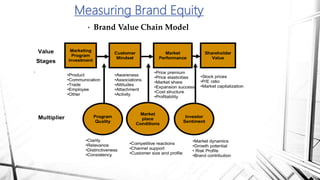
• Brand Value Chain Model
Measuring Brand Equity
• Brand Audit is a consumer-focused series of procedures to
assess health of brand, know its sources of brand equity, to
improve and leverage its equity.
• Brand-tracking studies collect data from consumers to
provide information about performance of brands and
marketing programs.
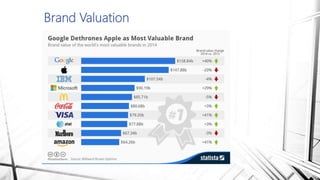
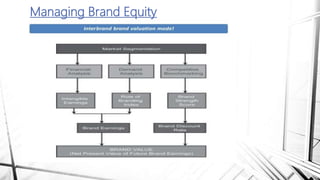
Brand Valuation
Managing Brand Equity
 Brand Reinforcement :- Brand equity can be
reinforced by consistently conveying brand’s
meaning by :-
(a) what products it represents, its core
benefits, needs it satisfies (b) how brand makes
products superior, strong, favorable and unique.
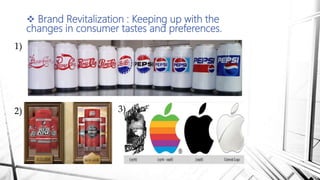
 Brand Revitalization : Keeping up with the
changes in consumer tastes and preferences.
1)
2) 3)
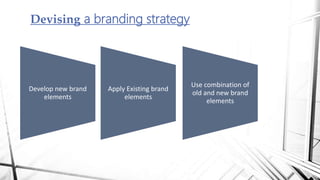
Devising a branding strategy
Develop new brand
elements
Apply Existing brand
elements
Use combination of
old and new brand
elements
 Brand Extension: Uses Established brand to introduce a new brand
 Sub Brand: Combine new brand with existing brand
 Parent Brand: Existing brand that give birth to a brand extension or sub-
brand
 Family Brand:Parent brand that is associated with multiple products
through extensions
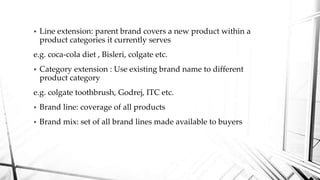
 Line extension: parent brand covers a new product within a product
categories it currently serves
e.g. coca-cola diet , Bisleri, colgate etc.
 Category extension : Use existing brand name to different product
category
e.g. colgate toothbrush, Godrej, ITC etc.
 Brand line: coverage of all products
 Brand mix: set of all brand lines made available to buyers
Branding Terms
 Line extension: parent brand covers a new product within a
product categories it currently serves
e.g. coca-cola diet , Bisleri, colgate etc.
 Category extension : Use existing brand name to different
product category
e.g. colgate toothbrush, Godrej, ITC etc.
 Brand line: coverage of all products
 Brand mix: set of all brand lines made available to buyers
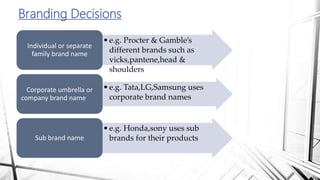
Branding Decisions
•e.g. Procter & Gamble’s
different brands such as
vicks,pantene,head &
shoulders
Individual or separate
family brand name
•e.g. Tata,LG,Samsung uses
corporate brand names
Corporate umbrella or
company brand name
•e.g. Honda,sony uses sub
brands for their productsSub brand name
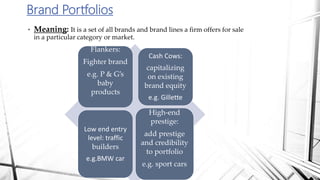
• Meaning: It is a set of all brands and brand lines a firm offers for sale
in a particular category or market.
Brand Portfolios
Flankers:
Fighter brand
e.g. P & G’s
baby
products
Cash Cows:
capitalizing
on existing
brand equity
e.g. Gillette
Low end entry
level: traffic
builders
e.g.BMW car
High-end
prestige:
add prestige
and credibility
to portfolio
e.g. sport cars
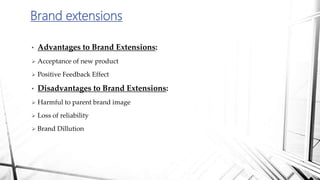
• Advantages to Brand Extensions:
 Acceptance of new product
 Positive Feedback Effect
• Disadvantages to Brand Extensions:
 Harmful to parent brand image
 Loss of reliability
 Brand Dillution
Brand extensions
• When brand equity exists
• When strong basis fitted
• When extension contributes to overall brand equity
• When marketing programs enhance equity
When brand extensions appropriate?
• Meaning: The sum of life time values of customers.
 Acquisition
 Retention
 Add-on spending
Customer Equity
• Customer Equity:
 Focuses on bottom line financial values
 Overlooks the value of brands
• Brand Equity:
 Emphasis on creating, leveraging brand awareness
 Ignores to develop detailed customer analyses
Brand v/s customer Equity
Setting Product Strategy
• Product can be anything that can be offered to a
market to satisfy a want.
• It can be goods, services, events, information, ideas
etc.
Product Characteristics and Classification
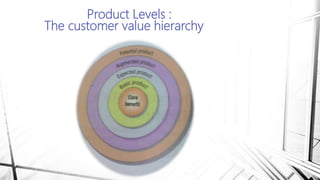
Product Levels :
The customer value hierarchy
These are the different level of products :
 Core benefit : The service
benefit customer is really
buying.
Ex: Hotel guest is buying rest
and sleep.
 Basic Product : The marketer
must turn the core benefit
into a basic product.
Ex: hotel room includes a bed,
bathroom etc facilities.
 Expected product : A set of
attributes and conditions
buyers normally expect
while purchasing product.
Ex: hotel guest expect clean
bed, fresh towel etc.
 Augmented Product :
something that exceeds
customer expectations.
• Brand positioning takes
place under this segment.
Potential product:
which encompasses all the
augmentations and
transformations the
product offering might be
in future.
Product Classifications :
DURABILITY AND
TANGIBILITY
 Nondurable goods: Which
are tangible goods
consumed in one or a few
uses.
Such as shampoo, drinks etc.
 Durable goods: which are
tangible goods that survive
many uses.
Such as cloths, machine tools .
 Service: These are intangible,
inseparable & perishable
products.
CONSUMER-GOODS
CLASSIFICATION
 Convenience goods:
purchased frequently,
immediately and with
minimal effort.
Ex: soft drink, soaps
 Staples
 Impulse
 emergency
 Shopping goods :these are
the goods the consumer
characteristically
compares on basis of
quality, price and style.
Ex: furniture, clothing
 Specialty goods: it has
unique characteristic
which make buyer to
purchase it.
Ex: Mercedes car
 Unsought goods: these are
the goods which
consumer dose not know
about normally think of
buying. Ex: life
insurance policy
 INDUSTRIAL-GOODS
CLASSIFICATION
 Material and parts : goods
that enter the
manufacture’s product
completely.
 Raw materials
 Manufactured materials
and parts
 Capital items: these are long
lasting goods that
facilitate developing or
managing the finished
product.
 Installation
 equipment
 Supply :
Short term goods and services that facilitate developing or managing
the finished product.
 Maintenance and repair items :- paint, nails, brooms
 Operating supplies:- lubricants, coal, writing paper, pencils
 Business services:
 Maintenance and repair services:- window cleaning, copier repair
 Business advisory services:- legal, management consulting , advertising.
Supplies and business services:
• To be branded, Products must be differentiated.
• Differentiation can be refer as variation in products by
variation company can carved out distinct identities in their
categories.
• For example; TATA steel , P & G
• Product differentiation includes differentiation by form,
features, customization, performance quality, conformance
quality, durability, reliability, repairability, and style.
Product and Service Differentiation
Product Differentiation
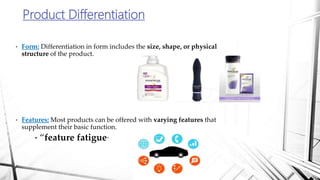
• Form: Differentiation in form includes the size, shape, or physical
structure of the product.
• Features: Most products can be offered with varying features that
supplement their basic function.
• “feature fatigue”
Customization:
Mass Customization is the
ability of a company to meet each customer’s
requirements.
Performance Quality:
It is the level at which the
product’s primary characteristics operate.
• Conformance Quality:
Buyers expect a high conformance quality,
the degree to which all produced units are identical
and meet promised specification.
Low conformance disappointment to buyers
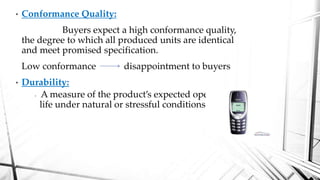
• Durability:
• A measure of the product’s expected operating
life under natural or stressful conditions.
• Reliability:
It is a measure of the product will not malfunction
or fail within a specific period. E.G. Nokia cell phones &
china cell phones
• Reparability:
It measures the ease of fixing a product when it
malfunctions or fails. E.G. warranties 6 months on mobile
phones.
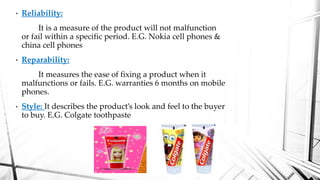
• Style: It describes the product’s look and feel to the buyer
to buy. E.G. Colgate toothpaste
Service Differentiation
Service quality often acts as the key differentiator.
• Ordering Ease: It refers to how easy it is for the
customer to place an order with the company. For
example ; online shopping order.
• Delivery: It refers to how well the product or service
is bought to the customer.It includes speed,
accuracy, and care throughout the process.
Installation: It refers to the work done to make a
product operational in its planned location. E.G.
Purchasing of A.C.
Customer Training: It helps the customer’s employees
use the vendor’s equipment properly and efficiently.
E.G. Expensive X-ray equipment in hospitals.
Customer Consulting: It includes data, information
system, and advice service the seller offers to buyers.
Maintenance and Repair: This helps customers
keep purchased in good working order. For
example; HP offer online technical support – “e-
support”
Returns: A nuisance to customers, manufactures,
retailers and distributors alike, product returns
are also an unavoidable reality of doing business,
especially with online purchases.
 Controllable returns
Uncontrollable returns
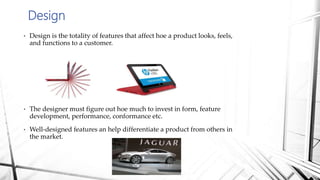
Design
• Design is the totality of features that affect hoe a product looks, feels,
and functions to a customer.
• The designer must figure out hoe much to invest in form, feature
development, performance, conformance etc.
• Well-designed features an help differentiate a product from others in
the market.
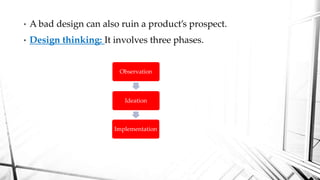
• A bad design can also ruin a product’s prospect.
• Design thinking: It involves three phases.
Observation
Ideation
Implementation
Product & Brand Relationship
• Levels of product hierarchy are as follows:-
1) Need family
2) Product family
3) Product class
4) Product line
5) Product type
6) Item
Product Hierarchy
• Product system is a group of diverse but related items that functions in a
compatible manner.
• Product mix is the set of all the products and items a particular seller offers
for sale.
• Following are the dimensions of product mix:-
1) Width
2) Length
3) Depth
4) Consistency
Product System & Product Mix
• Following are things that product manager need to know
for each item in the product line:-
1) Sales & Profit
2) Market Profile
3) Product map
• Product line analysis provides the information for
following two areas:-
1) Product line length
2) Product mix pricing
Product Line Analysis
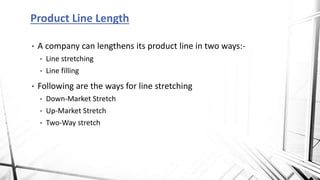
• A company can lengthens its product line in two ways:-
• Line stretching
• Line filling
• Following are the ways for line stretching
• Down-Market Stretch
• Up-Market Stretch
• Two-Way stretch
Product Line Length
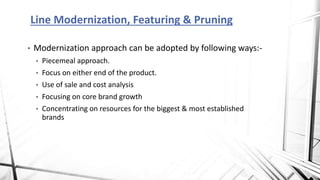
• Modernization approach can be adopted by following ways:-
• Piecemeal approach.
• Focus on either end of the product.
• Use of sale and cost analysis
• Focusing on core brand growth
• Concentrating on resources for the biggest & most established
brands
Line Modernization, Featuring & Pruning
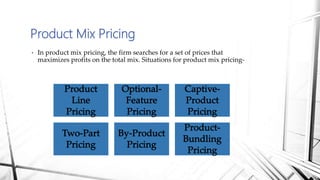
Product Mix Pricing
• In product mix pricing, the firm searches for a set of prices that
maximizes profits on the total mix. Situations for product mix pricing-
1) Product Line Pricing:
For products with various quality levels.
Eg: Computers- basic models, business models and premium high graphic or gaming models.
2) Optional-Feature Pricing:
For products with optional features.
Eg: Cars- power windows, power steering , etc.
3) Captive-Product Pricing:
For products which require ancillary or captive products.
Eg: Razor-Blades
4) Two-Part Pricing:
For service firms consisting of a fixed fee plus a variable usage fee.
Eg: Amusement Parks- Admission fee plus fee for rides over a certain minimum.
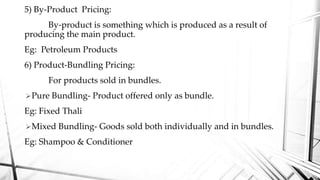
5) By-Product Pricing:
By-product is something which is produced as a result of
producing the main product.
Eg: Petroleum Products
6) Product-Bundling Pricing:
For products sold in bundles.
Pure Bundling- Product offered only as bundle.
Eg: Fixed Thali
Mixed Bundling- Goods sold both individually and in bundles.
Eg: Shampoo & Conditioner
Co-Branding and Ingredient Branding
Co-Branding:
Combining products with products from other companies in various ways.
Also called dual branding or brand bundling.
 Same company co-branding: Gillette Mach 3 Turbo & Gillette Shaving Gel
 Joint-Venture co-branding: Citibank & Jet Airways
 Retail co-branding: Pizza Hut & KFC
Ingredient Branding:
It creates brand equity for materials, components, or parts that are
necessarily contained within other branded products.
Eg: Intel Processors & Laptops of Dell, Lenovo, etc.
Packaging, Labelling, Warranties &
Guarantees
Packaging
Includes activities related to designing & producing container for a
product.
Layers of Packaging:
 Primary Package- Eg: Bottle of a perfume
 Secondary Package- Eg: Cardboard Box
 Shipping Package- Eg: Corrugated Box
Factors contributing to the growing use of packaging-
i) Self Service
ii) Consumer Affluence
iii) Company and Brand Image
iv) Innovation Opportunity
Labelling:
A simple attached tag or an elaborately designed graphic that is part of the
package.
Functions of label:
i) Identify product/brand
ii) Describe the product
iii) Promote the product
Warranties & Guarantees
Warranty-
Formal statement of expected product performance by the manufacturer
Legally enforceable
Expressed or implied
Guarantee-
Reduce the buyer’s perceived risk
Suggests that product is of high quality
Product’s service performance are dependable

brand, product mix development

  • 1.
  • 2.
     Distinguish thegood of one producer from those of another Brand Equity
  • 3.
     The consumersevaluate the product based on • how it is branded ? • through past experience • need satisfaction • The brand name can be protected through registered trademarks • Manufacturing can be protected through registered patents • Packaging can be protected through copyrights and proprietary designs The role of brands
  • 4.
     Brand differencescan be create through • Continuous innovation • Competitive advantage • Marketer can apply branding to • A physical good • A service • A store • A person • A place • An organization • An idea The Scope of Branding
  • 5.
     Improved perceptionof product performance  Less vulnerability to competitive marketing actions  Less vulnerability to marketing crises  Larger margins  More inelastic consumer response to price increases  More elastic consumer response to price decreases Marketing Advantages of Strong Brand
  • 6.
     Greater tradecooperation and support  Increased marketing communications effectiveness  Possible licensing opportunities  Improved employee recruiting and retention  Greater financial market returns Marketing Advantages of Strong Brand
  • 7.
     Customer BasedBrand Equity • Positive • Negative  Arises from differences in consumer response  Differences in response are a result of consumer’s brand knowledge  It reflected in perceptions, preferences, and behavior
  • 8.
    • Brand assetvaluator model: Energized differentiation: Measures the degree to which a brand is seen as different from other. Relevance: Measures the appropriateness of brand’s appeal. Esteem: Measures of quality and loyalty, how well the brand is regarded and respected. Knowledge: How aware and familiar consumers are with the brand. Brand equity models
  • 9.
    • Strong andnew brands show higher level of differentiation and energy than relevance, where as both esteem and knowledge are lower still. leadership brands show high levels on all stages. • Example: Sensodyne tooth paste give demonstration for its product which shows high differentiation but less esteem and knowledge. While Colgate is leading brand in toothpaste which is higher on all stages.
  • 10.
    • The branddynamic pyramid shows the number of consumers who have reached each level. • Presence: active familiarity based on past trial. • Relevance: relevance on consumer’s need, in the right price range. • Performance: belief to deliver acceptable product. • Advantage: belief that brand has emotional rational advantage. • Bonding: rational and emotional attachment to the brand. Brands model
  • 11.
    • Resonance isthe intensity of customer’s psychological bond with the brand. • Stages of brand development. • Identity • Meaning • Response • Relationship Brand resonance model It is callled six brand building blocks.
  • 12.
    • Brand salience:how often and how easily customers think of the brand under various consumption situation. • Brand performance: how well the product meet customer’s functional needs. • Brand imagery: the way in which the brand attempts to meet customer’s psychological and social needs. • Brand judgments: focus on customer’s own personal opinions and evaluations. • Brand feelings: customer’s emotional responses and reactions. • Brand resonance: relationship customers have with the brand and extent to which they feel they’re “in sync”.
  • 13.
    BUILDING BRAND EQUITY •BRAND EQUITY DRIVERS: 1) The initial choices for the brand elements or identifies making up the brand: • brand name • URLs • Logos • Symbols • Characters • Slogans • Jingle E.g.: AIRTEL recently changed its logo so that “a” represents AIR and the deeper red color conveys positive meaning.
  • 14.
    • E.g.: Virginmobile uses edgy and humorous advertisements that depicts pranks and mischievous acts by youngsters. 2) The product and service and all accompanying marketing activities and supporting marketing programs:
  • 15.
    • Person • Place •Thing E.g.: OLX using Kapil Sharma, as a brand endorser in its advertisements. 3) Other associations indirectly transferred to the brand by linking it to some other entity:
  • 16.
    • 1) CHOOSINGBRAND ELEMENTS: BRAND ELEMENTS are devices which can be trademarked that identify and differentiate the brand. E.g.: Nike has a distinctive SWOOSH logo and empowering JUST DO IT slogan and Nike name from Greek winged goddess of victory. WAYS TO BUILD BRAND EQUITY:
  • 17.
    BRAND ELEMENT CHOICECRITERIA: BRAND BUILDING DEFENSIVE Memorable Meaningful Likable Transferable Protectable Adaptable
  • 18.
    • E.g.: LifeInsurance Corporation of India uses the symbols of the flame of an enveloped by two hands folded in a Namaste, symbolizing PROTECTION & SECURITY. 1) Developing Brand Elements:
  • 19.
    • Brand contactsand touch points: word of mouth, online experience, etc. • BRAND CONTACT is any information bearing experience, positive or negative, a customer has with a brand, its product category or its market. • INTEGRATED MARKETING is mixing and matching marketing activities to maximize their individual and collective efforts. E.g.: Johnson & Johnson 2) DESIGNING HOLISTIC MARKETING ACTIVITIES:
  • 20.
    • It linksthe brand to sources like company itself, Characters, channels of distribution, Events, Countries and Other party sources. • INTERNAL BRANDING consists of activities and processes that help, inform and inspire employees about brands. Its principles are: 1. CHOOSE THE RIGHT MOMENT 2. LINK INTERNAL AND EXTERNAL MARKETING 3. BRING THE BRAND ALIVE FOR EMPLOYEES 3)LEVERAGING SECONDARY ASSOCIATIONS:
  • 21.
    SECONDARY SOURCES OFBRAND KNOWLEDGE
  • 22.
    • BRAND COMMUNITIESis a specialized community of consumers and employees whose identification and activities focus around the brand. E.g.: The Harley- Davidson Owner’s Group is a company sponsored and facilitated brand communities.
  • 23.
    • Brand ValueChain Model Measuring Brand Equity
  • 24.
    • Brand Auditis a consumer-focused series of procedures to assess health of brand, know its sources of brand equity, to improve and leverage its equity. • Brand-tracking studies collect data from consumers to provide information about performance of brands and marketing programs.
  • 25.
  • 26.
  • 27.
     Brand Reinforcement:- Brand equity can be reinforced by consistently conveying brand’s meaning by :- (a) what products it represents, its core benefits, needs it satisfies (b) how brand makes products superior, strong, favorable and unique.
  • 28.
     Brand Revitalization: Keeping up with the changes in consumer tastes and preferences. 1) 2) 3)
  • 29.
    Devising a brandingstrategy Develop new brand elements Apply Existing brand elements Use combination of old and new brand elements
  • 30.
     Brand Extension:Uses Established brand to introduce a new brand  Sub Brand: Combine new brand with existing brand  Parent Brand: Existing brand that give birth to a brand extension or sub- brand  Family Brand:Parent brand that is associated with multiple products through extensions  Line extension: parent brand covers a new product within a product categories it currently serves e.g. coca-cola diet , Bisleri, colgate etc.  Category extension : Use existing brand name to different product category e.g. colgate toothbrush, Godrej, ITC etc.  Brand line: coverage of all products  Brand mix: set of all brand lines made available to buyers Branding Terms
  • 31.
     Line extension:parent brand covers a new product within a product categories it currently serves e.g. coca-cola diet , Bisleri, colgate etc.  Category extension : Use existing brand name to different product category e.g. colgate toothbrush, Godrej, ITC etc.  Brand line: coverage of all products  Brand mix: set of all brand lines made available to buyers
  • 32.
    Branding Decisions •e.g. Procter& Gamble’s different brands such as vicks,pantene,head & shoulders Individual or separate family brand name •e.g. Tata,LG,Samsung uses corporate brand names Corporate umbrella or company brand name •e.g. Honda,sony uses sub brands for their productsSub brand name
  • 33.
    • Meaning: Itis a set of all brands and brand lines a firm offers for sale in a particular category or market. Brand Portfolios Flankers: Fighter brand e.g. P & G’s baby products Cash Cows: capitalizing on existing brand equity e.g. Gillette Low end entry level: traffic builders e.g.BMW car High-end prestige: add prestige and credibility to portfolio e.g. sport cars
  • 34.
    • Advantages toBrand Extensions:  Acceptance of new product  Positive Feedback Effect • Disadvantages to Brand Extensions:  Harmful to parent brand image  Loss of reliability  Brand Dillution Brand extensions
  • 35.
    • When brandequity exists • When strong basis fitted • When extension contributes to overall brand equity • When marketing programs enhance equity When brand extensions appropriate?
  • 36.
    • Meaning: Thesum of life time values of customers.  Acquisition  Retention  Add-on spending Customer Equity
  • 37.
    • Customer Equity: Focuses on bottom line financial values  Overlooks the value of brands • Brand Equity:  Emphasis on creating, leveraging brand awareness  Ignores to develop detailed customer analyses Brand v/s customer Equity
  • 38.
  • 39.
    • Product canbe anything that can be offered to a market to satisfy a want. • It can be goods, services, events, information, ideas etc. Product Characteristics and Classification
  • 40.
    Product Levels : Thecustomer value hierarchy
  • 41.
    These are thedifferent level of products :  Core benefit : The service benefit customer is really buying. Ex: Hotel guest is buying rest and sleep.  Basic Product : The marketer must turn the core benefit into a basic product. Ex: hotel room includes a bed, bathroom etc facilities.  Expected product : A set of attributes and conditions buyers normally expect while purchasing product. Ex: hotel guest expect clean bed, fresh towel etc.  Augmented Product : something that exceeds customer expectations. • Brand positioning takes place under this segment. Potential product: which encompasses all the augmentations and transformations the product offering might be in future.
  • 42.
    Product Classifications : DURABILITYAND TANGIBILITY  Nondurable goods: Which are tangible goods consumed in one or a few uses. Such as shampoo, drinks etc.  Durable goods: which are tangible goods that survive many uses. Such as cloths, machine tools .  Service: These are intangible, inseparable & perishable products. CONSUMER-GOODS CLASSIFICATION  Convenience goods: purchased frequently, immediately and with minimal effort. Ex: soft drink, soaps  Staples  Impulse  emergency
  • 43.
     Shopping goods:these are the goods the consumer characteristically compares on basis of quality, price and style. Ex: furniture, clothing  Specialty goods: it has unique characteristic which make buyer to purchase it. Ex: Mercedes car  Unsought goods: these are the goods which consumer dose not know about normally think of buying. Ex: life insurance policy  INDUSTRIAL-GOODS CLASSIFICATION  Material and parts : goods that enter the manufacture’s product completely.  Raw materials  Manufactured materials and parts  Capital items: these are long lasting goods that facilitate developing or managing the finished product.  Installation  equipment
  • 44.
     Supply : Shortterm goods and services that facilitate developing or managing the finished product.  Maintenance and repair items :- paint, nails, brooms  Operating supplies:- lubricants, coal, writing paper, pencils  Business services:  Maintenance and repair services:- window cleaning, copier repair  Business advisory services:- legal, management consulting , advertising. Supplies and business services:
  • 45.
    • To bebranded, Products must be differentiated. • Differentiation can be refer as variation in products by variation company can carved out distinct identities in their categories. • For example; TATA steel , P & G • Product differentiation includes differentiation by form, features, customization, performance quality, conformance quality, durability, reliability, repairability, and style. Product and Service Differentiation
  • 46.
    Product Differentiation • Form:Differentiation in form includes the size, shape, or physical structure of the product. • Features: Most products can be offered with varying features that supplement their basic function. • “feature fatigue”
  • 47.
    Customization: Mass Customization isthe ability of a company to meet each customer’s requirements. Performance Quality: It is the level at which the product’s primary characteristics operate.
  • 48.
    • Conformance Quality: Buyersexpect a high conformance quality, the degree to which all produced units are identical and meet promised specification. Low conformance disappointment to buyers • Durability: • A measure of the product’s expected operating life under natural or stressful conditions.
  • 49.
    • Reliability: It isa measure of the product will not malfunction or fail within a specific period. E.G. Nokia cell phones & china cell phones • Reparability: It measures the ease of fixing a product when it malfunctions or fails. E.G. warranties 6 months on mobile phones. • Style: It describes the product’s look and feel to the buyer to buy. E.G. Colgate toothpaste
  • 50.
    Service Differentiation Service qualityoften acts as the key differentiator. • Ordering Ease: It refers to how easy it is for the customer to place an order with the company. For example ; online shopping order. • Delivery: It refers to how well the product or service is bought to the customer.It includes speed, accuracy, and care throughout the process.
  • 51.
    Installation: It refersto the work done to make a product operational in its planned location. E.G. Purchasing of A.C. Customer Training: It helps the customer’s employees use the vendor’s equipment properly and efficiently. E.G. Expensive X-ray equipment in hospitals. Customer Consulting: It includes data, information system, and advice service the seller offers to buyers.
  • 52.
    Maintenance and Repair:This helps customers keep purchased in good working order. For example; HP offer online technical support – “e- support” Returns: A nuisance to customers, manufactures, retailers and distributors alike, product returns are also an unavoidable reality of doing business, especially with online purchases.  Controllable returns Uncontrollable returns
  • 53.
    Design • Design isthe totality of features that affect hoe a product looks, feels, and functions to a customer. • The designer must figure out hoe much to invest in form, feature development, performance, conformance etc. • Well-designed features an help differentiate a product from others in the market.
  • 54.
    • A baddesign can also ruin a product’s prospect. • Design thinking: It involves three phases. Observation Ideation Implementation
  • 55.
    Product & BrandRelationship
  • 56.
    • Levels ofproduct hierarchy are as follows:- 1) Need family 2) Product family 3) Product class 4) Product line 5) Product type 6) Item Product Hierarchy
  • 57.
    • Product systemis a group of diverse but related items that functions in a compatible manner. • Product mix is the set of all the products and items a particular seller offers for sale. • Following are the dimensions of product mix:- 1) Width 2) Length 3) Depth 4) Consistency Product System & Product Mix
  • 58.
    • Following arethings that product manager need to know for each item in the product line:- 1) Sales & Profit 2) Market Profile 3) Product map • Product line analysis provides the information for following two areas:- 1) Product line length 2) Product mix pricing Product Line Analysis
  • 59.
    • A companycan lengthens its product line in two ways:- • Line stretching • Line filling • Following are the ways for line stretching • Down-Market Stretch • Up-Market Stretch • Two-Way stretch Product Line Length
  • 60.
    • Modernization approachcan be adopted by following ways:- • Piecemeal approach. • Focus on either end of the product. • Use of sale and cost analysis • Focusing on core brand growth • Concentrating on resources for the biggest & most established brands Line Modernization, Featuring & Pruning
  • 61.
    Product Mix Pricing •In product mix pricing, the firm searches for a set of prices that maximizes profits on the total mix. Situations for product mix pricing-
  • 62.
    1) Product LinePricing: For products with various quality levels. Eg: Computers- basic models, business models and premium high graphic or gaming models. 2) Optional-Feature Pricing: For products with optional features. Eg: Cars- power windows, power steering , etc. 3) Captive-Product Pricing: For products which require ancillary or captive products. Eg: Razor-Blades 4) Two-Part Pricing: For service firms consisting of a fixed fee plus a variable usage fee. Eg: Amusement Parks- Admission fee plus fee for rides over a certain minimum.
  • 63.
    5) By-Product Pricing: By-productis something which is produced as a result of producing the main product. Eg: Petroleum Products 6) Product-Bundling Pricing: For products sold in bundles. Pure Bundling- Product offered only as bundle. Eg: Fixed Thali Mixed Bundling- Goods sold both individually and in bundles. Eg: Shampoo & Conditioner
  • 64.
    Co-Branding and IngredientBranding Co-Branding: Combining products with products from other companies in various ways. Also called dual branding or brand bundling.  Same company co-branding: Gillette Mach 3 Turbo & Gillette Shaving Gel  Joint-Venture co-branding: Citibank & Jet Airways  Retail co-branding: Pizza Hut & KFC Ingredient Branding: It creates brand equity for materials, components, or parts that are necessarily contained within other branded products. Eg: Intel Processors & Laptops of Dell, Lenovo, etc.
  • 65.
    Packaging, Labelling, Warranties& Guarantees Packaging Includes activities related to designing & producing container for a product. Layers of Packaging:  Primary Package- Eg: Bottle of a perfume  Secondary Package- Eg: Cardboard Box  Shipping Package- Eg: Corrugated Box
  • 66.
    Factors contributing tothe growing use of packaging- i) Self Service ii) Consumer Affluence iii) Company and Brand Image iv) Innovation Opportunity Labelling: A simple attached tag or an elaborately designed graphic that is part of the package. Functions of label: i) Identify product/brand ii) Describe the product iii) Promote the product
  • 67.
    Warranties & Guarantees Warranty- Formalstatement of expected product performance by the manufacturer Legally enforceable Expressed or implied Guarantee- Reduce the buyer’s perceived risk Suggests that product is of high quality Product’s service performance are dependable