
PRODUCT AND
BRAND
MANAGEMENT
PRESENTED BY
K. BALASRI PRASAD
B.Sc (KU), M.B.A (OU), NET (UGC), (Ph.D) (MGU)
ASSOCIATE PROFESSOR IN MANAGEMENT
UNIT – I
Product and Branding Decisions: Product, Policy,
Objectives, Product Mix, Product Line, Packaging,
Product Modification and Deletion.
Brand Management: Branding, Brand Positioning,
repositioning Strategies and Brand Loyalty, Brand
Equity, Brand Management practices.
Definition of Product:
A product is the item offered for sale.
A product can be a service or a good.
It can be in physical or virtual(cyber) form.
Each product is made at a cost.
Each product is sold at a price.
The price charged depends upon the
market, the quality, the marketing and the
targeted segment.
New Product Development
Most new product development is an
improvement on existing products
Less than 10% of new products are
totally new concepts.


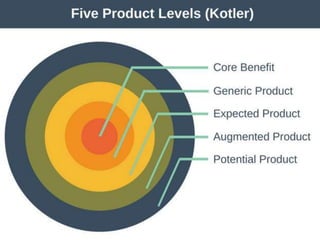
Product Levels
Customer value hierarchy :
Core benefit
Basic product
Expected product
Augmented product
Potential product
Product Mix Concept:
Also referred to as product assortment, it
is the total number of product lines that a
company offers to its customers.
The product lines may range from one to
many and the company may have many
products under the same product line as
well.
All of these product lines when grouped
together forms the product mix of the
company.
Width – how many different product lines?
Length – the number of items in the product
mix
Depth – The no. of variants offered in a
product line
Consistency – how closely the product lines
are related in usage
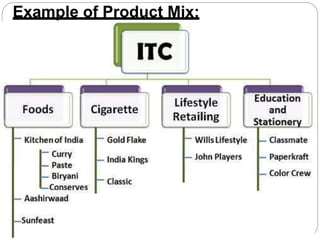
Example of Product Mix:
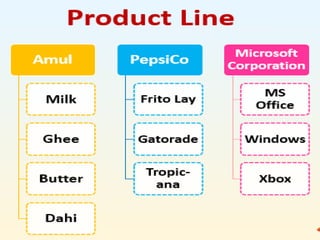
Product Line Concept:
A product line is a group of related
products under a single brand sold by the
same company.
Product lines are created by companies as
a marketing strategy to capture sales of
consumers already buying the brand.
The operating principle is that consumer
are more likely to respond positively to
brands they know, and are willing to buy
the new products based on their positive
experiences with the brand.
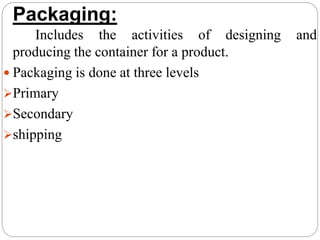
Packaging:
Includes the activities of designing and
producing the container for a product.
 Packaging is done at three levels
Primary
Secondary
shipping
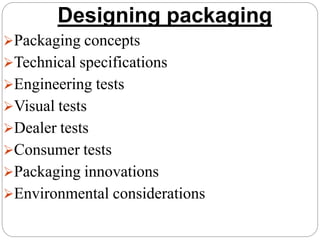
Designing packaging
Packaging concepts
Technical specifications
Engineering tests
Visual tests
Dealer tests
Consumer tests
Packaging innovations
Environmental considerations
Product Modification:
It refers to the improvement
of the existing products by making
necessary changes in the
characteristics, nature, size, packing
and colour, etc., of the products so
that the changes in demand of
consumers may be dealt effectively.
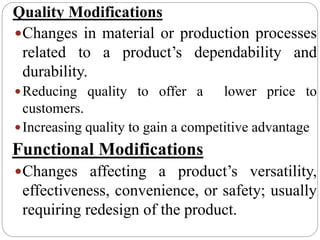
Quality Modifications
Changes in material or production processes
related to a product’s dependability and
durability.
Reducing quality to offer a lower price to
customers.
Increasing quality to gain a competitive advantage
Functional Modifications
Changes affecting a product’s versatility,
effectiveness, convenience, or safety; usually
requiring redesign of the product.
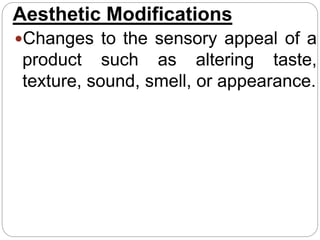
Aesthetic Modifications
Changes to the sensory appeal of a
product such as altering taste,
texture, sound, smell, or appearance.
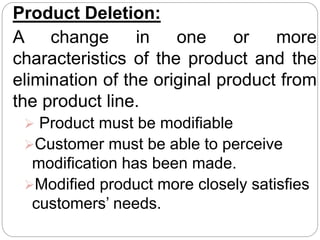
Product Deletion:
A change in one or more
characteristics of the product and the
elimination of the original product from
the product line.
 Product must be modifiable
Customer must be able to perceive
modification has been made.
Modified product more closely satisfies
customers’ needs.
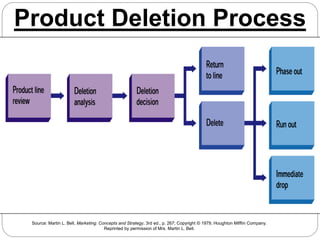
Product Deletion Process
Source: Martin L. Bell, Marketing: Concepts and Strategy, 3rd ed., p. 267; Copyright © 1979, Houghton Mifflin Company.
Reprinted by permission of Mrs. Martin L. Bell.
Definition of Brand:
A brand is an identifying symbol, mark,
logo, name, word and/or sentence that
companies use to distinguish their product
from others.
A combination of one or more of those
elements can be utilized to create a brand
identity.
It represents the face of the company. It is
often seen as the recognizable logo, slogan
or mark that the public associates with the
company.
Naming the Brand
Product benefits
Product qualities
Easy to pronounce
Should be distinctive
Should not have poor meanings in other
languages and countries
Brand strategy
Line extension – existing brand name extended to
new sizes in the existing product category.
Brand extension – brand name extended to new
product categories.
Multibrands – new brands in the same product
Category.
New brands – new product in a different product
category.
Cobrands –brands bearing two or more well known
brand names
Brand Positioning and Repositioning
Product Positioning
Creating and maintaining a certain concept of a
product in customers’ minds.
It is the process of developing a perception about
your brand in the minds of your customers.
A product’s position results from customers’
perceptions of a product’s attributes relative to
those of competing products.
Marketers emphasize characteristics most desired
by the target market (or segment) in advertising.
Repositioning a Brand
Adjusting a product’s present position can
strengthen/increase its market share and
profitability.
Repositioning is accomplished by changing the
product’s features, price, distribution, or image.
Adding new products to the line may necessitate
the repositioning of older products.
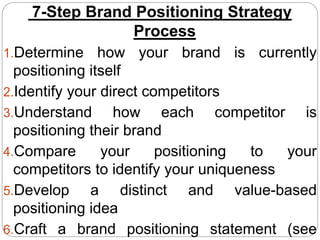
7-Step Brand Positioning Strategy
Process
1.Determine how your brand is currently
positioning itself
2.Identify your direct competitors
3.Understand how each competitor is
positioning their brand
4.Compare your positioning to your
competitors to identify your uniqueness
5.Develop a distinct and value-based
positioning idea
6.Craft a brand positioning statement (see
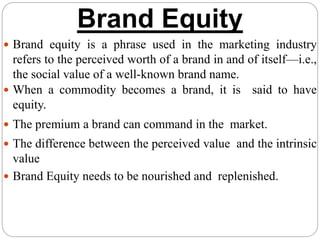
Brand Equity
 Brand equity is a phrase used in the marketing industry
refers to the perceived worth of a brand in and of itself—i.e.,
the social value of a well-known brand name.
 When a commodity becomes a brand, it is said to have
equity.
 The premium a brand can command in the market.
 The difference between the perceived value and the intrinsic
value
 Brand Equity needs to be nourished and replenished.
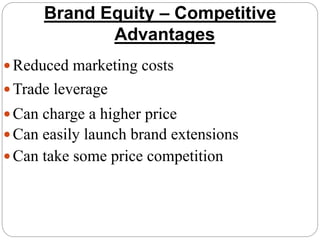
Brand Equity – Competitive
Advantages
Reduced marketing costs
Trade leverage
Can charge a higher price
Can easily launch brand extensions
Can take some price competition
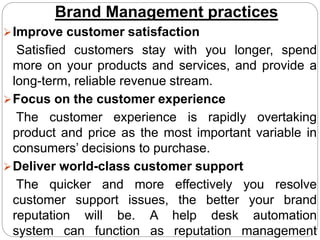
Brand Management practices
Improve customer satisfaction
Satisfied customers stay with you longer, spend
more on your products and services, and provide a
long-term, reliable revenue stream.
Focus on the customer experience
The customer experience is rapidly overtaking
product and price as the most important variable in
consumers’ decisions to purchase.
Deliver world-class customer support
The quicker and more effectively you resolve
customer support issues, the better your brand
reputation will be. A help desk automation
system can function as reputation management
Use social listening tools to respond to negative
comments
When someone posts a negative comment about your
brand on social media, it’s imperative that you respond
as quickly as possible.
When you receive a notification, respond to the
comment as quickly as possible and be diplomatic and
empathetic in your response. After all, your response
will be publicly-visible for the world to see. Responding
in a helpful, humble way will help your company
generate a reputation as a customer-centric brand.
Personalize your customer interactions
When you use an all-in-one CRM, you have access
to 360-degree contact views. These provide insight
Increase employee satisfaction
Employee engagement programs do wonders for
increasing employee satisfaction. According to the
Institute for Employment Studies, engaged, satisfied
employees perform 20% better than unengaged
employees and are much more likely to become brand
advocates.
Nurture brand advocates
Brand advocates are arguably the most effective
tool in your kit for brand reputation management. They
are satisfied customers, employees, or anyone else
who loves your brand enough to speak positively about
it and recommend it to others.
Deliver a great customer experience, maintain
Generate customer testimonials and success
stories
All your current and potential customers are each
other’s peers. Developing customer testimonials
and success stories allows current customers to
share their positive experiences with their peers
(i.e., your prospects).
Increase social media engagement
Experts predict that by 2021 there will be over 3
billion social media users, which will amount to
around one-third of the world’s population. It’s
logical to assume that the importance of engaging
Product and Brand Management unit - 1

Product and Brand Management unit - 1

  • 1.
    PRODUCT AND BRAND MANAGEMENT PRESENTED BY K.BALASRI PRASAD B.Sc (KU), M.B.A (OU), NET (UGC), (Ph.D) (MGU) ASSOCIATE PROFESSOR IN MANAGEMENT
  • 2.
    UNIT – I Productand Branding Decisions: Product, Policy, Objectives, Product Mix, Product Line, Packaging, Product Modification and Deletion. Brand Management: Branding, Brand Positioning, repositioning Strategies and Brand Loyalty, Brand Equity, Brand Management practices.
  • 3.
    Definition of Product: Aproduct is the item offered for sale. A product can be a service or a good. It can be in physical or virtual(cyber) form. Each product is made at a cost. Each product is sold at a price. The price charged depends upon the market, the quality, the marketing and the targeted segment.
  • 4.
    New Product Development Mostnew product development is an improvement on existing products Less than 10% of new products are totally new concepts.  
  • 6.
    Product Levels Customer valuehierarchy : Core benefit Basic product Expected product Augmented product Potential product
  • 8.
    Product Mix Concept: Alsoreferred to as product assortment, it is the total number of product lines that a company offers to its customers. The product lines may range from one to many and the company may have many products under the same product line as well. All of these product lines when grouped together forms the product mix of the company.
  • 9.
    Width – howmany different product lines? Length – the number of items in the product mix Depth – The no. of variants offered in a product line Consistency – how closely the product lines are related in usage
  • 10.
  • 11.
    Product Line Concept: Aproduct line is a group of related products under a single brand sold by the same company. Product lines are created by companies as a marketing strategy to capture sales of consumers already buying the brand. The operating principle is that consumer are more likely to respond positively to brands they know, and are willing to buy the new products based on their positive experiences with the brand.
  • 13.
    Packaging: Includes the activitiesof designing and producing the container for a product.  Packaging is done at three levels Primary Secondary shipping
  • 14.
    Designing packaging Packaging concepts Technicalspecifications Engineering tests Visual tests Dealer tests Consumer tests Packaging innovations Environmental considerations
  • 15.
    Product Modification: It refersto the improvement of the existing products by making necessary changes in the characteristics, nature, size, packing and colour, etc., of the products so that the changes in demand of consumers may be dealt effectively.
  • 16.
    Quality Modifications Changes inmaterial or production processes related to a product’s dependability and durability. Reducing quality to offer a lower price to customers. Increasing quality to gain a competitive advantage Functional Modifications Changes affecting a product’s versatility, effectiveness, convenience, or safety; usually requiring redesign of the product.
  • 17.
    Aesthetic Modifications Changes tothe sensory appeal of a product such as altering taste, texture, sound, smell, or appearance.
  • 18.
    Product Deletion: A changein one or more characteristics of the product and the elimination of the original product from the product line.  Product must be modifiable Customer must be able to perceive modification has been made. Modified product more closely satisfies customers’ needs.
  • 19.
    Product Deletion Process Source:Martin L. Bell, Marketing: Concepts and Strategy, 3rd ed., p. 267; Copyright © 1979, Houghton Mifflin Company. Reprinted by permission of Mrs. Martin L. Bell.
  • 20.
    Definition of Brand: Abrand is an identifying symbol, mark, logo, name, word and/or sentence that companies use to distinguish their product from others. A combination of one or more of those elements can be utilized to create a brand identity. It represents the face of the company. It is often seen as the recognizable logo, slogan or mark that the public associates with the company.
  • 21.
    Naming the Brand Productbenefits Product qualities Easy to pronounce Should be distinctive Should not have poor meanings in other languages and countries
  • 22.
    Brand strategy Line extension– existing brand name extended to new sizes in the existing product category. Brand extension – brand name extended to new product categories. Multibrands – new brands in the same product Category. New brands – new product in a different product category. Cobrands –brands bearing two or more well known brand names
  • 23.
    Brand Positioning andRepositioning Product Positioning Creating and maintaining a certain concept of a product in customers’ minds. It is the process of developing a perception about your brand in the minds of your customers. A product’s position results from customers’ perceptions of a product’s attributes relative to those of competing products. Marketers emphasize characteristics most desired by the target market (or segment) in advertising.
  • 24.
    Repositioning a Brand Adjustinga product’s present position can strengthen/increase its market share and profitability. Repositioning is accomplished by changing the product’s features, price, distribution, or image. Adding new products to the line may necessitate the repositioning of older products.
  • 25.
    7-Step Brand PositioningStrategy Process 1.Determine how your brand is currently positioning itself 2.Identify your direct competitors 3.Understand how each competitor is positioning their brand 4.Compare your positioning to your competitors to identify your uniqueness 5.Develop a distinct and value-based positioning idea 6.Craft a brand positioning statement (see
  • 26.
    Brand Equity  Brandequity is a phrase used in the marketing industry refers to the perceived worth of a brand in and of itself—i.e., the social value of a well-known brand name.  When a commodity becomes a brand, it is said to have equity.  The premium a brand can command in the market.  The difference between the perceived value and the intrinsic value  Brand Equity needs to be nourished and replenished.
  • 27.
    Brand Equity –Competitive Advantages Reduced marketing costs Trade leverage Can charge a higher price Can easily launch brand extensions Can take some price competition
  • 28.
    Brand Management practices Improvecustomer satisfaction Satisfied customers stay with you longer, spend more on your products and services, and provide a long-term, reliable revenue stream. Focus on the customer experience The customer experience is rapidly overtaking product and price as the most important variable in consumers’ decisions to purchase. Deliver world-class customer support The quicker and more effectively you resolve customer support issues, the better your brand reputation will be. A help desk automation system can function as reputation management
  • 29.
    Use social listeningtools to respond to negative comments When someone posts a negative comment about your brand on social media, it’s imperative that you respond as quickly as possible. When you receive a notification, respond to the comment as quickly as possible and be diplomatic and empathetic in your response. After all, your response will be publicly-visible for the world to see. Responding in a helpful, humble way will help your company generate a reputation as a customer-centric brand. Personalize your customer interactions When you use an all-in-one CRM, you have access to 360-degree contact views. These provide insight
  • 30.
    Increase employee satisfaction Employeeengagement programs do wonders for increasing employee satisfaction. According to the Institute for Employment Studies, engaged, satisfied employees perform 20% better than unengaged employees and are much more likely to become brand advocates. Nurture brand advocates Brand advocates are arguably the most effective tool in your kit for brand reputation management. They are satisfied customers, employees, or anyone else who loves your brand enough to speak positively about it and recommend it to others. Deliver a great customer experience, maintain
  • 31.
    Generate customer testimonialsand success stories All your current and potential customers are each other’s peers. Developing customer testimonials and success stories allows current customers to share their positive experiences with their peers (i.e., your prospects). Increase social media engagement Experts predict that by 2021 there will be over 3 billion social media users, which will amount to around one-third of the world’s population. It’s logical to assume that the importance of engaging