E-Banking
A new Era of Banking Saga
Banks
• Traditional banks were THE original banks, the
financial depository institutions first to offer
checkable deposits. ... Traditional banks are the
checking-account-issuing financial intermediaries
that most often come to mind when the term
"bank" is used.
• Modern Bank is a privately-owned commercial
wholesale bank that provides financing
and banking solutions to companies across a
wide variety of industries, and commercial real
estate financing to sponsors.
Definitions
• Online banking, also known as internet banking,
e-banking or virtual banking, is an electronic
payment system that enables customers of a
bank or other financial institution to conduct a
range of financial transactions through the
financial institution's website.
• Electronic banking, also known as electronic
funds transfer (EFT), is simply the use of
electronic means to transfer funds directly from
one account to another, rather than by cheque or
cash.
Features
• Learn your way around the portal. ...
• Opt out of paper statements. ...
• Use online bill pay. ...
• Apply for lines of credit or loans through the
online portal. ...
• Check for special offers or messages in the portal.
• Transfer money between accounts. ...
• Use a mobile banking application.
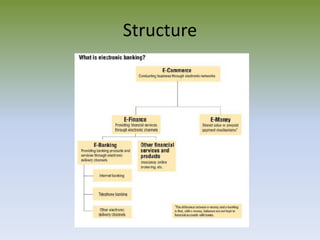
Structure
Forms of E-Banking
• Internet Banking
• Automated Teller Machine (ATM)
• Tele Banking
• Smart Cards
• Debit Cards
• E-Cheque
• E-Billing
Advantages of E-Banking
• Very convenient, comfortable, and easy way to do
whatever monetary transaction you wish to do with
your bank
• Provides 24/7 services as the e-bank never closes and
has no cutoff time
• Smart and interactive with auto-solutions and
troubleshooting functionalities.
• Higher interest rate enabled through the cost savings
achieved by digital firm capabilities.
• Speed and easiness of conducting the digital
transactions compared to paper-based dealings with
walk-in customers.
Disadvantages of E-Banking
• Poorly delivered e-banking services can be slow & time consuming
• Some identity authentication requirements can be annoying &
overwhelming for clients
• Might require lots of paperwork & procedures for registration &
set-up.
• Can be difficult for clients to get familiarized with the bank’s
website & e-banking channel.
• Frequent changes & adjustments to the bank’s website & delivery
channels.
• Distrust by some clients in some countries with primitive legal
system and unreliable technological infrastructure might face
security & legal challenges
• Some clients still prefer human interaction & personalized
attention.
Risks in E-Banking
• Operational Risk
• Credit Risk
• Liquidity Risk
• Foreign Exchange Risk
• Security Risk
• Compliance Risk
• Reputation Risk
• Legal Risk
E-Banking Facilities
• A bank customer can perform non-transactional
tasks through online banking, including –Viewing
account balances
– Viewing recent transactions
– Downloading bank statements, for example
in PDF format
– Viewing images of paid cheques
– Ordering cheque books
– Download periodic account statements
– Downloading applications for M-banking, E-banking
etc.
E-Banking Facilities
• Bank customers can transact banking tasks
through online banking, including – Funds
transfers between the customer's linked accounts
– Paying third parties, including bill payments and third
party fund transfers
– Investment purchase or sale
– Loan applications and transactions, such as
repayments of enrollments
– Credit card applications
– Register utility billers and make bill payments
Key Issues in E-Banking
• Customer Support
• Law
• Security
• Lack of Awareness
• Frequent Changes
• Necessity of the Internet
• Customer Care Services
Future of E-Banking
• Electronic banking is the wave of the future. It
provides enormous benefits to consumers in
terms of the ease and cost of transactions. But
it also poses new challenges for country
authorities in regulating and supervising the
financial system and in designing and
implementing macroeconomic policy.
Future Aspects
• International/Global Banking
• One Account Banking
• Instant Real Time Gross Settlement (RTGS)
• High-Tech Infrastructure
• Effective and Efficient Customer Care Services
• Online Trading and NSE.IT (Software Vendor)
• High End Security
Query Session
Much More to Discuss about E-
Banking ….
But still if some arises …

E banking

  • 1.
    E-Banking A new Eraof Banking Saga
  • 2.
    Banks • Traditional bankswere THE original banks, the financial depository institutions first to offer checkable deposits. ... Traditional banks are the checking-account-issuing financial intermediaries that most often come to mind when the term "bank" is used. • Modern Bank is a privately-owned commercial wholesale bank that provides financing and banking solutions to companies across a wide variety of industries, and commercial real estate financing to sponsors.
  • 3.
    Definitions • Online banking,also known as internet banking, e-banking or virtual banking, is an electronic payment system that enables customers of a bank or other financial institution to conduct a range of financial transactions through the financial institution's website. • Electronic banking, also known as electronic funds transfer (EFT), is simply the use of electronic means to transfer funds directly from one account to another, rather than by cheque or cash.
  • 4.
    Features • Learn yourway around the portal. ... • Opt out of paper statements. ... • Use online bill pay. ... • Apply for lines of credit or loans through the online portal. ... • Check for special offers or messages in the portal. • Transfer money between accounts. ... • Use a mobile banking application.
  • 5.
  • 6.
    Forms of E-Banking •Internet Banking • Automated Teller Machine (ATM) • Tele Banking • Smart Cards • Debit Cards • E-Cheque • E-Billing
  • 7.
    Advantages of E-Banking •Very convenient, comfortable, and easy way to do whatever monetary transaction you wish to do with your bank • Provides 24/7 services as the e-bank never closes and has no cutoff time • Smart and interactive with auto-solutions and troubleshooting functionalities. • Higher interest rate enabled through the cost savings achieved by digital firm capabilities. • Speed and easiness of conducting the digital transactions compared to paper-based dealings with walk-in customers.
  • 8.
    Disadvantages of E-Banking •Poorly delivered e-banking services can be slow & time consuming • Some identity authentication requirements can be annoying & overwhelming for clients • Might require lots of paperwork & procedures for registration & set-up. • Can be difficult for clients to get familiarized with the bank’s website & e-banking channel. • Frequent changes & adjustments to the bank’s website & delivery channels. • Distrust by some clients in some countries with primitive legal system and unreliable technological infrastructure might face security & legal challenges • Some clients still prefer human interaction & personalized attention.
  • 9.
    Risks in E-Banking •Operational Risk • Credit Risk • Liquidity Risk • Foreign Exchange Risk • Security Risk • Compliance Risk • Reputation Risk • Legal Risk
  • 10.
    E-Banking Facilities • Abank customer can perform non-transactional tasks through online banking, including –Viewing account balances – Viewing recent transactions – Downloading bank statements, for example in PDF format – Viewing images of paid cheques – Ordering cheque books – Download periodic account statements – Downloading applications for M-banking, E-banking etc.
  • 11.
    E-Banking Facilities • Bankcustomers can transact banking tasks through online banking, including – Funds transfers between the customer's linked accounts – Paying third parties, including bill payments and third party fund transfers – Investment purchase or sale – Loan applications and transactions, such as repayments of enrollments – Credit card applications – Register utility billers and make bill payments
  • 12.
    Key Issues inE-Banking • Customer Support • Law • Security • Lack of Awareness • Frequent Changes • Necessity of the Internet • Customer Care Services
  • 13.
    Future of E-Banking •Electronic banking is the wave of the future. It provides enormous benefits to consumers in terms of the ease and cost of transactions. But it also poses new challenges for country authorities in regulating and supervising the financial system and in designing and implementing macroeconomic policy.
  • 14.
    Future Aspects • International/GlobalBanking • One Account Banking • Instant Real Time Gross Settlement (RTGS) • High-Tech Infrastructure • Effective and Efficient Customer Care Services • Online Trading and NSE.IT (Software Vendor) • High End Security
  • 15.
    Query Session Much Moreto Discuss about E- Banking …. But still if some arises …