1
2
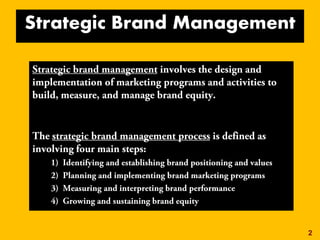
Strategic Brand Management
3
3
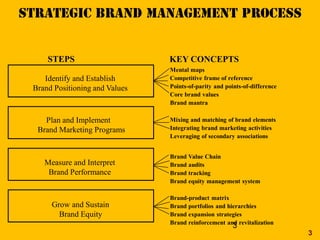
Mental maps
Competitive frame of reference
Points-of-parity and points-of-difference
Core brand values
Brand mantra
Mixing and matching of brand elements
Integrating brand marketing activities
Leveraging of secondary associations
Brand Value Chain
Brand audits
Brand tracking
Brand equity management system
Brand-product matrix
Brand portfolios and hierarchies
Brand expansion strategies
Brand reinforcement and revitalization
KEY CONCEPTSSTEPS
Grow and Sustain
Brand Equity
Identify and Establish
Brand Positioning and Values
Plan and Implement
Brand Marketing Programs
Measure and Interpret
Brand Performance
4
Concept of
Customer Based
Brand Equity
5
Keller’s Definition of Brand Equity
Brand equity is defined as the differential effect that
knowledge about the brand has on consumer response
to the marketing of that brand
Professor Kevin Keller
6
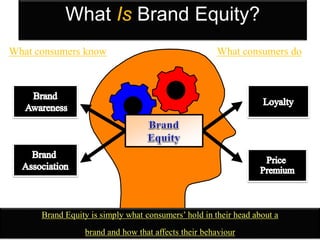
What Is Brand Equity?
Brand Equity is simply what consumers’ hold in their head about a
brand and how that affects their behaviour
What consumers doWhat consumers know
7
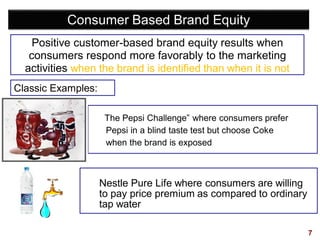
Consumer Based Brand Equity
Positive customer-based brand equity results when
consumers respond more favorably to the marketing
activities when the brand is identified than when it is not
The Pepsi Challenge” where consumers prefer
Pepsi in a blind taste test but choose Coke
when the brand is exposed
Nestle Pure Life where consumers are willing
to pay price premium as compared to ordinary
tap water
Classic Examples:
8
Benefits of Equity
• Loyal Customers
• Charge a price premium
• Trade co-operation
• Brand extensions
• Communication messages get through
etc etc ………
Building brand equity will improve brand profitability
9
Elements of Brand Equity:
Brand Loyalty
Brand Awareness
Perceived Quality
Brand Associations
10
Brand Loyalty
Brand loyalty is a measure of the
attachment that a customer has to a
brand.
It reflects how likely a customer will be to
switch to another brand, especially when that
brand makes a change, either in price or in
product features.
11
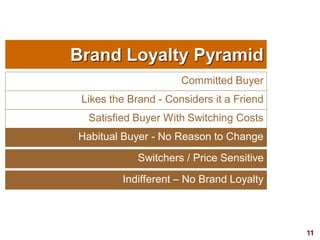
Brand Loyalty Pyramid
Committed Buyer
Likes the Brand - Considers it a Friend
Satisfied Buyer With Switching Costs
Habitual Buyer - No Reason to Change
Indifferent – No Brand Loyalty
Switchers / Price Sensitive
12
Measuring Brand Loyalty
• Purchase Behavior Patterns
• Switching Cost Analysis
• Satisfaction Measurement
13
Strategic Value of Brand Loyalty
• Reduce marketing cost
• Trade (channel distribution) leverage
• Attracting new customers
14
Enhancing
Brand Loyalty
• Treat the customer right
• Stay close to the customer
• Measure/manage customer
satisfaction
• Create switching cost
• Provide extras
15
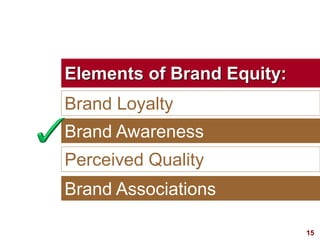
Elements of Brand Equity:
Brand Loyalty
Brand Awareness
Perceived Quality
Brand Associations
16
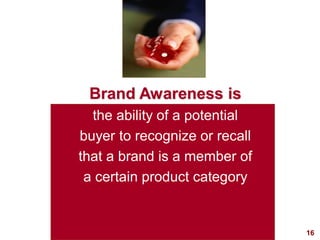
Brand Awareness is
the ability of a potential
buyer to recognize or recall
that a brand is a member of
a certain product category
17
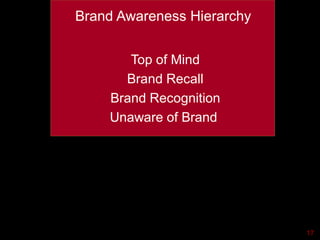
Brand Awareness Hierarchy
Top of Mind
Brand Recall
Brand Recognition
Unaware of Brand
18
Value of Brand Awareness
• Anchor to which other associations can be
attached
• Familiarity and liking
• Signal of substance/commitment
• Brand to be considered
19
How to Achieve
Brand Awareness
Be different, memorable
Involve a slogan or jingle
Symbol exposure
Publicity
Event sponsorship
20
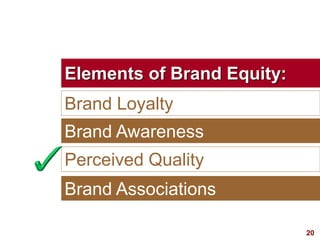
Elements of Brand Equity:
Brand Loyalty
Brand Awareness
Perceived Quality
Brand Associations
21
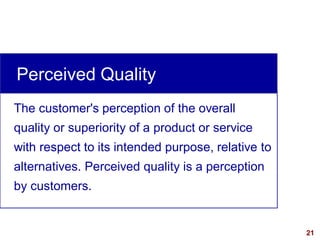
The customer's perception of the overall
quality or superiority of a product or service
with respect to its intended purpose, relative to
alternatives. Perceived quality is a perception
by customers.
Perceived Quality
22
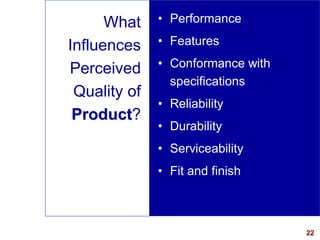
What
Influences
Perceived
Quality of
Product?
• Performance
• Features
• Conformance with
specifications
• Reliability
• Durability
• Serviceability
• Fit and finish
23
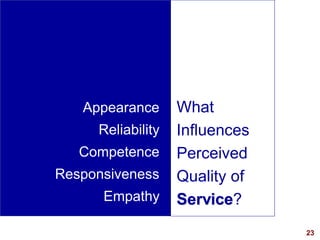
What
Influences
Perceived
Quality of
Service?
Appearance
Reliability
Competence
Responsiveness
Empathy
24
The Value of Perceived Quality
• Reason-to-Buy
• Differentiate/Position
• A Price Premium
• Channel Member Interest
• Brand Extensions
25
Elements of Brand Equity:
Brand Loyalty
Brand Awareness
Perceived Quality
Brand Associations
26
Brand Association
A brand association is anything
"linked" in memory to a brand.
Thus, McDonald's could be linked to a
character such as Ronald McDonald, a
consumer segment such as kids, a feeling
such as having fun, a product characteristic
such as service, or a symbol such as the
Golden Arches.
27
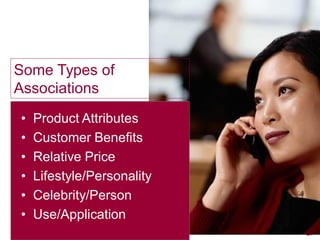
Some Types of
Associations
• Product Attributes
• Customer Benefits
• Relative Price
• Lifestyle/Personality
• Celebrity/Person
• Use/Application
28
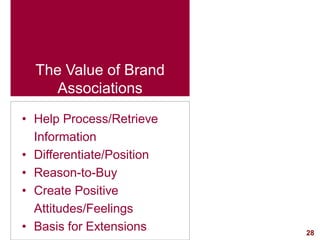
The Value of Brand
Associations
• Help Process/Retrieve
Information
• Differentiate/Position
• Reason-to-Buy
• Create Positive
Attitudes/Feelings
• Basis for Extensions
29
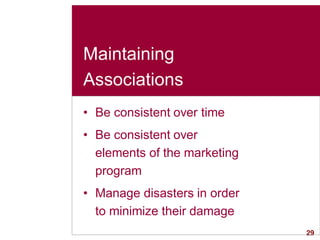
Maintaining
Associations
• Be consistent over time
• Be consistent over
elements of the marketing
program
• Manage disasters in order
to minimize their damage
30
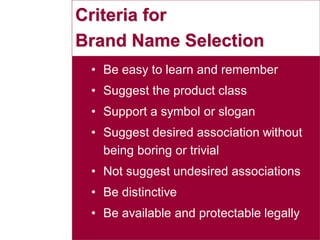
Criteria for
Brand Name Selection
• Be easy to learn and remember
• Suggest the product class
• Support a symbol or slogan
• Suggest desired association without
being boring or trivial
• Not suggest undesired associations
• Be distinctive
• Be available and protectable legally
31
32
33
Measuring Equity
34
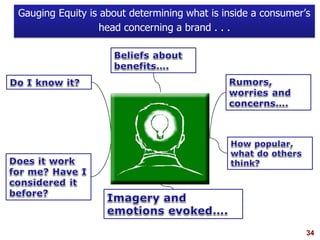
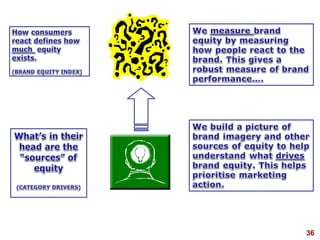
Gauging Equity is about determining what is inside a consumer’s
head concerning a brand . . .
35
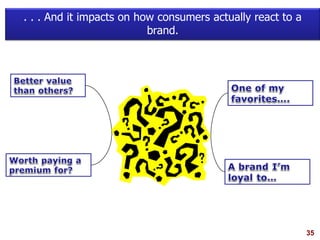
. . . And it impacts on how consumers actually react to a
brand.
36
37
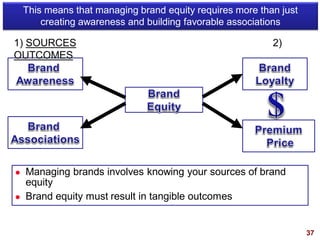
This means that managing brand equity requires more than just
creating awareness and building favorable associations
1) SOURCES 2)
OUTCOMES
 Managing brands involves knowing your sources of brand
equity
 Brand equity must result in tangible outcomes
38
The Outcome Must Be…….
• It is a favourite brand amongst consumers
• It is a brand consumers are happy to recommend to
someone else
• It is a brand for which consumers are more willing to pay
higher prices
Based on the above principle
Brand Equity Index for each
brand is calculated
This index is a single measure of
how strong a brand is
39
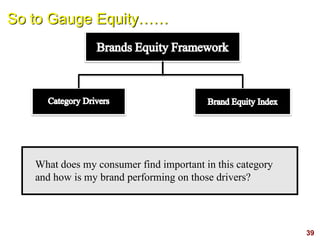
So to Gauge Equity……
What does my consumer find important in this category
and how is my brand performing on those drivers?
40
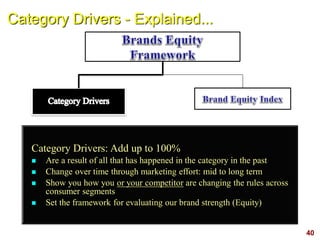
Category Drivers: Add up to 100%
 Are a result of all that has happened in the category in the past
 Change over time through marketing effort: mid to long term
 Show you how you or your competitor are changing the rules across
consumer segments
 Set the framework for evaluating our brand strength (Equity)
Category Drivers - Explained...
41
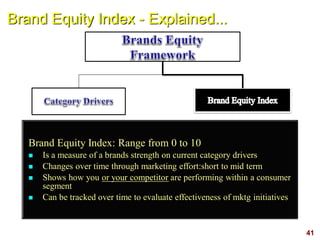
Brand Equity Index - Explained...
Brand Equity Index: Range from 0 to 10
 Is a measure of a brands strength on current category drivers
 Changes over time through marketing effort:short to mid term
 Shows how you or your competitor are performing within a consumer
segment
 Can be tracked over time to evaluate effectiveness of mktg initiatives
42
43
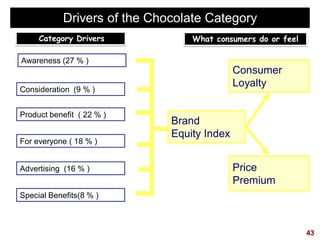
Category Drivers What consumers do or feel
Consumer
Loyalty
Price
Premium
Drivers of the Chocolate Category
Awareness (27 % )
Consideration (9 % )
Advertising (16 % )
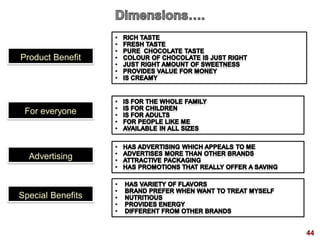
Product benefit ( 22 % )
For everyone ( 18 % )
Special Benefits(8 % )
Brand
Equity Index
44
For everyone
Product Benefit
Advertising
Special Benefits
45
Brand Equity Indices
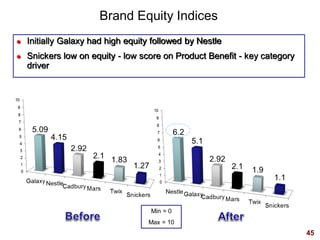
 Initially Galaxy had high equity followed by Nestle
 Snickers low on equity - low score on Product Benefit - key category
driver
Min = 0
Max = 10
46
How do the main brands perform on key dimensions?
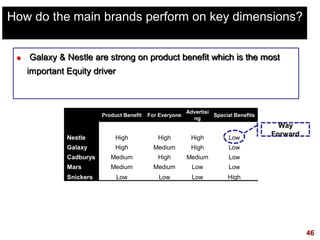
 Galaxy & Nestle are strong on product benefit which is the most
important Equity driver
Product Benefit For Everyone
Advertisi
ng
Special Benefits
Nestle High High High Low
Galaxy High Medium High Low
Cadburys Medium High Medium Low
Mars Medium Medium Low Low
Snickers Low Low Low High
Way
Forward
47
Mirza Shakeel

Brand Equity

  • 1.
  • 2.
  • 3.
    3 3 Mental maps Competitive frameof reference Points-of-parity and points-of-difference Core brand values Brand mantra Mixing and matching of brand elements Integrating brand marketing activities Leveraging of secondary associations Brand Value Chain Brand audits Brand tracking Brand equity management system Brand-product matrix Brand portfolios and hierarchies Brand expansion strategies Brand reinforcement and revitalization KEY CONCEPTSSTEPS Grow and Sustain Brand Equity Identify and Establish Brand Positioning and Values Plan and Implement Brand Marketing Programs Measure and Interpret Brand Performance
  • 4.
  • 5.
    5 Keller’s Definition ofBrand Equity Brand equity is defined as the differential effect that knowledge about the brand has on consumer response to the marketing of that brand Professor Kevin Keller
  • 6.
    6 What Is BrandEquity? Brand Equity is simply what consumers’ hold in their head about a brand and how that affects their behaviour What consumers doWhat consumers know
  • 7.
    7 Consumer Based BrandEquity Positive customer-based brand equity results when consumers respond more favorably to the marketing activities when the brand is identified than when it is not The Pepsi Challenge” where consumers prefer Pepsi in a blind taste test but choose Coke when the brand is exposed Nestle Pure Life where consumers are willing to pay price premium as compared to ordinary tap water Classic Examples:
  • 8.
    8 Benefits of Equity •Loyal Customers • Charge a price premium • Trade co-operation • Brand extensions • Communication messages get through etc etc ……… Building brand equity will improve brand profitability
  • 9.
    9 Elements of BrandEquity: Brand Loyalty Brand Awareness Perceived Quality Brand Associations
  • 10.
    10 Brand Loyalty Brand loyaltyis a measure of the attachment that a customer has to a brand. It reflects how likely a customer will be to switch to another brand, especially when that brand makes a change, either in price or in product features.
  • 11.
    11 Brand Loyalty Pyramid CommittedBuyer Likes the Brand - Considers it a Friend Satisfied Buyer With Switching Costs Habitual Buyer - No Reason to Change Indifferent – No Brand Loyalty Switchers / Price Sensitive
  • 12.
    12 Measuring Brand Loyalty •Purchase Behavior Patterns • Switching Cost Analysis • Satisfaction Measurement
  • 13.
    13 Strategic Value ofBrand Loyalty • Reduce marketing cost • Trade (channel distribution) leverage • Attracting new customers
  • 14.
    14 Enhancing Brand Loyalty • Treatthe customer right • Stay close to the customer • Measure/manage customer satisfaction • Create switching cost • Provide extras
  • 15.
    15 Elements of BrandEquity: Brand Loyalty Brand Awareness Perceived Quality Brand Associations
  • 16.
    16 Brand Awareness is theability of a potential buyer to recognize or recall that a brand is a member of a certain product category
  • 17.
    17 Brand Awareness Hierarchy Topof Mind Brand Recall Brand Recognition Unaware of Brand
  • 18.
    18 Value of BrandAwareness • Anchor to which other associations can be attached • Familiarity and liking • Signal of substance/commitment • Brand to be considered
  • 19.
    19 How to Achieve BrandAwareness Be different, memorable Involve a slogan or jingle Symbol exposure Publicity Event sponsorship
  • 20.
    20 Elements of BrandEquity: Brand Loyalty Brand Awareness Perceived Quality Brand Associations
  • 21.
    21 The customer's perceptionof the overall quality or superiority of a product or service with respect to its intended purpose, relative to alternatives. Perceived quality is a perception by customers. Perceived Quality
  • 22.
    22 What Influences Perceived Quality of Product? • Performance •Features • Conformance with specifications • Reliability • Durability • Serviceability • Fit and finish
  • 23.
  • 24.
    24 The Value ofPerceived Quality • Reason-to-Buy • Differentiate/Position • A Price Premium • Channel Member Interest • Brand Extensions
  • 25.
    25 Elements of BrandEquity: Brand Loyalty Brand Awareness Perceived Quality Brand Associations
  • 26.
    26 Brand Association A brandassociation is anything "linked" in memory to a brand. Thus, McDonald's could be linked to a character such as Ronald McDonald, a consumer segment such as kids, a feeling such as having fun, a product characteristic such as service, or a symbol such as the Golden Arches.
  • 27.
    27 Some Types of Associations •Product Attributes • Customer Benefits • Relative Price • Lifestyle/Personality • Celebrity/Person • Use/Application
  • 28.
    28 The Value ofBrand Associations • Help Process/Retrieve Information • Differentiate/Position • Reason-to-Buy • Create Positive Attitudes/Feelings • Basis for Extensions
  • 29.
    29 Maintaining Associations • Be consistentover time • Be consistent over elements of the marketing program • Manage disasters in order to minimize their damage
  • 30.
    30 Criteria for Brand NameSelection • Be easy to learn and remember • Suggest the product class • Support a symbol or slogan • Suggest desired association without being boring or trivial • Not suggest undesired associations • Be distinctive • Be available and protectable legally
  • 31.
  • 32.
  • 33.
  • 34.
    34 Gauging Equity isabout determining what is inside a consumer’s head concerning a brand . . .
  • 35.
    35 . . .And it impacts on how consumers actually react to a brand.
  • 36.
  • 37.
    37 This means thatmanaging brand equity requires more than just creating awareness and building favorable associations 1) SOURCES 2) OUTCOMES  Managing brands involves knowing your sources of brand equity  Brand equity must result in tangible outcomes
  • 38.
    38 The Outcome MustBe……. • It is a favourite brand amongst consumers • It is a brand consumers are happy to recommend to someone else • It is a brand for which consumers are more willing to pay higher prices Based on the above principle Brand Equity Index for each brand is calculated This index is a single measure of how strong a brand is
  • 39.
    39 So to GaugeEquity…… What does my consumer find important in this category and how is my brand performing on those drivers?
  • 40.
    40 Category Drivers: Addup to 100%  Are a result of all that has happened in the category in the past  Change over time through marketing effort: mid to long term  Show you how you or your competitor are changing the rules across consumer segments  Set the framework for evaluating our brand strength (Equity) Category Drivers - Explained...
  • 41.
    41 Brand Equity Index- Explained... Brand Equity Index: Range from 0 to 10  Is a measure of a brands strength on current category drivers  Changes over time through marketing effort:short to mid term  Shows how you or your competitor are performing within a consumer segment  Can be tracked over time to evaluate effectiveness of mktg initiatives
  • 42.
  • 43.
    43 Category Drivers Whatconsumers do or feel Consumer Loyalty Price Premium Drivers of the Chocolate Category Awareness (27 % ) Consideration (9 % ) Advertising (16 % ) Product benefit ( 22 % ) For everyone ( 18 % ) Special Benefits(8 % ) Brand Equity Index
  • 44.
  • 45.
    45 Brand Equity Indices Initially Galaxy had high equity followed by Nestle  Snickers low on equity - low score on Product Benefit - key category driver Min = 0 Max = 10
  • 46.
    46 How do themain brands perform on key dimensions?  Galaxy & Nestle are strong on product benefit which is the most important Equity driver Product Benefit For Everyone Advertisi ng Special Benefits Nestle High High High Low Galaxy High Medium High Low Cadburys Medium High Medium Low Mars Medium Medium Low Low Snickers Low Low Low High Way Forward
  • 47.