



https://www.youtube.com/watch?v=By9m3UBiRZM
Chapter 2 & Chapter 3
PRESTON AND SNOW
Chapter 2:
Strategic Implications of
Branding
WHAT DOES BRANDING REALLY MEAN?
Branding transforms the product category
How does the brand do this?
◦ Brands organize the market
◦ Gives the products their own identity
A brand is weak when products are transparent
(Coke keeps its recipe secret)
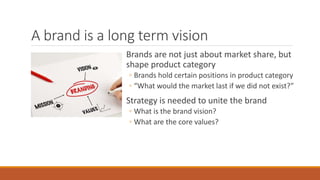
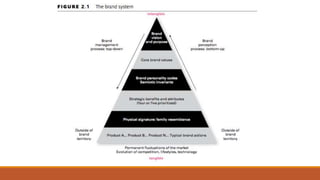
A brand is a long term vision
Brands are not just about market share, but
shape product category
◦ Brands hold certain positions in product category
◦ “What would the market last if we did not exist?”
Strategy is needed to unite the brand
◦ What is the brand vision?
◦ What are the core values?
Permanently nurtures the difference
Brands protect the innovators
◦ Grants exclusiveness
◦ Rewards risk-taking attitude
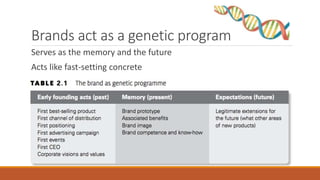
Brands act as a genetic program
Serves as the memory and the future
Acts like fast-setting concrete
Respect the brand contract
Brands are built through a consistent message
Once established, customers use brands as a benchmark
Satisfied customers become loyal customers
Brand requirements:
◦ Forecast the needs and expectations of potential buyers
◦ React to technical and technological progress
◦ Provide product/service quality and quantity simultaneously
◦ Control supply quantity and quality
◦ Deliver products to distributors
◦ Give meaning to the brand and communicate it to consumers
◦ Increase the experience of consumption or interaction
◦ Remain ethical and ecology-conscious
Halo Effect
https://www.youtube.com/watch?v=fxyAYTieXlQ
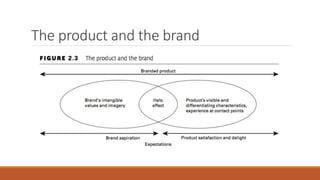
The product and the brand
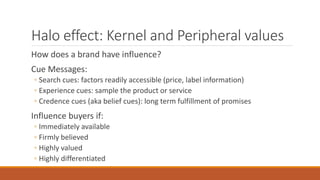
Halo effect: Kernel and Peripheral values
How does a brand have influence?
Cue Messages:
◦ Search cues: factors readily accessible (price, label information)
◦ Experience cues: sample the product or service
◦ Credence cues (aka belief cues): long term fulfillment of promises
Influence buyers if:
◦ Immediately available
◦ Firmly believed
◦ Highly valued
◦ Highly differentiated
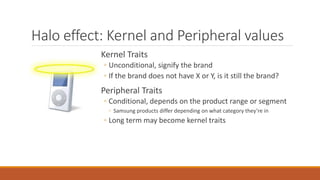
Halo effect: Kernel and Peripheral values
Kernel Traits
◦ Unconditional, signify the brand
◦ If the brand does not have X or Y, is it still the brand?
Peripheral Traits
◦ Conditional, depends on the product range or segment
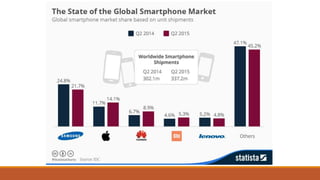
◦ Samsung products differ depending on what category they’re in
◦ Long term may become kernel traits
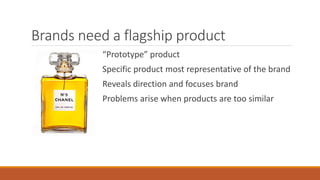
Brands need a flagship product
“Prototype” product
Specific product most representative of the brand
Reveals direction and focuses brand
Problems arise when products are too similar
Advertising products through
the brand prism
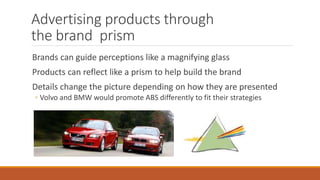
Brands can guide perceptions like a magnifying glass
Products can reflect like a prism to help build the brand
Details change the picture depending on how they are presented
◦ Volvo and BMW would promote ABS differently to fit their strategies
Brands versus other signs of quality
Brands often coexist with other signs of quality
This promotes and protects the brand
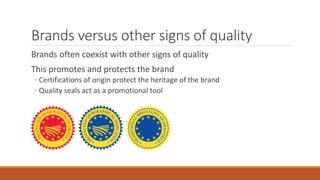
◦ Certifications of origin protect the heritage of the brand
◦ Quality seals act as a promotional tool
Obstacles to the implementation of branding
Branding is a long term process requiring repetition and consistency
Corporate accounting is often short term
◦ Focus on the bottom line and ROI
◦ Fast measurable results are preferred
Turnover with agencies and within brands results in new directions
Innovations quickly become the status quo
Asia’s branding culture
Paradoxical
◦ Asian brands enjoy high market share, but are not intrinsically desired
◦ Asians have a love affair with brands, but mostly Western brands (fashion and
luxury)
Samsung
◦ Successful but needs more branding
◦ Focus on products, not brand
◦ Innovations are not disruptive
◦ No capitalization, just distribution
◦ Highly centralized management and communication
Summary
Time is often overlooked, but pivotal
The brand needs focus
◦ Say no to products that change the brand
The essence of the brand creates is
◦ A flagship product embodies the idea of the brand
◦ Kernel traits identify products within the brand
Brands guide perceptions and promote products
Chapter 3:
Brands and business models
Are brands for all companies?
YES
An instrument for growth and profitability
Essentially another business tool
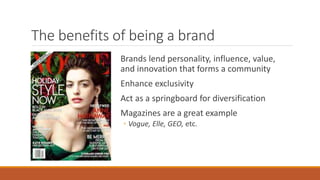
The benefits of being a brand
Brands lend personality, influence, value,
and innovation that forms a community
Enhance exclusivity
Act as a springboard for diversification
Magazines are a great example
◦ Vogue, Elle, GEO, etc.
Differentiating a commodity by the brand
A commodity market is runs on optimal price alone
◦ Consumers pay for the value of the good
◦ Long term differentiation between products suffers
◦ Hints of classical liberalism
Brands disrupt the commodity market
◦ Perception of brand product having more value
◦ Examples: Coke, Evian
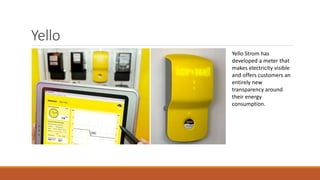
Yello
Yello Strom has
developed a meter that
makes electricity visible
and offers customers an
entirely new
transparency around
their energy
consumption.
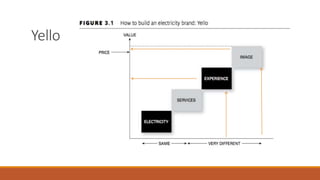
Yello
Building a market leader without
advertising
Brand needs to do the following
◦ Have enough volume/sufficient supply
◦ Have a stable quality to reduce risk
◦ Have a mainstream price
◦ Be end-user driven
◦ Create barriers to entry for other brands
◦ Have a strong national sales force
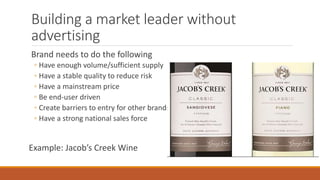
Example: Jacob’s Creek Wine
Jacob’s Creek Wine
https://www.youtube.com/watch?v=STnrf0w33wg
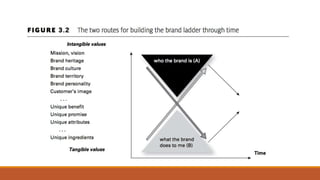
Brand building:
From product to values, and vice versa
From product to value
◦ Focus on product attributes
◦ Starting point for most goods
◦ As the product becomes more recognized, the name gains attention
From value to product
◦ Focus on the name behind the product
◦ Starting point for luxury and licensed goods
◦ Initially name alone is worth the money, but the product needs to support
Brand names are important and should NOT be descriptive
◦ Descriptive becomes generic, and the brand is lost
Are leading brands the best products or
best value curve? What’s a value curve?
Paradox that the number one brands are not the best products
Value curve: what does it mean to be the best?
◦ Meet the needs of consumers in the best way possible
◦ Have added intangible values, such as personality
Bacardi: easy to mix, appeals to casual partygoers
BREAK THE RULE AND ACT FAST
Strong brand awareness is enough to catch the attention of
consumers unaware of product differences
What to learn from branding and the
value curve?
Starting a brand means finding a disruptive innovation
Creating a market is the best way to lead the market
Winners start first and move fast
Reach critical size rapidly
Focus on the customer’s values
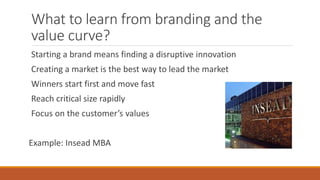
Example: Insead MBA
Backing the brand by a business model
Competition between brands is often a competition between
business models
To grow through expansion, strategy relies on three factors
◦ Availability
◦ Accessibility
◦ Attractiveness
Case Study
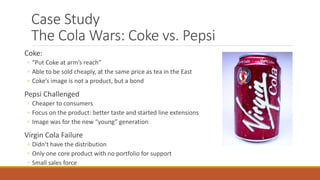
The Cola Wars: Coke vs. Pepsi
Coke:
◦ “Put Coke at arm’s reach”
◦ Able to be sold cheaply, at the same price as tea in the East
◦ Coke’s image is not a product, but a bond
Pepsi Challenged
◦ Cheaper to consumers
◦ Focus on the product: better taste and started line extensions
◦ Image was for the new “young” generation
Virgin Cola Failure
◦ Didn’t have the distribution
◦ Only one core product with no portfolio for support
◦ Small sales force
Summary
Brands are necessary for all companies and products
Brands foster differentiation in the market
Branding can be a chicken or egg debate: product or value?
◦ Either way you get a chicken
The value curve identifies the “best” brand
Brand competition is often business model competition
Questions
Thank you

New Strategic Brand Management Chapter 2-3

  • 1.
  • 2.
    Chapter 2 &Chapter 3 PRESTON AND SNOW
  • 3.
    Chapter 2: Strategic Implicationsof Branding WHAT DOES BRANDING REALLY MEAN?
  • 4.
    Branding transforms theproduct category How does the brand do this? ◦ Brands organize the market ◦ Gives the products their own identity A brand is weak when products are transparent (Coke keeps its recipe secret)
  • 5.
    A brand isa long term vision Brands are not just about market share, but shape product category ◦ Brands hold certain positions in product category ◦ “What would the market last if we did not exist?” Strategy is needed to unite the brand ◦ What is the brand vision? ◦ What are the core values?
  • 7.
    Permanently nurtures thedifference Brands protect the innovators ◦ Grants exclusiveness ◦ Rewards risk-taking attitude
  • 8.
    Brands act asa genetic program Serves as the memory and the future Acts like fast-setting concrete
  • 9.
    Respect the brandcontract Brands are built through a consistent message Once established, customers use brands as a benchmark Satisfied customers become loyal customers Brand requirements: ◦ Forecast the needs and expectations of potential buyers ◦ React to technical and technological progress ◦ Provide product/service quality and quantity simultaneously ◦ Control supply quantity and quality ◦ Deliver products to distributors ◦ Give meaning to the brand and communicate it to consumers ◦ Increase the experience of consumption or interaction ◦ Remain ethical and ecology-conscious
  • 10.
  • 11.
    The product andthe brand
  • 12.
    Halo effect: Kerneland Peripheral values How does a brand have influence? Cue Messages: ◦ Search cues: factors readily accessible (price, label information) ◦ Experience cues: sample the product or service ◦ Credence cues (aka belief cues): long term fulfillment of promises Influence buyers if: ◦ Immediately available ◦ Firmly believed ◦ Highly valued ◦ Highly differentiated
  • 13.
    Halo effect: Kerneland Peripheral values Kernel Traits ◦ Unconditional, signify the brand ◦ If the brand does not have X or Y, is it still the brand? Peripheral Traits ◦ Conditional, depends on the product range or segment ◦ Samsung products differ depending on what category they’re in ◦ Long term may become kernel traits
  • 14.
    Brands need aflagship product “Prototype” product Specific product most representative of the brand Reveals direction and focuses brand Problems arise when products are too similar
  • 15.
    Advertising products through thebrand prism Brands can guide perceptions like a magnifying glass Products can reflect like a prism to help build the brand Details change the picture depending on how they are presented ◦ Volvo and BMW would promote ABS differently to fit their strategies
  • 16.
    Brands versus othersigns of quality Brands often coexist with other signs of quality This promotes and protects the brand ◦ Certifications of origin protect the heritage of the brand ◦ Quality seals act as a promotional tool
  • 17.
    Obstacles to theimplementation of branding Branding is a long term process requiring repetition and consistency Corporate accounting is often short term ◦ Focus on the bottom line and ROI ◦ Fast measurable results are preferred Turnover with agencies and within brands results in new directions Innovations quickly become the status quo
  • 19.
    Asia’s branding culture Paradoxical ◦Asian brands enjoy high market share, but are not intrinsically desired ◦ Asians have a love affair with brands, but mostly Western brands (fashion and luxury) Samsung ◦ Successful but needs more branding ◦ Focus on products, not brand ◦ Innovations are not disruptive ◦ No capitalization, just distribution ◦ Highly centralized management and communication
  • 20.
    Summary Time is oftenoverlooked, but pivotal The brand needs focus ◦ Say no to products that change the brand The essence of the brand creates is ◦ A flagship product embodies the idea of the brand ◦ Kernel traits identify products within the brand Brands guide perceptions and promote products
  • 21.
    Chapter 3: Brands andbusiness models
  • 22.
    Are brands forall companies? YES An instrument for growth and profitability Essentially another business tool
  • 23.
    The benefits ofbeing a brand Brands lend personality, influence, value, and innovation that forms a community Enhance exclusivity Act as a springboard for diversification Magazines are a great example ◦ Vogue, Elle, GEO, etc.
  • 24.
    Differentiating a commodityby the brand A commodity market is runs on optimal price alone ◦ Consumers pay for the value of the good ◦ Long term differentiation between products suffers ◦ Hints of classical liberalism Brands disrupt the commodity market ◦ Perception of brand product having more value ◦ Examples: Coke, Evian
  • 25.
    Yello Yello Strom has developeda meter that makes electricity visible and offers customers an entirely new transparency around their energy consumption.
  • 26.
  • 27.
    Building a marketleader without advertising Brand needs to do the following ◦ Have enough volume/sufficient supply ◦ Have a stable quality to reduce risk ◦ Have a mainstream price ◦ Be end-user driven ◦ Create barriers to entry for other brands ◦ Have a strong national sales force Example: Jacob’s Creek Wine
  • 28.
  • 29.
    Brand building: From productto values, and vice versa From product to value ◦ Focus on product attributes ◦ Starting point for most goods ◦ As the product becomes more recognized, the name gains attention From value to product ◦ Focus on the name behind the product ◦ Starting point for luxury and licensed goods ◦ Initially name alone is worth the money, but the product needs to support Brand names are important and should NOT be descriptive ◦ Descriptive becomes generic, and the brand is lost
  • 31.
    Are leading brandsthe best products or best value curve? What’s a value curve? Paradox that the number one brands are not the best products Value curve: what does it mean to be the best? ◦ Meet the needs of consumers in the best way possible ◦ Have added intangible values, such as personality Bacardi: easy to mix, appeals to casual partygoers BREAK THE RULE AND ACT FAST Strong brand awareness is enough to catch the attention of consumers unaware of product differences
  • 32.
    What to learnfrom branding and the value curve? Starting a brand means finding a disruptive innovation Creating a market is the best way to lead the market Winners start first and move fast Reach critical size rapidly Focus on the customer’s values Example: Insead MBA
  • 33.
    Backing the brandby a business model Competition between brands is often a competition between business models To grow through expansion, strategy relies on three factors ◦ Availability ◦ Accessibility ◦ Attractiveness
  • 34.
    Case Study The ColaWars: Coke vs. Pepsi Coke: ◦ “Put Coke at arm’s reach” ◦ Able to be sold cheaply, at the same price as tea in the East ◦ Coke’s image is not a product, but a bond Pepsi Challenged ◦ Cheaper to consumers ◦ Focus on the product: better taste and started line extensions ◦ Image was for the new “young” generation Virgin Cola Failure ◦ Didn’t have the distribution ◦ Only one core product with no portfolio for support ◦ Small sales force
  • 35.
    Summary Brands are necessaryfor all companies and products Brands foster differentiation in the market Branding can be a chicken or egg debate: product or value? ◦ Either way you get a chicken The value curve identifies the “best” brand Brand competition is often business model competition
  • 36.