1
Polygon FillingPolygon Filling
Types of filling
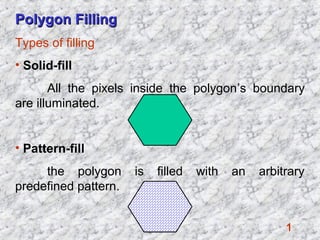
• Solid-fill
All the pixels inside the polygon’s boundary
are illuminated.
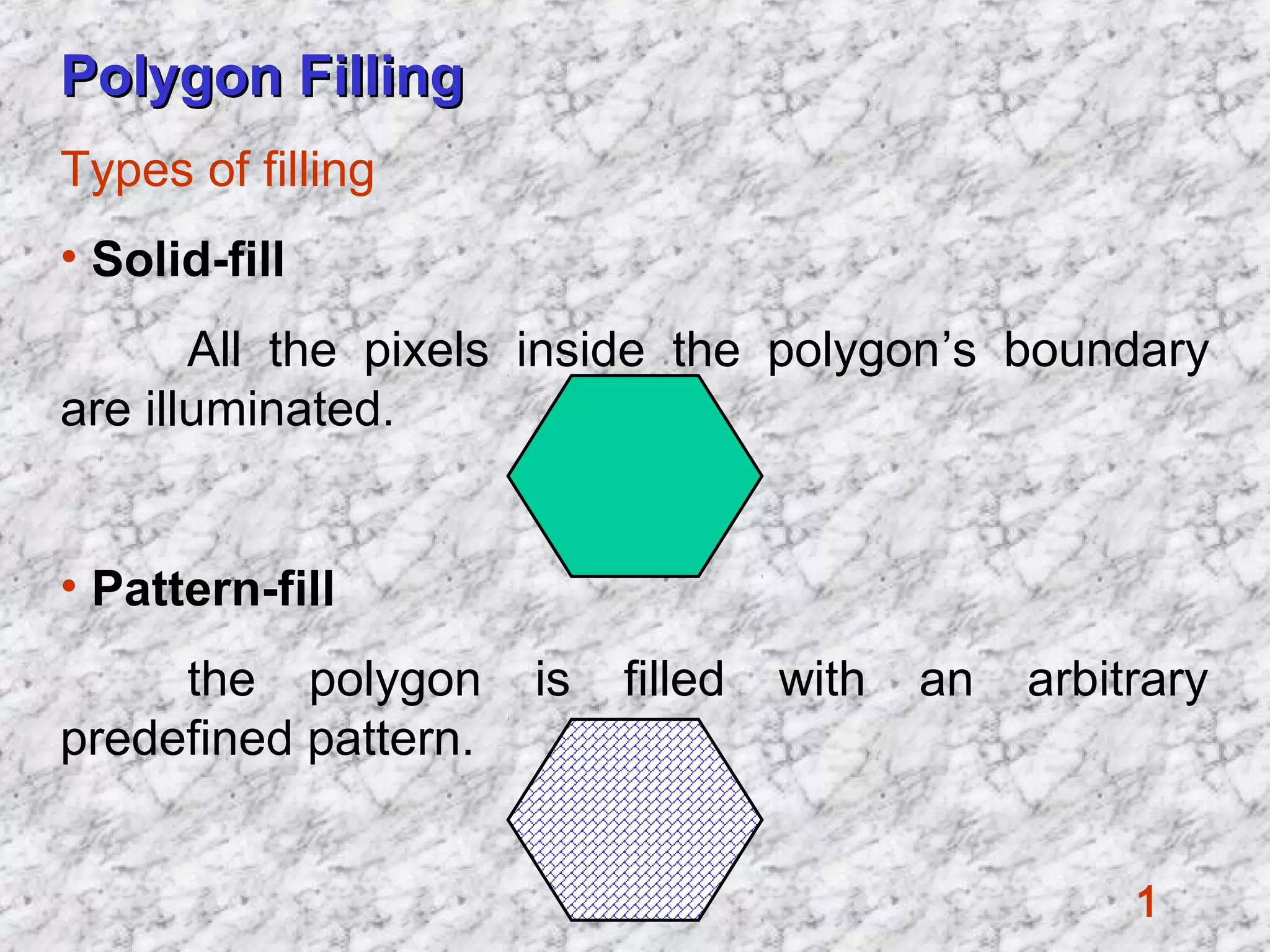
• Pattern-fill
the polygon is filled with an arbitrary
predefined pattern.
2
Polygon Representation
The polygon can be represented by listing its n
vertices in an ordered list.
P = {(x1
, y1
), (x2
, y2
), ……., (xn
, yn
)}.
The polygon can be displayed by drawing a line
between (x1
, y1
), and (x2
, y2
), then a line between
(x2
, y2
), and (x3
, y3
), and so on until the end vertex.
In order to close up the polygon, a line between (xn
,
yn
), and (x1
, y1
) must be drawn.
One problem with this representation is that if we
wish to translate the polygon, it is necessary to
apply the translation transformation to each vertex in
3
Polygon Representation
For objects described by many polygons with many
vertices, this can be a time consuming process.
One method for reducing the computational
time is to represent the polygon by the (absolute)
location of its first vertex, and represent
subsequent vertices as relative positions from the
previous vertex. This enables us to translate the
polygon simply by changing the coordinates of the
first vertex.
4
Inside-Outside Tests
when filling polygons we should decide whether a
particular point is interior or exterior to a polygon.
A rule called the odd-parity (or the odd-even rule)
is applied to test whether a point is interior or not.
To apply this rule, we conceptually draw a line
starting from the particular point and extending to a
distance point outside the coordinate extends of the
object in any direction such that no polygon vertex
intersects with the line.
5
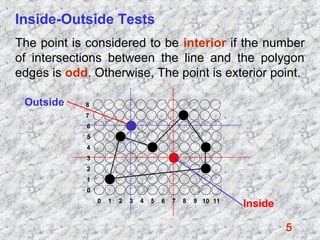
Inside-Outside Tests
The point is considered to be interior if the number
of intersections between the line and the polygon
edges is odd. Otherwise, The point is exterior point.
8
7
6
5
4
3
2
1
0
0 1 2 3 4 5 6 7 8 9 10 11
Outside
Inside
6
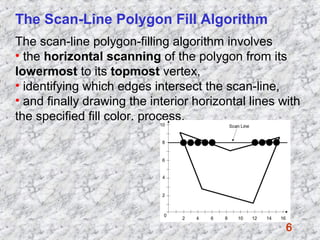
The Scan-Line Polygon Fill Algorithm
The scan-line polygon-filling algorithm involves
• the horizontal scanning of the polygon from its
lowermost to its topmost vertex,
• identifying which edges intersect the scan-line,
• and finally drawing the interior horizontal lines with
the specified fill color. process.
7
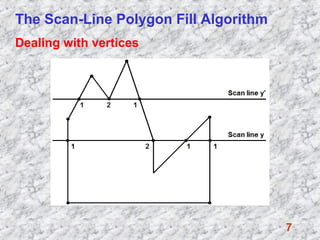
The Scan-Line Polygon Fill Algorithm
Dealing with vertices
8
The Scan-Line Polygon Fill Algorithm
Dealing with vertices
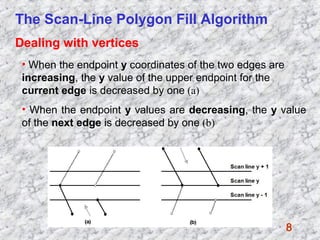
• When the endpoint y coordinates of the two edges are
increasing, the y value of the upper endpoint for the
current edge is decreased by one (a)
• When the endpoint y values are decreasing, the y value
of the next edge is decreased by one (b)
9
The Scan-Line Polygon Fill Algorithm
Determining Edge Intersections
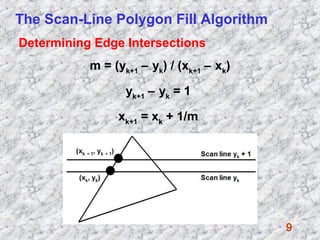
m = (yk+1
– yk
) / (xk+1
– xk
)
yk+1
– yk
= 1
xk+1
= xk
+ 1/m
10
The Scan-Line Polygon Fill Algorithm
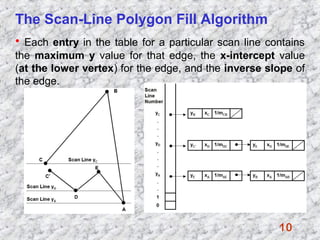
• Each entry in the table for a particular scan line contains
the maximum y value for that edge, the x-intercept value
(at the lower vertex) for the edge, and the inverse slope of
the edge.
11
The Scan-Line Polygon Fill Algorithm
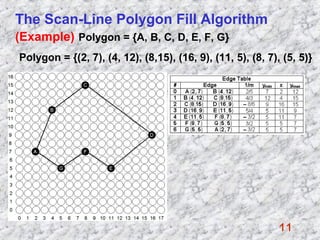
(Example) Polygon = {A, B, C, D, E, F, G}
Polygon = {(2, 7), (4, 12), (8,15), (16, 9), (11, 5), (8, 7), (5, 5)}

Boundary fill algm

  • 1.
    1 Polygon FillingPolygon Filling Typesof filling • Solid-fill All the pixels inside the polygon’s boundary are illuminated. • Pattern-fill the polygon is filled with an arbitrary predefined pattern.
  • 2.
    2 Polygon Representation The polygoncan be represented by listing its n vertices in an ordered list. P = {(x1 , y1 ), (x2 , y2 ), ……., (xn , yn )}. The polygon can be displayed by drawing a line between (x1 , y1 ), and (x2 , y2 ), then a line between (x2 , y2 ), and (x3 , y3 ), and so on until the end vertex. In order to close up the polygon, a line between (xn , yn ), and (x1 , y1 ) must be drawn. One problem with this representation is that if we wish to translate the polygon, it is necessary to apply the translation transformation to each vertex in
  • 3.
    3 Polygon Representation For objectsdescribed by many polygons with many vertices, this can be a time consuming process. One method for reducing the computational time is to represent the polygon by the (absolute) location of its first vertex, and represent subsequent vertices as relative positions from the previous vertex. This enables us to translate the polygon simply by changing the coordinates of the first vertex.
  • 4.
    4 Inside-Outside Tests when fillingpolygons we should decide whether a particular point is interior or exterior to a polygon. A rule called the odd-parity (or the odd-even rule) is applied to test whether a point is interior or not. To apply this rule, we conceptually draw a line starting from the particular point and extending to a distance point outside the coordinate extends of the object in any direction such that no polygon vertex intersects with the line.
  • 5.
    5 Inside-Outside Tests The pointis considered to be interior if the number of intersections between the line and the polygon edges is odd. Otherwise, The point is exterior point. 8 7 6 5 4 3 2 1 0 0 1 2 3 4 5 6 7 8 9 10 11 Outside Inside
  • 6.
    6 The Scan-Line PolygonFill Algorithm The scan-line polygon-filling algorithm involves • the horizontal scanning of the polygon from its lowermost to its topmost vertex, • identifying which edges intersect the scan-line, • and finally drawing the interior horizontal lines with the specified fill color. process.
  • 7.
    7 The Scan-Line PolygonFill Algorithm Dealing with vertices
  • 8.
    8 The Scan-Line PolygonFill Algorithm Dealing with vertices • When the endpoint y coordinates of the two edges are increasing, the y value of the upper endpoint for the current edge is decreased by one (a) • When the endpoint y values are decreasing, the y value of the next edge is decreased by one (b)
  • 9.
    9 The Scan-Line PolygonFill Algorithm Determining Edge Intersections m = (yk+1 – yk ) / (xk+1 – xk ) yk+1 – yk = 1 xk+1 = xk + 1/m
  • 10.
    10 The Scan-Line PolygonFill Algorithm • Each entry in the table for a particular scan line contains the maximum y value for that edge, the x-intercept value (at the lower vertex) for the edge, and the inverse slope of the edge.
  • 11.
    11 The Scan-Line PolygonFill Algorithm (Example) Polygon = {A, B, C, D, E, F, G} Polygon = {(2, 7), (4, 12), (8,15), (16, 9), (11, 5), (8, 7), (5, 5)}