Scan Conversion

The process of representing continuous
  graphics object as a collection of discrete
  pixels is called Scan Conversion.
For e.g a line is defined by its two end pts &
  the line equation, where as a circle is
  defined by its radius, center position &
  circle equation.
It is the responsibility of graphics system or
    the application program to convert each
    primitive from its geometric definition into
    a set of pixels that make up the primitive in
    image space. This conversion task is
    generally referred to as a scan conversion
    or rasterization.
In case of line, it can be possible that any
    pixel may have any floating value like
    (2.7,5) which will not be considered by the
    system.
Therefore, the process of making these
   coordinate according to system’s
   assumption i.e (3,5) to plot the pixel is scan
   conversion.
Points to be remember:-
1.) All the objects should be drawn with
   constant brightness.
2.) Object should be independent of length &
    orientation.
Scan converting a Point:-
A mathematical point (x,y) where x & y are
   real numbers within an image area, needs
   to be scan-converted to a pixel at location
   (x’,y’).
This may be done by making x’& y’ to be the
   integer part of x & y.
x’= Floor(x) and y’= Floor(y)
Floor is a function that returns the largest
   integer that is less than or equal to the
   argument.
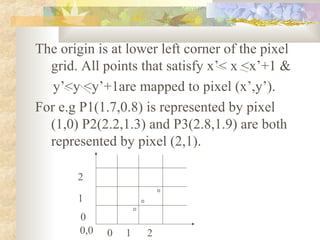
The origin is at lower left corner of the pixel
  grid. All points that satisfy x’< x <x’+1 &
   y’<y <y’+1are mapped to pixel (x’,y’).
For e.g P1(1.7,0.8) is represented by pixel
  (1,0) P2(2.2,1.3) and P3(2.8,1.9) are both
  represented by pixel (2,1).

       2

       1
        0
        0,0   0   1   2
Another approach is to scan convert (x,y) by
  making x’ = Floor(x + 0.5) and y’ =
  Floor(y+0.5). This essentially places the
  origin of the coordinate system for (x,y) at
  the center of pixel(0,0). All point that
  satisfy x’-0.5<x<x’+0.5 & y’-
  0.5<y<y’+0.5
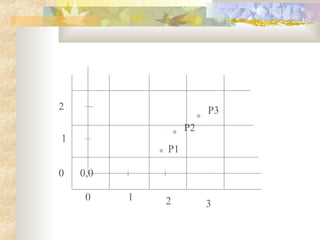
  are mapped to (x’,y’).This means that
  points P1 and P2 are now both represented
  by pixel (2,1) whereas point P3 is
  represented by pixel (3,2).
2                       P3
                   P2
1
              P1

0   0,0

     0    1   2         3

Intro to scan conversion

  • 1.
    Scan Conversion The processof representing continuous graphics object as a collection of discrete pixels is called Scan Conversion. For e.g a line is defined by its two end pts & the line equation, where as a circle is defined by its radius, center position & circle equation.
  • 2.
    It is theresponsibility of graphics system or the application program to convert each primitive from its geometric definition into a set of pixels that make up the primitive in image space. This conversion task is generally referred to as a scan conversion or rasterization. In case of line, it can be possible that any pixel may have any floating value like (2.7,5) which will not be considered by the system.
  • 3.
    Therefore, the processof making these coordinate according to system’s assumption i.e (3,5) to plot the pixel is scan conversion. Points to be remember:- 1.) All the objects should be drawn with constant brightness. 2.) Object should be independent of length & orientation.
  • 4.
    Scan converting aPoint:- A mathematical point (x,y) where x & y are real numbers within an image area, needs to be scan-converted to a pixel at location (x’,y’). This may be done by making x’& y’ to be the integer part of x & y. x’= Floor(x) and y’= Floor(y) Floor is a function that returns the largest integer that is less than or equal to the argument.
  • 5.
    The origin isat lower left corner of the pixel grid. All points that satisfy x’< x <x’+1 & y’<y <y’+1are mapped to pixel (x’,y’). For e.g P1(1.7,0.8) is represented by pixel (1,0) P2(2.2,1.3) and P3(2.8,1.9) are both represented by pixel (2,1). 2 1 0 0,0 0 1 2
  • 6.
    Another approach isto scan convert (x,y) by making x’ = Floor(x + 0.5) and y’ = Floor(y+0.5). This essentially places the origin of the coordinate system for (x,y) at the center of pixel(0,0). All point that satisfy x’-0.5<x<x’+0.5 & y’- 0.5<y<y’+0.5 are mapped to (x’,y’).This means that points P1 and P2 are now both represented by pixel (2,1) whereas point P3 is represented by pixel (3,2).
  • 7.
    2 P3 P2 1 P1 0 0,0 0 1 2 3