Implementation III
Objectives
• Survey Line Drawing Algorithms
• DDA
• Bresenham
2
Rasterization
• Rasterization (scan conversion)
• Determine which pixels that are inside primitive specified by a set of vertices
• Produces a set of fragments
• Fragments have a location (pixel location) and other attributes such color
and texture coordinates that are determined by interpolating values at
vertices
• Pixel colors determined later using color, texture, and other vertex
properties
3
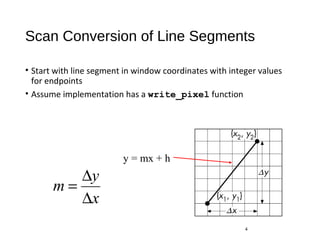
Scan Conversion of Line Segments
• Start with line segment in window coordinates with integer values
for endpoints
• Assume implementation has a write_pixel function
4
y = mx + h
x
y
m
∆
∆
=
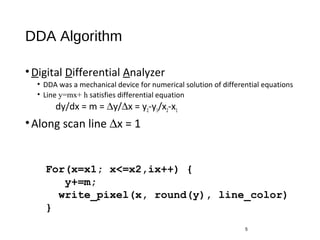
DDA Algorithm
•Digital Differential Analyzer
• DDA was a mechanical device for numerical solution of differential equations
• Line y=mx+ h satisfies differential equation
dy/dx = m = ∆y/∆x = y2-y1/x2-x1
•Along scan line ∆x = 1
5
For(x=x1; x<=x2,ix++) {
y+=m;
write_pixel(x, round(y), line_color)
}
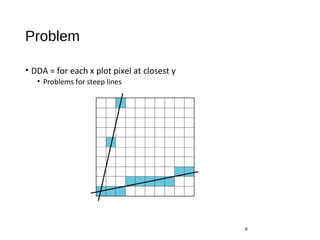
Problem
• DDA = for each x plot pixel at closest y
• Problems for steep lines
6
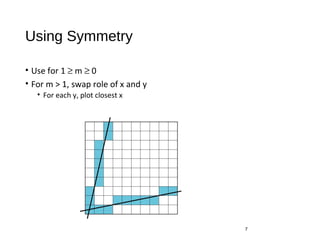
Using Symmetry
• Use for 1 ≥ m ≥ 0
• For m > 1, swap role of x and y
• For each y, plot closest x
7
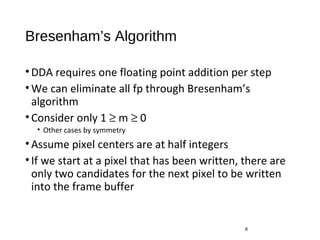
Bresenham’s Algorithm
•DDA requires one floating point addition per step
•We can eliminate all fp through Bresenham’s
algorithm
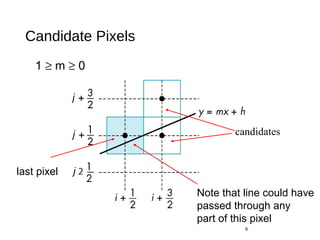
•Consider only 1 ≥ m ≥ 0
• Other cases by symmetry
•Assume pixel centers are at half integers
•If we start at a pixel that has been written, there are
only two candidates for the next pixel to be written
into the frame buffer
8
Candidate Pixels
9
1 ≥ m ≥ 0
last pixel
candidates
Note that line could have
passed through any
part of this pixel
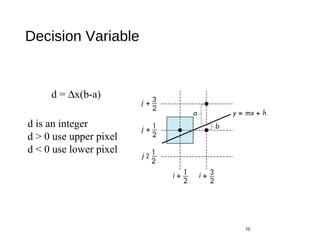
Decision Variable
-
10
d = ∆x(b-a)
d is an integer
d > 0 use upper pixel
d < 0 use lower pixel
Incremental Form
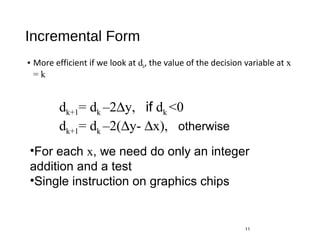
• More efficient if we look at dk, the value of the decision variable at x
= k
11
dk+1= dk –2∆y, if dk <0
dk+1= dk –2(∆y- ∆x), otherwise
•For each x, we need do only an integer
addition and a test
•Single instruction on graphics chips
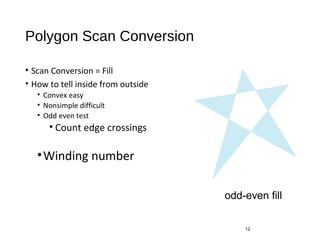
Polygon Scan Conversion
• Scan Conversion = Fill
• How to tell inside from outside
• Convex easy
• Nonsimple difficult
• Odd even test
• Count edge crossings
•Winding number
12
odd-even fill
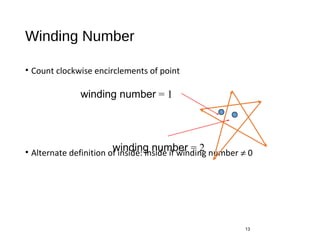
Winding Number
• Count clockwise encirclements of point
• Alternate definition of inside: inside if winding number ≠ 0
13
winding number = 2
winding number = 1
Filling in the Frame Buffer
• Fill at end of pipeline
• Convex Polygons only
• Nonconvex polygons assumed to have been tessellated
• Shades (colors) have been computed for vertices (Gouraud shading)
• Combine with z-buffer algorithm
• March across scan lines interpolating shades
• Incremental work small
14
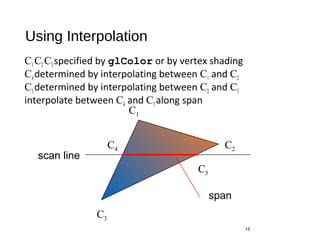
Using Interpolation
C1 C2 C3specified by glColor or by vertex shading
C4 determined by interpolating between C1 and C2
C5 determined by interpolating between C2 and C3
interpolate between C4 and C5 along span
15
span
C1
C3
C2
C5
C4
scan line
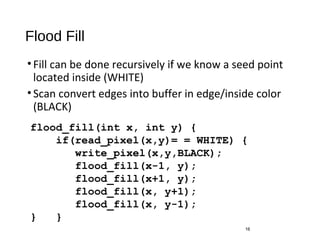
Flood Fill
•Fill can be done recursively if we know a seed point
located inside (WHITE)
•Scan convert edges into buffer in edge/inside color
(BLACK)
16
flood_fill(int x, int y) {
if(read_pixel(x,y)= = WHITE) {
write_pixel(x,y,BLACK);
flood_fill(x-1, y);
flood_fill(x+1, y);
flood_fill(x, y+1);
flood_fill(x, y-1);
} }
Scan Line Fill
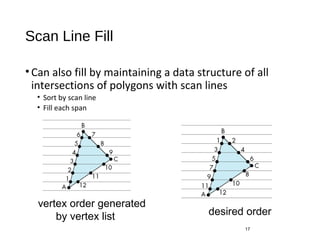
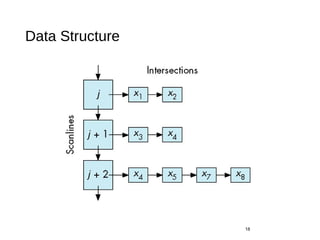
•Can also fill by maintaining a data structure of all
intersections of polygons with scan lines
• Sort by scan line
• Fill each span
17
vertex order generated
by vertex list desired order
Data Structure
18
Aliasing
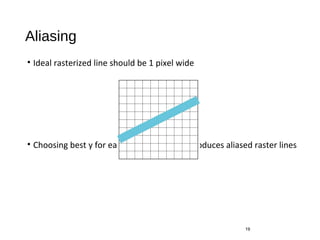
• Ideal rasterized line should be 1 pixel wide
• Choosing best y for each x (or visa versa) produces aliased raster lines
19
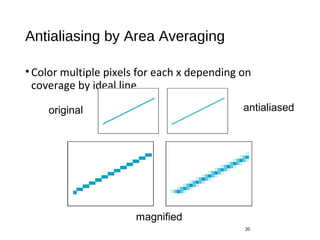
Antialiasing by Area Averaging
•Color multiple pixels for each x depending on
coverage by ideal line
20
original antialiased
magnified
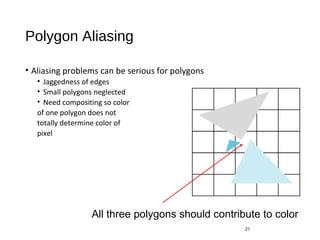
Polygon Aliasing
• Aliasing problems can be serious for polygons
• Jaggedness of edges
• Small polygons neglected
• Need compositing so color
of one polygon does not
totally determine color of
pixel
21
All three polygons should contribute to color

Implementation

  • 1.
  • 2.
    Objectives • Survey LineDrawing Algorithms • DDA • Bresenham 2
  • 3.
    Rasterization • Rasterization (scanconversion) • Determine which pixels that are inside primitive specified by a set of vertices • Produces a set of fragments • Fragments have a location (pixel location) and other attributes such color and texture coordinates that are determined by interpolating values at vertices • Pixel colors determined later using color, texture, and other vertex properties 3
  • 4.
    Scan Conversion ofLine Segments • Start with line segment in window coordinates with integer values for endpoints • Assume implementation has a write_pixel function 4 y = mx + h x y m ∆ ∆ =
  • 5.
    DDA Algorithm •Digital DifferentialAnalyzer • DDA was a mechanical device for numerical solution of differential equations • Line y=mx+ h satisfies differential equation dy/dx = m = ∆y/∆x = y2-y1/x2-x1 •Along scan line ∆x = 1 5 For(x=x1; x<=x2,ix++) { y+=m; write_pixel(x, round(y), line_color) }
  • 6.
    Problem • DDA =for each x plot pixel at closest y • Problems for steep lines 6
  • 7.
    Using Symmetry • Usefor 1 ≥ m ≥ 0 • For m > 1, swap role of x and y • For each y, plot closest x 7
  • 8.
    Bresenham’s Algorithm •DDA requiresone floating point addition per step •We can eliminate all fp through Bresenham’s algorithm •Consider only 1 ≥ m ≥ 0 • Other cases by symmetry •Assume pixel centers are at half integers •If we start at a pixel that has been written, there are only two candidates for the next pixel to be written into the frame buffer 8
  • 9.
    Candidate Pixels 9 1 ≥m ≥ 0 last pixel candidates Note that line could have passed through any part of this pixel
  • 10.
    Decision Variable - 10 d =∆x(b-a) d is an integer d > 0 use upper pixel d < 0 use lower pixel
  • 11.
    Incremental Form • Moreefficient if we look at dk, the value of the decision variable at x = k 11 dk+1= dk –2∆y, if dk <0 dk+1= dk –2(∆y- ∆x), otherwise •For each x, we need do only an integer addition and a test •Single instruction on graphics chips
  • 12.
    Polygon Scan Conversion •Scan Conversion = Fill • How to tell inside from outside • Convex easy • Nonsimple difficult • Odd even test • Count edge crossings •Winding number 12 odd-even fill
  • 13.
    Winding Number • Countclockwise encirclements of point • Alternate definition of inside: inside if winding number ≠ 0 13 winding number = 2 winding number = 1
  • 14.
    Filling in theFrame Buffer • Fill at end of pipeline • Convex Polygons only • Nonconvex polygons assumed to have been tessellated • Shades (colors) have been computed for vertices (Gouraud shading) • Combine with z-buffer algorithm • March across scan lines interpolating shades • Incremental work small 14
  • 15.
    Using Interpolation C1 C2C3specified by glColor or by vertex shading C4 determined by interpolating between C1 and C2 C5 determined by interpolating between C2 and C3 interpolate between C4 and C5 along span 15 span C1 C3 C2 C5 C4 scan line
  • 16.
    Flood Fill •Fill canbe done recursively if we know a seed point located inside (WHITE) •Scan convert edges into buffer in edge/inside color (BLACK) 16 flood_fill(int x, int y) { if(read_pixel(x,y)= = WHITE) { write_pixel(x,y,BLACK); flood_fill(x-1, y); flood_fill(x+1, y); flood_fill(x, y+1); flood_fill(x, y-1); } }
  • 17.
    Scan Line Fill •Canalso fill by maintaining a data structure of all intersections of polygons with scan lines • Sort by scan line • Fill each span 17 vertex order generated by vertex list desired order
  • 18.
  • 19.
    Aliasing • Ideal rasterizedline should be 1 pixel wide • Choosing best y for each x (or visa versa) produces aliased raster lines 19
  • 20.
    Antialiasing by AreaAveraging •Color multiple pixels for each x depending on coverage by ideal line 20 original antialiased magnified
  • 21.
    Polygon Aliasing • Aliasingproblems can be serious for polygons • Jaggedness of edges • Small polygons neglected • Need compositing so color of one polygon does not totally determine color of pixel 21 All three polygons should contribute to color