Obesity
Consequences:
Social isolation
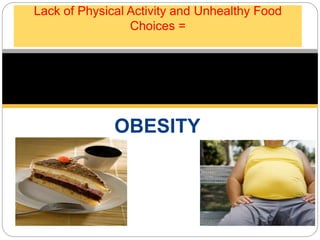
OBESITY
Lack of Physical Activity and Unhealthy Food
Choices =
WHAT IS OBESITY ?
An increase in bodyweight because
of excess body fat .
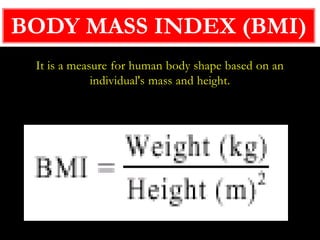
It is a measure for human body shape based on an
individual's mass and height.
BODY MASS INDEX (BMI)
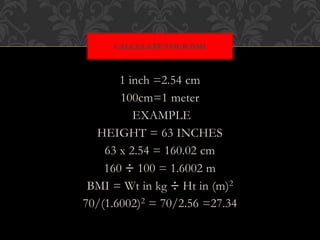
1 inch =2.54 cm
100cm=1 meter
EXAMPLE
HEIGHT = 63 INCHES
63 x 2.54 = 160.02 cm
160 ÷ 100 = 1.6002 m
BMI = Wt in kg ÷ Ht in (m)2
70/(1.6002)2 = 70/2.56 =27.34
CALCULATE YOUR BMI
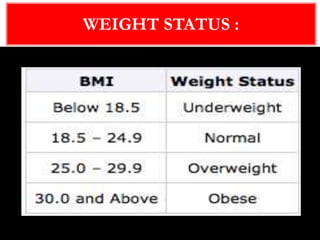
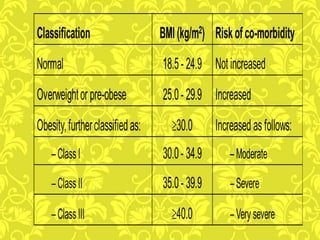
WEIGHT STATUS :
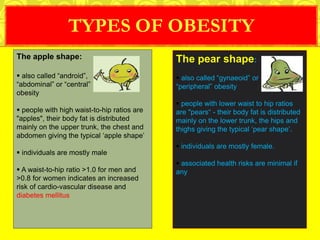
TYPES OF OBESITY
The apple shape:
 also called “android”,
“abdominal” or “central”
obesity
 people with high waist-to-hip ratios are
"apples", their body fat is distributed
mainly on the upper trunk, the chest and
abdomen giving the typical ‘apple shape’
 individuals are mostly male
 A waist-to-hip ratio >1.0 for men and
>0.8 for women indicates an increased
risk of cardio-vascular disease and
diabetes mellitus
The pear shape:
 also called “gynaeoid” or
“peripheral” obesity
 people with lower waist to hip ratios
are "pears“ - their body fat is distributed
mainly on the lower trunk, the hips and
thighs giving the typical ‘pear shape’.
 individuals are mostly female.
 associated health risks are minimal if
any
• Enzyme lipoprotein lipase synthesized by
adipocytes is released in circulation and
stimulate feeding center and increase food
intake leading to obesity.
• Leptin(peptide) produce satiety through
receptors in hypothalamus and decrease food
intake.
• Catecholamines also produce statiety.
REGULATION OF FOOD INTAKE
• Lack of physical
activities.
• Bad nutrition
habits.
• Genes.
MAIN CAUSES FOR OBESITY
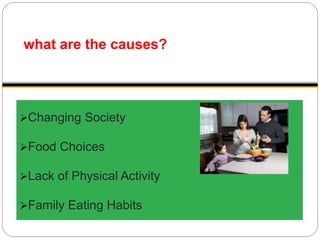
what are the causes?
Changing Society
Food Choices
Lack of Physical Activity
Family Eating Habits
Some examples include:
Cost of food.
More food is prepared away from home.
Energy-dense foods / drinks are readily available.
Portion sizes have increased.
Marketing of energy-dense foods / drinks has increased.
The use of cars has increased.
The families has increased income
number of two-income
(
NUGGETS
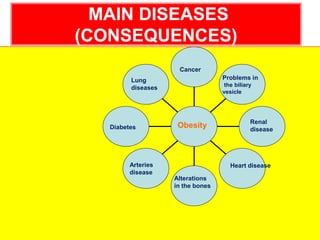
MAIN DISEASES
(CONSEQUENCES)
Arteries
disease
Cancer
Problems in
the biliary
vesicle
Lung
diseases
Diabetes
Alterations
in the bones
Heart disease
Renal
disease
Obesity
• Decreased respiratory movements due to obesity lead to: hypoxia---increased
erythropoiton---increased RBC formation---increased Haematocrit---
Thromboembolic phenomena.
• In obese persons snoring lead to sleep apnoea-cardiac arrhythmias
• Cancer of rectum,colon,breast,ovary and uterus are common in obese persons
due to more body fat.
• Fatty liver lead to liver demage & disorders.
• Insuline insufficiency lead to diabetese
• In females menstrual disorders(inadequate horm) lead to infertility and sterility.
• In males adipose tissue aromatase convert plasma testosterone to estrogen
which exert anti-testosterone.
• Infections and hiatus hernia are common and poor surgical risks.
• Short life expectancy.
• Longer the belt shorter is the life span.
MAIN DISEASES
What health problems associated with
obesity ?
Type 2 diabetes
Eating disorders
Orthopedic disorders
Liver problems, including fatty liver
Respiratory disorders
Sleep apnea
Cardiomyopathy – a problem with the heart muscle,
caused when extra effort is needed to pump blood.
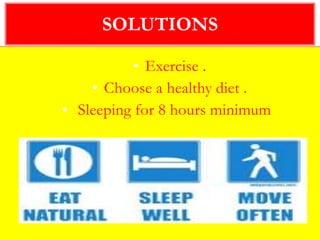
• Exercise .
• Choose a healthy diet .
• Sleeping for 8 hours minimum .
SOLUTIONS
HOW CAN I BE MOTIVATED ?
Did you know?
Obesity is the leading cause of preventable death, next to
smoking!
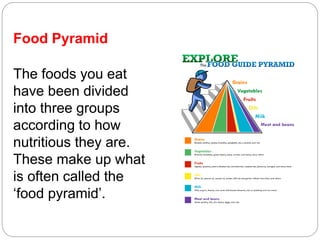
Food Pyramid
The foods you eat
have been divided
into three groups
according to how
nutritious they are.
These make up what
is often called the
‘food pyramid’.
Three Food Groups
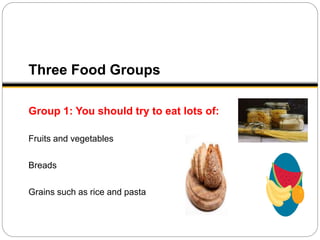
Group 1: You should try to eat lots of:
Fruits and vegetables
Breads
Grains such as rice and pasta
Three Food Groups
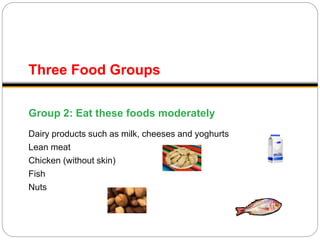
Group 2: Eat these foods moderately
Dairy products such as milk, cheeses and yoghurts
Lean meat
Chicken (without skin)
Fish
Nuts
Three Food Groups
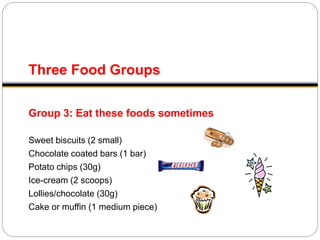
Group 3: Eat these foods sometimes
Sweet biscuits (2 small)
Chocolate coated bars (1 bar)
Potato chips (30g)
Ice-cream (2 scoops)
Lollies/chocolate (30g)
Cake or muffin (1 medium piece)
What are the benefits of Physical
Activity?
Cardiovascular fitness
Healthy weight
Improved posture
Reduced blood cholesterol
Better sleep
Boosted self-esteem and confidence
Improved concentration
Reduced stress, depression and anxiety
Enhanced social skills.
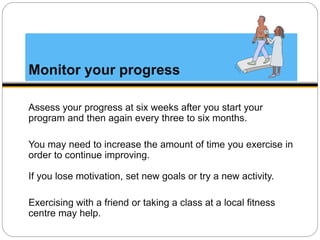
Monitor your progress
Assess your progress at six weeks after you start your
program and then again every three to six months.
You may need to increase the amount of time you exercise in
order to continue improving.
If you lose motivation, set new goals or try a new activity.
Exercising with a friend or taking a class at a local fitness
centre may help.
NO PAIN NO GAIN ..
Obesity is a diseases which
affected the whole world but
there is always a way out .
No pain no gain, So do you
have the guts to fight for life ?
CONCLUSION
Obesity

Obesity

  • 1.
  • 2.
  • 3.
    OBESITY Lack of PhysicalActivity and Unhealthy Food Choices =
  • 4.
    WHAT IS OBESITY? An increase in bodyweight because of excess body fat .
  • 5.
    It is ameasure for human body shape based on an individual's mass and height. BODY MASS INDEX (BMI)
  • 6.
    1 inch =2.54cm 100cm=1 meter EXAMPLE HEIGHT = 63 INCHES 63 x 2.54 = 160.02 cm 160 ÷ 100 = 1.6002 m BMI = Wt in kg ÷ Ht in (m)2 70/(1.6002)2 = 70/2.56 =27.34 CALCULATE YOUR BMI
  • 7.
  • 9.
    TYPES OF OBESITY Theapple shape:  also called “android”, “abdominal” or “central” obesity  people with high waist-to-hip ratios are "apples", their body fat is distributed mainly on the upper trunk, the chest and abdomen giving the typical ‘apple shape’  individuals are mostly male  A waist-to-hip ratio >1.0 for men and >0.8 for women indicates an increased risk of cardio-vascular disease and diabetes mellitus The pear shape:  also called “gynaeoid” or “peripheral” obesity  people with lower waist to hip ratios are "pears“ - their body fat is distributed mainly on the lower trunk, the hips and thighs giving the typical ‘pear shape’.  individuals are mostly female.  associated health risks are minimal if any
  • 11.
    • Enzyme lipoproteinlipase synthesized by adipocytes is released in circulation and stimulate feeding center and increase food intake leading to obesity. • Leptin(peptide) produce satiety through receptors in hypothalamus and decrease food intake. • Catecholamines also produce statiety. REGULATION OF FOOD INTAKE
  • 12.
    • Lack ofphysical activities. • Bad nutrition habits. • Genes. MAIN CAUSES FOR OBESITY
  • 13.
    what are thecauses? Changing Society Food Choices Lack of Physical Activity Family Eating Habits
  • 14.
    Some examples include: Costof food. More food is prepared away from home. Energy-dense foods / drinks are readily available. Portion sizes have increased. Marketing of energy-dense foods / drinks has increased. The use of cars has increased. The families has increased income number of two-income (
  • 15.
  • 16.
    MAIN DISEASES (CONSEQUENCES) Arteries disease Cancer Problems in thebiliary vesicle Lung diseases Diabetes Alterations in the bones Heart disease Renal disease Obesity
  • 17.
    • Decreased respiratorymovements due to obesity lead to: hypoxia---increased erythropoiton---increased RBC formation---increased Haematocrit--- Thromboembolic phenomena. • In obese persons snoring lead to sleep apnoea-cardiac arrhythmias • Cancer of rectum,colon,breast,ovary and uterus are common in obese persons due to more body fat. • Fatty liver lead to liver demage & disorders. • Insuline insufficiency lead to diabetese • In females menstrual disorders(inadequate horm) lead to infertility and sterility. • In males adipose tissue aromatase convert plasma testosterone to estrogen which exert anti-testosterone. • Infections and hiatus hernia are common and poor surgical risks. • Short life expectancy. • Longer the belt shorter is the life span. MAIN DISEASES
  • 18.
    What health problemsassociated with obesity ? Type 2 diabetes Eating disorders Orthopedic disorders Liver problems, including fatty liver Respiratory disorders Sleep apnea Cardiomyopathy – a problem with the heart muscle, caused when extra effort is needed to pump blood.
  • 19.
    • Exercise . •Choose a healthy diet . • Sleeping for 8 hours minimum . SOLUTIONS
  • 20.
    HOW CAN IBE MOTIVATED ?
  • 21.
    Did you know? Obesityis the leading cause of preventable death, next to smoking!
  • 22.
    Food Pyramid The foodsyou eat have been divided into three groups according to how nutritious they are. These make up what is often called the ‘food pyramid’.
  • 23.
    Three Food Groups Group1: You should try to eat lots of: Fruits and vegetables Breads Grains such as rice and pasta
  • 24.
    Three Food Groups Group2: Eat these foods moderately Dairy products such as milk, cheeses and yoghurts Lean meat Chicken (without skin) Fish Nuts
  • 25.
    Three Food Groups Group3: Eat these foods sometimes Sweet biscuits (2 small) Chocolate coated bars (1 bar) Potato chips (30g) Ice-cream (2 scoops) Lollies/chocolate (30g) Cake or muffin (1 medium piece)
  • 26.
    What are thebenefits of Physical Activity? Cardiovascular fitness Healthy weight Improved posture Reduced blood cholesterol Better sleep Boosted self-esteem and confidence Improved concentration Reduced stress, depression and anxiety Enhanced social skills.
  • 27.
    Monitor your progress Assessyour progress at six weeks after you start your program and then again every three to six months. You may need to increase the amount of time you exercise in order to continue improving. If you lose motivation, set new goals or try a new activity. Exercising with a friend or taking a class at a local fitness centre may help.
  • 28.
    NO PAIN NOGAIN ..
  • 29.
    Obesity is adiseases which affected the whole world but there is always a way out . No pain no gain, So do you have the guts to fight for life ? CONCLUSION