MALNUTRITION
BY
DR SHAMIM AKRAM
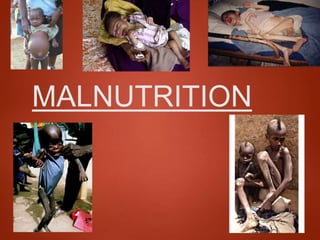
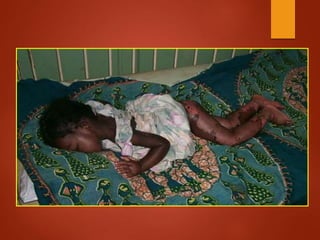
MALNUTRITION
Malnutrition
 Derived from malus (bad) and nutrire (to
nourish)
 Includes both
 Under nutrition (deficiency of one or more essential nutrients)
 Over nutrition (an excess of a nutrient or nutrients)
DEFINITION
 MALNUTRITION
WHO defines Malnutrition as "the cellular
imbalance between the supply of nutrients
and energy and the body's demand for them
to ensure growth, maintenance, and specific
functions.“
Malnutrition is the condition that develops
when the body does not get the right amount
of the vitamins, minerals, and other nutrients
it needs to maintain healthy tissues and
organ function
WHAT CAUSES
MALNUTRITION?
Human beings need a wide
variety of nutrients to supply
essential energy. Do you
know what nutrients we
need?
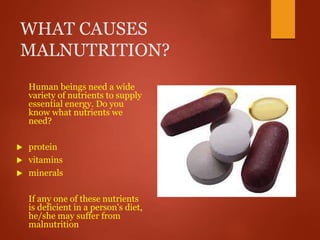
 protein
 vitamins
 minerals
If any one of these nutrients
is deficient in a person's diet,
he/she may suffer from
malnutrition
WHAT CAUSES
MALNUTRITION?
Malnutrition is poor nutrition due to:
 An insufficient food,
 Poorly balanced diet,
 Faulty digestion or poor utilization of foods.
(This can result in the inability to absorb
foods.)
 Malnutrition is not only insufficient intake of
nutrients. It can occur when an individual is
getting excessive nutrients as well.
WHAT CAUSES
MALNUTRITION?
(continued)
Malnutrition also occurs when there is an imbalance of energy and
protein in an individual’s diet. The body may become unable to
absorb the nutrients it requires to function properly.
*For example, if a child is suffering from energy
and protein malnutrition, they will most likely
have deficiencies in iron, calcium, and other
vitamins and minerals.
WHO IS AFFECTED BY
MALNUTRITION?
 Individuals who are dependent on others for
their nourishment. (infants, children, the
elderly, prisoners)
 Mentally disabled or ill because they are not
aware of what to eat.
 People who are suffering from tuberculosis,
eating disorders, HIV/AIDS, cancer, or who
have undergone surgical procedures are
susceptible to interferences with appetite or
food uptake which can lead to malnutrition.
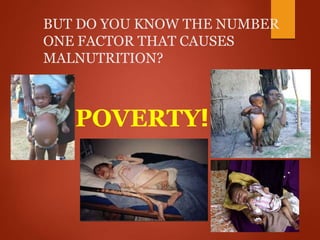
BUT DO YOU KNOW THE NUMBER
ONE FACTOR THAT CAUSES
MALNUTRITION?
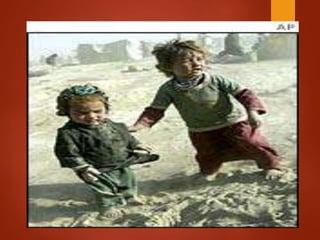
POVERTY!
Effects of malnutrition
Nutritional deficiencies can contribute to various diseases
which can be found everywhere, but most often go
without cures/treatment in Less Developed Countries
(LDCs).
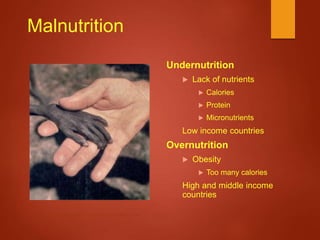
Malnutrition
Undernutrition
 Lack of nutrients
 Calories
 Protein
 Micronutrients
Low income countries
Overnutrition
 Obesity
 Too many calories
High and middle income
countries
http://i105.photobucket.com/albums/m203/sspasha/Malnutrition.jpg
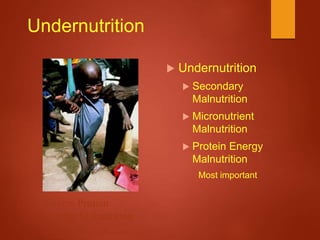
Undernutrition
 Undernutrition
 Secondary
Malnutrition
 Micronutrient
Malnutrition
 Protein Energy
Malnutrition
Most important
Severe Protein
Energy Malnutrition
http://www.bio.davidson.edu/people/kabernd/seminar/2002/tech/ma
lnutrition.jpg
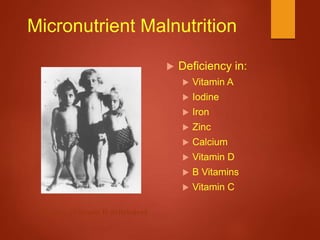
Micronutrient Malnutrition
 Deficiency in:
 Vitamin A
 Iodine
 Iron
 Zinc
 Calcium
 Vitamin D
 B Vitamins
 Vitamin C
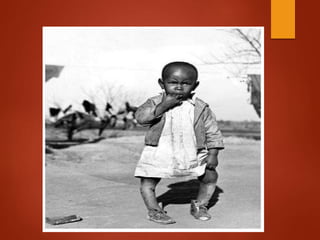
Rickets (Vitamin D deficiency)
http://www.talkorigins.org/faqs/homs/rickets.jpg
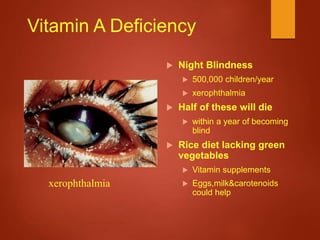
Vitamin A Deficiency
 Night Blindness
 500,000 children/year
 xerophthalmia
 Half of these will die
 within a year of becoming
blind
 Rice diet lacking green
vegetables
 Vitamin supplements
 Eggs,milk&carotenoids
could help
http://www.vitaminsdiary.com/UserFiles/Image/keratomalacia.jpg
xerophthalmia
Rickets
 Vitamin D deficiencies may result in
“Rickets” which is a lack of proper calcium
characterized by poorly developed and
deformed bones.
 Vitamin D can be best found in beef
products (especially cows milk) but is very
low in breast milk. Thus, women in
developing countries are contributing to
this disease if their babies sole source of
nourishment is breast milk.
 Sun exppsure,cod liver oil & eggs could
help
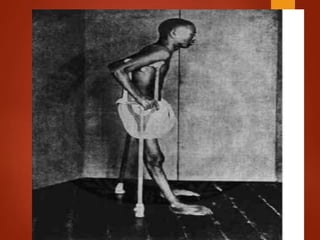
Beriberi
 Beriberi is a thiamine (vitamin B1) deficiency
which is common in South East Asia where many
diets consist solely of white rice.
 Beriberi affects the proper functioning of the
nervous system as well as the circulatory system
and heart.
 Pregnancy, breast feeding mothers and those who
are ill with fever may have a heightened
dependency on thiamine and may develop a
deficiency.
 Thiamine is best acquired through foods such as
beef and whole grain (unrefined) breads and
grains.
Pellagra
 Pellagra ”rough skin” is a niacin (or Tryptophan)
deficiency which often results in the “3 Ds”; diarrhea,
demetia and dermatitis.
 The large scale consumption of corn has resulted in
many cases of pellagra because corn is poorly absorbed
in the body. The best sources of Niacin are broccoli,
eggs, dates, beef, salmon, seeds and peanuts.
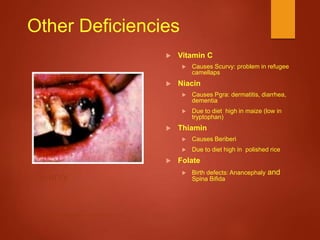
Scurvy
 Scurvy is a disease which is born of Vitamin C
deficiency. It is characterized by bleeding around hair
follicles, anemia and gingivitis.
 Scurvy may occur in those who consume large
amounts of junk foods, smokers (as smoking depletes
Vitamin C) and those who don’t have proper access to
sources of vitamin C. Namely, the poor.
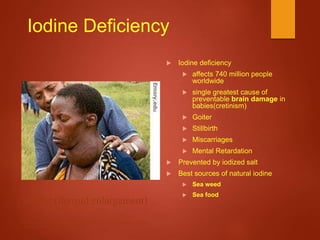
Iodine Deficiency
 Iodine deficiency
 affects 740 million people
worldwide
 single greatest cause of
preventable brain damage in
babies(cretinism)
 Goiter
 Stillbirth
 Miscarriages
 Mental Retardation
 Prevented by iodized salt
 Best sources of natural iodine
 Sea weed
 Sea food
Goiter (thyroid enlargement)
http://www.voanews.com/english/images/emory_edu_goiter_Iodine_Deficiency_Disorder
_195_eng_11may06_0.jpg
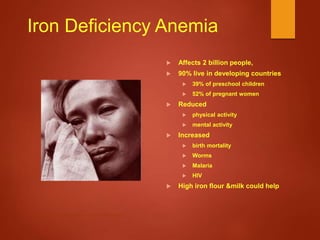
Iron Deficiency Anemia
 Affects 2 billion people,
 90% live in developing countries
 39% of preschool children
 52% of pregnant women
 Reduced
 physical activity
 mental activity
 Increased
 birth mortality
 Worms
 Malaria
 HIV
 High iron flour &milk could help
http://www.micronutrient.org/reports/images/Page16Image.jpg
Other Deficiencies
 Zinc
 Growth retardation
 delayed sexual maturation
 skin and eye lesions
 48% of world at risk for zinc
deficiency
 Calcium
 Osteoporosis: bone loss
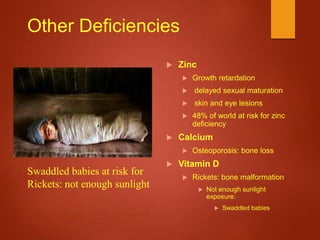
 Vitamin D
 Rickets: bone malformation
 Not enough sunlight
exposure:
 Swaddled babies
http://www.ulanbatoronline.org/cammp_section/article_images_lamc_lati
mes/scans/latimes_images/thumbnails/babyswaddle.jpg
Swaddled babies at risk for
Rickets: not enough sunlight
Other Deficiencies
 Vitamin C
 Causes Scurvy: problem in refugee
camellaps
 Niacin
 Causes Pgra: dermatitis, diarrhea,
dementia
 Due to diet high in maize (low in
tryptophan)
 Thiamin
 Causes Beriberi
 Due to diet high in polished rice
 Folate
 Birth defects: Anancephaly and
Spina Bifida
http://www.athropolis.com/arctic-facts/misc/scurvy.jpg
Scurvy
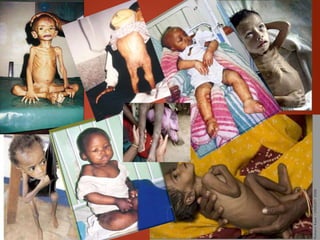
MALNUTRITION
(PEM)
MARASMUS/
KWASHIORKOR
31
Kwashiokor/Marasmus
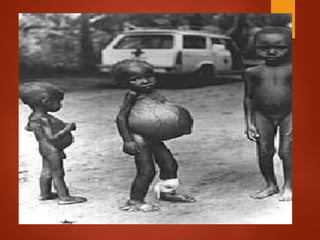
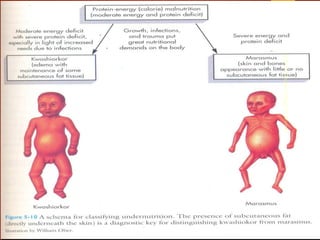
 Kwashiokor, is “the disease of the Weaning child”
is an extreme protein deficiency (affects after 1
years) which is characterized by inability to gain
weight, diarrhea, lethargy and a swollen belly.
Kwashiokor can lead to coma as well as death.
 Marasmus is a disease resulting from caloric &
protein deficiency which affects chidlren early in
life (typically in the 1st year) due to use of diluted
milk,characterized by slowing growth, decreasing
weight and hindering proper development.
 Nutrition supplements, rehydration and
education all can all serve to cure and prevent
these diseases.
Kwashiorkor - Definition
It is an acute form of childhood protein-energy malnutrition
characterized by inadequate protein intake with reasonable caloric
(energy) intake; it tends to occur after weaning, when children
change from breast milk to a diet consisting mainly of
carbohydrates.
Studies suggest that kwashiorkor represents a maladaptive response
to starvation
35
KWASHIORKOR
 The term kwashiorkor is taken from the Ga language of Ghana and
means "the sickness of the weaning”.
 Williams first used the term in 1933, and it refers to an inadequate
protein intake with reasonable caloric (energy) intake.
 Kwashiorkor, also called wet protein-energy malnutrition, is a form of
PEM characterized primarily by protein deficiency.
 This condition usually appears at the age of about 12 months when
breastfeeding is discontinued, but it can develop at any time during a
child's formative years.
 It causes fluid retention (edema); dry, peeling skin; and hair
discoloration.
 Kwashiorkor was thought to be caused by
insufficient protein consumption but with sufficient calorie
intake, distinguishing it from marasmus.
 More recently, micronutrient and antioxidant deficiencies
have come to be recognized as contributory.
 Victims of kwashiorkor fail to
produce antibodies following vaccination against diseases,
including diphtheria and typhoid.
 Generally, the disease can be treated by adding food energy
and protein to the diet; however, it can have a long-term
impact on a child's physical and mental development,
and in severe cases may lead to death.
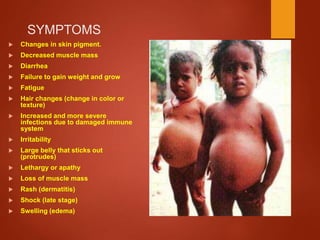
SYMPTOMS
 Changes in skin pigment.
 Decreased muscle mass
 Diarrhea
 Failure to gain weight and grow
 Fatigue
 Hair changes (change in color or
texture)
 Increased and more severe
infections due to damaged immune
system
 Irritability
 Large belly that sticks out
(protrudes)
 Lethargy or apathy
 Loss of muscle mass
 Rash (dermatitis)
 Shock (late stage)
 Swelling (edema)
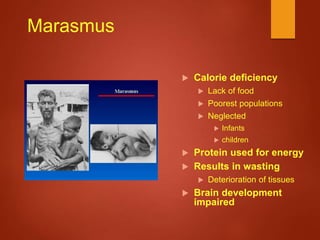
Marasmus
 Calorie deficiency
 Lack of food
 Poorest populations
 Neglected
 Infants
 children
 Protein used for energy
 Results in wasting
 Deterioration of tissues
 Brain development
impaired
MARASMUS
 The term marasmus is derived from the Greek word marasmos, which
means withering or wasting.
 Marasmus is a form of severe protein-energy malnutrition characterized
by energy deficiency and emaciation.
 Primarily caused by energy deficiency, marasmus is characterized by
stunted growth and wasting of muscle and tissue.
 Marasmus usually develops between the ages of six months and one
year in children who have been weaned from breast milk or who suffer
from weakening conditions like chronic diarrhea.
Etiology:
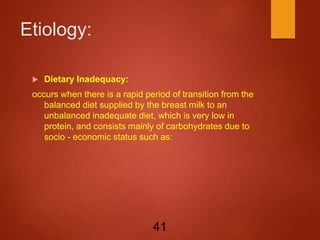
 Dietary Inadequacy:
occurs when there is a rapid period of transition from the
balanced diet supplied by the breast milk to an
unbalanced inadequate diet, which is very low in
protein, and consists mainly of carbohydrates due to
socio - economic status such as:
41
Cont..
 Poverty
 Ignorance
 Inadequate weaning practice
 Lack of basic health education and nutritional
knowledge.
 Child abuse
42
SYMPTOMS
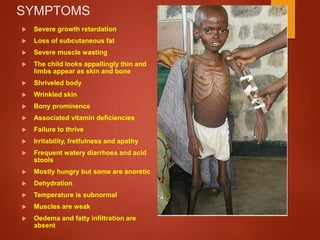
 Severe growth retardation
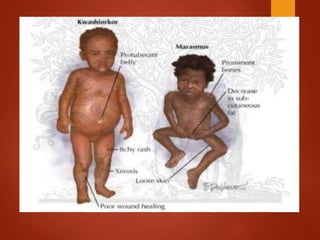
 Loss of subcutaneous fat
 Severe muscle wasting
 The child looks appallingly thin and
limbs appear as skin and bone
 Shriveled body
 Wrinkled skin
 Bony prominence
 Associated vitamin deficiencies
 Failure to thrive
 Irritability, fretfulness and apathy
 Frequent watery diarrhoea and acid
stools
 Mostly hungry but some are anoretic
 Dehydration
 Temperature is subnormal
 Muscles are weak
 Oedema and fatty infiltration are
absent
Marasmus
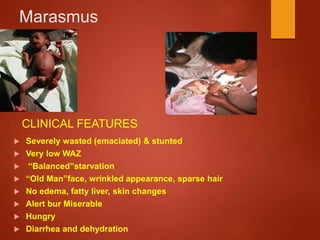
 Severely wasted (emaciated) & stunted
 Very low WAZ
 “Balanced”starvation
 “Old Man”face, wrinkled appearance, sparse hair
 No edema, fatty liver, skin changes
 Alert bur Miserable
 Hungry
 Diarrhea and dehydration
CLINICAL FEATURES
CAUSES OF MARASMUS
 Seen most commonly in the first year of life due to
lack of breast feeding and the use of dilute animal
milk.
 Poverty or famine and diarrhoea are the usual
precipitating factors
 Ignorance & poor maternal nutrition are also
contributory
 Too little breast milk or complementary foods •< 2
yrs of age
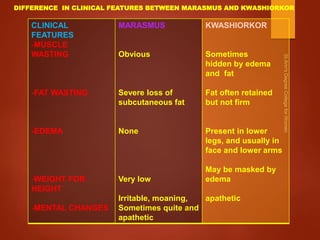
DIFFERENCE IN CLINICAL FEATURES BETWEEN
MARASMUS AND KWASHIORKOR
CLINICAL
FEATURES
-MUSCLE
WASTING
-FAT WASTING
-EDEMA
-WEIGHT FOR
HEIGHT
-MENTAL CHANGES
MARASMUS
Obvious
Severe loss of
subcutaneous fat
None
Very low
Irritable, moaning,
Sometimes quite and
apathetic
KWASHIORKOR
Sometimes
hidden by edema
and fat
Fat often retained
but not firm
Present in lower
legs, and usually in
face and lower arms
May be masked by
edema
apathetic
DIFFERENCE IN CLINICAL FEATURES BETWEEN MARASMUS AND KWASHIORKOR
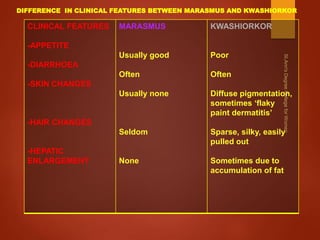
CLINICAL FEATURES
-APPETITE
-DIARRHOEA
-SKIN CHANGES
-HAIR CHANGES
-HEPATIC
ENLARGEMENT
MARASMUS
Usually good
Often
Usually none
Seldom
None
KWASHIORKOR
Poor
Often
Diffuse pigmentation,
sometimes ‘flaky
paint dermatitis’
Sparse, silky, easily
pulled out
Sometimes due to
accumulation of fat
DIFFERENCE IN CLINICAL FEATURES BETWEEN MARASMUS AND KWASHIORKOR
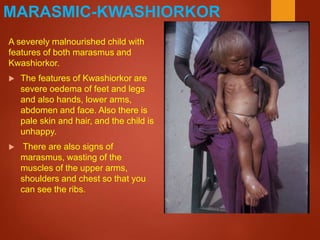
A severely malnourished child with
features of both marasmus and
Kwashiorkor.
 The features of Kwashiorkor are
severe oedema of feet and legs
and also hands, lower arms,
abdomen and face. Also there is
pale skin and hair, and the child is
unhappy.
 There are also signs of
marasmus, wasting of the
muscles of the upper arms,
shoulders and chest so that you
can see the ribs.
MARASMIC-KWASHIORKOR
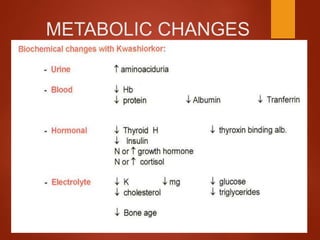
METABOLIC CHANGES
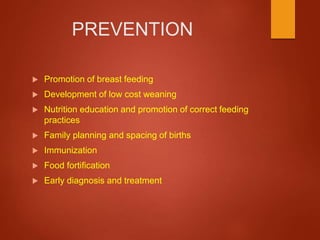
PREVENTION
 Promotion of breast feeding
 Development of low cost weaning
 Nutrition education and promotion of correct feeding
practices
 Family planning and spacing of births
 Immunization
 Food fortification
 Early diagnosis and treatment
TREATMENT
1. Hospital Treatment
The following conditions should be corrected.
Hypothermia, hypoglycemia, infection, dehydration,
electrolyte imbalance, anaemia and other vitamin and
mineral deficiencies.
2. Dietary Management
The diet should be from locally available staple foods -
inexpensive, easily digestible, evenly distributed
throughout the day and increased number of feedings to
increase the quantity of food.
3. Rehabilitation
The concept of nutritional rehabilitation is based on
practical nutritional training for mothers in which they
learn by feeding their children back to health under
supervision and using local foods
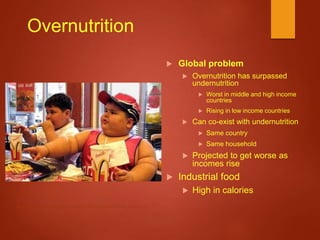
Overnutrition
 Global problem
 Overnutrition has surpassed
undernutrition
 Worst in middle and high income
countries
 Rising in low income countries
 Can co-exist with undernutrition
 Same country
 Same household
 Projected to get worse as
incomes rise
 Industrial food
 High in calories
http://i.dailymail.co.uk/i/pix/2008/05/16/article-0-064EFCA50000044D-848_468x296.jpg
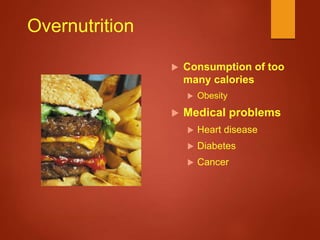
Overnutrition
 Consumption of too
many calories
 Obesity
 Medical problems
 Heart disease
 Diabetes
 Cancer
http://www.mercola.com/images/blog/2005/01.01.junkfood.gif
Malnutrition

Malnutrition

  • 2.
  • 3.
  • 7.
    Malnutrition  Derived frommalus (bad) and nutrire (to nourish)  Includes both  Under nutrition (deficiency of one or more essential nutrients)  Over nutrition (an excess of a nutrient or nutrients)
  • 8.
    DEFINITION  MALNUTRITION WHO definesMalnutrition as "the cellular imbalance between the supply of nutrients and energy and the body's demand for them to ensure growth, maintenance, and specific functions.“ Malnutrition is the condition that develops when the body does not get the right amount of the vitamins, minerals, and other nutrients it needs to maintain healthy tissues and organ function
  • 9.
    WHAT CAUSES MALNUTRITION? Human beingsneed a wide variety of nutrients to supply essential energy. Do you know what nutrients we need?  protein  vitamins  minerals If any one of these nutrients is deficient in a person's diet, he/she may suffer from malnutrition
  • 10.
    WHAT CAUSES MALNUTRITION? Malnutrition ispoor nutrition due to:  An insufficient food,  Poorly balanced diet,  Faulty digestion or poor utilization of foods. (This can result in the inability to absorb foods.)  Malnutrition is not only insufficient intake of nutrients. It can occur when an individual is getting excessive nutrients as well.
  • 11.
    WHAT CAUSES MALNUTRITION? (continued) Malnutrition alsooccurs when there is an imbalance of energy and protein in an individual’s diet. The body may become unable to absorb the nutrients it requires to function properly. *For example, if a child is suffering from energy and protein malnutrition, they will most likely have deficiencies in iron, calcium, and other vitamins and minerals.
  • 12.
    WHO IS AFFECTEDBY MALNUTRITION?  Individuals who are dependent on others for their nourishment. (infants, children, the elderly, prisoners)  Mentally disabled or ill because they are not aware of what to eat.  People who are suffering from tuberculosis, eating disorders, HIV/AIDS, cancer, or who have undergone surgical procedures are susceptible to interferences with appetite or food uptake which can lead to malnutrition.
  • 13.
    BUT DO YOUKNOW THE NUMBER ONE FACTOR THAT CAUSES MALNUTRITION? POVERTY!
  • 14.
    Effects of malnutrition Nutritionaldeficiencies can contribute to various diseases which can be found everywhere, but most often go without cures/treatment in Less Developed Countries (LDCs).
  • 15.
    Malnutrition Undernutrition  Lack ofnutrients  Calories  Protein  Micronutrients Low income countries Overnutrition  Obesity  Too many calories High and middle income countries http://i105.photobucket.com/albums/m203/sspasha/Malnutrition.jpg
  • 16.
    Undernutrition  Undernutrition  Secondary Malnutrition Micronutrient Malnutrition  Protein Energy Malnutrition Most important Severe Protein Energy Malnutrition http://www.bio.davidson.edu/people/kabernd/seminar/2002/tech/ma lnutrition.jpg
  • 17.
    Micronutrient Malnutrition  Deficiencyin:  Vitamin A  Iodine  Iron  Zinc  Calcium  Vitamin D  B Vitamins  Vitamin C Rickets (Vitamin D deficiency) http://www.talkorigins.org/faqs/homs/rickets.jpg
  • 18.
    Vitamin A Deficiency Night Blindness  500,000 children/year  xerophthalmia  Half of these will die  within a year of becoming blind  Rice diet lacking green vegetables  Vitamin supplements  Eggs,milk&carotenoids could help http://www.vitaminsdiary.com/UserFiles/Image/keratomalacia.jpg xerophthalmia
  • 19.
    Rickets  Vitamin Ddeficiencies may result in “Rickets” which is a lack of proper calcium characterized by poorly developed and deformed bones.  Vitamin D can be best found in beef products (especially cows milk) but is very low in breast milk. Thus, women in developing countries are contributing to this disease if their babies sole source of nourishment is breast milk.  Sun exppsure,cod liver oil & eggs could help
  • 21.
    Beriberi  Beriberi isa thiamine (vitamin B1) deficiency which is common in South East Asia where many diets consist solely of white rice.  Beriberi affects the proper functioning of the nervous system as well as the circulatory system and heart.  Pregnancy, breast feeding mothers and those who are ill with fever may have a heightened dependency on thiamine and may develop a deficiency.  Thiamine is best acquired through foods such as beef and whole grain (unrefined) breads and grains.
  • 23.
    Pellagra  Pellagra ”roughskin” is a niacin (or Tryptophan) deficiency which often results in the “3 Ds”; diarrhea, demetia and dermatitis.  The large scale consumption of corn has resulted in many cases of pellagra because corn is poorly absorbed in the body. The best sources of Niacin are broccoli, eggs, dates, beef, salmon, seeds and peanuts.
  • 25.
    Scurvy  Scurvy isa disease which is born of Vitamin C deficiency. It is characterized by bleeding around hair follicles, anemia and gingivitis.  Scurvy may occur in those who consume large amounts of junk foods, smokers (as smoking depletes Vitamin C) and those who don’t have proper access to sources of vitamin C. Namely, the poor.
  • 27.
    Iodine Deficiency  Iodinedeficiency  affects 740 million people worldwide  single greatest cause of preventable brain damage in babies(cretinism)  Goiter  Stillbirth  Miscarriages  Mental Retardation  Prevented by iodized salt  Best sources of natural iodine  Sea weed  Sea food Goiter (thyroid enlargement) http://www.voanews.com/english/images/emory_edu_goiter_Iodine_Deficiency_Disorder _195_eng_11may06_0.jpg
  • 28.
    Iron Deficiency Anemia Affects 2 billion people,  90% live in developing countries  39% of preschool children  52% of pregnant women  Reduced  physical activity  mental activity  Increased  birth mortality  Worms  Malaria  HIV  High iron flour &milk could help http://www.micronutrient.org/reports/images/Page16Image.jpg
  • 29.
    Other Deficiencies  Zinc Growth retardation  delayed sexual maturation  skin and eye lesions  48% of world at risk for zinc deficiency  Calcium  Osteoporosis: bone loss  Vitamin D  Rickets: bone malformation  Not enough sunlight exposure:  Swaddled babies http://www.ulanbatoronline.org/cammp_section/article_images_lamc_lati mes/scans/latimes_images/thumbnails/babyswaddle.jpg Swaddled babies at risk for Rickets: not enough sunlight
  • 30.
    Other Deficiencies  VitaminC  Causes Scurvy: problem in refugee camellaps  Niacin  Causes Pgra: dermatitis, diarrhea, dementia  Due to diet high in maize (low in tryptophan)  Thiamin  Causes Beriberi  Due to diet high in polished rice  Folate  Birth defects: Anancephaly and Spina Bifida http://www.athropolis.com/arctic-facts/misc/scurvy.jpg Scurvy
  • 31.
  • 32.
    Kwashiokor/Marasmus  Kwashiokor, is“the disease of the Weaning child” is an extreme protein deficiency (affects after 1 years) which is characterized by inability to gain weight, diarrhea, lethargy and a swollen belly. Kwashiokor can lead to coma as well as death.  Marasmus is a disease resulting from caloric & protein deficiency which affects chidlren early in life (typically in the 1st year) due to use of diluted milk,characterized by slowing growth, decreasing weight and hindering proper development.  Nutrition supplements, rehydration and education all can all serve to cure and prevent these diseases.
  • 34.
    Kwashiorkor - Definition Itis an acute form of childhood protein-energy malnutrition characterized by inadequate protein intake with reasonable caloric (energy) intake; it tends to occur after weaning, when children change from breast milk to a diet consisting mainly of carbohydrates. Studies suggest that kwashiorkor represents a maladaptive response to starvation 35
  • 35.
    KWASHIORKOR  The termkwashiorkor is taken from the Ga language of Ghana and means "the sickness of the weaning”.  Williams first used the term in 1933, and it refers to an inadequate protein intake with reasonable caloric (energy) intake.  Kwashiorkor, also called wet protein-energy malnutrition, is a form of PEM characterized primarily by protein deficiency.  This condition usually appears at the age of about 12 months when breastfeeding is discontinued, but it can develop at any time during a child's formative years.  It causes fluid retention (edema); dry, peeling skin; and hair discoloration.
  • 36.
     Kwashiorkor wasthought to be caused by insufficient protein consumption but with sufficient calorie intake, distinguishing it from marasmus.  More recently, micronutrient and antioxidant deficiencies have come to be recognized as contributory.  Victims of kwashiorkor fail to produce antibodies following vaccination against diseases, including diphtheria and typhoid.  Generally, the disease can be treated by adding food energy and protein to the diet; however, it can have a long-term impact on a child's physical and mental development, and in severe cases may lead to death.
  • 37.
    SYMPTOMS  Changes inskin pigment.  Decreased muscle mass  Diarrhea  Failure to gain weight and grow  Fatigue  Hair changes (change in color or texture)  Increased and more severe infections due to damaged immune system  Irritability  Large belly that sticks out (protrudes)  Lethargy or apathy  Loss of muscle mass  Rash (dermatitis)  Shock (late stage)  Swelling (edema)
  • 38.
    Marasmus  Calorie deficiency Lack of food  Poorest populations  Neglected  Infants  children  Protein used for energy  Results in wasting  Deterioration of tissues  Brain development impaired
  • 39.
    MARASMUS  The termmarasmus is derived from the Greek word marasmos, which means withering or wasting.  Marasmus is a form of severe protein-energy malnutrition characterized by energy deficiency and emaciation.  Primarily caused by energy deficiency, marasmus is characterized by stunted growth and wasting of muscle and tissue.  Marasmus usually develops between the ages of six months and one year in children who have been weaned from breast milk or who suffer from weakening conditions like chronic diarrhea.
  • 40.
    Etiology:  Dietary Inadequacy: occurswhen there is a rapid period of transition from the balanced diet supplied by the breast milk to an unbalanced inadequate diet, which is very low in protein, and consists mainly of carbohydrates due to socio - economic status such as: 41
  • 41.
    Cont..  Poverty  Ignorance Inadequate weaning practice  Lack of basic health education and nutritional knowledge.  Child abuse 42
  • 42.
    SYMPTOMS  Severe growthretardation  Loss of subcutaneous fat  Severe muscle wasting  The child looks appallingly thin and limbs appear as skin and bone  Shriveled body  Wrinkled skin  Bony prominence  Associated vitamin deficiencies  Failure to thrive  Irritability, fretfulness and apathy  Frequent watery diarrhoea and acid stools  Mostly hungry but some are anoretic  Dehydration  Temperature is subnormal  Muscles are weak  Oedema and fatty infiltration are absent
  • 43.
    Marasmus  Severely wasted(emaciated) & stunted  Very low WAZ  “Balanced”starvation  “Old Man”face, wrinkled appearance, sparse hair  No edema, fatty liver, skin changes  Alert bur Miserable  Hungry  Diarrhea and dehydration CLINICAL FEATURES
  • 44.
    CAUSES OF MARASMUS Seen most commonly in the first year of life due to lack of breast feeding and the use of dilute animal milk.  Poverty or famine and diarrhoea are the usual precipitating factors  Ignorance & poor maternal nutrition are also contributory  Too little breast milk or complementary foods •< 2 yrs of age
  • 45.
    DIFFERENCE IN CLINICALFEATURES BETWEEN MARASMUS AND KWASHIORKOR
  • 48.
    CLINICAL FEATURES -MUSCLE WASTING -FAT WASTING -EDEMA -WEIGHT FOR HEIGHT -MENTALCHANGES MARASMUS Obvious Severe loss of subcutaneous fat None Very low Irritable, moaning, Sometimes quite and apathetic KWASHIORKOR Sometimes hidden by edema and fat Fat often retained but not firm Present in lower legs, and usually in face and lower arms May be masked by edema apathetic DIFFERENCE IN CLINICAL FEATURES BETWEEN MARASMUS AND KWASHIORKOR
  • 49.
    CLINICAL FEATURES -APPETITE -DIARRHOEA -SKIN CHANGES -HAIRCHANGES -HEPATIC ENLARGEMENT MARASMUS Usually good Often Usually none Seldom None KWASHIORKOR Poor Often Diffuse pigmentation, sometimes ‘flaky paint dermatitis’ Sparse, silky, easily pulled out Sometimes due to accumulation of fat DIFFERENCE IN CLINICAL FEATURES BETWEEN MARASMUS AND KWASHIORKOR
  • 50.
    A severely malnourishedchild with features of both marasmus and Kwashiorkor.  The features of Kwashiorkor are severe oedema of feet and legs and also hands, lower arms, abdomen and face. Also there is pale skin and hair, and the child is unhappy.  There are also signs of marasmus, wasting of the muscles of the upper arms, shoulders and chest so that you can see the ribs. MARASMIC-KWASHIORKOR
  • 51.
  • 52.
    PREVENTION  Promotion ofbreast feeding  Development of low cost weaning  Nutrition education and promotion of correct feeding practices  Family planning and spacing of births  Immunization  Food fortification  Early diagnosis and treatment
  • 53.
    TREATMENT 1. Hospital Treatment Thefollowing conditions should be corrected. Hypothermia, hypoglycemia, infection, dehydration, electrolyte imbalance, anaemia and other vitamin and mineral deficiencies. 2. Dietary Management The diet should be from locally available staple foods - inexpensive, easily digestible, evenly distributed throughout the day and increased number of feedings to increase the quantity of food. 3. Rehabilitation The concept of nutritional rehabilitation is based on practical nutritional training for mothers in which they learn by feeding their children back to health under supervision and using local foods
  • 54.
    Overnutrition  Global problem Overnutrition has surpassed undernutrition  Worst in middle and high income countries  Rising in low income countries  Can co-exist with undernutrition  Same country  Same household  Projected to get worse as incomes rise  Industrial food  High in calories http://i.dailymail.co.uk/i/pix/2008/05/16/article-0-064EFCA50000044D-848_468x296.jpg
  • 55.
    Overnutrition  Consumption oftoo many calories  Obesity  Medical problems  Heart disease  Diabetes  Cancer http://www.mercola.com/images/blog/2005/01.01.junkfood.gif