Ajay Mohan Goel
ajaymgoel@gmail.com
A wake up Call!!!!
 Between 1975 and 1995, 60 percent of Fortune 500 companies were
  replaced on the list.
    Markets are opening
    Competitors are agile
    Competitors can pick and choose where to compete
 In 10 years time will your market place still be populated by the same
  dominant industry players????


                                                                           2
The Lessons we all need to learn
 Industries and companies continuously rise and fall.
 Therefore, there are no permanently great industries or companies
 Instead, there are strategic moves that propel companies and
  continuously create new industries.
 Example: Nokia
    137 year old company, leading mobile manufacturer with USD 31
     Billion in sales in 130 countries
    Has practiced renewal for a lifetime, starting out making paper,
     then boots, rain coats, hunting rifles, consumer electronics and
     now mobile phones.


                                                                        3
Staying at the top is not about having a great new
technology to deploy
 In strategy formation, innovation is often equated with technology
  requiring sizable development and investment.
    In contrast, Value Inn0vation aims to substantially raise the value
     proposition towards customers (Hence “Innovation in Value”).

    The question is: “How can we best identify and serve their overall
     needs and offer them unparalleled value?”

    Example: IBM
         Between 1991-1993, $16B in losses
         In ‘93 first non-IT CEO switches co. focus from ‘technology
          driven’ to ‘customer solutions driven’, creating new “Global
          Services Group”
         By 2001 the Global Services Group represents $35B of $86B in
          total sales.

                                                                           4
When should a company consider using value innovation

 Highly competitive industry
 Few differentiators
 Low entry barriers
 Downward margin pressures
 Limited opportunity for new customers
 Struggling to compete
 Leadership position stagnant
 Forced into acquisition model to sustain growth expectations.


                                                                  5
The Commerce Bank Experience – Blue Ocean Strategy
in Financial Services

The Commerce Model

   Growth Retailers Not Bankers
   FANS Not Customers
   Unique Deposit Driven/Retail Focus
   Service Not Rate Drives Growth
   Growth is Essential to Success and Value


                                                     6
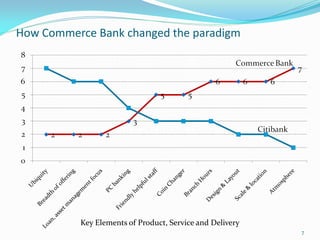
How Commerce Bank changed the paradigm


          Key Elements of Product, Service and Delivery
                                                          7
What did Commerce Bank do?
 Moving to a convenience retailer
 Assessing what’s really important to customers
     Convenience (62%)
      Convenience (29%), Checking account (16%),
       Personal/Friendly/Nice, Treated well (9%), Good Service (8%)
    Good Rates/Returns (3%)
 The Philosophy of Commerce Bank is ‘dare to be different’
    Bankers Hours – Open 7 days
    Need a pen
    Paint your vans
    Dogs rule!
    Coins!

Results are impressive:
    •Consistently winning consumer awards
    •Annual growth of 19%
                                                                      8
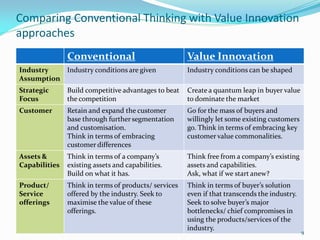
Comparing Conventional Thinking with Value Innovation
approaches
               Conventional                           Value Innovation
Industry   Industry conditions are given              Industry conditions can be shaped
Assumption
Strategic      Build competitive advantages to beat   Create a quantum leap in buyer value
Focus          the competition                        to dominate the market
Customer       Retain and expand the customer         Go for the mass of buyers and
               base through further segmentation      willingly let some existing customers
               and customisation.                     go. Think in terms of embracing key
               Think in terms of embracing            customer value commonalities.
               customer differences
Assets &       Think in terms of a company’s          Think free from a company’s existing
Capabilities   existing assets and capabilities.      assets and capabilities.
               Build on what it has.                  Ask, what if we start anew?
Product/       Think in terms of products/ services   Think in terms of buyer’s solution
Service        offered by the industry. Seek to       even if that transcends the industry.
offerings      maximise the value of these            Seek to solve buyer’s major
               offerings.                             bottlenecks/ chief compromises in
                                                      using the products/services of the
                                                      industry.
                                                                                              9
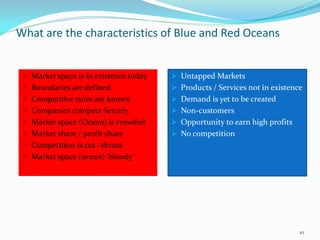
What are the characteristics of Blue and Red Oceans


    Market space is in existence today    Untapped Markets
    Boundaries are defined                Products / Services not in existence
    Competitive rules are known           Demand is yet to be created
    Companies compete fiercely            Non-customers
    Market space (Ocean) is crowded       Opportunity to earn high profits
    Market share / profit share           No competition
    Competition is cut –throat
    Market space (ocean) ‘bloody’


                                                                               10
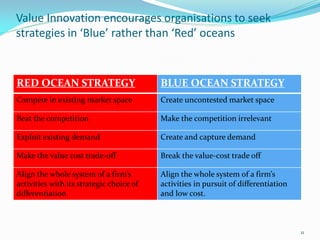
Value Innovation encourages organisations to seek
strategies in ‘Blue’ rather than ‘Red’ oceans


RED OCEAN STRATEGY                        BLUE OCEAN STRATEGY
Compete in existing market space          Create uncontested market space

Beat the competition                      Make the competition irrelevant

Exploit existing demand                   Create and capture demand

Make the value cost trade-off             Break the value-cost trade off

Align the whole system of a firm’s        Align the whole system of a firm’s
activities with its strategic choice of   activities in pursuit of differentiation
differentiation                           and low cost.


                                                                                     11
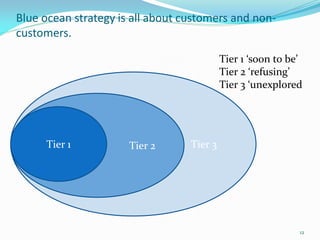
Blue ocean strategy is all about customers and non-
customers.

                                           Tier 1 ‘soon to be’
                                           Tier 2 ‘refusing’
                                           Tier 3 ‘unexplored


     Tier 1           Tier 2      Tier 3


                                                             12
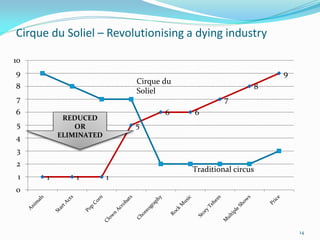
Cirque du Soliel – Revolutionising a dying industry

10
9                                                            9
                        Cirque du
8                                                        8
                        Soliel
7                                            7
6                              6    6
5                       5
4
3
2
                                    Traditional circus
 1    1     1     1
0


                                                                 13
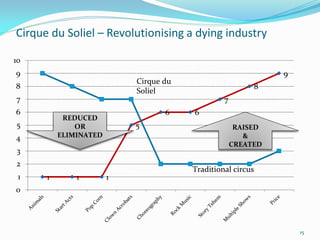
Cirque du Soliel – Revolutionising a dying industry

10
9                                                               9
                           Cirque du
8                                                           8
                           Soliel
7                                               7
6                                 6    6
           REDUCED
5             OR           5
4         ELIMINATED

3
2
                                       Traditional circus
 1    1       1        1
0


                                                                    14
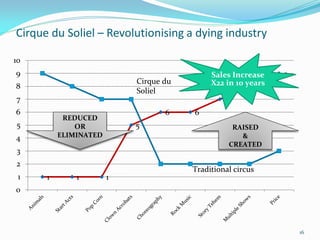
Cirque du Soliel – Revolutionising a dying industry

10
9                                                               9
                           Cirque du
8                                                           8
                           Soliel
7                                               7
6                                 6    6
           REDUCED
5             OR           5                         RAISED
4         ELIMINATED                                   &
                                                    CREATED
3
2
                                       Traditional circus
 1    1       1        1
0


                                                                    15
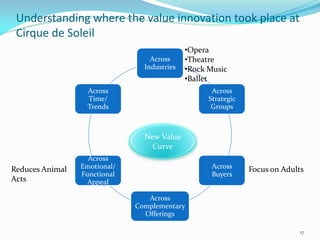
Cirque du Soliel – Revolutionising a dying industry

10
9                                           Sales Increase    9
                           Cirque du        X22 in 10 years
8                                                       8
                           Soliel
7                                               7
6                                 6    6
           REDUCED
5             OR           5                         RAISED
4         ELIMINATED                                   &
                                                    CREATED
3
2
                                       Traditional circus
 1    1       1        1
0


                                                                  16
Understanding where the value innovation took place at
 Cirque de Soleil
                                             •Opera
                                  Across     •Theatre
                                Industries   •Rock Music
                                             •Ballet
                   Across                           Across
                   Time/                           Strategic
                   Trends                           Groups


                                New Value
                                  Curve
                   Across
Reduces Animal   Emotional/                         Across     Focus on Adults
                 Functional                         Buyers
Acts               Appeal

                                 Across
                              Complementary
                                Offerings

                                                                             17
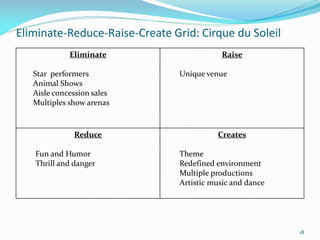
Eliminate-Reduce-Raise-Create Grid: Cirque du Soleil
             Eliminate                     Raise

   Star performers              Unique venue
   Animal Shows
   Aisle concession sales
   Multiples show arenas


              Reduce                      Creates

   Fun and Humor                Theme
   Thrill and danger            Redefined environment
                                Multiple productions
                                Artistic music and dance


                                                           18
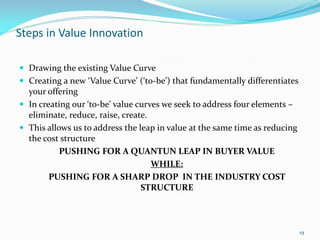
Steps in Value Innovation

 Drawing the existing Value Curve
 Creating a new ‘Value Curve’ (‘to-be’) that fundamentally differentiates
  your offering
 In creating our ‘to-be’ value curves we seek to address four elements –
  eliminate, reduce, raise, create.
 This allows us to address the leap in value at the same time as reducing
  the cost structure
         PUSHING FOR A QUANTUN LEAP IN BUYER VALUE
                          WHILE:
       PUSHING FOR A SHARP DROP IN THE INDUSTRY COST
                        STRUCTURE


                                                                             19
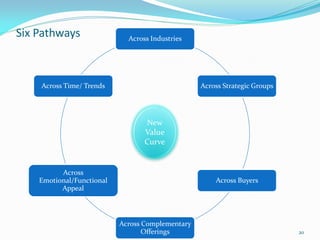
Six Pathways                 Across Industries


    Across Time/ Trends                           Across Strategic Groups


                                  New
                                  Value
                                  Curve


          Across
    Emotional/Functional                              Across Buyers
          Appeal


                           Across Complementary
                                  Offerings                                 20
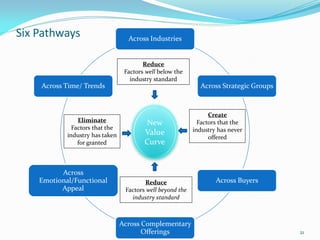
Six Pathways                       Across Industries


                                         Reduce
                                  Factors well below the
                                    industry standard
    Across Time/ Trends                                       Across Strategic Groups


                                                                  Create
                Eliminate                New                  Factors that the
              Factors that the                              industry has never
            industry has taken           Value
                                                                  offered
                for granted              Curve


          Across
    Emotional/Functional                 Reduce                     Across Buyers
          Appeal                  Factors well beyond the
                                    industry standard


                                 Across Complementary
                                        Offerings                                       21
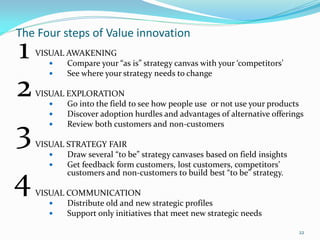
The Four steps of Value innovation
1   VISUAL AWAKENING
          Compare your “as is” strategy canvas with your ‘competitors’
          See where your strategy needs to change

2   VISUAL EXPLORATION
          Go into the field to see how people use or not use your products
          Discover adoption hurdles and advantages of alternative offerings

3         Review both customers and non-customers

    VISUAL STRATEGY FAIR
          Draw several “to be” strategy canvases based on field insights
          Get feedback form customers, lost customers, competitors’

4          customers and non-customers to build best “to be” strategy.

    VISUAL COMMUNICATION
          Distribute old and new strategic profiles
          Support only initiatives that meet new strategic needs

                                                                            22
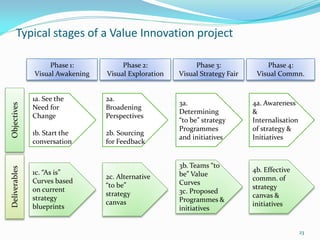
Typical stages of a Value Innovation project

                    Phase 1:           Phase 2:             Phase 3:              Phase 4:
               Visual Awakening   Visual Exploration   Visual Strategy Fair    Visual Commn.


               1a. See the        2a.
                                                       3a.                    4a. Awareness
Objectives


               Need for           Broadening
                                                       Determining            &
               Change             Perspectives
                                                       “to be” strategy       Internalisation
                                                       Programmes             of strategy &
               1b. Start the      2b. Sourcing
                                                       and initiatives        Initiatives
               conversation       for Feedback


                                                       3b. Teams “to
Deliverables


               1c. “As is”                                                    4b. Effective
                                  2c. Alternative      be” Value
               Curves based                                                   commn. of
                                  “to be”              Curves
               on current                                                     strategy
                                  strategy             3c. Proposed
               strategy                                                       canvas &
                                  canvas               Programmes &
               blueprints                                                     initiatives
                                                       initiatives


                                                                                                23
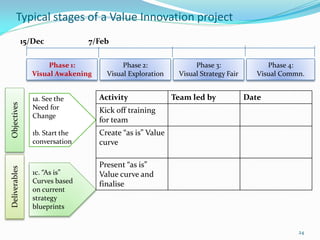
Typical stages of a Value Innovation project
               15/Dec             7/Feb

                       Phase 1:             Phase 2:              Phase 3:                Phase 4:
                  Visual Awakening     Visual Exploration    Visual Strategy Fair      Visual Commn.


                  1a. See the        Activity               Team led by             Date
Objectives


                  Need for           Kick off training
                  Change
                                     for team
                  1b. Start the      Create “as is” Value
                  conversation       curve

                                     Present “as is”
Deliverables


                  1c. “As is”        Value curve and
                  Curves based       finalise
                  on current
                  strategy
                  blueprints


                                                                                                  24
Typical stages of a Value Innovation project
               23/Dec              7/Feb                 31/Apr

                       Phase 1:            Phase 2:                Phase 3:             Phase 4:
                  Visual Awakening    Visual Exploration      Visual Strategy Fair   Visual Commn.


                 2a.                 Activity                          Team led Date
Objectives


                 Broadening                                            by
                 Perspectives        Study Customers, non-
                                     Customers, competitors
                 2b. Sourcing        customers, placement clients,
                 for Feedback        Tech partners, BPs,
                                     Each team prepares six value
                                     curves each
Deliverables


                 2c. Alternative
                 “to be”
                 strategy
                 canvas


                                                                                                25
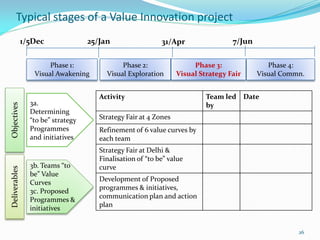
Typical stages of a Value Innovation project
               1/5Dec               25/Jan                  31/Apr                 7/Jun

                       Phase 1:               Phase 2:                 Phase 3:               Phase 4:
                  Visual Awakening       Visual Exploration       Visual Strategy Fair     Visual Commn.


                                       Activity                            Team led Date
                 3a.
Objectives


                                                                           by
                 Determining
                 “to be” strategy      Strategy Fair at 4 Zones
                 Programmes            Refinement of 6 value curves by
                 and initiatives       each team
                                       Strategy Fair at Delhi &
                                       Finalisation of “to be” value
                 3b. Teams “to         curve
Deliverables


                 be” Value
                 Curves                Development of Proposed
                 3c. Proposed          programmes & initiatives,
                 Programmes &          communication plan and action
                 initiatives           plan


                                                                                                      26
Typical stages of a Value Innovation project
               1/Dec               7/Jan                28-Feb                 9-Apr

                       Phase 1:             Phase 2:              Phase 3:                Phase 4:
                  Visual Awakening     Visual Exploration    Visual Strategy Fair      Visual Commn.


                 4a. Awareness       Activity                         Resp:         Date
Objectives


                 &
                 Internalisation     Implementation of action plan
                 of strategy &       & communication
                 Initiatives         Review implementation
Deliverables


                 4b. Effective
                 commn. of
                 strategy
                 canvas &
                 initiatives


                                                                                                  27

Blue ocean strategy presentation

  • 1.
  • 2.
    A wake upCall!!!!  Between 1975 and 1995, 60 percent of Fortune 500 companies were replaced on the list.  Markets are opening  Competitors are agile  Competitors can pick and choose where to compete  In 10 years time will your market place still be populated by the same dominant industry players???? 2
  • 3.
    The Lessons weall need to learn  Industries and companies continuously rise and fall.  Therefore, there are no permanently great industries or companies  Instead, there are strategic moves that propel companies and continuously create new industries.  Example: Nokia  137 year old company, leading mobile manufacturer with USD 31 Billion in sales in 130 countries  Has practiced renewal for a lifetime, starting out making paper, then boots, rain coats, hunting rifles, consumer electronics and now mobile phones. 3
  • 4.
    Staying at thetop is not about having a great new technology to deploy  In strategy formation, innovation is often equated with technology requiring sizable development and investment.  In contrast, Value Inn0vation aims to substantially raise the value proposition towards customers (Hence “Innovation in Value”).  The question is: “How can we best identify and serve their overall needs and offer them unparalleled value?”  Example: IBM  Between 1991-1993, $16B in losses  In ‘93 first non-IT CEO switches co. focus from ‘technology driven’ to ‘customer solutions driven’, creating new “Global Services Group”  By 2001 the Global Services Group represents $35B of $86B in total sales. 4
  • 5.
    When should acompany consider using value innovation  Highly competitive industry  Few differentiators  Low entry barriers  Downward margin pressures  Limited opportunity for new customers  Struggling to compete  Leadership position stagnant  Forced into acquisition model to sustain growth expectations. 5
  • 6.
    The Commerce BankExperience – Blue Ocean Strategy in Financial Services The Commerce Model Growth Retailers Not Bankers FANS Not Customers Unique Deposit Driven/Retail Focus Service Not Rate Drives Growth Growth is Essential to Success and Value 6
  • 7.
    How Commerce Bankchanged the paradigm Key Elements of Product, Service and Delivery 7
  • 8.
    What did CommerceBank do?  Moving to a convenience retailer  Assessing what’s really important to customers  Convenience (62%) Convenience (29%), Checking account (16%), Personal/Friendly/Nice, Treated well (9%), Good Service (8%)  Good Rates/Returns (3%)  The Philosophy of Commerce Bank is ‘dare to be different’  Bankers Hours – Open 7 days  Need a pen  Paint your vans  Dogs rule!  Coins! Results are impressive: •Consistently winning consumer awards •Annual growth of 19% 8
  • 9.
    Comparing Conventional Thinkingwith Value Innovation approaches Conventional Value Innovation Industry Industry conditions are given Industry conditions can be shaped Assumption Strategic Build competitive advantages to beat Create a quantum leap in buyer value Focus the competition to dominate the market Customer Retain and expand the customer Go for the mass of buyers and base through further segmentation willingly let some existing customers and customisation. go. Think in terms of embracing key Think in terms of embracing customer value commonalities. customer differences Assets & Think in terms of a company’s Think free from a company’s existing Capabilities existing assets and capabilities. assets and capabilities. Build on what it has. Ask, what if we start anew? Product/ Think in terms of products/ services Think in terms of buyer’s solution Service offered by the industry. Seek to even if that transcends the industry. offerings maximise the value of these Seek to solve buyer’s major offerings. bottlenecks/ chief compromises in using the products/services of the industry. 9
  • 10.
    What are thecharacteristics of Blue and Red Oceans  Market space is in existence today  Untapped Markets  Boundaries are defined  Products / Services not in existence  Competitive rules are known  Demand is yet to be created  Companies compete fiercely  Non-customers  Market space (Ocean) is crowded  Opportunity to earn high profits  Market share / profit share  No competition  Competition is cut –throat  Market space (ocean) ‘bloody’ 10
  • 11.
    Value Innovation encouragesorganisations to seek strategies in ‘Blue’ rather than ‘Red’ oceans RED OCEAN STRATEGY BLUE OCEAN STRATEGY Compete in existing market space Create uncontested market space Beat the competition Make the competition irrelevant Exploit existing demand Create and capture demand Make the value cost trade-off Break the value-cost trade off Align the whole system of a firm’s Align the whole system of a firm’s activities with its strategic choice of activities in pursuit of differentiation differentiation and low cost. 11
  • 12.
    Blue ocean strategyis all about customers and non- customers. Tier 1 ‘soon to be’ Tier 2 ‘refusing’ Tier 3 ‘unexplored Tier 1 Tier 2 Tier 3 12
  • 13.
    Cirque du Soliel– Revolutionising a dying industry 10 9 9 Cirque du 8 8 Soliel 7 7 6 6 6 5 5 4 3 2 Traditional circus 1 1 1 1 0 13
  • 14.
    Cirque du Soliel– Revolutionising a dying industry 10 9 9 Cirque du 8 8 Soliel 7 7 6 6 6 REDUCED 5 OR 5 4 ELIMINATED 3 2 Traditional circus 1 1 1 1 0 14
  • 15.
    Cirque du Soliel– Revolutionising a dying industry 10 9 9 Cirque du 8 8 Soliel 7 7 6 6 6 REDUCED 5 OR 5 RAISED 4 ELIMINATED & CREATED 3 2 Traditional circus 1 1 1 1 0 15
  • 16.
    Cirque du Soliel– Revolutionising a dying industry 10 9 Sales Increase 9 Cirque du X22 in 10 years 8 8 Soliel 7 7 6 6 6 REDUCED 5 OR 5 RAISED 4 ELIMINATED & CREATED 3 2 Traditional circus 1 1 1 1 0 16
  • 17.
    Understanding where thevalue innovation took place at Cirque de Soleil •Opera Across •Theatre Industries •Rock Music •Ballet Across Across Time/ Strategic Trends Groups New Value Curve Across Reduces Animal Emotional/ Across Focus on Adults Functional Buyers Acts Appeal Across Complementary Offerings 17
  • 18.
    Eliminate-Reduce-Raise-Create Grid: Cirquedu Soleil Eliminate Raise Star performers Unique venue Animal Shows Aisle concession sales Multiples show arenas Reduce Creates Fun and Humor Theme Thrill and danger Redefined environment Multiple productions Artistic music and dance 18
  • 19.
    Steps in ValueInnovation  Drawing the existing Value Curve  Creating a new ‘Value Curve’ (‘to-be’) that fundamentally differentiates your offering  In creating our ‘to-be’ value curves we seek to address four elements – eliminate, reduce, raise, create.  This allows us to address the leap in value at the same time as reducing the cost structure PUSHING FOR A QUANTUN LEAP IN BUYER VALUE WHILE: PUSHING FOR A SHARP DROP IN THE INDUSTRY COST STRUCTURE 19
  • 20.
    Six Pathways Across Industries Across Time/ Trends Across Strategic Groups New Value Curve Across Emotional/Functional Across Buyers Appeal Across Complementary Offerings 20
  • 21.
    Six Pathways Across Industries Reduce Factors well below the industry standard Across Time/ Trends Across Strategic Groups Create Eliminate New Factors that the Factors that the industry has never industry has taken Value offered for granted Curve Across Emotional/Functional Reduce Across Buyers Appeal Factors well beyond the industry standard Across Complementary Offerings 21
  • 22.
    The Four stepsof Value innovation 1 VISUAL AWAKENING  Compare your “as is” strategy canvas with your ‘competitors’  See where your strategy needs to change 2 VISUAL EXPLORATION  Go into the field to see how people use or not use your products  Discover adoption hurdles and advantages of alternative offerings 3  Review both customers and non-customers VISUAL STRATEGY FAIR  Draw several “to be” strategy canvases based on field insights  Get feedback form customers, lost customers, competitors’ 4 customers and non-customers to build best “to be” strategy. VISUAL COMMUNICATION  Distribute old and new strategic profiles  Support only initiatives that meet new strategic needs 22
  • 23.
    Typical stages ofa Value Innovation project Phase 1: Phase 2: Phase 3: Phase 4: Visual Awakening Visual Exploration Visual Strategy Fair Visual Commn. 1a. See the 2a. 3a. 4a. Awareness Objectives Need for Broadening Determining & Change Perspectives “to be” strategy Internalisation Programmes of strategy & 1b. Start the 2b. Sourcing and initiatives Initiatives conversation for Feedback 3b. Teams “to Deliverables 1c. “As is” 4b. Effective 2c. Alternative be” Value Curves based commn. of “to be” Curves on current strategy strategy 3c. Proposed strategy canvas & canvas Programmes & blueprints initiatives initiatives 23
  • 24.
    Typical stages ofa Value Innovation project 15/Dec 7/Feb Phase 1: Phase 2: Phase 3: Phase 4: Visual Awakening Visual Exploration Visual Strategy Fair Visual Commn. 1a. See the Activity Team led by Date Objectives Need for Kick off training Change for team 1b. Start the Create “as is” Value conversation curve Present “as is” Deliverables 1c. “As is” Value curve and Curves based finalise on current strategy blueprints 24
  • 25.
    Typical stages ofa Value Innovation project 23/Dec 7/Feb 31/Apr Phase 1: Phase 2: Phase 3: Phase 4: Visual Awakening Visual Exploration Visual Strategy Fair Visual Commn. 2a. Activity Team led Date Objectives Broadening by Perspectives Study Customers, non- Customers, competitors 2b. Sourcing customers, placement clients, for Feedback Tech partners, BPs, Each team prepares six value curves each Deliverables 2c. Alternative “to be” strategy canvas 25
  • 26.
    Typical stages ofa Value Innovation project 1/5Dec 25/Jan 31/Apr 7/Jun Phase 1: Phase 2: Phase 3: Phase 4: Visual Awakening Visual Exploration Visual Strategy Fair Visual Commn. Activity Team led Date 3a. Objectives by Determining “to be” strategy Strategy Fair at 4 Zones Programmes Refinement of 6 value curves by and initiatives each team Strategy Fair at Delhi & Finalisation of “to be” value 3b. Teams “to curve Deliverables be” Value Curves Development of Proposed 3c. Proposed programmes & initiatives, Programmes & communication plan and action initiatives plan 26
  • 27.
    Typical stages ofa Value Innovation project 1/Dec 7/Jan 28-Feb 9-Apr Phase 1: Phase 2: Phase 3: Phase 4: Visual Awakening Visual Exploration Visual Strategy Fair Visual Commn. 4a. Awareness Activity Resp: Date Objectives & Internalisation Implementation of action plan of strategy & & communication Initiatives Review implementation Deliverables 4b. Effective commn. of strategy canvas & initiatives 27