Revision
Sesion-10:
Environmental Studies & Disaster
Management
Prof. Ajay Mohan Goel
ajay.goel@bmu.edu.in
What is Environment?
Complete ecological
units that function as natural
systems without massive
civilized human intervention,
including all:
2 22/02/2020 Add a footer
• Natural environment
• Living & non-living things
• Occurring Naturally
• On Earth
• Interaction of:
• All living species
• Climate
• Weather
• Natural resources
• That affect:
• Human Survival
• Economic Activity
•Elements
• Air
• Water
• Soil
• Minerals
Environmental Challenges
• Pollution
• Species extinction
• GlobalWarming
• Deforestation
• Forest Fires
• Floods
• Changing climate cycle
• Human Population Growth
3 22/02/2020 Add a footer
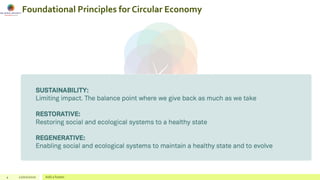
Foundational Principles for Circular Economy
4 22/02/2020 Add a footer
Foundational Principles for Circular Economy
Restorative & Regenerative by Design
5 22/02/2020 Add a footer
Foundational Principles for Circular Economy.
6 22/02/2020 Add a footer
•What if we could build an economy that uses things,
rather than uses them up?
Keep Products
and Materials
in USE
•What if we could not only protect but actively improve
the environment?
Regenerate
Natural
Systems
•What if waste and pollution were never created in the
first place?
Design out
Waste and
POLLUTION
Foundational Principles for Circular Economy.
7 22/02/2020 Add a footer
•What if we could build an economy that uses things, rather than uses them up?
We can’t keep wasting resources. Design some products and components so that they
can be reused, repaired and remanufactured. But making things last forever is not the
only solution.When it comes to products like food or packaging, we should be able to
get the materials back, so they don’t end up in landfill.
Keep Products
and Materials
in USE
•What if we could not only protect but actively improve the environment?
In nature, there is no concept of waste. Everything is food for something else – a leaf
that falls from a tree feeds the forest. Instead of simply trying to do less harm, we
should aim to do good. By returning valuable nutrients to the soil and other
ecosystems, we can enhance our natural resources.
Regenerate
Natural
Systems
•What if waste and pollution were never created in the first place?
A circular economy reveals and designs out the negative impacts of economic activity
that cause damage to human health and natural systems.This includes the release of
greenhouses gases and hazardous substances, the pollution of air, land, and water, as
well as structural waste such as traffic congestion.
Design out
Waste and
POLLUTION
Global Water Usage
8 22/02/2020 Add a footer
1.(Adapted from FAO, 2012)
1. Domestic
2. Agriculture
3. Industrial Use
Water Footprint
Sugar (1Kg) 1782 Liters
one pizza margherita (725 gram) 1259 Liters
Pork (1 Kg) 5990 Liters
Orange (1 Kg) 560 Liters
Leather (Bovine) (1 Kg) 17,000 Liters
Butter (1 kg) 5553 Liters
Wheat Bread (1 kg) 1608
Wheat (1 kg) 1827
Rice (1 Kg)) 2500
Jeans (1 pair) 10,000 Liters
CottonT-Shirt (500 Gm) 4100
9 22/02/2020 Add a footer
Effects of Ground WaterTable Depletion
10 22/02/2020 Add a footer
• Force us to pump water from deeper within the Earth.
• Large bodies of water will become shallower from groundwater depletion
• Saltwater contamination can occur
• As large aquifers are depleted, food supply and people will suffer
• limits biodiversity and dangerous sinkholes result from depleted aquifers
Ways to Reduce Water Stress
Increase agricultural efficiency
• Use seeds requiring less water
• Improve irrigation techniques
• Remove electrical subsidy
• Develop technologies for improving agriculture efficiency
• Reduce food loss & waste
Invest in grey and green infrastructure
• Build Grey Infrastructure like Pipes &Treatment plants
• Invest in Green infrastructure (like wetlands & watersheds)
Treat, reuse and recycle
• Treating & reusing creates a new water source
• Reuse or sell energy- and nutrient-rich byproducts of waste-water treatment
Stop Polluting Rivers
11 22/02/2020 Add a footer
What is an Ecosystem?
• A dynamic complex of plant, animal, and microorganism
communities and the non-living environment interacting as a
functional unit.
• Humans are an integral part of ecosystems.
• Ecosystems vary enormously in size; a temporary pond in a tree
hollow and an ocean basin can both be ecosystems.
12 22/02/2020 Add a footer
13 22/02/2020 Add a footer
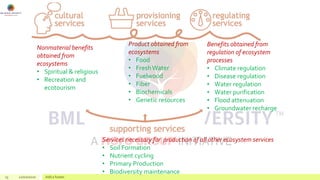
Product obtained from
ecosystems
• Food
• FreshWater
• Fuelwood
• Fiber
• Biochemicals
• Genetic resources
Services necessary for production of all other ecosystem services
• Soil Formation
• Nutrient cycling
• Primary Production
• Biodiversity maintenance
Benefits obtained from
regulation of ecosystem
processes
• Climate regulation
• Disease regulation
• Water regulation
• Water purification
• Flood attenuation
• Groundwater recharge
Nonmaterial benefits
obtained from
ecosystems
• Spiritual & religious
• Recreation and
ecotourism
HumanWell-being: what are its key constituents?
• Has multiple constituents, including
• basic material for a good life,
• freedom and choice,
• health,
• good social relations, and
• security.
• Well- being is at the opposite end of a continuum from poverty, which has been
defined as a “pronounced deprivation in well-being.”
• The constituents of well-being, as experienced and perceived by people, are
situation-dependent, reflecting local geography, culture, and ecological
circumstances.
14 22/02/2020 Add a footer
Ecosystem services from wetlands
15 22/02/2020 Add a footer
Wetlands - Ramsar Convention’s definition
16 22/02/2020 Add a footer
What are the benefits of Wetlands?
• Provide us water,
• Protect us from floods, droughts and other disasters,
• Provide food and livelihoods to millions of people,
• Support rich biodiversity
• Store more carbon than any other ecosystem.
• Contribute directly or indirectly to 75 SDG indicators
• Complex biogeochemical processes maintain functional wetland ecosystems
17 22/02/2020 Add a footer
Tragedy of the Commons
• Individuals, acting independently and rationally according to each one's self-interest,
behave contrary to the whole group's long-term best interests by depleting some
common resource
18 22/02/2020 Add a footer
The Global Goals for Sustainable Development
19 22/02/2020 Add a footer
Areas of Critical Importance for Humanity and the Planet
20 22/02/2020 Add a footer
People
• Healthy Environment
• Poverty removal
• Education
Planet
• Protect the planet from degradation
• Sustainable consumption and production
• sustainably managing its natural resources
• Preventing & reversing climate change
Prosperity
• Economic, social and technological progress occurs in harmony with nature
Peace
• No sustainable development without peace
• No peace without sustainable development
Partnerships
Largest business themes in a world economy heading for the Global Goals
21 22/02/2020 Add a footer
FiveTransformational Policies
22 22/02/2020 Add a footer
Rapid renewable energy growth
• Halving emissions every decade from 2020
Accelerated sustainable food chains
• +1% / year better productivity
New development model in the developing world
• Copying aspects of S-Korean / Chinese / Ethiopian Success
Active inequality reduction
• Ensuring 10% richest < 40% of Income
Investment in educating all, gender equality, health, family planning
• Improves wellbeing with reduced ecological footprint
23 22/02/2020 Add a footer
Wetlands and biodiversity
2 February 2020
Wetlands and biodiversity
2 February 2020
Wetland biodiversity matters
Loss of wetlands = Loss of biodiversity
End biodiversity loss, restore wetlands
For the climate
30% of land-based carbon
is stored in peatlands
87%
of the world’s wetlands
have been lost globally
in the last 300 years
One million
animal and plant
species threatened
with extinction
Key drivers of wetland loss
• Pollution
• Drainage
• Land conversion
Learn more: WorldWetlandsDay.org #WetlandBiodiversityMatters
For economies
Wetlands provide
USD 47 trillion in essential
services annually
CO2
Wetland species
threatened with extinction
• Reptiles
• Amphibians
• Water birds
• Mammals
For clean water
Swamps and marshes
remove pollutants
For jobs
One billion people depend
on wetlands
for their livelihoods
Thank you
2422/02/2020 Add a footer
Prof. Ajay Mohan Goel
ajay.goel@bmu.edu.in

Session 10 - EVS revision

  • 1.
    Revision Sesion-10: Environmental Studies &Disaster Management Prof. Ajay Mohan Goel ajay.goel@bmu.edu.in
  • 2.
    What is Environment? Completeecological units that function as natural systems without massive civilized human intervention, including all: 2 22/02/2020 Add a footer • Natural environment • Living & non-living things • Occurring Naturally • On Earth • Interaction of: • All living species • Climate • Weather • Natural resources • That affect: • Human Survival • Economic Activity •Elements • Air • Water • Soil • Minerals
  • 3.
    Environmental Challenges • Pollution •Species extinction • GlobalWarming • Deforestation • Forest Fires • Floods • Changing climate cycle • Human Population Growth 3 22/02/2020 Add a footer
  • 4.
    Foundational Principles forCircular Economy 4 22/02/2020 Add a footer
  • 5.
    Foundational Principles forCircular Economy Restorative & Regenerative by Design 5 22/02/2020 Add a footer
  • 6.
    Foundational Principles forCircular Economy. 6 22/02/2020 Add a footer •What if we could build an economy that uses things, rather than uses them up? Keep Products and Materials in USE •What if we could not only protect but actively improve the environment? Regenerate Natural Systems •What if waste and pollution were never created in the first place? Design out Waste and POLLUTION
  • 7.
    Foundational Principles forCircular Economy. 7 22/02/2020 Add a footer •What if we could build an economy that uses things, rather than uses them up? We can’t keep wasting resources. Design some products and components so that they can be reused, repaired and remanufactured. But making things last forever is not the only solution.When it comes to products like food or packaging, we should be able to get the materials back, so they don’t end up in landfill. Keep Products and Materials in USE •What if we could not only protect but actively improve the environment? In nature, there is no concept of waste. Everything is food for something else – a leaf that falls from a tree feeds the forest. Instead of simply trying to do less harm, we should aim to do good. By returning valuable nutrients to the soil and other ecosystems, we can enhance our natural resources. Regenerate Natural Systems •What if waste and pollution were never created in the first place? A circular economy reveals and designs out the negative impacts of economic activity that cause damage to human health and natural systems.This includes the release of greenhouses gases and hazardous substances, the pollution of air, land, and water, as well as structural waste such as traffic congestion. Design out Waste and POLLUTION
  • 8.
    Global Water Usage 822/02/2020 Add a footer 1.(Adapted from FAO, 2012) 1. Domestic 2. Agriculture 3. Industrial Use
  • 9.
    Water Footprint Sugar (1Kg)1782 Liters one pizza margherita (725 gram) 1259 Liters Pork (1 Kg) 5990 Liters Orange (1 Kg) 560 Liters Leather (Bovine) (1 Kg) 17,000 Liters Butter (1 kg) 5553 Liters Wheat Bread (1 kg) 1608 Wheat (1 kg) 1827 Rice (1 Kg)) 2500 Jeans (1 pair) 10,000 Liters CottonT-Shirt (500 Gm) 4100 9 22/02/2020 Add a footer
  • 10.
    Effects of GroundWaterTable Depletion 10 22/02/2020 Add a footer • Force us to pump water from deeper within the Earth. • Large bodies of water will become shallower from groundwater depletion • Saltwater contamination can occur • As large aquifers are depleted, food supply and people will suffer • limits biodiversity and dangerous sinkholes result from depleted aquifers
  • 11.
    Ways to ReduceWater Stress Increase agricultural efficiency • Use seeds requiring less water • Improve irrigation techniques • Remove electrical subsidy • Develop technologies for improving agriculture efficiency • Reduce food loss & waste Invest in grey and green infrastructure • Build Grey Infrastructure like Pipes &Treatment plants • Invest in Green infrastructure (like wetlands & watersheds) Treat, reuse and recycle • Treating & reusing creates a new water source • Reuse or sell energy- and nutrient-rich byproducts of waste-water treatment Stop Polluting Rivers 11 22/02/2020 Add a footer
  • 12.
    What is anEcosystem? • A dynamic complex of plant, animal, and microorganism communities and the non-living environment interacting as a functional unit. • Humans are an integral part of ecosystems. • Ecosystems vary enormously in size; a temporary pond in a tree hollow and an ocean basin can both be ecosystems. 12 22/02/2020 Add a footer
  • 13.
    13 22/02/2020 Adda footer Product obtained from ecosystems • Food • FreshWater • Fuelwood • Fiber • Biochemicals • Genetic resources Services necessary for production of all other ecosystem services • Soil Formation • Nutrient cycling • Primary Production • Biodiversity maintenance Benefits obtained from regulation of ecosystem processes • Climate regulation • Disease regulation • Water regulation • Water purification • Flood attenuation • Groundwater recharge Nonmaterial benefits obtained from ecosystems • Spiritual & religious • Recreation and ecotourism
  • 14.
    HumanWell-being: what areits key constituents? • Has multiple constituents, including • basic material for a good life, • freedom and choice, • health, • good social relations, and • security. • Well- being is at the opposite end of a continuum from poverty, which has been defined as a “pronounced deprivation in well-being.” • The constituents of well-being, as experienced and perceived by people, are situation-dependent, reflecting local geography, culture, and ecological circumstances. 14 22/02/2020 Add a footer
  • 15.
    Ecosystem services fromwetlands 15 22/02/2020 Add a footer
  • 16.
    Wetlands - RamsarConvention’s definition 16 22/02/2020 Add a footer
  • 17.
    What are thebenefits of Wetlands? • Provide us water, • Protect us from floods, droughts and other disasters, • Provide food and livelihoods to millions of people, • Support rich biodiversity • Store more carbon than any other ecosystem. • Contribute directly or indirectly to 75 SDG indicators • Complex biogeochemical processes maintain functional wetland ecosystems 17 22/02/2020 Add a footer
  • 18.
    Tragedy of theCommons • Individuals, acting independently and rationally according to each one's self-interest, behave contrary to the whole group's long-term best interests by depleting some common resource 18 22/02/2020 Add a footer
  • 19.
    The Global Goalsfor Sustainable Development 19 22/02/2020 Add a footer
  • 20.
    Areas of CriticalImportance for Humanity and the Planet 20 22/02/2020 Add a footer People • Healthy Environment • Poverty removal • Education Planet • Protect the planet from degradation • Sustainable consumption and production • sustainably managing its natural resources • Preventing & reversing climate change Prosperity • Economic, social and technological progress occurs in harmony with nature Peace • No sustainable development without peace • No peace without sustainable development Partnerships
  • 21.
    Largest business themesin a world economy heading for the Global Goals 21 22/02/2020 Add a footer
  • 22.
    FiveTransformational Policies 22 22/02/2020Add a footer Rapid renewable energy growth • Halving emissions every decade from 2020 Accelerated sustainable food chains • +1% / year better productivity New development model in the developing world • Copying aspects of S-Korean / Chinese / Ethiopian Success Active inequality reduction • Ensuring 10% richest < 40% of Income Investment in educating all, gender equality, health, family planning • Improves wellbeing with reduced ecological footprint
  • 23.
    23 22/02/2020 Adda footer Wetlands and biodiversity 2 February 2020 Wetlands and biodiversity 2 February 2020 Wetland biodiversity matters Loss of wetlands = Loss of biodiversity End biodiversity loss, restore wetlands For the climate 30% of land-based carbon is stored in peatlands 87% of the world’s wetlands have been lost globally in the last 300 years One million animal and plant species threatened with extinction Key drivers of wetland loss • Pollution • Drainage • Land conversion Learn more: WorldWetlandsDay.org #WetlandBiodiversityMatters For economies Wetlands provide USD 47 trillion in essential services annually CO2 Wetland species threatened with extinction • Reptiles • Amphibians • Water birds • Mammals For clean water Swamps and marshes remove pollutants For jobs One billion people depend on wetlands for their livelihoods
  • 24.
    Thank you 2422/02/2020 Adda footer Prof. Ajay Mohan Goel ajay.goel@bmu.edu.in