Sustainability & Sustainable
Development
Sesion-2:
Environmental Studies & Disaster
Management
Prof. Ajay Mohan Goel
ajay.goel@bmu.edu.in
Who is she?
2 20/02/2020 Add a footer
“We can’t just continue living as if there was no tomorrow,
because there is a tomorrow.That is all we are saying”
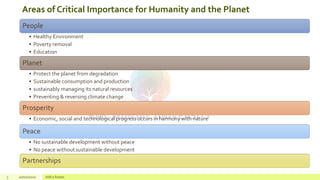
Areas of Critical Importance for Humanity and the Planet
3 20/02/2020 Add a footer
People
• Healthy Environment
• Poverty removal
• Education
Planet
• Protect the planet from degradation
• Sustainable consumption and production
• sustainably managing its natural resources
• Preventing & reversing climate change
Prosperity
• Economic, social and technological progress occurs in harmony with nature
Peace
• No sustainable development without peace
• No peace without sustainable development
Partnerships
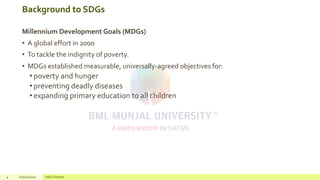
Background to SDGs
Millennium Development Goals (MDGs)
• A global effort in 2000
• To tackle the indignity of poverty.
• MDGs established measurable, universally-agreed objectives for:
• poverty and hunger
• preventing deadly diseases
• expanding primary education to all children
4 20/02/2020 Add a footer
Background to SDGs
Millennium Development Goals (MDGs) - Key achievements
• More than 1 billion people have been lifted out of extreme poverty (since 1990)
• Child mortality dropped by more than half (since 1990)
• The number of out of school children has dropped by more than half (since 1990)
• HIV/AIDS infections fell by almost 40 percent (since 2000)
5 20/02/2020 Add a footer
Origin of SDGs
• United Nations Conference on Sustainable Development in Rio de Janeiro in 2012
• An urgent call to shift the world onto a more sustainable path.
• 17 Interconnected Goals
• 169Targets
• Improve life for future generations.
• cover issues that affect us all
• build a more sustainable, safer, more prosperous planet for all humanity.
6 20/02/2020 Add a footer
The Global Goals for Sustainable Development
7 20/02/2020 Add a footer
8 20/02/2020 Add a footer
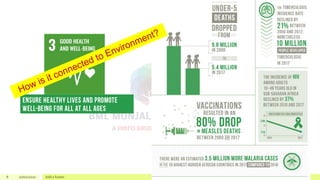
How is it connected to Environment?
9 20/02/2020 Add a footer
GOOD HEALTH AND
WELL-BEING
ADOPT CLEANER
ENERGY to reduce
indoor and outdoor
air pollution and save
millions of lives
Challenges Solutions
AVOID AND
REDUCE
POLLUTION to
prevent millions of
premature deaths every
year
Work with energy,
transport, agriculture
and industry sectors
to CREATE A
HEALTHIER
ENVIRONMENT
AIR POLLUTION is the world’s
largest environmental health
risk killing 6.5 million people
prematurely every year
ENVIRONMENTAL FACTORS
KILL MILLIONS OF PEOPLE
every year causing nearly one
quarter of all deaths worldwide
POLLUTION, CHEMICAL
EXPOSURE, CLIMATE CHANGE,
and ULTRAVIOLET RADIATION
contribute to more than 100 DISEASES
affecting primarily young children and
elder people
Target 3.9:
Substantially reduce the
number of deaths and
illnesses from
hazardous chemicals
and air, water and soil
pollution and
contamination
10 20/02/2020 Add a footer
How is it connected to Environment?
11 20/02/2020 Add a footer
Clean water and
sanitation
Challenges Solutions
STOP DUMPING
CHEMICALS AND
WASTE into the
environment, INVEST
IN SANITATION and
RAISE AWARENESS
on best hygiene
practices
PROTECT NATURAL
RESOURCES and
avoid water pollution
WATER SCARCITY
affects more than 40%
of the global population
UNSAFE WATER,
INADEQUATE
SANITATION and
INSUFFICIENT HYGIENE
kill 3.5 million people
every year
80% of WASTEWATER is
released the environment
UNTREATED. Degrade the
environment and you destroy
NATURE’S ABILITY TO
PROVIDE SAFE
DRINKING WATER
RESTORE
ECOSYSTEMS to
secure access to
safe water
Data and Statistics / Facts and Figures
• More than 80 per cent of wastewater resulting from human activities is discharged
into rivers or sea without any pollution removal
• Hydropower is the most important and widely-used renewable source of energy
and as of 2011, represented 16 per cent of total electricity production worldwide
• Floods and other water-related disasters account for 70 per cent of all deaths
related to natural disasters
• Over 1.4 billion people currently live in river basins where the use of water exceeds
minimum recharge levels.
• In 60% of European cities with more than 100 000 people, groundwater is being
used at a faster rate than it can be replenished.
• Meat production requires 8-10 times more water than cereal production Part of the
current pressure on water resources comes from increasing demands for animal
feed.
12 20/02/2020 Add a footer
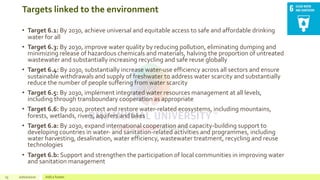
Targets linked to the environment
• Target 6.1: By 2030, achieve universal and equitable access to safe and affordable drinking
water for all
• Target 6.3: By 2030, improve water quality by reducing pollution, eliminating dumping and
minimizing release of hazardous chemicals and materials, halving the proportion of untreated
wastewater and substantially increasing recycling and safe reuse globally
• Target 6.4: By 2030, substantially increase water-use efficiency across all sectors and ensure
sustainable withdrawals and supply of freshwater to address water scarcity and substantially
reduce the number of people suffering from water scarcity
• Target 6.5: By 2030, implement integrated water resources management at all levels,
including through transboundary cooperation as appropriate
• Target 6.6: By 2020, protect and restore water-related ecosystems, including mountains,
forests, wetlands, rivers, aquifers and lakes
• Target 6.a: By 2030, expand international cooperation and capacity-building support to
developing countries in water- and sanitation-related activities and programmes, including
water harvesting, desalination, water efficiency, wastewater treatment, recycling and reuse
technologies
• Target 6.b: Support and strengthen the participation of local communities in improving water
and sanitation management
13 20/02/2020 Add a footer
14 20/02/2020 Add a footer
15 20/02/2020 Add a footer
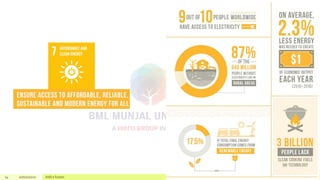
Affordable and
clean energy
Challenges Solutions
Ensure everyone has
access to CLEAN,
AFFORDABLE,
RELIABLE and
MODERN ENERGY
Invest in
RENEWABLE
ENERGY and
disseminate its use
Energy provided by FOSSIL
FUELS is the MAIN
CONTRIBUTOR OF CLIMATE
CHANGE representing 60% of all
greenhouse gas
ONE IN FIVE PEOPLE STILL
LACK ACCESS TO MODERN
ELECTRICITY and three billion
people rely on wood, charcoal or
animal waste for cooking
and eating
Every year INDOOR AIR
POLLUTION kills 4.3 million
people – most of them women
and children
Put in place ENERGY
SAVING POLICIES
16 20/02/2020 Add a footer
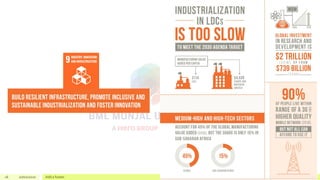
Industry, innovation
and infrastructure
Challenges Solutions
INVEST IN
INFRASTRUCTURE
fostering sustainable
growth and development
INNOVATE to
make GREEN
INFRASTRUCTURE,
increase ENERGY
EFFICIENCY and
reduce their adverse
environmental impact
Infrastructure and
industrialization often cause
ENVIRONMENTAL
DEGRADATION
Many countries
LACK BASIC and
RESILIENT
INFRASTRUCTURE
Poor infrastructure is a major
BARRIER FOR THRIVING
BUSINESSES
BUILD RESILIENT
INFRASTRUCTURE
protecting livelihoods
against environmental
and natural disasters
17 20/02/2020 Add a footer
18 20/02/2020 Add a footer
19 20/02/2020 Add a footer
20 20/02/2020 Add a footer
21 20/02/2020 Add a footer
Responsible consumption
and production
Challenges Solutions
REDUCE THE FOOD
WASTED by producers,
retailers and consumers
SWITCH TO
ENERGY EFFICIENT
LIGHTNING to save
$120 billion every year
and prevent 16 billion
tons of carbon emissions
over the next 25 years
The world’s FRESH
WATER SUPPLY such as rivers
and lakes ARE POLLUTED
at much faster rate than
nature can recycle
and purify
Every year about ONE THIRD
OF ALL FOOD PRODUCED –
equivalent to 1.3 billion tones – IS
WASTED while 1 billion people
remain undernourished and another
1 billion go to bed hungry
HOUSEHOLDS CONSUME
29% OF GLOBAL ENERGY
contributing to 21%
of CO2 emissions
REDUCE THE
RELEASE OF
CHEMICALS AND
WASTE into the air,
water and soil
22 20/02/2020 Add a footer
23 20/02/2020 Add a footer
24 20/02/2020 Add a footer
25 20/02/2020 Add a footer
26 20/02/2020 Add a footer
27 20/02/2020 Add a footer
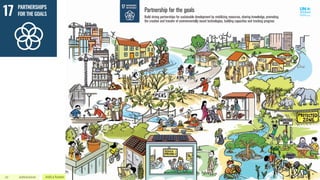
Partnership for the goals
Build strong partnerships for sustainable development by mobilizing resources, sharing knowledge, promoting
the creation and transfer of environmentally sound technologies, building capacities and tracking progress
Environment and SDGs
28 20/02/2020 Add a footer
29 20/02/2020 Add a footer
30 20/02/2020 Add a footer
Group Presentation
• Understand the topic
• Do Information Search
• Pick key Learnings
• What,Why,Where, How,When,Who, How much
• Interconnect learnings from different sources
• What are the Learning outcomes of your presentation?
• Decide on Presentation Format
• Make a coherent flow
• Design, Prepare and Rehearse the Presentation
• PresentationTime Management (15 Minutes)
• Present in Class
• Be prepared for Q&A from your classmates and from Faculty Member(s) / Guest Invitees
• Each Group member would also be individually assessed
31 20/02/2020 Add a footer
Thank you
3220/02/2020 Add a footer

Session 2- Sustainable development

  • 1.
    Sustainability & Sustainable Development Sesion-2: EnvironmentalStudies & Disaster Management Prof. Ajay Mohan Goel ajay.goel@bmu.edu.in
  • 2.
    Who is she? 220/02/2020 Add a footer “We can’t just continue living as if there was no tomorrow, because there is a tomorrow.That is all we are saying”
  • 3.
    Areas of CriticalImportance for Humanity and the Planet 3 20/02/2020 Add a footer People • Healthy Environment • Poverty removal • Education Planet • Protect the planet from degradation • Sustainable consumption and production • sustainably managing its natural resources • Preventing & reversing climate change Prosperity • Economic, social and technological progress occurs in harmony with nature Peace • No sustainable development without peace • No peace without sustainable development Partnerships
  • 4.
    Background to SDGs MillenniumDevelopment Goals (MDGs) • A global effort in 2000 • To tackle the indignity of poverty. • MDGs established measurable, universally-agreed objectives for: • poverty and hunger • preventing deadly diseases • expanding primary education to all children 4 20/02/2020 Add a footer
  • 5.
    Background to SDGs MillenniumDevelopment Goals (MDGs) - Key achievements • More than 1 billion people have been lifted out of extreme poverty (since 1990) • Child mortality dropped by more than half (since 1990) • The number of out of school children has dropped by more than half (since 1990) • HIV/AIDS infections fell by almost 40 percent (since 2000) 5 20/02/2020 Add a footer
  • 6.
    Origin of SDGs •United Nations Conference on Sustainable Development in Rio de Janeiro in 2012 • An urgent call to shift the world onto a more sustainable path. • 17 Interconnected Goals • 169Targets • Improve life for future generations. • cover issues that affect us all • build a more sustainable, safer, more prosperous planet for all humanity. 6 20/02/2020 Add a footer
  • 7.
    The Global Goalsfor Sustainable Development 7 20/02/2020 Add a footer
  • 8.
    8 20/02/2020 Adda footer How is it connected to Environment?
  • 9.
    9 20/02/2020 Adda footer GOOD HEALTH AND WELL-BEING ADOPT CLEANER ENERGY to reduce indoor and outdoor air pollution and save millions of lives Challenges Solutions AVOID AND REDUCE POLLUTION to prevent millions of premature deaths every year Work with energy, transport, agriculture and industry sectors to CREATE A HEALTHIER ENVIRONMENT AIR POLLUTION is the world’s largest environmental health risk killing 6.5 million people prematurely every year ENVIRONMENTAL FACTORS KILL MILLIONS OF PEOPLE every year causing nearly one quarter of all deaths worldwide POLLUTION, CHEMICAL EXPOSURE, CLIMATE CHANGE, and ULTRAVIOLET RADIATION contribute to more than 100 DISEASES affecting primarily young children and elder people Target 3.9: Substantially reduce the number of deaths and illnesses from hazardous chemicals and air, water and soil pollution and contamination
  • 10.
    10 20/02/2020 Adda footer How is it connected to Environment?
  • 11.
    11 20/02/2020 Adda footer Clean water and sanitation Challenges Solutions STOP DUMPING CHEMICALS AND WASTE into the environment, INVEST IN SANITATION and RAISE AWARENESS on best hygiene practices PROTECT NATURAL RESOURCES and avoid water pollution WATER SCARCITY affects more than 40% of the global population UNSAFE WATER, INADEQUATE SANITATION and INSUFFICIENT HYGIENE kill 3.5 million people every year 80% of WASTEWATER is released the environment UNTREATED. Degrade the environment and you destroy NATURE’S ABILITY TO PROVIDE SAFE DRINKING WATER RESTORE ECOSYSTEMS to secure access to safe water
  • 12.
    Data and Statistics/ Facts and Figures • More than 80 per cent of wastewater resulting from human activities is discharged into rivers or sea without any pollution removal • Hydropower is the most important and widely-used renewable source of energy and as of 2011, represented 16 per cent of total electricity production worldwide • Floods and other water-related disasters account for 70 per cent of all deaths related to natural disasters • Over 1.4 billion people currently live in river basins where the use of water exceeds minimum recharge levels. • In 60% of European cities with more than 100 000 people, groundwater is being used at a faster rate than it can be replenished. • Meat production requires 8-10 times more water than cereal production Part of the current pressure on water resources comes from increasing demands for animal feed. 12 20/02/2020 Add a footer
  • 13.
    Targets linked tothe environment • Target 6.1: By 2030, achieve universal and equitable access to safe and affordable drinking water for all • Target 6.3: By 2030, improve water quality by reducing pollution, eliminating dumping and minimizing release of hazardous chemicals and materials, halving the proportion of untreated wastewater and substantially increasing recycling and safe reuse globally • Target 6.4: By 2030, substantially increase water-use efficiency across all sectors and ensure sustainable withdrawals and supply of freshwater to address water scarcity and substantially reduce the number of people suffering from water scarcity • Target 6.5: By 2030, implement integrated water resources management at all levels, including through transboundary cooperation as appropriate • Target 6.6: By 2020, protect and restore water-related ecosystems, including mountains, forests, wetlands, rivers, aquifers and lakes • Target 6.a: By 2030, expand international cooperation and capacity-building support to developing countries in water- and sanitation-related activities and programmes, including water harvesting, desalination, water efficiency, wastewater treatment, recycling and reuse technologies • Target 6.b: Support and strengthen the participation of local communities in improving water and sanitation management 13 20/02/2020 Add a footer
  • 14.
  • 15.
    15 20/02/2020 Adda footer Affordable and clean energy Challenges Solutions Ensure everyone has access to CLEAN, AFFORDABLE, RELIABLE and MODERN ENERGY Invest in RENEWABLE ENERGY and disseminate its use Energy provided by FOSSIL FUELS is the MAIN CONTRIBUTOR OF CLIMATE CHANGE representing 60% of all greenhouse gas ONE IN FIVE PEOPLE STILL LACK ACCESS TO MODERN ELECTRICITY and three billion people rely on wood, charcoal or animal waste for cooking and eating Every year INDOOR AIR POLLUTION kills 4.3 million people – most of them women and children Put in place ENERGY SAVING POLICIES
  • 16.
  • 17.
    Industry, innovation and infrastructure ChallengesSolutions INVEST IN INFRASTRUCTURE fostering sustainable growth and development INNOVATE to make GREEN INFRASTRUCTURE, increase ENERGY EFFICIENCY and reduce their adverse environmental impact Infrastructure and industrialization often cause ENVIRONMENTAL DEGRADATION Many countries LACK BASIC and RESILIENT INFRASTRUCTURE Poor infrastructure is a major BARRIER FOR THRIVING BUSINESSES BUILD RESILIENT INFRASTRUCTURE protecting livelihoods against environmental and natural disasters 17 20/02/2020 Add a footer
  • 18.
  • 19.
  • 20.
  • 21.
    21 20/02/2020 Adda footer Responsible consumption and production Challenges Solutions REDUCE THE FOOD WASTED by producers, retailers and consumers SWITCH TO ENERGY EFFICIENT LIGHTNING to save $120 billion every year and prevent 16 billion tons of carbon emissions over the next 25 years The world’s FRESH WATER SUPPLY such as rivers and lakes ARE POLLUTED at much faster rate than nature can recycle and purify Every year about ONE THIRD OF ALL FOOD PRODUCED – equivalent to 1.3 billion tones – IS WASTED while 1 billion people remain undernourished and another 1 billion go to bed hungry HOUSEHOLDS CONSUME 29% OF GLOBAL ENERGY contributing to 21% of CO2 emissions REDUCE THE RELEASE OF CHEMICALS AND WASTE into the air, water and soil
  • 22.
  • 23.
  • 24.
  • 25.
  • 26.
  • 27.
    27 20/02/2020 Adda footer Partnership for the goals Build strong partnerships for sustainable development by mobilizing resources, sharing knowledge, promoting the creation and transfer of environmentally sound technologies, building capacities and tracking progress
  • 28.
    Environment and SDGs 2820/02/2020 Add a footer
  • 29.
  • 30.
  • 31.
    Group Presentation • Understandthe topic • Do Information Search • Pick key Learnings • What,Why,Where, How,When,Who, How much • Interconnect learnings from different sources • What are the Learning outcomes of your presentation? • Decide on Presentation Format • Make a coherent flow • Design, Prepare and Rehearse the Presentation • PresentationTime Management (15 Minutes) • Present in Class • Be prepared for Q&A from your classmates and from Faculty Member(s) / Guest Invitees • Each Group member would also be individually assessed 31 20/02/2020 Add a footer
  • 32.