Coach Workshop Supporting MLDP Colleagues
The key aims of the MLDP Develop highly effective middle leaders, in order to improve the quality of teaching and learning. Raise standards and improve pupil achievement.   Reduce variation in pupil outcomes and help close the gap in achievement.   Develop a system in which leaders of today develop leaders of the future.   Develop a learning culture in which middle leaders, and those aspiring to be middle leaders, learn with and from others – in school, across schools and beyond clusters of schools, resulting in increased leadership capacity
What are my expectations from the MLDP programme? As a coach?   Write down up to 3 expectations on post it notes and place on the outcomes sheet on the wall Your expectations will be shared with participants in the joint plenary at the end of the session.
Coaching Workshop - Objectives Make colleagues aware of the role of the Learning Coach in the MLDP strategy. Raise awareness of the skills used by coaches to support development. Make colleagues aware of the MLDP strategy and of the expectations of the partners. Introduction /Activity MLDP Structure The Role of the Coach & Coach responsibilities Coaching skills – Practical Reflection & Feedback
Knowing the participant INDVIDUAL THINKING TIME - 2 mins (can make notes) Consider your participating colleague(s) How well do you know them? What qualities have they got that will enable them to successfully complete a leadership challenge? What might be barriers for them? How can you help them to succeed?   Tell a partner (not from same school) 4 mins each Listeners ask open questions to help the coach formulate approaches to supporting their participant  
Coaching: four essential characteristics A desire to make a difference to young people ’ s learning A commitment to professional learning A belief in the abilities of colleagues A commitment to developing emotional intelligence
What is a coach? Your thoughts? What isn't a coach?
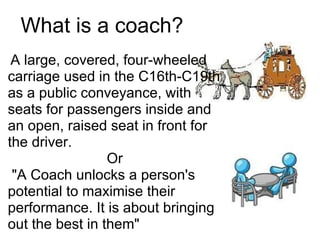
What is a coach?   A large, covered, four-wheeled carriage used in the C16th-C19th as a public conveyance, with seats for passengers inside and an open, raised seat in front for the driver.  Or   "A Coach unlocks a person's potential to maximise their performance. It is about bringing out the best in them"
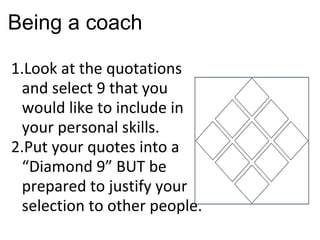
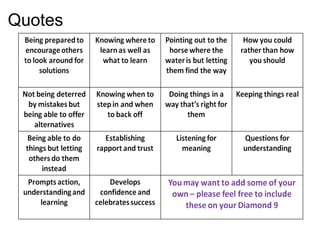
Being a coach Look at the quotations and select 9 that you would like to include in your personal skills. Put your quotes into a  “Diamond 9” BUT be prepared to justify your selection to other people.
Quotes
Reflect and Review Share your  “Diamond 9” with a partner(s) What things are common in your view of the role?  What differences exist? Were any additional statements added to the quotes bank?   After consideration would YOU change anything in your selection?
The skills of client-centred coaching include: Building rapport Contracting Active listening Use of open questions Summarising Demonstrating empathy Using appropriate challenge Setting goals
Coaching is  not  about: Giving answers or advice   Making judgements   Offering counselling   Creating dependency   Imposing agenda/initiatives   Confirming long-held prejudices
Supporting Stage 1 Register online   Coach/participant meeting   Agree contractual arrangements inc schedule of meetings    Reflect on introductory session   Support 360 diagnostic (completed by ML & a minimum of 3 colleagues)   Support/enable the participant to engage with school data   Consider and discuss 'Closing the Gap' leadership challenge   Encourage reading of key programme documents
Supporting Stage 2 Meet to reflect on learning of leadership after engagement with each module 1-6 Leading & managing the organisation Leading in a diverse system (context) Leading Teaching and Learning Leading people and effective teams Leading change and continuous improvement Developing your own leadership potential     What has been recorded in the learning log?   Regular review of progress with in-school leadership challenge
Supporting Stage 3 Leading changes to improve teaching and learning   Action Plan   Data/evidence collection   Ongoing consideration of the impact of MLDP
Supporting Stage 4 Gathering evidence on the impact of the leadership challenge What have been the successes of the 'closing the gap' activity? Better if? Supporting presentation of evidence to colleagues/SLT/Coaches/HTs/cluster cohort Celebration Where next in leadership development?
Participant ’s Evidence Learning Log Portfolio of evidence possibly including: Action Plan(amended as appropriate) Quantitative and qualitative student data   Account of learning journey and Leadership Challenge Peer reviews Outcomes of Performance Management Reviews Leadership Diagnostic Reviews (start and end) SLMT Leadership Challenge Presentation
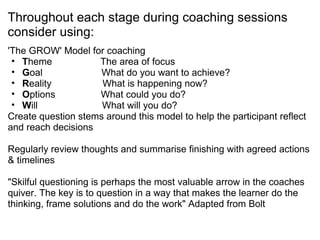
Throughout each stage during coaching sessions consider using: 'The GROW' Model for coaching T heme                  The area of focus G oal                      What do you want to achieve? R eality                   What is happening now? O ptions                 What could you do?          W ill                        What will you do? Create question stems around this model to help the participant reflect and reach decisions Regularly review thoughts and summarise finishing with agreed actions & timelines "Skilful questioning is perhaps the most valuable arrow in the coaches quiver. The key is to question in a way that makes the learner do the thinking, frame solutions and do the work" Adapted from Bolt
Supporting you the coach Our checking mechanism: We will make contact with LC (update/ how can we support you?/ anything else?) at points during this 8 month process. Review the roles of the LC after each session with the participants. Check and facilitate any required training/drop in sessions for the LC, eg use of 360, coaching….. Provide further practical coaching training if required
Our intentions as an MLDP coach I will.... Write down 3 things you are prepared to commit to as a coach for your colleague Share with a partner Agree 3 most important between you
Thank you for your support You will benefit! As well as the participant As well as the school And now back to join our colleagues...

Mldp coaching workshop

  • 1.
  • 2.
    The key aimsof the MLDP Develop highly effective middle leaders, in order to improve the quality of teaching and learning. Raise standards and improve pupil achievement. Reduce variation in pupil outcomes and help close the gap in achievement. Develop a system in which leaders of today develop leaders of the future. Develop a learning culture in which middle leaders, and those aspiring to be middle leaders, learn with and from others – in school, across schools and beyond clusters of schools, resulting in increased leadership capacity
  • 3.
    What are myexpectations from the MLDP programme? As a coach?   Write down up to 3 expectations on post it notes and place on the outcomes sheet on the wall Your expectations will be shared with participants in the joint plenary at the end of the session.
  • 4.
    Coaching Workshop -Objectives Make colleagues aware of the role of the Learning Coach in the MLDP strategy. Raise awareness of the skills used by coaches to support development. Make colleagues aware of the MLDP strategy and of the expectations of the partners. Introduction /Activity MLDP Structure The Role of the Coach & Coach responsibilities Coaching skills – Practical Reflection & Feedback
  • 5.
    Knowing the participantINDVIDUAL THINKING TIME - 2 mins (can make notes) Consider your participating colleague(s) How well do you know them? What qualities have they got that will enable them to successfully complete a leadership challenge? What might be barriers for them? How can you help them to succeed?   Tell a partner (not from same school) 4 mins each Listeners ask open questions to help the coach formulate approaches to supporting their participant  
  • 6.
    Coaching: four essentialcharacteristics A desire to make a difference to young people ’ s learning A commitment to professional learning A belief in the abilities of colleagues A commitment to developing emotional intelligence
  • 7.
    What is acoach? Your thoughts? What isn't a coach?
  • 8.
    What is acoach?   A large, covered, four-wheeled carriage used in the C16th-C19th as a public conveyance, with seats for passengers inside and an open, raised seat in front for the driver. Or   "A Coach unlocks a person's potential to maximise their performance. It is about bringing out the best in them"
  • 9.
    Being a coachLook at the quotations and select 9 that you would like to include in your personal skills. Put your quotes into a “Diamond 9” BUT be prepared to justify your selection to other people.
  • 10.
  • 11.
    Reflect and ReviewShare your “Diamond 9” with a partner(s) What things are common in your view of the role? What differences exist? Were any additional statements added to the quotes bank?  After consideration would YOU change anything in your selection?
  • 12.
    The skills ofclient-centred coaching include: Building rapport Contracting Active listening Use of open questions Summarising Demonstrating empathy Using appropriate challenge Setting goals
  • 13.
    Coaching is not about: Giving answers or advice   Making judgements   Offering counselling   Creating dependency   Imposing agenda/initiatives   Confirming long-held prejudices
  • 14.
    Supporting Stage 1Register online   Coach/participant meeting   Agree contractual arrangements inc schedule of meetings   Reflect on introductory session   Support 360 diagnostic (completed by ML & a minimum of 3 colleagues)   Support/enable the participant to engage with school data   Consider and discuss 'Closing the Gap' leadership challenge   Encourage reading of key programme documents
  • 15.
    Supporting Stage 2Meet to reflect on learning of leadership after engagement with each module 1-6 Leading & managing the organisation Leading in a diverse system (context) Leading Teaching and Learning Leading people and effective teams Leading change and continuous improvement Developing your own leadership potential   What has been recorded in the learning log?   Regular review of progress with in-school leadership challenge
  • 16.
    Supporting Stage 3Leading changes to improve teaching and learning   Action Plan   Data/evidence collection   Ongoing consideration of the impact of MLDP
  • 17.
    Supporting Stage 4Gathering evidence on the impact of the leadership challenge What have been the successes of the 'closing the gap' activity? Better if? Supporting presentation of evidence to colleagues/SLT/Coaches/HTs/cluster cohort Celebration Where next in leadership development?
  • 18.
    Participant ’s EvidenceLearning Log Portfolio of evidence possibly including: Action Plan(amended as appropriate) Quantitative and qualitative student data   Account of learning journey and Leadership Challenge Peer reviews Outcomes of Performance Management Reviews Leadership Diagnostic Reviews (start and end) SLMT Leadership Challenge Presentation
  • 19.
    Throughout each stageduring coaching sessions consider using: 'The GROW' Model for coaching T heme                  The area of focus G oal                      What do you want to achieve? R eality                   What is happening now? O ptions                 What could you do?         W ill                        What will you do? Create question stems around this model to help the participant reflect and reach decisions Regularly review thoughts and summarise finishing with agreed actions & timelines "Skilful questioning is perhaps the most valuable arrow in the coaches quiver. The key is to question in a way that makes the learner do the thinking, frame solutions and do the work" Adapted from Bolt
  • 20.
    Supporting you thecoach Our checking mechanism: We will make contact with LC (update/ how can we support you?/ anything else?) at points during this 8 month process. Review the roles of the LC after each session with the participants. Check and facilitate any required training/drop in sessions for the LC, eg use of 360, coaching….. Provide further practical coaching training if required
  • 21.
    Our intentions asan MLDP coach I will.... Write down 3 things you are prepared to commit to as a coach for your colleague Share with a partner Agree 3 most important between you
  • 22.
    Thank you foryour support You will benefit! As well as the participant As well as the school And now back to join our colleagues...

Editor's Notes

  • #3 Start by sharing the NC aims for MLDP This is the basis for consideration of your role as a coach in MLDP 1 min
  • #4 You've heard the outline of the programme in the joint session     Consider - what's in it for you? the school? the participant When you've written them stick them on the expectations sheet on the wall We'll come back to them later 3 mins
  • #5 OK thse are the objectives for this particular coaching workshop Have any of you had any formal training in leadership coaching? It requires practice as well as theory to develop skills and reflection and feedback on your practice. Tonight we don't have time to engage in coaching practice. There are several organisations that run coaching courses and if this group would like a future  practical session, Jamie and |i could run an additional session. 2 mins
  • #6 Stress confidentiality aspect Practising coaching Enabling reflection Agreeing actions Start thinking like coaches When you were the person sharing your knowledge of the participant, what Qs did your partner ask that helped you to formulate ways in which you can help them to succeed? Why was that a good question? 10 mins
  • #8 Ask the group 3 mins
  • #9 Consider this definition of coaching
  • #10 Being concious of the definition of coaching look at the nine quotes & put them in to a diamond nine order For those of you not familiar with a diamond nine - the most importnat goes at the top, least important at the bottom You might wish to add your own additional coaching skill that you feel should be included Blue tac on to A4 paper
  • #12 2 mins to shape diamond Get up and move to a different table & partner, someone you haven't talked with yet & share diamond 3 mins to discuss choices Total 6 mins
  • #13 What do we mean by each - ask individuals   1. Trust & confidence 2. Agreeing intentions - what will be done, when 3.  etc 3 mins
  • #14 Anyone have any issues with this? Or wish to add any other definitely nots? 2 mins
  • #15 Diagnostic - develop understanding of stengths & areas for development - will shape your meetings early on
  • #18 5 mins to go through each stage & take questions
  • #22 Collate the intentions to share with participants on a flipchart At this stage do you have any questions about the programme? Or requests for further support 6 mins
  • #23 Total time 45 mins