BK virus nephropathyBK virus nephropathy
• DNA virus that belongs to the polyomaviridae family:
 Polyomavirus BK
 Polyomavirus JC
 SV40
 New: Polyomavirus KI, Polyomavirus WU, Polyomavirus MC
BKV infection: the virusBKV infection: the virus
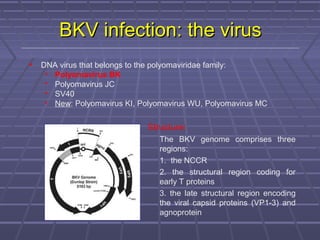
Structure:
The BKV genome comprises three
regions:
1. the NCCR
2. the structural region coding for
early T proteins
3. the late structural region encoding
the viral capsid proteins (VP1-3) and
agnoprotein
VirologyVirology
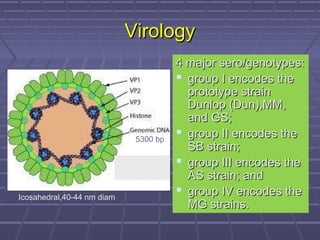
4 major sero/genotypes:4 major sero/genotypes:
 group I encodes thegroup I encodes the
prototype strainprototype strain
Dunlop (Dun),MM,Dunlop (Dun),MM,
and GS;and GS;
 group II encodes thegroup II encodes the
SB strain;SB strain;
 group III encodes thegroup III encodes the
AS strain; andAS strain; and
 group IV encodes thegroup IV encodes the
MG strains.MG strains.
5300 bp
Icosahedral,40-44 nm diam
History of BKVNHistory of BKVN
 First reported in a renal transplant patient, BK, inFirst reported in a renal transplant patient, BK, in
1971.1971.
 No reported cases of this disease for the next 24No reported cases of this disease for the next 24
years, until Purighalla and co-workers observedyears, until Purighalla and co-workers observed
their first case in early 1995.their first case in early 1995.
 Subsequently there has been a surge in reportedSubsequently there has been a surge in reported
cases worldwide.cases worldwide.
Epidemiology of BKV infectionEpidemiology of BKV infection
 Approx. 80% of the general population has aApprox. 80% of the general population has a
detectable antibody to BKV, which appears earlydetectable antibody to BKV, which appears early
in life and remains elevated throughout life.in life and remains elevated throughout life.
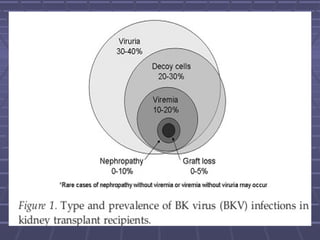
 The prevalence of BK viruria, viremia, andThe prevalence of BK viruria, viremia, and
nephritis after renal Tx has been estimated at 30,nephritis after renal Tx has been estimated at 30,
13, and 8%, respectively.13, and 8%, respectively.
N Engl J Med 2002; 347 : 488–496.
J Gen Virol 2003; 84: 1499–1504
Epidemiology of BKV infectionEpidemiology of BKV infection
 BKVN is also seen in other SOTx but at a much lowerBKVN is also seen in other SOTx but at a much lower
rate. It also has been observed in patients with HIVrate. It also has been observed in patients with HIV
infection, other immunodeficiency states and rarelyinfection, other immunodeficiency states and rarely
also in SLE.also in SLE.
 Primary Infection occurs in early life when it is eitherPrimary Infection occurs in early life when it is either
asymptomatic or with mild URTI.asymptomatic or with mild URTI. Thereafter BKVThereafter BKV
largely persists in the kidneys and urinary tract in alargely persists in the kidneys and urinary tract in a
latent form.latent form.
TransmissionTransmission
 Transmission through the feco-oral andTransmission through the feco-oral and
respiratory routes has been suggestedrespiratory routes has been suggested
 Other routes include blood transfusion,Other routes include blood transfusion,
transplacentally, through semen, &organtransplacentally, through semen, &organ
transplantationtransplantation
BKV nephropathy after kidney Tx:BKV nephropathy after kidney Tx: risk factorsrisk factors
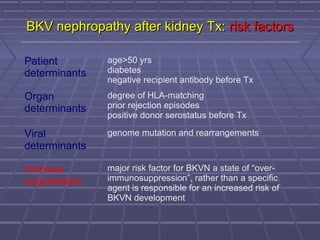
Patient
determinants
age>50 yrs
diabetes
negative recipient antibody before Tx
Organ
determinants
degree of HLA-matching
prior rejection episodes
positive donor serostatus before Tx
Viral
determinants
genome mutation and rearrangements
Immune
suppression
major risk factor for BKVN a state of “over-
immunosuppression”, rather than a specific
agent is responsible for an increased risk of
BKVN development
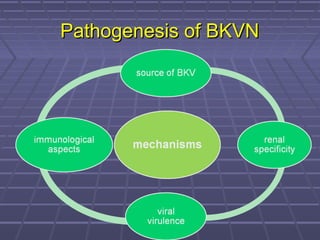
Pathogenesis of BKVNPathogenesis of BKVN
Source of infectionSource of infection
Two proposed hypotheses:Two proposed hypotheses:
1.1.Transmission occurs through the donor kidney.Transmission occurs through the donor kidney.
2.2.Reactivation in the recipient renal epithelium afterReactivation in the recipient renal epithelium after
transplantation.transplantation.
Immunology of BKVN:Immunology of BKVN:
Humoral immunityHumoral immunity
 Humoral immunity seems to be involved in theHumoral immunity seems to be involved in the
regulation of BKV activity:regulation of BKV activity:
 Early report of fatal BKV infection with renal damage in a pt ofEarly report of fatal BKV infection with renal damage in a pt of
hyper- IgM immunodeficiency.hyper- IgM immunodeficiency.
 In paediatric renal Tx recipients, the absence of BKV-specificIn paediatric renal Tx recipients, the absence of BKV-specific
anti bodies was associated with an increased rate of acute BKVanti bodies was associated with an increased rate of acute BKV
infection.infection.
 recovery from BKVAN and clearance of BKV was associatedrecovery from BKVAN and clearance of BKV was associated
with the development of BKV-specific IgG anti bodies.with the development of BKV-specific IgG anti bodies.
 Other studies did not show high titers were protective againstOther studies did not show high titers were protective against
development of BKVAN and very titer were seen in patientsdevelopment of BKVAN and very titer were seen in patients
where the BKV viruria was highest.where the BKV viruria was highest.
N. Engl. J. Med. 308 , 1192–
1196(1983)
Am. J. Transplant. 7, 2727–2735
(2007).
Am. J. Transplant. 5, 2719–2724
(2005)
J. Clin. Virol. 43, 184–189 (2008)
Humoral immunityHumoral immunity
Taken together, the current data suggest that:Taken together, the current data suggest that:
 BKV-specific antibodies provideBKV-specific antibodies provide incompleteincomplete
protectionprotection against BKVAN for patients after kidneyagainst BKVAN for patients after kidney
transplantation.transplantation.
 However, theyHowever, they may attenuate the severitymay attenuate the severity of BKVof BKV
infection and its clinical manifestations.infection and its clinical manifestations.
 In addition, evaluation of BKV-specific antibodyIn addition, evaluation of BKV-specific antibody
titers can provide information on thetiters can provide information on the severityseverity ofof
past or current BKV infections and onpast or current BKV infections and on prognosis.prognosis.
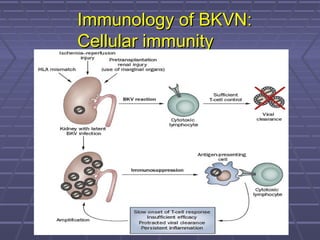
Immunology of BKVN:Immunology of BKVN:
Cellular immunityCellular immunity
Role of ImmunosuppressiveRole of Immunosuppressive
medicationsmedications
 Prior to 1995; when Tac and MMF werePrior to 1995; when Tac and MMF were
introduced, BKVAN was a rare entity.introduced, BKVAN was a rare entity.
 The occurrence of BKVN is not due to specificThe occurrence of BKVN is not due to specific
immunosuppressive agents, but may be related toimmunosuppressive agents, but may be related to
the overall degree of immunosuppression.the overall degree of immunosuppression.
 TropismTropism of the virus for renal tubular cells andof the virus for renal tubular cells and
their replication in these cells.their replication in these cells.
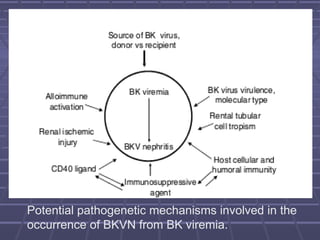
Potential pathogenetic mechanisms involved in the
occurrence of BKVN from BK viremia.
timingof BKV infectiontimingof BKV infection
 Fifty percent of patients who develop BK viremiaFifty percent of patients who develop BK viremia
do so by 3 months after kidney transplantation.do so by 3 months after kidney transplantation.
 Ninety-five percent of BKV nephropathy occurs inNinety-five percent of BKV nephropathy occurs in
the first 2 years after kidney transplantation.the first 2 years after kidney transplantation.
Clinical Features of BKV infectionClinical Features of BKV infection
 Most renal transplant recipients with BKVNMost renal transplant recipients with BKVN
manifest withmanifest with renal dysfunctionrenal dysfunction..
 OccasionallyOccasionallyureteric obstructionureteric obstruction andand
hydronephrosishydronephrosis..
 Cystitis(haemorrhagic/nonhaemorrhagic).Cystitis(haemorrhagic/nonhaemorrhagic).
 Featurs of viremiaFeaturs of viremia
 Rare fatal disseminated BK virus infection afterRare fatal disseminated BK virus infection after
cadaveric transplantation has also been reported.cadaveric transplantation has also been reported.
Diagnosis of BKVANDiagnosis of BKVAN
Decoy cellsDecoy cells
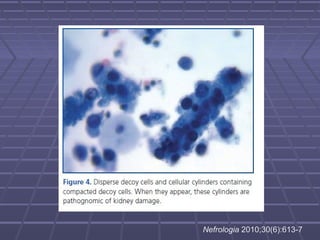
 Decoy cells are renal tubular or urothelial cellsDecoy cells are renal tubular or urothelial cells
with intranuclear BKV-bearing inclusion bodies.with intranuclear BKV-bearing inclusion bodies.
 Problems in using Decoy cells as screening test:Problems in using Decoy cells as screening test:
 BKV shedding in the urine occurs in a substantialBKV shedding in the urine occurs in a substantial
proportion of healthy Individuals, only quantitativeproportion of healthy Individuals, only quantitative
cytology results are suitable for routine diagnostic use.cytology results are suitable for routine diagnostic use.
Urine cytology in BKV infectionUrine cytology in BKV infection
Decoy cells are seen with three methods:Decoy cells are seen with three methods:
 Papanicolaou stainsPapanicolaou stains
 Electron microscopyElectron microscopy
 Phase contrast microscopyPhase contrast microscopy
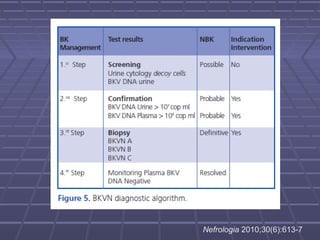
Nefrologia 2010;30(6):613-7
What to screen?What to screen?
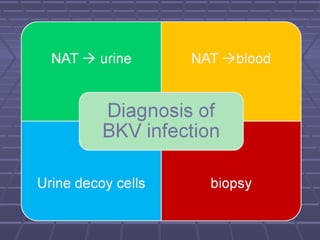
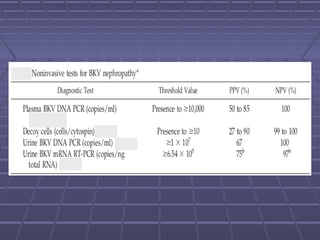
 Urine NAT has a very high negative predictive valueUrine NAT has a very high negative predictive value
and it tends to precede Plasma NAT by 4 weeksand it tends to precede Plasma NAT by 4 weeks
and histological BKVAN by 12 weeks.and histological BKVAN by 12 weeks.
 But it has been shown thatBut it has been shown that the presence of athe presence of a
positive NAT for BKV in urine, in the absence of anpositive NAT for BKV in urine, in the absence of an
elevated BKV load in the plasma, is not associatedelevated BKV load in the plasma, is not associated
with an increased risk for BKV disease.with an increased risk for BKV disease.
 Thus positive urine NAT requires it to be followed byThus positive urine NAT requires it to be followed by
a plasma NAT making 2 tests necessary.a plasma NAT making 2 tests necessary.
Transplantation 2005;79: 1277–1286.
Current screening guidelinesCurrent screening guidelines
 Screen all kidney transplant patients for BKVScreen all kidney transplant patients for BKV
using quantitative PCR of serum or plasmausing quantitative PCR of serum or plasma
samples at the following time points:samples at the following time points:
 Monthly for the first 3–6 months after transplantation,Monthly for the first 3–6 months after transplantation,
then every 3 months until the end of the first post-then every 3 months until the end of the first post-
transplantation year.transplantation year.
 In addition, patients should undergo PCR-basedIn addition, patients should undergo PCR-based
screening for BKV every time an unexplained risescreening for BKV every time an unexplained rise
in serum creatinine occurs, and after treatment forin serum creatinine occurs, and after treatment for
acute rejection.acute rejection.
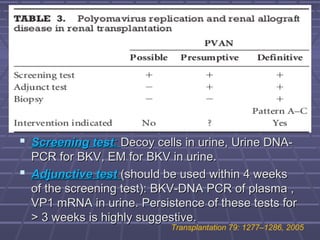
 Screening testScreening test:: Decoy cells in urine, Urine DNA-Decoy cells in urine, Urine DNA-
PCR for BKV, EM for BKV in urine.PCR for BKV, EM for BKV in urine.
 Adjunctive testAdjunctive test (should be used within 4 weeks(should be used within 4 weeks
of the screening test): BKV-DNA PCR of plasma ,of the screening test): BKV-DNA PCR of plasma ,
VP1 mRNA in urine. Persistence of these tests forVP1 mRNA in urine. Persistence of these tests for
> 3 weeks is highly suggestive.> 3 weeks is highly suggestive.
Transplantation 79: 1277–1286, 2005
biopsybiopsy
Since it has a patchy distributionSince it has a patchy distribution
affecting mostly the medulla,affecting mostly the medulla, twotwo
core biopsycore biopsy samples includingsamples including
medulla should be obtained.medulla should be obtained.
biopsybiopsy
 BK nephropathy develops through three stagesBK nephropathy develops through three stages
 Stage AStage A
 Few viral inclusion bodies and occasional positiveFew viral inclusion bodies and occasional positive
immunohistochemical staining, with an antibody to SV40immunohistochemical staining, with an antibody to SV40
large T antigen that cross-reacts with BK large T antigenlarge T antigen that cross-reacts with BK large T antigen
 Stage BStage B
 Fulminant nephropathy shows an inflammatory infiltrate withFulminant nephropathy shows an inflammatory infiltrate with
focal tubulitis, which may mimic acute rejection but includesfocal tubulitis, which may mimic acute rejection but includes
prominent intranuclear inclusions and T-antigen stainingprominent intranuclear inclusions and T-antigen staining
 Stage CStage C
 Diffuse interstitial fibrosis and closely resembles chronicDiffuse interstitial fibrosis and closely resembles chronic
allograft nephropathyallograft nephropathy
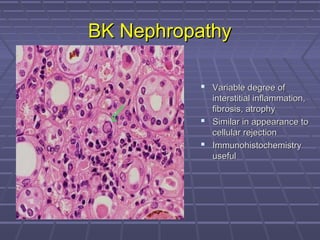
BK NephropathyBK Nephropathy
 Variable degree ofVariable degree of
interstitial inflammation,interstitial inflammation,
fibrosis, atrophyfibrosis, atrophy
 Similar in appearance toSimilar in appearance to
cellular rejectioncellular rejection
 ImmunohistochemistryImmunohistochemistry
usefuluseful
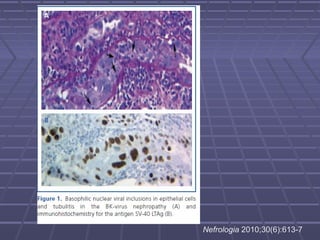
Nefrologia 2010;30(6):613-7
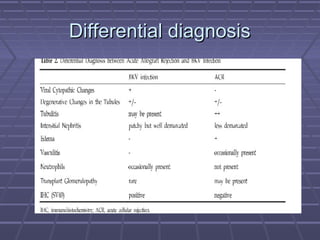
Differential diagnosisDifferential diagnosis
 Early BKVN Vs acute rejectionEarly BKVN Vs acute rejection
 Late BKVN Vs CANLate BKVN Vs CAN
Differential diagnosisDifferential diagnosis
Nefrologia 2010;30(6):613-7
More recently..More recently..
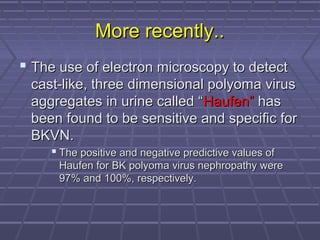
 The use of electron microscopy to detectThe use of electron microscopy to detect
cast-like, three dimensional polyoma viruscast-like, three dimensional polyoma virus
aggregates in urine called “aggregates in urine called “Haufen”Haufen” hashas
been found to be sensitive and specific forbeen found to be sensitive and specific for
BKVN.BKVN.
 The positive and negative predictive values ofThe positive and negative predictive values of
Haufen for BK polyoma virus nephropathy wereHaufen for BK polyoma virus nephropathy were
97% and 100%, respectively.97% and 100%, respectively.
ManagementManagement
Two approachesTwo approaches
 Timely screening and adjustment inTimely screening and adjustment in
immunosuppresionimmunosuppresion
 Identify patients at risk for BK infection andIdentify patients at risk for BK infection and
use an immunosuppressive regimen from theuse an immunosuppressive regimen from the
time of transplant that could be expected totime of transplant that could be expected to
minimize risk.minimize risk.
BK virus infection: TreatmentBK virus infection: Treatment
 Currently,Currently,
 Reduction of immunosuppression remains theReduction of immunosuppression remains the
most widely accepted approach to treatmentmost widely accepted approach to treatment
 It is now assumed thatIt is now assumed that
 Screening all transplant patients with serialScreening all transplant patients with serial
PCR analyses of urine or serum, withPCR analyses of urine or serum, with
 Prompt reduction of immunosuppression whenPrompt reduction of immunosuppression when
patients initially display viruria or viremia, willpatients initially display viruria or viremia, will
 Prevent or reduce the risk for developing BKVNPrevent or reduce the risk for developing BKVN
Transplantation Reviews 2010 ;24: 28–31
Reduction in immunosuppresionReduction in immunosuppresion
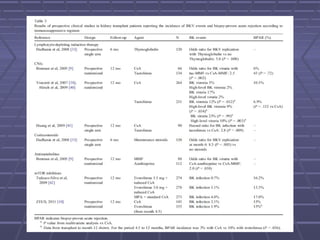
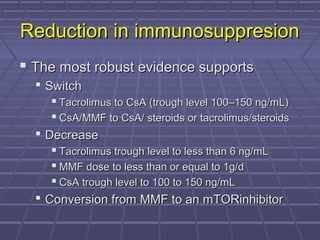
 The most robust evidence supportsThe most robust evidence supports
 SwitchSwitch
 Tacrolimus to CsA (trough level 100–150 ng/mL)Tacrolimus to CsA (trough level 100–150 ng/mL)
 CsA/MMF to CsA/ steroids or tacrolimus/steroidsCsA/MMF to CsA/ steroids or tacrolimus/steroids
 DecreaseDecrease
 Tacrolimus trough level to less than 6 ng/mLTacrolimus trough level to less than 6 ng/mL
 MMF dose to less than or equal to 1g/dMMF dose to less than or equal to 1g/d
 CsA trough level to 100 to 150 ng/mLCsA trough level to 100 to 150 ng/mL
 Conversion from MMF to an mTORinhibitorConversion from MMF to an mTORinhibitor
Adjunctive TreatmentAdjunctive Treatment
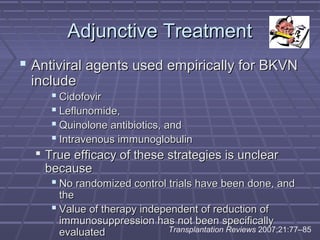
 Antiviral agents used empirically for BKVNAntiviral agents used empirically for BKVN
includeinclude
 CidofovirCidofovir
 Leflunomide,Leflunomide,
 Quinolone antibiotics, andQuinolone antibiotics, and
 Intravenous immunoglobulinIntravenous immunoglobulin
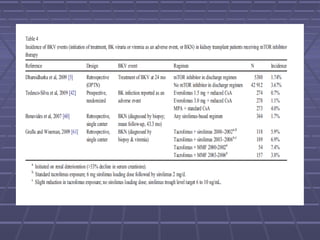
 True efficacy of these strategies is unclearTrue efficacy of these strategies is unclear
becausebecause
 No randomized control trials have been done, andNo randomized control trials have been done, and
thethe
 Value of therapy independent of reduction ofValue of therapy independent of reduction of
immunosuppression has not been specificallyimmunosuppression has not been specifically
evaluatedevaluated Transplantation Reviews 2007;21:77–85
Adjunctive therapiesAdjunctive therapies
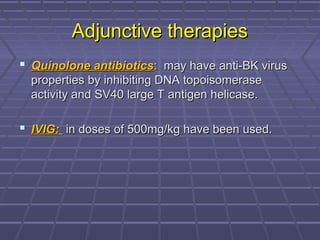
 Quinolone antibioticsQuinolone antibiotics: may have anti-BK virus: may have anti-BK virus
properties by inhibiting DNA topoisomeraseproperties by inhibiting DNA topoisomerase
activity and SV40 large T antigen helicase.activity and SV40 large T antigen helicase.
 IVIG:IVIG: in doses of 500mg/kg have been used.in doses of 500mg/kg have been used.
Adjunctive therapiesAdjunctive therapies
 Leflunomide:Leflunomide: is a prodrug whose anti-metabolite,is a prodrug whose anti-metabolite,
A77 1726, has both immunosuppressive and anti-A77 1726, has both immunosuppressive and anti-
viral activity.viral activity.
 Dosage: 100mg/d X 5 days followed byDosage: 100mg/d X 5 days followed by 20–60 mg daily,20–60 mg daily,
with a target trough blood level of 50–100 mg/mlwith a target trough blood level of 50–100 mg/ml
 Cidofovir:Cidofovir: a nucleotide analogue of cytosine thata nucleotide analogue of cytosine that
is active against various DNA viruses.is active against various DNA viruses.
 Dosage: 0.25-0.33mg/kg/dose X 1-3 doses every 2-3Dosage: 0.25-0.33mg/kg/dose X 1-3 doses every 2-3
weeksweeks
 Problem with cidofovir is that it is nephrotoxic.Problem with cidofovir is that it is nephrotoxic.
BK virus infection: TreatmentBK virus infection: Treatment
 Recent review “Treatment of polyomavirusRecent review “Treatment of polyomavirus
infection in kidney transplant recipients”infection in kidney transplant recipients”
ConclusionsConclusions
 There does not seem to be a graft survivalThere does not seem to be a graft survival
benefit of adding cidofovir or leflunomide tobenefit of adding cidofovir or leflunomide to
immunosuppression reduction for theimmunosuppression reduction for the
management of PVANmanagement of PVAN
 Evidence base is poor and highlights theEvidence base is poor and highlights the
urgent need for adequately poweredurgent need for adequately powered
randomized trials to define the optimalrandomized trials to define the optimal
treatment of this important conditiontreatment of this important condition
Transplantation. 2010 May 15;89(9):1057-70.
RetransplantationRetransplantation
 It is a medical and an ethical dilemmaIt is a medical and an ethical dilemma
 Whether retransplantation should be doneWhether retransplantation should be done
after a patient loses the renal graft to polyomaafter a patient loses the renal graft to polyoma
nephropathynephropathy
 Should immunosuppressive therapy beShould immunosuppressive therapy be
altered?altered?
 Is nephroureterectomy of the failed graftIs nephroureterectomy of the failed graft
necessary?necessary?
 What is the natural course of the disease afterWhat is the natural course of the disease after
retransplantation?retransplantation?
Transplantation Reviews 2007;21:77–85
RetransplantationRetransplantation
 Retransplantation after polyomavirus-Retransplantation after polyomavirus-
associated nephropathy has been reported in 17associated nephropathy has been reported in 17
casescases
 In these cases, recurrence of nephropathy hasIn these cases, recurrence of nephropathy has
occurred in 2 patients and viremia alone in aoccurred in 2 patients and viremia alone in a
third patient.third patient.
 For most of these patients, immunosuppressionFor most of these patients, immunosuppression
after retransplantation was the same as for theafter retransplantation was the same as for the
first transplantationfirst transplantation
 Allograft nephrectomy was performed in 11 of the 15Allograft nephrectomy was performed in 11 of the 15
patientspatients
Transplantation Reviews 2007;21:77–85
RetransplantationRetransplantation
 Also, all 15 patients had reconstituted theirAlso, all 15 patients had reconstituted their
BKV-specific immune control, asBKV-specific immune control, as
demonstrated by negative urine cytologydemonstrated by negative urine cytology
pretransplantpretransplant
 Authors conclude thatAuthors conclude that
 Retransplantation in patients without activeRetransplantation in patients without active
replication is generally safereplication is generally safe
Transplantation Reviews 2007;21:77–85
RetransplantationRetransplantation
 Authors conclude that..Authors conclude that..
 Control of viral replication, allowing enoughControl of viral replication, allowing enough
time to raise sufficient immune response,time to raise sufficient immune response,
which usually requires more than 12 weeks ofwhich usually requires more than 12 weeks of
reduced immunosuppression, appears to be areduced immunosuppression, appears to be a
desirable goal before a second transplant isdesirable goal before a second transplant is
contemplated.contemplated.
 In addition, nephroureterectomy is notIn addition, nephroureterectomy is not
necessary when viral replication is absentnecessary when viral replication is absent
before retransplantation.before retransplantation.
Transplantation Reviews 2007;21:77–85
Take home pearlsTake home pearls
 significant concern in kidney transplantsignificant concern in kidney transplant
patientspatients
 Intensive viral monitoring and adjustmentIntensive viral monitoring and adjustment
of immunosuppressionof immunosuppression
 do not have reliable antiviral drugsdo not have reliable antiviral drugs
available at this timeavailable at this time
 Differentiation from rejection challengingDifferentiation from rejection challenging
THANK YOUTHANK YOU

BK Virus Nephropathy

  • 1.
    BK virus nephropathyBKvirus nephropathy
  • 2.
    • DNA virusthat belongs to the polyomaviridae family:  Polyomavirus BK  Polyomavirus JC  SV40  New: Polyomavirus KI, Polyomavirus WU, Polyomavirus MC BKV infection: the virusBKV infection: the virus Structure: The BKV genome comprises three regions: 1. the NCCR 2. the structural region coding for early T proteins 3. the late structural region encoding the viral capsid proteins (VP1-3) and agnoprotein
  • 3.
    VirologyVirology 4 major sero/genotypes:4major sero/genotypes:  group I encodes thegroup I encodes the prototype strainprototype strain Dunlop (Dun),MM,Dunlop (Dun),MM, and GS;and GS;  group II encodes thegroup II encodes the SB strain;SB strain;  group III encodes thegroup III encodes the AS strain; andAS strain; and  group IV encodes thegroup IV encodes the MG strains.MG strains. 5300 bp Icosahedral,40-44 nm diam
  • 4.
    History of BKVNHistoryof BKVN  First reported in a renal transplant patient, BK, inFirst reported in a renal transplant patient, BK, in 1971.1971.  No reported cases of this disease for the next 24No reported cases of this disease for the next 24 years, until Purighalla and co-workers observedyears, until Purighalla and co-workers observed their first case in early 1995.their first case in early 1995.  Subsequently there has been a surge in reportedSubsequently there has been a surge in reported cases worldwide.cases worldwide.
  • 5.
    Epidemiology of BKVinfectionEpidemiology of BKV infection  Approx. 80% of the general population has aApprox. 80% of the general population has a detectable antibody to BKV, which appears earlydetectable antibody to BKV, which appears early in life and remains elevated throughout life.in life and remains elevated throughout life.  The prevalence of BK viruria, viremia, andThe prevalence of BK viruria, viremia, and nephritis after renal Tx has been estimated at 30,nephritis after renal Tx has been estimated at 30, 13, and 8%, respectively.13, and 8%, respectively. N Engl J Med 2002; 347 : 488–496. J Gen Virol 2003; 84: 1499–1504
  • 6.
    Epidemiology of BKVinfectionEpidemiology of BKV infection  BKVN is also seen in other SOTx but at a much lowerBKVN is also seen in other SOTx but at a much lower rate. It also has been observed in patients with HIVrate. It also has been observed in patients with HIV infection, other immunodeficiency states and rarelyinfection, other immunodeficiency states and rarely also in SLE.also in SLE.  Primary Infection occurs in early life when it is eitherPrimary Infection occurs in early life when it is either asymptomatic or with mild URTI.asymptomatic or with mild URTI. Thereafter BKVThereafter BKV largely persists in the kidneys and urinary tract in alargely persists in the kidneys and urinary tract in a latent form.latent form.
  • 7.
    TransmissionTransmission  Transmission throughthe feco-oral andTransmission through the feco-oral and respiratory routes has been suggestedrespiratory routes has been suggested  Other routes include blood transfusion,Other routes include blood transfusion, transplacentally, through semen, &organtransplacentally, through semen, &organ transplantationtransplantation
  • 8.
    BKV nephropathy afterkidney Tx:BKV nephropathy after kidney Tx: risk factorsrisk factors Patient determinants age>50 yrs diabetes negative recipient antibody before Tx Organ determinants degree of HLA-matching prior rejection episodes positive donor serostatus before Tx Viral determinants genome mutation and rearrangements Immune suppression major risk factor for BKVN a state of “over- immunosuppression”, rather than a specific agent is responsible for an increased risk of BKVN development
  • 9.
  • 10.
    Source of infectionSourceof infection Two proposed hypotheses:Two proposed hypotheses: 1.1.Transmission occurs through the donor kidney.Transmission occurs through the donor kidney. 2.2.Reactivation in the recipient renal epithelium afterReactivation in the recipient renal epithelium after transplantation.transplantation.
  • 11.
    Immunology of BKVN:Immunologyof BKVN: Humoral immunityHumoral immunity  Humoral immunity seems to be involved in theHumoral immunity seems to be involved in the regulation of BKV activity:regulation of BKV activity:  Early report of fatal BKV infection with renal damage in a pt ofEarly report of fatal BKV infection with renal damage in a pt of hyper- IgM immunodeficiency.hyper- IgM immunodeficiency.  In paediatric renal Tx recipients, the absence of BKV-specificIn paediatric renal Tx recipients, the absence of BKV-specific anti bodies was associated with an increased rate of acute BKVanti bodies was associated with an increased rate of acute BKV infection.infection.  recovery from BKVAN and clearance of BKV was associatedrecovery from BKVAN and clearance of BKV was associated with the development of BKV-specific IgG anti bodies.with the development of BKV-specific IgG anti bodies.  Other studies did not show high titers were protective againstOther studies did not show high titers were protective against development of BKVAN and very titer were seen in patientsdevelopment of BKVAN and very titer were seen in patients where the BKV viruria was highest.where the BKV viruria was highest. N. Engl. J. Med. 308 , 1192– 1196(1983) Am. J. Transplant. 7, 2727–2735 (2007). Am. J. Transplant. 5, 2719–2724 (2005) J. Clin. Virol. 43, 184–189 (2008)
  • 12.
    Humoral immunityHumoral immunity Takentogether, the current data suggest that:Taken together, the current data suggest that:  BKV-specific antibodies provideBKV-specific antibodies provide incompleteincomplete protectionprotection against BKVAN for patients after kidneyagainst BKVAN for patients after kidney transplantation.transplantation.  However, theyHowever, they may attenuate the severitymay attenuate the severity of BKVof BKV infection and its clinical manifestations.infection and its clinical manifestations.  In addition, evaluation of BKV-specific antibodyIn addition, evaluation of BKV-specific antibody titers can provide information on thetiters can provide information on the severityseverity ofof past or current BKV infections and onpast or current BKV infections and on prognosis.prognosis.
  • 13.
    Immunology of BKVN:Immunologyof BKVN: Cellular immunityCellular immunity
  • 14.
    Role of ImmunosuppressiveRoleof Immunosuppressive medicationsmedications  Prior to 1995; when Tac and MMF werePrior to 1995; when Tac and MMF were introduced, BKVAN was a rare entity.introduced, BKVAN was a rare entity.  The occurrence of BKVN is not due to specificThe occurrence of BKVN is not due to specific immunosuppressive agents, but may be related toimmunosuppressive agents, but may be related to the overall degree of immunosuppression.the overall degree of immunosuppression.  TropismTropism of the virus for renal tubular cells andof the virus for renal tubular cells and their replication in these cells.their replication in these cells.
  • 15.
    Potential pathogenetic mechanismsinvolved in the occurrence of BKVN from BK viremia.
  • 16.
    timingof BKV infectiontimingofBKV infection  Fifty percent of patients who develop BK viremiaFifty percent of patients who develop BK viremia do so by 3 months after kidney transplantation.do so by 3 months after kidney transplantation.  Ninety-five percent of BKV nephropathy occurs inNinety-five percent of BKV nephropathy occurs in the first 2 years after kidney transplantation.the first 2 years after kidney transplantation.
  • 17.
    Clinical Features ofBKV infectionClinical Features of BKV infection  Most renal transplant recipients with BKVNMost renal transplant recipients with BKVN manifest withmanifest with renal dysfunctionrenal dysfunction..  OccasionallyOccasionallyureteric obstructionureteric obstruction andand hydronephrosishydronephrosis..  Cystitis(haemorrhagic/nonhaemorrhagic).Cystitis(haemorrhagic/nonhaemorrhagic).  Featurs of viremiaFeaturs of viremia  Rare fatal disseminated BK virus infection afterRare fatal disseminated BK virus infection after cadaveric transplantation has also been reported.cadaveric transplantation has also been reported.
  • 18.
  • 21.
    Decoy cellsDecoy cells Decoy cells are renal tubular or urothelial cellsDecoy cells are renal tubular or urothelial cells with intranuclear BKV-bearing inclusion bodies.with intranuclear BKV-bearing inclusion bodies.  Problems in using Decoy cells as screening test:Problems in using Decoy cells as screening test:  BKV shedding in the urine occurs in a substantialBKV shedding in the urine occurs in a substantial proportion of healthy Individuals, only quantitativeproportion of healthy Individuals, only quantitative cytology results are suitable for routine diagnostic use.cytology results are suitable for routine diagnostic use.
  • 22.
    Urine cytology inBKV infectionUrine cytology in BKV infection Decoy cells are seen with three methods:Decoy cells are seen with three methods:  Papanicolaou stainsPapanicolaou stains  Electron microscopyElectron microscopy  Phase contrast microscopyPhase contrast microscopy
  • 23.
  • 25.
    What to screen?Whatto screen?  Urine NAT has a very high negative predictive valueUrine NAT has a very high negative predictive value and it tends to precede Plasma NAT by 4 weeksand it tends to precede Plasma NAT by 4 weeks and histological BKVAN by 12 weeks.and histological BKVAN by 12 weeks.  But it has been shown thatBut it has been shown that the presence of athe presence of a positive NAT for BKV in urine, in the absence of anpositive NAT for BKV in urine, in the absence of an elevated BKV load in the plasma, is not associatedelevated BKV load in the plasma, is not associated with an increased risk for BKV disease.with an increased risk for BKV disease.  Thus positive urine NAT requires it to be followed byThus positive urine NAT requires it to be followed by a plasma NAT making 2 tests necessary.a plasma NAT making 2 tests necessary. Transplantation 2005;79: 1277–1286.
  • 26.
    Current screening guidelinesCurrentscreening guidelines  Screen all kidney transplant patients for BKVScreen all kidney transplant patients for BKV using quantitative PCR of serum or plasmausing quantitative PCR of serum or plasma samples at the following time points:samples at the following time points:  Monthly for the first 3–6 months after transplantation,Monthly for the first 3–6 months after transplantation, then every 3 months until the end of the first post-then every 3 months until the end of the first post- transplantation year.transplantation year.  In addition, patients should undergo PCR-basedIn addition, patients should undergo PCR-based screening for BKV every time an unexplained risescreening for BKV every time an unexplained rise in serum creatinine occurs, and after treatment forin serum creatinine occurs, and after treatment for acute rejection.acute rejection.
  • 27.
     Screening testScreeningtest:: Decoy cells in urine, Urine DNA-Decoy cells in urine, Urine DNA- PCR for BKV, EM for BKV in urine.PCR for BKV, EM for BKV in urine.  Adjunctive testAdjunctive test (should be used within 4 weeks(should be used within 4 weeks of the screening test): BKV-DNA PCR of plasma ,of the screening test): BKV-DNA PCR of plasma , VP1 mRNA in urine. Persistence of these tests forVP1 mRNA in urine. Persistence of these tests for > 3 weeks is highly suggestive.> 3 weeks is highly suggestive. Transplantation 79: 1277–1286, 2005
  • 28.
    biopsybiopsy Since it hasa patchy distributionSince it has a patchy distribution affecting mostly the medulla,affecting mostly the medulla, twotwo core biopsycore biopsy samples includingsamples including medulla should be obtained.medulla should be obtained.
  • 29.
    biopsybiopsy  BK nephropathydevelops through three stagesBK nephropathy develops through three stages  Stage AStage A  Few viral inclusion bodies and occasional positiveFew viral inclusion bodies and occasional positive immunohistochemical staining, with an antibody to SV40immunohistochemical staining, with an antibody to SV40 large T antigen that cross-reacts with BK large T antigenlarge T antigen that cross-reacts with BK large T antigen  Stage BStage B  Fulminant nephropathy shows an inflammatory infiltrate withFulminant nephropathy shows an inflammatory infiltrate with focal tubulitis, which may mimic acute rejection but includesfocal tubulitis, which may mimic acute rejection but includes prominent intranuclear inclusions and T-antigen stainingprominent intranuclear inclusions and T-antigen staining  Stage CStage C  Diffuse interstitial fibrosis and closely resembles chronicDiffuse interstitial fibrosis and closely resembles chronic allograft nephropathyallograft nephropathy
  • 30.
    BK NephropathyBK Nephropathy Variable degree ofVariable degree of interstitial inflammation,interstitial inflammation, fibrosis, atrophyfibrosis, atrophy  Similar in appearance toSimilar in appearance to cellular rejectioncellular rejection  ImmunohistochemistryImmunohistochemistry usefuluseful
  • 31.
  • 32.
    Differential diagnosisDifferential diagnosis Early BKVN Vs acute rejectionEarly BKVN Vs acute rejection  Late BKVN Vs CANLate BKVN Vs CAN
  • 33.
  • 34.
  • 35.
    More recently..More recently.. The use of electron microscopy to detectThe use of electron microscopy to detect cast-like, three dimensional polyoma viruscast-like, three dimensional polyoma virus aggregates in urine called “aggregates in urine called “Haufen”Haufen” hashas been found to be sensitive and specific forbeen found to be sensitive and specific for BKVN.BKVN.  The positive and negative predictive values ofThe positive and negative predictive values of Haufen for BK polyoma virus nephropathy wereHaufen for BK polyoma virus nephropathy were 97% and 100%, respectively.97% and 100%, respectively.
  • 36.
  • 37.
    Two approachesTwo approaches Timely screening and adjustment inTimely screening and adjustment in immunosuppresionimmunosuppresion  Identify patients at risk for BK infection andIdentify patients at risk for BK infection and use an immunosuppressive regimen from theuse an immunosuppressive regimen from the time of transplant that could be expected totime of transplant that could be expected to minimize risk.minimize risk.
  • 38.
    BK virus infection:TreatmentBK virus infection: Treatment  Currently,Currently,  Reduction of immunosuppression remains theReduction of immunosuppression remains the most widely accepted approach to treatmentmost widely accepted approach to treatment  It is now assumed thatIt is now assumed that  Screening all transplant patients with serialScreening all transplant patients with serial PCR analyses of urine or serum, withPCR analyses of urine or serum, with  Prompt reduction of immunosuppression whenPrompt reduction of immunosuppression when patients initially display viruria or viremia, willpatients initially display viruria or viremia, will  Prevent or reduce the risk for developing BKVNPrevent or reduce the risk for developing BKVN Transplantation Reviews 2010 ;24: 28–31
  • 41.
    Reduction in immunosuppresionReductionin immunosuppresion  The most robust evidence supportsThe most robust evidence supports  SwitchSwitch  Tacrolimus to CsA (trough level 100–150 ng/mL)Tacrolimus to CsA (trough level 100–150 ng/mL)  CsA/MMF to CsA/ steroids or tacrolimus/steroidsCsA/MMF to CsA/ steroids or tacrolimus/steroids  DecreaseDecrease  Tacrolimus trough level to less than 6 ng/mLTacrolimus trough level to less than 6 ng/mL  MMF dose to less than or equal to 1g/dMMF dose to less than or equal to 1g/d  CsA trough level to 100 to 150 ng/mLCsA trough level to 100 to 150 ng/mL  Conversion from MMF to an mTORinhibitorConversion from MMF to an mTORinhibitor
  • 42.
    Adjunctive TreatmentAdjunctive Treatment Antiviral agents used empirically for BKVNAntiviral agents used empirically for BKVN includeinclude  CidofovirCidofovir  Leflunomide,Leflunomide,  Quinolone antibiotics, andQuinolone antibiotics, and  Intravenous immunoglobulinIntravenous immunoglobulin  True efficacy of these strategies is unclearTrue efficacy of these strategies is unclear becausebecause  No randomized control trials have been done, andNo randomized control trials have been done, and thethe  Value of therapy independent of reduction ofValue of therapy independent of reduction of immunosuppression has not been specificallyimmunosuppression has not been specifically evaluatedevaluated Transplantation Reviews 2007;21:77–85
  • 43.
    Adjunctive therapiesAdjunctive therapies Quinolone antibioticsQuinolone antibiotics: may have anti-BK virus: may have anti-BK virus properties by inhibiting DNA topoisomeraseproperties by inhibiting DNA topoisomerase activity and SV40 large T antigen helicase.activity and SV40 large T antigen helicase.  IVIG:IVIG: in doses of 500mg/kg have been used.in doses of 500mg/kg have been used.
  • 44.
    Adjunctive therapiesAdjunctive therapies Leflunomide:Leflunomide: is a prodrug whose anti-metabolite,is a prodrug whose anti-metabolite, A77 1726, has both immunosuppressive and anti-A77 1726, has both immunosuppressive and anti- viral activity.viral activity.  Dosage: 100mg/d X 5 days followed byDosage: 100mg/d X 5 days followed by 20–60 mg daily,20–60 mg daily, with a target trough blood level of 50–100 mg/mlwith a target trough blood level of 50–100 mg/ml  Cidofovir:Cidofovir: a nucleotide analogue of cytosine thata nucleotide analogue of cytosine that is active against various DNA viruses.is active against various DNA viruses.  Dosage: 0.25-0.33mg/kg/dose X 1-3 doses every 2-3Dosage: 0.25-0.33mg/kg/dose X 1-3 doses every 2-3 weeksweeks  Problem with cidofovir is that it is nephrotoxic.Problem with cidofovir is that it is nephrotoxic.
  • 45.
    BK virus infection:TreatmentBK virus infection: Treatment  Recent review “Treatment of polyomavirusRecent review “Treatment of polyomavirus infection in kidney transplant recipients”infection in kidney transplant recipients” ConclusionsConclusions  There does not seem to be a graft survivalThere does not seem to be a graft survival benefit of adding cidofovir or leflunomide tobenefit of adding cidofovir or leflunomide to immunosuppression reduction for theimmunosuppression reduction for the management of PVANmanagement of PVAN  Evidence base is poor and highlights theEvidence base is poor and highlights the urgent need for adequately poweredurgent need for adequately powered randomized trials to define the optimalrandomized trials to define the optimal treatment of this important conditiontreatment of this important condition Transplantation. 2010 May 15;89(9):1057-70.
  • 46.
    RetransplantationRetransplantation  It isa medical and an ethical dilemmaIt is a medical and an ethical dilemma  Whether retransplantation should be doneWhether retransplantation should be done after a patient loses the renal graft to polyomaafter a patient loses the renal graft to polyoma nephropathynephropathy  Should immunosuppressive therapy beShould immunosuppressive therapy be altered?altered?  Is nephroureterectomy of the failed graftIs nephroureterectomy of the failed graft necessary?necessary?  What is the natural course of the disease afterWhat is the natural course of the disease after retransplantation?retransplantation? Transplantation Reviews 2007;21:77–85
  • 47.
    RetransplantationRetransplantation  Retransplantation afterpolyomavirus-Retransplantation after polyomavirus- associated nephropathy has been reported in 17associated nephropathy has been reported in 17 casescases  In these cases, recurrence of nephropathy hasIn these cases, recurrence of nephropathy has occurred in 2 patients and viremia alone in aoccurred in 2 patients and viremia alone in a third patient.third patient.  For most of these patients, immunosuppressionFor most of these patients, immunosuppression after retransplantation was the same as for theafter retransplantation was the same as for the first transplantationfirst transplantation  Allograft nephrectomy was performed in 11 of the 15Allograft nephrectomy was performed in 11 of the 15 patientspatients Transplantation Reviews 2007;21:77–85
  • 48.
    RetransplantationRetransplantation  Also, all15 patients had reconstituted theirAlso, all 15 patients had reconstituted their BKV-specific immune control, asBKV-specific immune control, as demonstrated by negative urine cytologydemonstrated by negative urine cytology pretransplantpretransplant  Authors conclude thatAuthors conclude that  Retransplantation in patients without activeRetransplantation in patients without active replication is generally safereplication is generally safe Transplantation Reviews 2007;21:77–85
  • 49.
    RetransplantationRetransplantation  Authors concludethat..Authors conclude that..  Control of viral replication, allowing enoughControl of viral replication, allowing enough time to raise sufficient immune response,time to raise sufficient immune response, which usually requires more than 12 weeks ofwhich usually requires more than 12 weeks of reduced immunosuppression, appears to be areduced immunosuppression, appears to be a desirable goal before a second transplant isdesirable goal before a second transplant is contemplated.contemplated.  In addition, nephroureterectomy is notIn addition, nephroureterectomy is not necessary when viral replication is absentnecessary when viral replication is absent before retransplantation.before retransplantation. Transplantation Reviews 2007;21:77–85
  • 50.
    Take home pearlsTakehome pearls  significant concern in kidney transplantsignificant concern in kidney transplant patientspatients  Intensive viral monitoring and adjustmentIntensive viral monitoring and adjustment of immunosuppressionof immunosuppression  do not have reliable antiviral drugsdo not have reliable antiviral drugs available at this timeavailable at this time  Differentiation from rejection challengingDifferentiation from rejection challenging
  • 51.

Editor's Notes

  • #11 Donor: pediatric transplantation shows donor responsible as they were not yet exposed to infection. High donor BKV titres found to be related to the BKV infection in recipient. Also, recepients with high BKV titres were found to develop BKVN when the donors also had the same genotype virus infection.