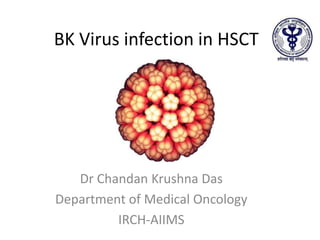
BK Virus infection in HSCT
Dr Chandan Krushna Das
Department of Medical Oncology
IRCH-AIIMS
introduction
• Polyomavirus hominis 1, the BK virus:non-
enveloped, encapsulated DNA Papovaviridae
family
• BK virus infection early-childhood
:asymptomatic or associated with fever and
mild upper respiratory symptoms. Up to 90%
of adults are seropositive.
• Transmission via the respiratory route
Arther et al N Engl J Med. 1986 Jul 24;315(4):230-4.
BK virus infection
• BK viruria occurs in about 50% of patients
after BMT, usually within 2 months of
transplantation
• similar in allogeneic (range 46–53%) and
autologous (range 39–54%) marrow
recipients.
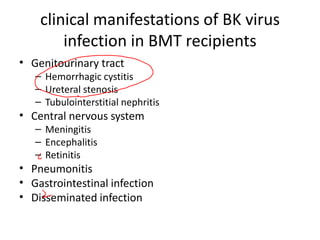
clinical manifestations of BK virus
infection in BMT recipients
• Genitourinary tract
– Hemorrhagic cystitis
– Ureteral stenosis
– Tubulointerstitial nephritis
• Central nervous system
– Meningitis
– Encephalitis
– Retinitis
• Pneumonitis
• Gastrointestinal infection
• Disseminated infection
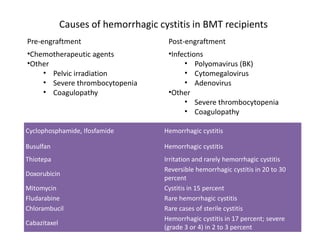
Pre-engraftment Post-engraftment
•Chemotherapeutic agents
•Other
• Pelvic irradiation
• Severe thrombocytopenia
• Coagulopathy
•Infections
• Polyomavirus (BK)
• Cytomegalovirus
• Adenovirus
•Other
• Severe thrombocytopenia
• Coagulopathy
Causes of hemorrhagic cystitis in BMT recipients
Cyclophosphamide, Ifosfamide Hemorrhagic cystitis
Busulfan Hemorrhagic cystitis
Thiotepa Irritation and rarely hemorrhagic cystitis
Doxorubicin
Reversible hemorrhagic cystitis in 20 to 30
percent
Mitomycin Cystitis in 15 percent
Fludarabine Rare hemorrhagic cystitis
Chlorambucil Rare cases of sterile cystitis
Cabazitaxel
Hemorrhagic cystitis in 17 percent; severe
(grade 3 or 4) in 2 to 3 percent
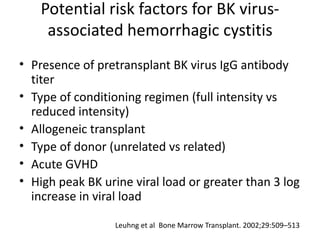
Potential risk factors for BK virus-
associated hemorrhagic cystitis
• Presence of pretransplant BK virus IgG antibody
titer
• Type of conditioning regimen (full intensity vs
reduced intensity)
• Allogeneic transplant
• Type of donor (unrelated vs related)
• Acute GVHD
• High peak BK urine viral load or greater than 3 log
increase in viral load
Leuhng et al Bone Marrow Transplant. 2002;29:509–513
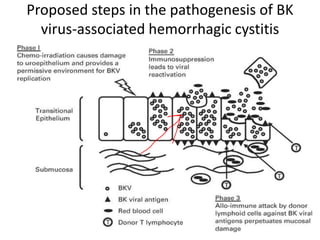
Proposed steps in the pathogenesis of BK
virus-associated hemorrhagic cystitis
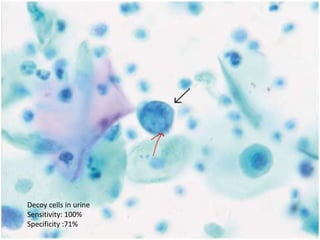
Decoy cells in urine
Sensitivity: 100%
Specificity :71%
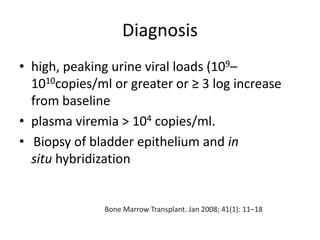
Diagnosis
• high, peaking urine viral loads (109–
1010copies/ml or greater or ≥ 3 log increase
from baseline
• plasma viremia > 104 copies/ml.
• Biopsy of bladder epithelium and in
situ hybridization
Bone Marrow Transplant. Jan 2008; 41(1): 11–18
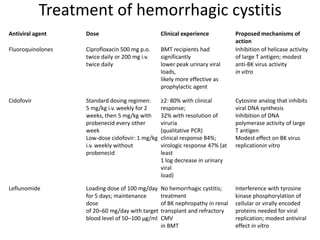
Treatment of hemorrhagic cystitis
Antiviral agent Dose Clinical experience Proposed mechanisms of
action
Fluoroquinolones Ciprofloxacin 500 mg p.o.
twice daily or 200 mg i.v.
twice daily
BMT recipients had
significantly
lower peak urinary viral
loads,
likely more effective as
prophylactic agent
Inhibition of helicase activity
of large T antigen; modest
anti-BK virus activity
in vitro
Cidofovir Standard dosing regimen:
5 mg/kg i.v. weekly for 2
weeks, then 5 mg/kg with
probenecid every other
week
Low-dose cidofovir: 1 mg/kg
i.v. weekly without
probenecid
≥2: 80% with clinical
response;
32% with resolution of
viruria
(qualitative PCR)
clinical response 84%;
virologic response 47% (at
least
1 log decrease in urinary
viral
load)
Cytosine analog that inhibits
viral DNA synthesis
Inhibition of DNA
polymerase activity of large
T antigen
Modest effect on BK virus
replicationin vitro
Leflunomide Loading dose of 100 mg/day
for 5 days; maintenance
dose
of 20–60 mg/day with target
blood level of 50–100 µg/ml
No hemorrhagic cystitis;
treatment
of BK nephropathy in renal
transplant and refractory
CMV
in BMT
Interference with tyrosine
kinase phosphorylation of
cellular or virally encoded
proteins needed for viral
replication; modest antiviral
effect in vitro
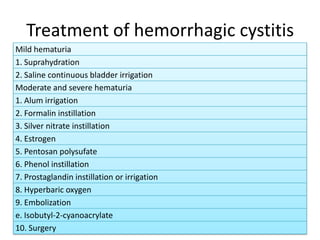
Treatment of hemorrhagic cystitis
Mild hematuria
1. Suprahydration
2. Saline continuous bladder irrigation
Moderate and severe hematuria
1. Alum irrigation
2. Formalin instillation
3. Silver nitrate instillation
4. Estrogen
5. Pentosan polysufate
6. Phenol instillation
7. Prostaglandin instillation or irrigation
8. Hyperbaric oxygen
9. Embolization
e. Isobutyl-2-cyanoacrylate
10. Surgery
• The fluoroquinolone antibiotics should be
evaluated as a prophylactic therapy
• cidofovir and leflunomide as therapeutic
agents.

BK Virus infection in HSCT

  • 1.
    BK Virus infectionin HSCT Dr Chandan Krushna Das Department of Medical Oncology IRCH-AIIMS
  • 3.
    introduction • Polyomavirus hominis1, the BK virus:non- enveloped, encapsulated DNA Papovaviridae family • BK virus infection early-childhood :asymptomatic or associated with fever and mild upper respiratory symptoms. Up to 90% of adults are seropositive. • Transmission via the respiratory route Arther et al N Engl J Med. 1986 Jul 24;315(4):230-4.
  • 4.
    BK virus infection •BK viruria occurs in about 50% of patients after BMT, usually within 2 months of transplantation • similar in allogeneic (range 46–53%) and autologous (range 39–54%) marrow recipients.
  • 5.
    clinical manifestations ofBK virus infection in BMT recipients • Genitourinary tract – Hemorrhagic cystitis – Ureteral stenosis – Tubulointerstitial nephritis • Central nervous system – Meningitis – Encephalitis – Retinitis • Pneumonitis • Gastrointestinal infection • Disseminated infection
  • 6.
    Pre-engraftment Post-engraftment •Chemotherapeutic agents •Other •Pelvic irradiation • Severe thrombocytopenia • Coagulopathy •Infections • Polyomavirus (BK) • Cytomegalovirus • Adenovirus •Other • Severe thrombocytopenia • Coagulopathy Causes of hemorrhagic cystitis in BMT recipients Cyclophosphamide, Ifosfamide Hemorrhagic cystitis Busulfan Hemorrhagic cystitis Thiotepa Irritation and rarely hemorrhagic cystitis Doxorubicin Reversible hemorrhagic cystitis in 20 to 30 percent Mitomycin Cystitis in 15 percent Fludarabine Rare hemorrhagic cystitis Chlorambucil Rare cases of sterile cystitis Cabazitaxel Hemorrhagic cystitis in 17 percent; severe (grade 3 or 4) in 2 to 3 percent
  • 7.
    Potential risk factorsfor BK virus- associated hemorrhagic cystitis • Presence of pretransplant BK virus IgG antibody titer • Type of conditioning regimen (full intensity vs reduced intensity) • Allogeneic transplant • Type of donor (unrelated vs related) • Acute GVHD • High peak BK urine viral load or greater than 3 log increase in viral load Leuhng et al Bone Marrow Transplant. 2002;29:509–513
  • 8.
    Proposed steps inthe pathogenesis of BK virus-associated hemorrhagic cystitis
  • 9.
    Decoy cells inurine Sensitivity: 100% Specificity :71%
  • 10.
    Diagnosis • high, peakingurine viral loads (109– 1010copies/ml or greater or ≥ 3 log increase from baseline • plasma viremia > 104 copies/ml. • Biopsy of bladder epithelium and in situ hybridization Bone Marrow Transplant. Jan 2008; 41(1): 11–18
  • 11.
    Treatment of hemorrhagiccystitis Antiviral agent Dose Clinical experience Proposed mechanisms of action Fluoroquinolones Ciprofloxacin 500 mg p.o. twice daily or 200 mg i.v. twice daily BMT recipients had significantly lower peak urinary viral loads, likely more effective as prophylactic agent Inhibition of helicase activity of large T antigen; modest anti-BK virus activity in vitro Cidofovir Standard dosing regimen: 5 mg/kg i.v. weekly for 2 weeks, then 5 mg/kg with probenecid every other week Low-dose cidofovir: 1 mg/kg i.v. weekly without probenecid ≥2: 80% with clinical response; 32% with resolution of viruria (qualitative PCR) clinical response 84%; virologic response 47% (at least 1 log decrease in urinary viral load) Cytosine analog that inhibits viral DNA synthesis Inhibition of DNA polymerase activity of large T antigen Modest effect on BK virus replicationin vitro Leflunomide Loading dose of 100 mg/day for 5 days; maintenance dose of 20–60 mg/day with target blood level of 50–100 µg/ml No hemorrhagic cystitis; treatment of BK nephropathy in renal transplant and refractory CMV in BMT Interference with tyrosine kinase phosphorylation of cellular or virally encoded proteins needed for viral replication; modest antiviral effect in vitro
  • 12.
    Treatment of hemorrhagiccystitis Mild hematuria 1. Suprahydration 2. Saline continuous bladder irrigation Moderate and severe hematuria 1. Alum irrigation 2. Formalin instillation 3. Silver nitrate instillation 4. Estrogen 5. Pentosan polysufate 6. Phenol instillation 7. Prostaglandin instillation or irrigation 8. Hyperbaric oxygen 9. Embolization e. Isobutyl-2-cyanoacrylate 10. Surgery
  • 13.
    • The fluoroquinoloneantibiotics should be evaluated as a prophylactic therapy • cidofovir and leflunomide as therapeutic agents.