Ian Miles Research Laboratory for the Economics of Innovation, HSE (and Manchester Institute of Innovation Research) December 2011 e - Business  and  e - Business  Models – Part 2 [ « Business and business models in the Internet »]
The Story so far… In the first seminar we looked at the very first efforts to create new e-businesses, aimed at consumers and at private firms We considered some of the reasons for the limited success of many of these ventures, and introduced ideas like “design paradigms” and “complementary assets” We also considered the dot com bubble, which had the beneficial side-effect of making people think seriously about  Business Models
Agenda for Today Business Model versus Business Plan Basic ideas about Elements of Business MODELS EXERCISES.
Business Model is NOT a Business Plan Business Plan Written down on paper to convince investors: a SELLING job [though preparing this can be very instructive] Formalised (one looks much like another): a set of guesses about opportunities and risks, with justifications where possible. Justifies action by providing an account of how business and its markets should evolve. Criterion: Does it sell the firm to investors?
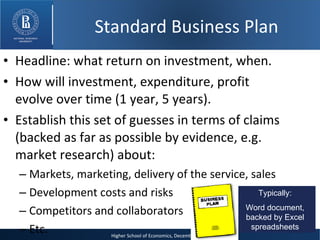
Headline: what return on investment, when. How will investment, expenditure, profit evolve over time (1 year, 5 years). Establish this set of guesses in terms of claims (backed as far as possible by evidence, e.g. market research) about: Markets, marketing, delivery of the service, sales Development costs and risks Competitors and collaborators Etc. Typically: Word document, backed by Excel spreadsheets Standard Business Plan
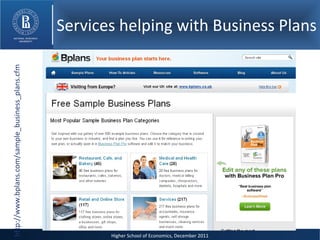
Services helping with Business Plans http://www.bplans.com/sample_business_plans.cfm
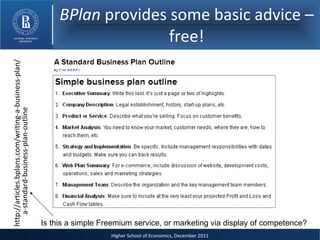
BPlan  provides some basic advice – free! http://articles.bplans.com/writing-a-business-plan/a-standard-business-plan-outline Is this a simple Freemium service, or marketing via display of competence?
* This terminology from Steve Blank, who has good presentations at http:// www.steveblank.com Business Plan versus Business Model Business Plan Business Model Written down on paper to convince investors: a SELLING job [though preparing this can be very instructive] May be partly written [e.g. For visualisation], but largely tacit and shared mental model to coordinate partners Formalised (one looks much like another): a set of guesses about opportunities and risks, with justifications where possible. Appraisal of how different “building blocks” can be aligned, under what circumstances.* Justifies action by providing an account of how business and its markets should evolve. Prompts analysis of where actions are required to fulfil (or modify) ambitions. Criterion: Does it sell the firm to investors? Criterion: Does it guide action effectively, and can it be revised when needed?
What benefits are we delivering? How are they made available to our consumers/clients? How are we creating them? Who is helping us create them? What are the resources and capabilities we need to do these things? How are we balancing the books and making a profit? A series of points where we need to take action, to monitor developments, to appraise competitors, customers, partners…                Business Plan is NOT a Business Model Business Plan Business Model Written down on paper to convince investors: a SELLING job [though preparing this can be very instructive] May be partly written [e.g. For visualisation], but largely tacit and shared mental model to coordinate partners Formalised (one looks much like another): a set of guesses about opportunities and risks, with justifications where possible. Appraisal of how different “building blocks” can be aligned, under what circumstances.* Justifies action by providing an account of how business and its markets should evolve. Prompts analysis of where actions are required to fulfil (or modify) ambitions. Does it sell the firm to investors? Does it guide action effectively, and can it be revised when needed?
David Teece on Business Models Often BM is seen as  how you make money  David Teece -  “ how a firm delivers value to customers, entices customers to make payments, and converts customers payments to profits” paper in  Long Range Planning , but see powerpoints at:  http://businessinnovation.berkeley.edu/ teece / Business_Models_Business_Strategy_and_Innovation.pptx “ A business model reflects management’s  hypothesis  about  what   customers  want,  how  they want it, and how the enterprise can  organize  to best meet those needs, get  paid  for doing so, and make a  profit .”
Model A mental representation, a set of hypotheses May be codified (written down), but more important to  share and use for guidance Will typically be modified by cruel reality What are the key elements?  commentators vary in the number they propose, see  essays  in  Long-Range Planning   June  2010 Business Model  thinking  to help   business planning and analysis:
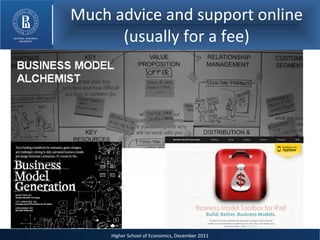
Much advice and support online (usually for a fee)
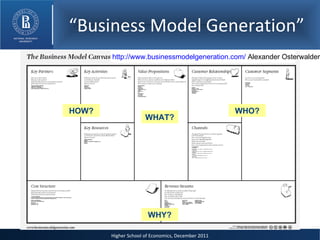
“ Business Model Generation” http://www.businessmodelgeneration.com/  Alexander Osterwalder WHAT? WHO? HOW? WHY?
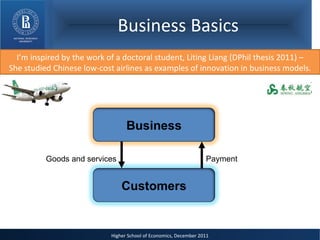
Business Basics Goods and services Payment I’m inspired by the work of a doctoral student, Liting Liang (DPhil thesis 2011) – She studied Chinese low-cost airlines as examples of innovation in business models. Business Customers
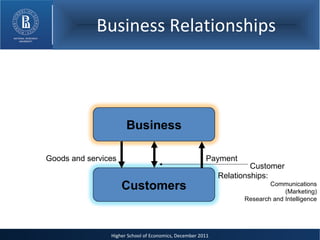
Business Relationships Goods and services Payment Customer  Relationships:  Communications (Marketing) Research and Intelligence Business Customers
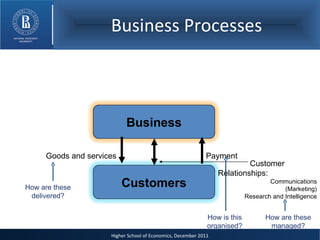
Business Processes Goods and services Payment Customer  Relationships:  Communications (Marketing) Research and Intelligence How are these managed? How is this organised? How are these delivered? Business Customers
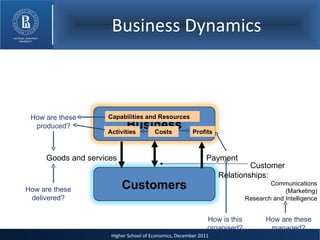
Business Dynamics Goods and services Payment Customer  Relationships:  Communications (Marketing) Research and Intelligence How are these managed? How is this organised? How are these delivered? How are these produced? Capabilities and Resources Activities Costs Profits Business Customers
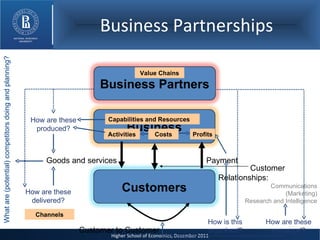
Business Partnerships Goods and services Payment Customer  Relationships:  Communications (Marketing) Research and Intelligence How are these managed? How is this organised? How are these delivered? How are these produced? Capabilities and Resources Activities Costs Profits Value Chains Channels Customer to Customer What are (potential) competitors doing and planning? Business Customers Business Partners
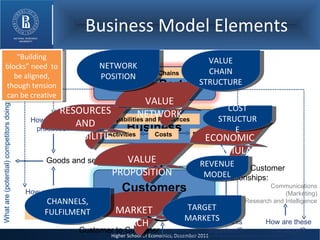
Business Model Elements What are (potential) competitors doing and planning? Customer to Customer Goods and services Payment Customer  Relationships:  Communications (Marketing) Research and Intelligence How are these managed? How is this organised? How are these delivered? How are these produced? Capabilities and Resources Activities Costs Profits Value Chains Channels ECONOMIC FORMULA VALUE PROPOSITION RESOURCES AND CAPABILITIES REVENUE MODEL COST STRUCTURE VALUE NETWORK VALUE CHAIN STRUCTURE NETWORK POSITION MARKET REACH TARGET MARKETS CHANNELS, FULFILMENT “ Building blocks” need  to be aligned, though tension can be creative Business Customers Business Partners
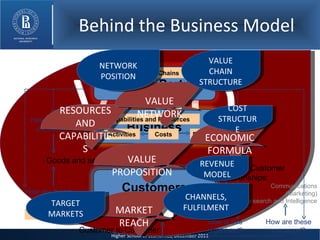
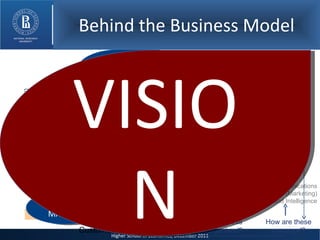
Behind the Business Model VISION Customer to Customer Goods and services Payment Customer  Relationships:  Communications (Marketing) Research and Intelligence How are these managed? How is this organised? How are these delivered? How are these produced? Capabilities and Resources Activities Costs Profits Value Chains Channels ECONOMIC FORMULA VALUE PROPOSITION RESOURCES AND CAPABILITIES REVENUE MODEL COST STRUCTURE VALUE NETWORK VALUE CHAIN STRUCTURE NETWORK POSITION MARKET REACH TARGET MARKETS CHANNELS, FULFILMENT Business Customers Business Partners
Behind the Business Model Customer to Customer Goods and services Payment Customer  Relationships:  Communications (Marketing) Research and Intelligence How are these managed? How is this organised? How are these delivered? How are these produced? Capabilities and Resources Activities Costs Profits Value Chains Channels ECONOMIC FORMULA VALUE PROPOSITION RESOURCES AND CAPABILITIES REVENUE MODEL COST STRUCTURE VALUE NETWORK VALUE CHAIN STRUCTURE NETWORK POSITION MARKET REACH TARGET MARKETS CHANNELS, FULFILMENT VISION Business Customers Business Partners
e- and Business Models The models may be different, but the elements or building blocks are essentially the same. Much of the recent discussion of Business Models, however, focuses on cases of relatively conventional businesses, though with some e-features thrown in. Perhaps this reflects the fear that  many e-business models are, as the bubble showed, not really sustainable, not the great models for the rest of us that were claimed. Much discussion of disruptive innovators (Christensen)
TODAY’S EXERCISE Two (maybe three) groups. Each to take an area for e-business development  Either  within an existing business you know well Or  a product space (some type of functionality offered by a good or service) where you can imagine that there are business and market opportunities  EXAMPLES New location-based service  – providing useful (or entertaining) information related to whereabouts of yourself (or your property, family/friends/pets…) Business service  – providing access to knowledge and skills capable of solving problems in business processes – anything from marketing and legal support to IT systems integration and industrial or service design Utilities  – usually big infrastructure firms supplying power, water, telecommunications – transport could be included here, though (e.g. taxis) Goods-related industries  – manufacturing, assembly, retail firms. TASK 1:  Form groups Decide on area Choose rapporteur
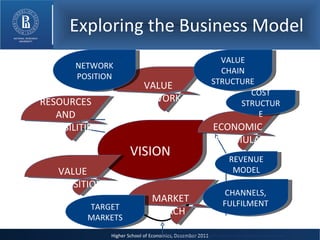
Exploring the Business Model VISION ECONOMIC FORMULA VALUE PROPOSITION RESOURCES AND CAPABILITIES REVENUE MODEL COST STRUCTURE VALUE NETWORK VALUE CHAIN STRUCTURE NETWORK POSITION MARKET REACH TARGET MARKETS CHANNELS, FULFILMENT
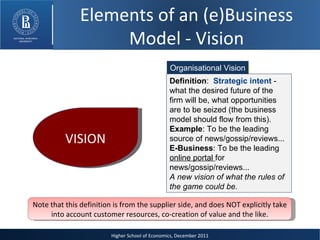
Organisational Vision Definition :  Strategic intent  - what the desired future of the firm will be, what opportunities are to be seized (the business model should flow from this). Example : To be the leading source of news/gossip/reviews... E-Business : To be the leading  online portal  for news/gossip/reviews... A new vision of what the rules of the game could be.   Note that this definition is from the supplier side, and does NOT explicitly take into account customer resources, co-creation of value and the like. VISION Elements of an (e)Business Model - Vision
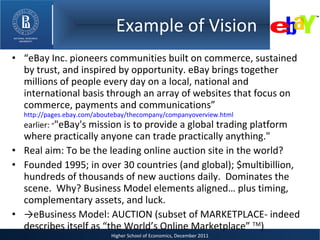
Example of Vision “ eBay Inc. pioneers communities built on commerce, sustained by trust, and inspired by opportunity. eBay brings together millions of people every day on a local, national and international basis through an array of websites that focus on commerce, payments and communications” http://pages.ebay.com/aboutebay/thecompany/companyoverview.html earlier:  “ "eBay's mission is to provide a global trading platform where practically anyone can trade practically anything."  Real aim: To be the leading online auction site in the world? Founded 1995; in over 30 countries (and global); $multibillion, hundreds of thousands of new auctions daily.  Dominates the scene.  Why? Business Model elements aligned… plus timing, complementary assets, and luck. -> eBusiness Model: AUCTION (subset of MARKETPLACE- indeed describes itself as “the World’s Online Marketplace”  TM )
So: What is your Vision? TASK TWO What is your  Strategic Intent ? what is the future that could be your “stretch target”? Try to complete the following statement:  “By [year] we want [firm name] to be known as the leading/ one of the leading  suppliers of [your product] in [your intended market]” Can you do a SWOT on this: what are your  Strengths  for this, your areas of  Weakness , the  Opportunities   to be seized, the  Threats  to be confronted?
Results
Elements of an (e)Business Model – Value Proposition Value Proposition Definition : What benefits offered to the consumer, at what price and conditions. Example:  Books; sold at shop; can examine there; can keep and share them.  eBusiness : e-books; copying/sharing may be restricted; available online anywhere; need a reader.  New services, new delivery mechanisms, new prices, new service/price combinations (e.g. “no frills”).  [scope for “blue ocean strategy”?] VALUE PROPOSITION TARGET MARKETS
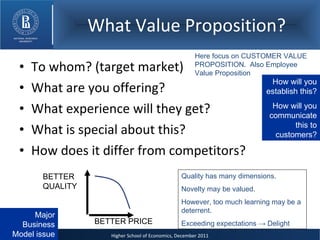
What Value Proposition? To whom? (target market) What are you offering? What experience will they get? What is special about this? How does it differ from competitors? How will you establish this? How will you communicate this to customers? Here focus on CUSTOMER VALUE PROPOSITION.  Also Employee Value Proposition BETTER QUALITY BETTER PRICE Quality has many dimensions. Novelty may be valued. However, too much learning may be a deterrent. Exceeding expectations  -> Delight Major Business Model issue
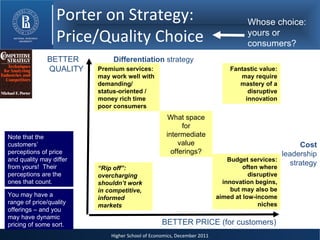
Porter on Strategy: Price/Quality Choice BETTER   Differentiation  strategy   QUALITY BETTER PRICE (for customers) “ Rip off”: overcharging shouldn’t work in competitive, informed markets Fantastic value: may require mastery of a disruptive innovation Premium services: may work well with demanding/  status-oriented / money rich time poor consumers Budget services: often where disruptive innovation begins, but may also be aimed at low-income niches What space for intermediate value offerings? Whose choice: yours or consumers? Note that the customers’ perceptions of price and quality may differ from yours!  Their perceptions are the ones that count. You may have a range of price/quality offerings – and you may have dynamic pricing of some sort. Cost  leadership strategy
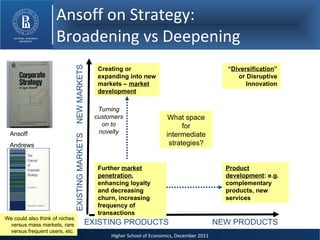
Ansoff on Strategy: Broadening vs Deepening EXISTING MARKETS  NEW MARKETS EXISTING PRODUCTS NEW PRODUCTS Further  market penetration , enhancing loyalty and decreasing churn, increasing frequency of transactions “ Diversification ” or Disruptive Innovation Creating or expanding into new markets –  market development Product development : e.g. complementary products, new services What space for intermediate strategies? Ansoff Andrews Turning customers on to novelty We could also think of niches versus mass markets, rare versus frequent users, etc.
So: What is your Value Proposition? TASK TWO What  do customers get?  What are you  Offering  - what consumer need or want is addressed, at what cost, in what form? How does the product (good/service) provide this? What does the product consist of? What mixture of goods and services? What (if anything) is new about this? Is this a familiar offering, an incremental improvement, a radical  improvement? Is it disruptive to existing markets and industries? Is it a high quality or no-frills offering?  Do you offer a choice  (e.g. freemium vs. executive?)  (Note that some aspects of quality probably cannot be sacrificed) What consumer inputs might be required? Are we dealing directly with final consumers, or intermediaries (e.g. Retail)? How does it differ from competitors’ (potential) offerings? What target market?  Who are the customers? Niche versus mass market (as ultimate target)? What mix of regular customers, infrequent customers? [We will have more questions to ask about the market in future sessions]
Results
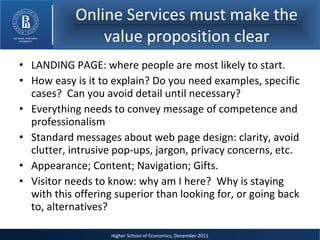
Online Services must make the value proposition clear LANDING PAGE: where people are most likely to start. How easy is it to explain? Do you need examples, specific cases?  Can you avoid detail until necessary? Everything needs to convey message of competence and professionalism Standard messages about web page design: clarity, avoid clutter, intrusive pop-ups, jargon, privacy concerns, etc. Appearance; Content; Navigation; Gifts.  Visitor needs to know: why am I here?  Why is staying with this offering superior than looking for, or going back to, alternatives?
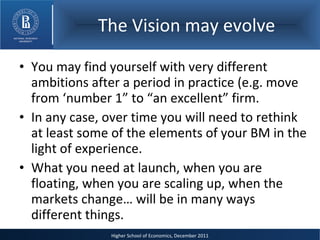
The Vision may evolve You may find yourself with very different ambitions after a period in practice (e.g. move from ‘number 1” to “an excellent” firm. In any case, over time you will need to rethink at least some of the elements of your BM in the light of experience. What you need at launch, when you are floating, when you are scaling up, when the markets change… will be in many ways different things.
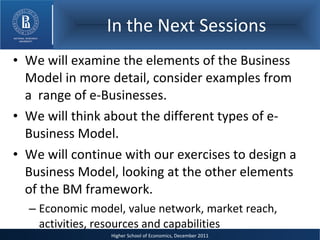
In the Next Sessions We will examine the elements of the Business Model in more detail, consider examples from a  range of e-Businesses. We will think about the different types of e-Business Model. We will continue with our exercises to design a Business Model, looking at the other elements of the BM framework. Economic model, value network, market reach, activities, resources and capabilities
20, Myasnitskaya str., Moscow, Russia, 101000 Tel.: +7 (495)  621-2873 , Fax: +7 (495)  625-0367 www.hse.ru [email_address] ------------------------PARTICIPATION!

2011 autumn e business models 2

  • 1.
    Ian Miles ResearchLaboratory for the Economics of Innovation, HSE (and Manchester Institute of Innovation Research) December 2011 e - Business and e - Business Models – Part 2 [ « Business and business models in the Internet »]
  • 2.
    The Story sofar… In the first seminar we looked at the very first efforts to create new e-businesses, aimed at consumers and at private firms We considered some of the reasons for the limited success of many of these ventures, and introduced ideas like “design paradigms” and “complementary assets” We also considered the dot com bubble, which had the beneficial side-effect of making people think seriously about Business Models
  • 3.
    Agenda for TodayBusiness Model versus Business Plan Basic ideas about Elements of Business MODELS EXERCISES.
  • 4.
    Business Model isNOT a Business Plan Business Plan Written down on paper to convince investors: a SELLING job [though preparing this can be very instructive] Formalised (one looks much like another): a set of guesses about opportunities and risks, with justifications where possible. Justifies action by providing an account of how business and its markets should evolve. Criterion: Does it sell the firm to investors?
  • 5.
    Headline: what returnon investment, when. How will investment, expenditure, profit evolve over time (1 year, 5 years). Establish this set of guesses in terms of claims (backed as far as possible by evidence, e.g. market research) about: Markets, marketing, delivery of the service, sales Development costs and risks Competitors and collaborators Etc. Typically: Word document, backed by Excel spreadsheets Standard Business Plan
  • 6.
    Services helping withBusiness Plans http://www.bplans.com/sample_business_plans.cfm
  • 7.
    BPlan providessome basic advice – free! http://articles.bplans.com/writing-a-business-plan/a-standard-business-plan-outline Is this a simple Freemium service, or marketing via display of competence?
  • 8.
    * This terminologyfrom Steve Blank, who has good presentations at http:// www.steveblank.com Business Plan versus Business Model Business Plan Business Model Written down on paper to convince investors: a SELLING job [though preparing this can be very instructive] May be partly written [e.g. For visualisation], but largely tacit and shared mental model to coordinate partners Formalised (one looks much like another): a set of guesses about opportunities and risks, with justifications where possible. Appraisal of how different “building blocks” can be aligned, under what circumstances.* Justifies action by providing an account of how business and its markets should evolve. Prompts analysis of where actions are required to fulfil (or modify) ambitions. Criterion: Does it sell the firm to investors? Criterion: Does it guide action effectively, and can it be revised when needed?
  • 9.
    What benefits arewe delivering? How are they made available to our consumers/clients? How are we creating them? Who is helping us create them? What are the resources and capabilities we need to do these things? How are we balancing the books and making a profit? A series of points where we need to take action, to monitor developments, to appraise competitors, customers, partners…                Business Plan is NOT a Business Model Business Plan Business Model Written down on paper to convince investors: a SELLING job [though preparing this can be very instructive] May be partly written [e.g. For visualisation], but largely tacit and shared mental model to coordinate partners Formalised (one looks much like another): a set of guesses about opportunities and risks, with justifications where possible. Appraisal of how different “building blocks” can be aligned, under what circumstances.* Justifies action by providing an account of how business and its markets should evolve. Prompts analysis of where actions are required to fulfil (or modify) ambitions. Does it sell the firm to investors? Does it guide action effectively, and can it be revised when needed?
  • 10.
    David Teece onBusiness Models Often BM is seen as how you make money David Teece - “ how a firm delivers value to customers, entices customers to make payments, and converts customers payments to profits” paper in Long Range Planning , but see powerpoints at: http://businessinnovation.berkeley.edu/ teece / Business_Models_Business_Strategy_and_Innovation.pptx “ A business model reflects management’s hypothesis about what customers want, how they want it, and how the enterprise can organize to best meet those needs, get paid for doing so, and make a profit .”
  • 11.
    Model A mentalrepresentation, a set of hypotheses May be codified (written down), but more important to share and use for guidance Will typically be modified by cruel reality What are the key elements? commentators vary in the number they propose, see essays in Long-Range Planning June 2010 Business Model thinking to help business planning and analysis:
  • 12.
    Much advice andsupport online (usually for a fee)
  • 13.
    “ Business ModelGeneration” http://www.businessmodelgeneration.com/ Alexander Osterwalder WHAT? WHO? HOW? WHY?
  • 14.
    Business Basics Goodsand services Payment I’m inspired by the work of a doctoral student, Liting Liang (DPhil thesis 2011) – She studied Chinese low-cost airlines as examples of innovation in business models. Business Customers
  • 15.
    Business Relationships Goodsand services Payment Customer Relationships: Communications (Marketing) Research and Intelligence Business Customers
  • 16.
    Business Processes Goodsand services Payment Customer Relationships: Communications (Marketing) Research and Intelligence How are these managed? How is this organised? How are these delivered? Business Customers
  • 17.
    Business Dynamics Goodsand services Payment Customer Relationships: Communications (Marketing) Research and Intelligence How are these managed? How is this organised? How are these delivered? How are these produced? Capabilities and Resources Activities Costs Profits Business Customers
  • 18.
    Business Partnerships Goodsand services Payment Customer Relationships: Communications (Marketing) Research and Intelligence How are these managed? How is this organised? How are these delivered? How are these produced? Capabilities and Resources Activities Costs Profits Value Chains Channels Customer to Customer What are (potential) competitors doing and planning? Business Customers Business Partners
  • 19.
    Business Model ElementsWhat are (potential) competitors doing and planning? Customer to Customer Goods and services Payment Customer Relationships: Communications (Marketing) Research and Intelligence How are these managed? How is this organised? How are these delivered? How are these produced? Capabilities and Resources Activities Costs Profits Value Chains Channels ECONOMIC FORMULA VALUE PROPOSITION RESOURCES AND CAPABILITIES REVENUE MODEL COST STRUCTURE VALUE NETWORK VALUE CHAIN STRUCTURE NETWORK POSITION MARKET REACH TARGET MARKETS CHANNELS, FULFILMENT “ Building blocks” need to be aligned, though tension can be creative Business Customers Business Partners
  • 20.
    Behind the BusinessModel VISION Customer to Customer Goods and services Payment Customer Relationships: Communications (Marketing) Research and Intelligence How are these managed? How is this organised? How are these delivered? How are these produced? Capabilities and Resources Activities Costs Profits Value Chains Channels ECONOMIC FORMULA VALUE PROPOSITION RESOURCES AND CAPABILITIES REVENUE MODEL COST STRUCTURE VALUE NETWORK VALUE CHAIN STRUCTURE NETWORK POSITION MARKET REACH TARGET MARKETS CHANNELS, FULFILMENT Business Customers Business Partners
  • 21.
    Behind the BusinessModel Customer to Customer Goods and services Payment Customer Relationships: Communications (Marketing) Research and Intelligence How are these managed? How is this organised? How are these delivered? How are these produced? Capabilities and Resources Activities Costs Profits Value Chains Channels ECONOMIC FORMULA VALUE PROPOSITION RESOURCES AND CAPABILITIES REVENUE MODEL COST STRUCTURE VALUE NETWORK VALUE CHAIN STRUCTURE NETWORK POSITION MARKET REACH TARGET MARKETS CHANNELS, FULFILMENT VISION Business Customers Business Partners
  • 22.
    e- and BusinessModels The models may be different, but the elements or building blocks are essentially the same. Much of the recent discussion of Business Models, however, focuses on cases of relatively conventional businesses, though with some e-features thrown in. Perhaps this reflects the fear that many e-business models are, as the bubble showed, not really sustainable, not the great models for the rest of us that were claimed. Much discussion of disruptive innovators (Christensen)
  • 23.
    TODAY’S EXERCISE Two(maybe three) groups. Each to take an area for e-business development Either within an existing business you know well Or a product space (some type of functionality offered by a good or service) where you can imagine that there are business and market opportunities EXAMPLES New location-based service – providing useful (or entertaining) information related to whereabouts of yourself (or your property, family/friends/pets…) Business service – providing access to knowledge and skills capable of solving problems in business processes – anything from marketing and legal support to IT systems integration and industrial or service design Utilities – usually big infrastructure firms supplying power, water, telecommunications – transport could be included here, though (e.g. taxis) Goods-related industries – manufacturing, assembly, retail firms. TASK 1: Form groups Decide on area Choose rapporteur
  • 24.
    Exploring the BusinessModel VISION ECONOMIC FORMULA VALUE PROPOSITION RESOURCES AND CAPABILITIES REVENUE MODEL COST STRUCTURE VALUE NETWORK VALUE CHAIN STRUCTURE NETWORK POSITION MARKET REACH TARGET MARKETS CHANNELS, FULFILMENT
  • 25.
    Organisational Vision Definition: Strategic intent - what the desired future of the firm will be, what opportunities are to be seized (the business model should flow from this). Example : To be the leading source of news/gossip/reviews... E-Business : To be the leading online portal for news/gossip/reviews... A new vision of what the rules of the game could be. Note that this definition is from the supplier side, and does NOT explicitly take into account customer resources, co-creation of value and the like. VISION Elements of an (e)Business Model - Vision
  • 26.
    Example of Vision“ eBay Inc. pioneers communities built on commerce, sustained by trust, and inspired by opportunity. eBay brings together millions of people every day on a local, national and international basis through an array of websites that focus on commerce, payments and communications” http://pages.ebay.com/aboutebay/thecompany/companyoverview.html earlier: “ "eBay's mission is to provide a global trading platform where practically anyone can trade practically anything." Real aim: To be the leading online auction site in the world? Founded 1995; in over 30 countries (and global); $multibillion, hundreds of thousands of new auctions daily. Dominates the scene. Why? Business Model elements aligned… plus timing, complementary assets, and luck. -> eBusiness Model: AUCTION (subset of MARKETPLACE- indeed describes itself as “the World’s Online Marketplace” TM )
  • 27.
    So: What isyour Vision? TASK TWO What is your Strategic Intent ? what is the future that could be your “stretch target”? Try to complete the following statement: “By [year] we want [firm name] to be known as the leading/ one of the leading suppliers of [your product] in [your intended market]” Can you do a SWOT on this: what are your Strengths for this, your areas of Weakness , the Opportunities to be seized, the Threats to be confronted?
  • 28.
  • 29.
    Elements of an(e)Business Model – Value Proposition Value Proposition Definition : What benefits offered to the consumer, at what price and conditions. Example: Books; sold at shop; can examine there; can keep and share them. eBusiness : e-books; copying/sharing may be restricted; available online anywhere; need a reader. New services, new delivery mechanisms, new prices, new service/price combinations (e.g. “no frills”). [scope for “blue ocean strategy”?] VALUE PROPOSITION TARGET MARKETS
  • 30.
    What Value Proposition?To whom? (target market) What are you offering? What experience will they get? What is special about this? How does it differ from competitors? How will you establish this? How will you communicate this to customers? Here focus on CUSTOMER VALUE PROPOSITION. Also Employee Value Proposition BETTER QUALITY BETTER PRICE Quality has many dimensions. Novelty may be valued. However, too much learning may be a deterrent. Exceeding expectations -> Delight Major Business Model issue
  • 31.
    Porter on Strategy:Price/Quality Choice BETTER Differentiation strategy QUALITY BETTER PRICE (for customers) “ Rip off”: overcharging shouldn’t work in competitive, informed markets Fantastic value: may require mastery of a disruptive innovation Premium services: may work well with demanding/ status-oriented / money rich time poor consumers Budget services: often where disruptive innovation begins, but may also be aimed at low-income niches What space for intermediate value offerings? Whose choice: yours or consumers? Note that the customers’ perceptions of price and quality may differ from yours! Their perceptions are the ones that count. You may have a range of price/quality offerings – and you may have dynamic pricing of some sort. Cost leadership strategy
  • 32.
    Ansoff on Strategy:Broadening vs Deepening EXISTING MARKETS NEW MARKETS EXISTING PRODUCTS NEW PRODUCTS Further market penetration , enhancing loyalty and decreasing churn, increasing frequency of transactions “ Diversification ” or Disruptive Innovation Creating or expanding into new markets – market development Product development : e.g. complementary products, new services What space for intermediate strategies? Ansoff Andrews Turning customers on to novelty We could also think of niches versus mass markets, rare versus frequent users, etc.
  • 33.
    So: What isyour Value Proposition? TASK TWO What do customers get? What are you Offering - what consumer need or want is addressed, at what cost, in what form? How does the product (good/service) provide this? What does the product consist of? What mixture of goods and services? What (if anything) is new about this? Is this a familiar offering, an incremental improvement, a radical improvement? Is it disruptive to existing markets and industries? Is it a high quality or no-frills offering? Do you offer a choice (e.g. freemium vs. executive?) (Note that some aspects of quality probably cannot be sacrificed) What consumer inputs might be required? Are we dealing directly with final consumers, or intermediaries (e.g. Retail)? How does it differ from competitors’ (potential) offerings? What target market? Who are the customers? Niche versus mass market (as ultimate target)? What mix of regular customers, infrequent customers? [We will have more questions to ask about the market in future sessions]
  • 34.
  • 35.
    Online Services mustmake the value proposition clear LANDING PAGE: where people are most likely to start. How easy is it to explain? Do you need examples, specific cases? Can you avoid detail until necessary? Everything needs to convey message of competence and professionalism Standard messages about web page design: clarity, avoid clutter, intrusive pop-ups, jargon, privacy concerns, etc. Appearance; Content; Navigation; Gifts. Visitor needs to know: why am I here? Why is staying with this offering superior than looking for, or going back to, alternatives?
  • 36.
    The Vision mayevolve You may find yourself with very different ambitions after a period in practice (e.g. move from ‘number 1” to “an excellent” firm. In any case, over time you will need to rethink at least some of the elements of your BM in the light of experience. What you need at launch, when you are floating, when you are scaling up, when the markets change… will be in many ways different things.
  • 37.
    In the NextSessions We will examine the elements of the Business Model in more detail, consider examples from a range of e-Businesses. We will think about the different types of e-Business Model. We will continue with our exercises to design a Business Model, looking at the other elements of the BM framework. Economic model, value network, market reach, activities, resources and capabilities
  • 38.
    20, Myasnitskaya str.,Moscow, Russia, 101000 Tel.: +7 (495) 621-2873 , Fax: +7 (495) 625-0367 www.hse.ru [email_address] ------------------------PARTICIPATION!