Graduate Champions
Boot camp
Session 2
Business Models
What is a business
model?
What is a business model?
Stories that explain
how enterprises work
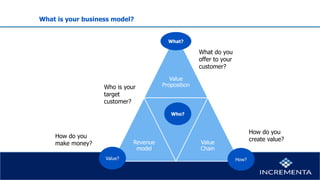
That answer fundamental questions:
Who is the customer?
What does the customer
value?
We must also not forget the issue of revenue
“A million people walk into a
Silicon Valley bar. No one buys
anything. The bar is declared a
massive success”
What is a business model?
Value
Proposition
Revenue
model
Who?
Value
Chain
What do you
offer to your
customer?
How do you
create value?
How do you
make money?
Who is your
target
customer?
What?
How?Value?
Who?
Business Models
• Who – every business model serves a certain customer group. Who, therefore, is in your target
customer segment?
• What – is being offered to the target customer. The important aspect here is not the actual
product or service but the elements which the customer value (CVP)
• How – To build and distribute the value proposition the business has to master several processes
and activities. This, in addition to, your resources and capabilities creates your value chain
• Value – How are you going to generate revenue? How are you going to make money?
Business Models
By understanding these 4
associated points we can create a
tangible business model
What is your business model?
Value
Proposition
Revenue
model
Who?
Value
Chain
What do you
offer to your
customer?
How do you
create value?
How do you
make money?
Who is your
target
customer?
What?
How?Value?
Who?
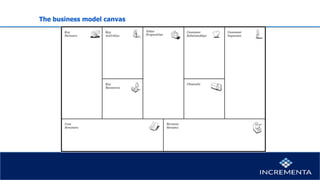
The business model canvas
Value Proposition
• How are we going to create value?
• Which one of our customer’s problems are we solving
• What’s different about our idea?
• A value proposition creates value for a customer through a distinct mix of elements specifically catering
for their needs:
− Newness
−Some value propositions satisfy an entirely new set of needs that customers previously didn’t perceive
− Performance
−Improving product performance is traditionally a common way to add value
− Customisation
−Tailoring products and services to specific needs of customers.
Value Proposition
− Design
−Design is an important but difficult element to measure – Apple
− Brand / status
−Customers may find a value in the simple act of using and displaying a specific brand – brand aspiration
− Price
−Offering similar value at a lower price is a common way of satisfying needs.
− Risk reduction
−Businesses add guarantees to generate value through risk reduction, e.g. car warranties
− Convenience / Usability
−Making things more convenient to buy or easier to use is a good value proposition. Apple again is a good
example
Customer segments
• Who are you creating value to?
• Who are your most important customers?
• Mass Market – for example Coke – no real differentiation
• Niche – a specific and defined target audience
• Segmented – a few different niches who have different needs
• Diversified – two very different and unrelated customer segments
Channels
• How do your customers want to be reached?
• Channels are touch points that play an important role in the customer experience.
• Channels serve several functions:
− Raising awareness among customers about a company
− Helping customers evaluate a company’s value proposition
− Allow customers to purchase specific products and services
− Delivering a value proposition
− Providing post purchase support
Customer relationships
• What type of relationship does each of our customer segments expect us to establish?
• How costly are they to establish?
• Personal assistance – email, phone, non specific
• Dedicated personal assistance – specific one to one service with a named individual
• Self service – no direct relationship with individuals
• Automated services – more sophisticated version of self service – recognising individual preferences
• Communities – Many companies are utilising on line communities to allow users to exchange knowledge
and solve each others problems.
• Co-creation – Wikipedia, You Tube, Amazon (through reviews) – co create value
Key activities
• What key activities do we need to do?
• These are the most important things a company must do to make its business work
− Production
−These relate to designing, making and delivering a product
− Problem Solving
−Coming up with new solutions to individual customer problems
− E.g. consultancies, hospitals, physios etc
− Platform / Network
−Ebay, matchmaking websites for example
−Visa with its payment platform
−Key activities in this area are platform management, service positioning and platform production
Key resources
• What key resources do you require?
• These are the most important assets required to make the business work.
− Physical
−For example, manufacturing facilities, vehicles, buildings, specialist equipment
− Intellectual
−For example, brands, patents, copyright, trademark
− Human
−Crucial in knowledge led (consultancy) and creative industries
− Financial
−Start up costs
−Financial resources
Key Partners
• Who are our key partners?
• Who are our key suppliers
• What do we need from them?
• The key partners building block describes the network of suppliers and partners that will make the
business work:
Who will we need to make this idea work?
• Key suppliers?
• Joint ventures?
Revenue Streams
• For what value are our customer really willing to pay?
• How are they currently paying?
• How would they prefer to pay?
• A business usually involves one of two different types of revenue streams:
− Transaction revenues resulting from a one off sale to a customer
− Recurring revenues resulting from on going payments to deliver services or to provide post purchase support
Revenue streams
• Different ways to generate revenue:
− Asset sale – standard product purchase model.
− Usage fee – mobile phones – the more you use something the more it costs
− Subscription – gym membership for example
− Lending / Renting – Temporarily using an asset
− Licensing – Image rights – music / sport
− Brokerage fees – Go Compare etc
− Advertising – fee generated by allowing advertising
Cost structure
• What are the most important costs in our business?
• Which resources are most expensive?
• Are any prohibitive?
• This area describes all of the costs that the business is likely to be charged:
− Cost driven
− Lean delivery such as Easy Jet / Ryan Air
− Value driven
− Some companies look in the opposite way to cost driven businesses.
− Their focus is on value creation – for example luxury hotels
There are 2 further characteristics
− Fixed Costs
− Variable costs
Adding to your canvas
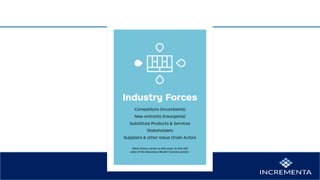
External Forces
Competition
• Who are our competitors?
• Who are the dominant players in our particular sector?
• What are their competitive advantages or disadvantages?
• Describe their main offers.
• Which Customer Segments are they focusing on?
Substitutes
• Which products or services could replace ours?
• How much do they cost compared to yours?
• How easy it is for customers to switch to these substitutes?
Competition
CVP / USP
How are you different?
What are your unique
competences?
External Forces
Do the external forces
change anything:
Create opportunities?
Create threats?
Graduate Outcomes Survey
If you receive a call, please complete the survey.
Thank you!
Any questions?

Business modelling dmu

  • 1.
  • 2.
    Business Models What isa business model?
  • 3.
    What is abusiness model? Stories that explain how enterprises work
  • 4.
    That answer fundamentalquestions: Who is the customer? What does the customer value?
  • 5.
    We must alsonot forget the issue of revenue “A million people walk into a Silicon Valley bar. No one buys anything. The bar is declared a massive success”
  • 6.
    What is abusiness model? Value Proposition Revenue model Who? Value Chain What do you offer to your customer? How do you create value? How do you make money? Who is your target customer? What? How?Value? Who?
  • 7.
    Business Models • Who– every business model serves a certain customer group. Who, therefore, is in your target customer segment? • What – is being offered to the target customer. The important aspect here is not the actual product or service but the elements which the customer value (CVP) • How – To build and distribute the value proposition the business has to master several processes and activities. This, in addition to, your resources and capabilities creates your value chain • Value – How are you going to generate revenue? How are you going to make money?
  • 8.
    Business Models By understandingthese 4 associated points we can create a tangible business model
  • 9.
    What is yourbusiness model? Value Proposition Revenue model Who? Value Chain What do you offer to your customer? How do you create value? How do you make money? Who is your target customer? What? How?Value? Who?
  • 10.
  • 15.
    Value Proposition • Howare we going to create value? • Which one of our customer’s problems are we solving • What’s different about our idea? • A value proposition creates value for a customer through a distinct mix of elements specifically catering for their needs: − Newness −Some value propositions satisfy an entirely new set of needs that customers previously didn’t perceive − Performance −Improving product performance is traditionally a common way to add value − Customisation −Tailoring products and services to specific needs of customers.
  • 16.
    Value Proposition − Design −Designis an important but difficult element to measure – Apple − Brand / status −Customers may find a value in the simple act of using and displaying a specific brand – brand aspiration − Price −Offering similar value at a lower price is a common way of satisfying needs. − Risk reduction −Businesses add guarantees to generate value through risk reduction, e.g. car warranties − Convenience / Usability −Making things more convenient to buy or easier to use is a good value proposition. Apple again is a good example
  • 17.
    Customer segments • Whoare you creating value to? • Who are your most important customers? • Mass Market – for example Coke – no real differentiation • Niche – a specific and defined target audience • Segmented – a few different niches who have different needs • Diversified – two very different and unrelated customer segments
  • 18.
    Channels • How doyour customers want to be reached? • Channels are touch points that play an important role in the customer experience. • Channels serve several functions: − Raising awareness among customers about a company − Helping customers evaluate a company’s value proposition − Allow customers to purchase specific products and services − Delivering a value proposition − Providing post purchase support
  • 19.
    Customer relationships • Whattype of relationship does each of our customer segments expect us to establish? • How costly are they to establish? • Personal assistance – email, phone, non specific • Dedicated personal assistance – specific one to one service with a named individual • Self service – no direct relationship with individuals • Automated services – more sophisticated version of self service – recognising individual preferences • Communities – Many companies are utilising on line communities to allow users to exchange knowledge and solve each others problems. • Co-creation – Wikipedia, You Tube, Amazon (through reviews) – co create value
  • 20.
    Key activities • Whatkey activities do we need to do? • These are the most important things a company must do to make its business work − Production −These relate to designing, making and delivering a product − Problem Solving −Coming up with new solutions to individual customer problems − E.g. consultancies, hospitals, physios etc − Platform / Network −Ebay, matchmaking websites for example −Visa with its payment platform −Key activities in this area are platform management, service positioning and platform production
  • 21.
    Key resources • Whatkey resources do you require? • These are the most important assets required to make the business work. − Physical −For example, manufacturing facilities, vehicles, buildings, specialist equipment − Intellectual −For example, brands, patents, copyright, trademark − Human −Crucial in knowledge led (consultancy) and creative industries − Financial −Start up costs −Financial resources
  • 22.
    Key Partners • Whoare our key partners? • Who are our key suppliers • What do we need from them? • The key partners building block describes the network of suppliers and partners that will make the business work: Who will we need to make this idea work? • Key suppliers? • Joint ventures?
  • 23.
    Revenue Streams • Forwhat value are our customer really willing to pay? • How are they currently paying? • How would they prefer to pay? • A business usually involves one of two different types of revenue streams: − Transaction revenues resulting from a one off sale to a customer − Recurring revenues resulting from on going payments to deliver services or to provide post purchase support
  • 24.
    Revenue streams • Differentways to generate revenue: − Asset sale – standard product purchase model. − Usage fee – mobile phones – the more you use something the more it costs − Subscription – gym membership for example − Lending / Renting – Temporarily using an asset − Licensing – Image rights – music / sport − Brokerage fees – Go Compare etc − Advertising – fee generated by allowing advertising
  • 25.
    Cost structure • Whatare the most important costs in our business? • Which resources are most expensive? • Are any prohibitive? • This area describes all of the costs that the business is likely to be charged: − Cost driven − Lean delivery such as Easy Jet / Ryan Air − Value driven − Some companies look in the opposite way to cost driven businesses. − Their focus is on value creation – for example luxury hotels There are 2 further characteristics − Fixed Costs − Variable costs
  • 26.
  • 31.
  • 32.
    Competition • Who areour competitors? • Who are the dominant players in our particular sector? • What are their competitive advantages or disadvantages? • Describe their main offers. • Which Customer Segments are they focusing on?
  • 33.
    Substitutes • Which productsor services could replace ours? • How much do they cost compared to yours? • How easy it is for customers to switch to these substitutes?
  • 34.
  • 35.
    CVP / USP Howare you different? What are your unique competences?
  • 36.
    External Forces Do theexternal forces change anything: Create opportunities? Create threats?
  • 37.
    Graduate Outcomes Survey Ifyou receive a call, please complete the survey. Thank you!
  • 38.