Preparing your
start-up “Pitch”
1
Dr. Jose María Alvarez Rodríguez
Business Applications of Big data Analytics
MASTER IN BIG DATA ANALYTICS
Universidad Carlos III de Madrid
15th of March, 2018
2
What is Pitch?
3
A verbal
Business
Plan
4
How to deliver a Pitch?
Source: https://www.entrepreneur.com/article/251311
5
Time is
critical
10 minutes
https://www.entrepreneur.com/article/251311
Some recommendations…
• If you say that you’ll take “only X minutes,” then take at least one
minute less.
• If you are told, “You only have X minutes to pitch,” then take at least
five minutes less.
• If you say, “One last thing” or something similar, then make sure it’s
truly the one last thing.
• Move at a good pace. Don’t rush at the end.
• If you’re using slides, don’t get stuck on one slide for more than
three minutes.
6
https://www.entrepreneur.com/article/251311
7
Turn your
pitch into
Story
Engagement
https://www.entrepreneur.com/article/251311
8
Be laser-
focused
Core
elements
https://www.entrepreneur.com/article/251311
9
Explain
exactly
Your
product/service
https://www.entrepreneur.com/article/251311
10
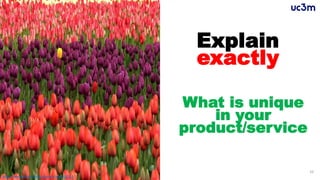
Explain
exactly
What is unique
in your
product/service
https://www.entrepreneur.com/article/251311
11
Explain
exactly
Who is your
audience
https://www.entrepreneur.com/article/251311
12
Explain
exactly
How you are
going to get your
audience
https://www.entrepreneur.com/article/251311
13
Explain
exactly
Your revenue
model
https://www.entrepreneur.com/article/251311
14
Be
wildly
Enthusiastic/
Optimistic/
Self-confident
https://www.entrepreneur.com/article/251311
Others…
Dress to kill Practice your pitch
Anticipate
questions, and
answer them
ahead of time
15
https://www.entrepreneur.com/article/251311
16
Exit
Strategy
https://www.entrepreneur.com/article/251311
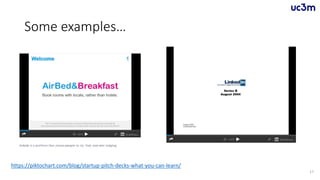
Some examples…
17
https://piktochart.com/blog/startup-pitch-decks-what-you-can-learn/
18
Structure
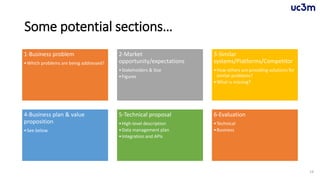
Some potential sections…
1-Business problem
•Which problems are being addressed?
2-Market
opportunity/expectations
•Stakeholders & Size
•Figures
3-Similar
systems/Platforms/Competitor
•How others are providing solutions for
similar problems?
•What is missing?
4-Business plan & value
proposition
•See below
5-Technical proposal
•High-level description
•Data management plan
•Integration and APIs
6-Evaluation
•Technical
•Business
19
20
Business plan
Data-driven
company
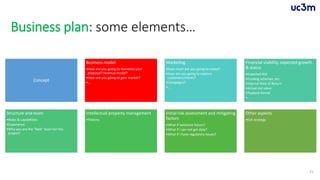
Business plan: some elements…
Concept
Business model
•How are you going to monetize your
proposal? revenue model?
•How are you going to gain market?
•…
Marketing
•How much are you going to invest?
•How are you going to capture
customers/clients?
•Campaigns?
•…
Financial viability, expected growth
& status
•Expected ROI
•Funding schemes, etc.
•Internal Rate of Return
•Actual net value
•Payback Period
•…
Structure and team
•Roles & capabilities
•Experience
•Why you are the “best” team for this
project?
Intellectual property management
•Patents
Initial risk assessment and mitigating
factors
•What if someone leaves?
•What if I can not get data?
•What if I have regulatory issues?
Other aspects
•Exit strategy
21
22
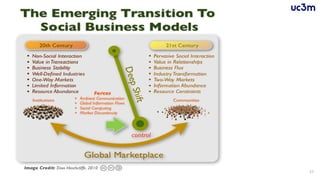
Business
Model
https://hbr.org/2011/01/how-to-design-a-winning-
business-model%20
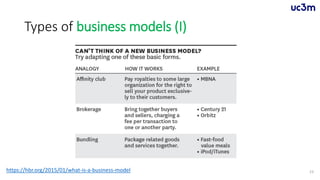
Types of business models (I)
23https://hbr.org/2015/01/what-is-a-business-model
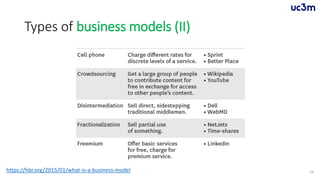
Types of business models (II)
24https://hbr.org/2015/01/what-is-a-business-model
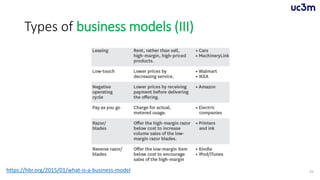
Types of business models (III)
25https://hbr.org/2015/01/what-is-a-business-model
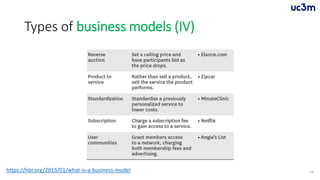
Types of business models (IV)
26https://hbr.org/2015/01/what-is-a-business-model
27
28
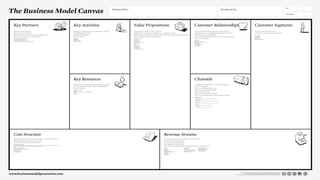
Any technique to prepare
a business model?
30
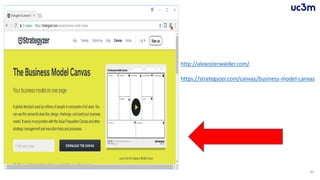
https://strategyzer.com/canvas/business-model-canvas
http://alexosterwalder.com/
31
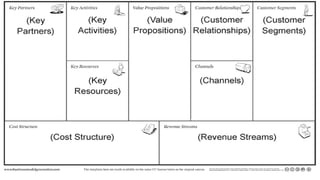
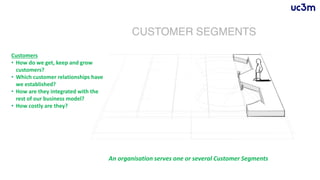
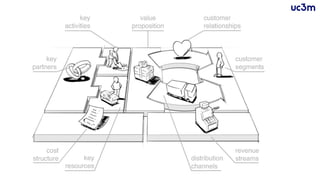
An organisation serves one or several Customer Segments
Customers
• How do we get, keep and grow
customers?
• Which customer relationships have
we established?
• How are they integrated with the
rest of our business model?
• How costly are they?
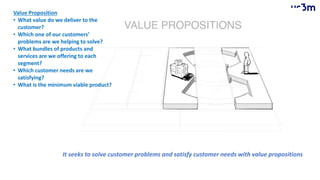
It seeks to solve customer problems and satisfy customer needs with value propositions
Value Proposition
• What value do we deliver to the
customer?
• Which one of our customers’
problems are we helping to solve?
• What bundles of products and
services are we offering to each
segment?
• Which customer needs are we
satisfying?
• What is the minimum viable product?
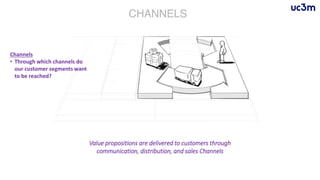
Value propositions are delivered to customers through
communication, distribution, and sales Channels
Channels
• Through which channels do
our customer segments want
to be reached?
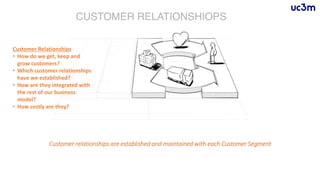
Customer relationships are established and maintained with each Customer Segment
Customer Relationships
• How do we get, keep and
grow customers?
• Which customer relationships
have we established?
• How are they integrated with
the rest of our business
model?
• How costly are they?
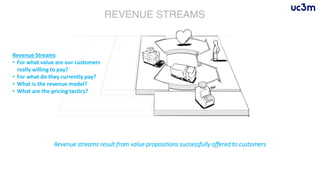
Revenue streams result from value propositions successfully offered to customers
Revenue Streams
• For what value are our customers
really willing to pay?
• For what do they currently pay?
• What is the revenue model?
• What are the pricing tactics?
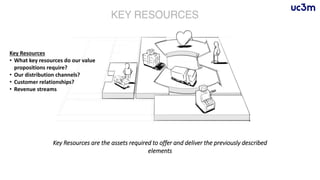
Key Resources are the assets required to offer and deliver the previously described
elements
Key Resources
• What key resources do our value
propositions require?
• Our distribution channels?
• Customer relationships?
• Revenue streams
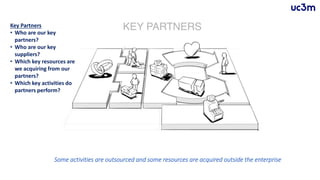
Some activities are outsourced and some resources are acquired outside the enterprise
Key Partners
• Who are our key
partners?
• Who are our key
suppliers?
• Which key resources are
we acquiring from our
partners?
• Which key activities do
partners perform?
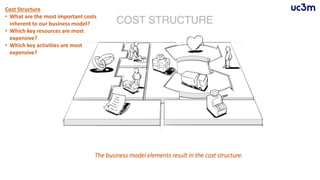
The business model elements result in the cost structure.
Cost Structure
• What are the most important costs
inherent to our business model?
• Which key resources are most
expensive?
• Which key activities are most
expensive?
41
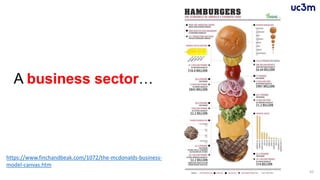
A business sector…
42
https://www.finchandbeak.com/1072/the-mcdonalds-business-
model-canvas.htm
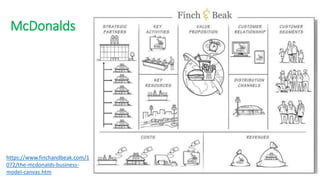
McDonalds
43
https://www.finchandbeak.com/1
072/the-mcdonalds-business-
model-canvas.htm
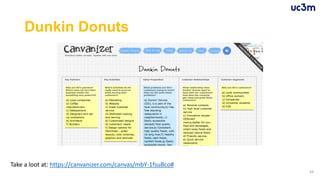
Dunkin Donuts
Take a loot at: https://canvanizer.com/canvas/mbY-1fsuBco#
44
45
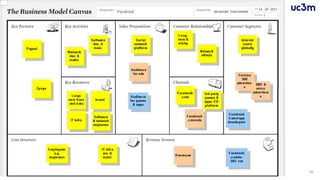
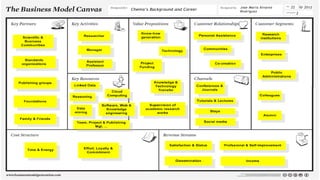
My own business model…
46
47
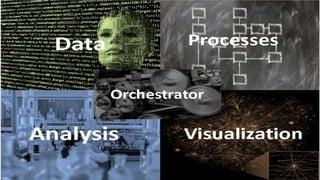
Technology
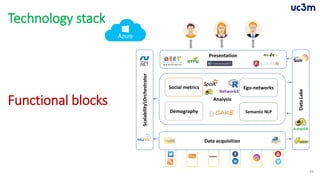
Technology stack
49
Analysis
Demography
Data acquisition
ScalabilityOrchestrator
DataLake
Presentation
Semantic NLP
Social metrics Ego-networks
NetworkX
ArangoDB
Functional blocks
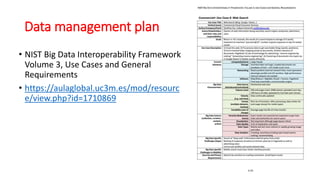
Data management plan
• NIST Big Data Interoperability Framework:
Volume 3, Use Cases and General
Requirements
• https://aulaglobal.uc3m.es/mod/resourc
e/view.php?id=1710869
50
51
Structure of the
presentation
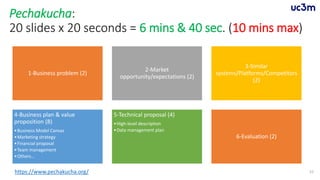
Pechakucha:
20 slides x 20 seconds = 6 mins & 40 sec. (10 mins max)
1-Business problem (2)
2-Market
opportunity/expectations (2)
3-Similar
systems/Platforms/Competitors
(2)
4-Business plan & value
proposition (8)
•Business Model Canvas
•Marketing strategy
•Financial proposal
•Team management
•Others…
5-Technical proposal (4)
•High-level description
•Data management plan
6-Evaluation (2)
52https://www.pechakucha.org/
53
Evaluation
54
Food
for thought
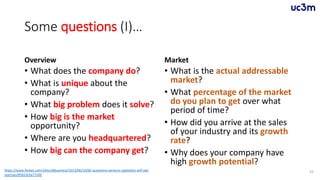
Some questions (I)…
Overview
• What does the company do?
• What is unique about the
company?
• What big problem does it solve?
• How big is the market
opportunity?
• Where are you headquartered?
• How big can the company get?
Market
• What is the actual addressable
market?
• What percentage of the market
do you plan to get over what
period of time?
• How did you arrive at the sales
of your industry and its growth
rate?
• Why does your company have
high growth potential?
55https://www.forbes.com/sites/allbusiness/2013/06/10/65-questions-venture-capitalists-will-ask-
startups/#5653c9a77c0d
Some questions(II)…
Founders & Team
• Who are the founders and key team
members?
• What relevant domain experience does
the team have?
• What key additions to the team are
needed in the short term?
• Why is the team uniquely capable to
execute the company’s business plan?
• How many employees do you have?
• What motivates the founders?
• How do you plan to scale the team in the
next 12 months?
Product & service
• Why do users care about your product or
service?
• What are the major product milestones?
• What are the key differentiated features
of your product or service?
• What have you learned from early
versions of the product or service?
• Provide a demonstration of the product or
service.
• What are the two or three key features
you plan to add?
56https://www.forbes.com/sites/allbusiness/2013/06/10/65-questions-venture-capitalists-will-ask-
startups/#5653c9a77c0d
Some questions (III)…
Competition
• Who are the company’s competitors?
• What gives your company a competitive
advantage?
• What advantages does your competition
have over you?
• Compared to your competition, how do you
compete with respect to price, features, and
performance?
• What are the barriers to entry?
Marketing
• How does the company market or plan to
market its products or services?
• What is the company’s PR strategy?
• What is the company’s social media strategy?
• What is the cost of a customer acquisition?
• What is the projected lifetime value of a
customer?
• What advertising will you be doing?
• What is the typical sales cycle between initial
customer contact and closing of a sale?
57https://www.forbes.com/sites/allbusiness/2013/06/10/65-questions-venture-capitalists-will-ask-
startups/#5653c9a77c0d
Some questions (IV)…
Traction
• What early traction has the
company gotten (sales, traffic to
the company’s website, app
downloads, etc., as relevant).
• How can the early traction be
accelerated?
• What has been the principal
reasons for the early traction?
Risks
• What do you see are the
principal risks to the business?
• What legal risks do you have?
• Do you have any regulatory
risks?
• Are there any product liability
risks?
58https://www.forbes.com/sites/allbusiness/2013/06/10/65-questions-venture-capitalists-will-ask-
startups/#5653c9a77c0d
Some questions (V)…
End Game
• What is the likely exit - IPO or M&A?
• When do you see the exit happening?
• Who will be the likely acquirers?
• How will valuation of an exit be
determined given market
comparables?
IPR
• What key intellectual property does
the company have (patents, patents
pending, copyrights, trade secrets,
trademarks, domain names)?
• What comfort do you have that the
company’s intellectual property does
not violate the rights of a third party?
• How was the company’s intellectual
property developed?
• Would any prior employers of a team
member have a potential claim to the
company’s intellectual property?
59https://www.forbes.com/sites/allbusiness/2013/06/10/65-questions-venture-capitalists-will-ask-
startups/#5653c9a77c0d
Some questions (VI)…
Financials
• What are the company’s three-year projections?
• What are the key assumptions underlying your projections?
• How much equity and debt has the company raised; what is
the capitalization structure?
• What future equity or debt financing will be necessary?
• How much of a stock option pool is being set aside for
employees?
• When will the company get to profitability?
• How much burn will occur until the company gets to
profitability?
• What are your unit economics?
• What are the factors that limit faster growth?
• What are the key metrics that the management team
focuses on?
Financial Rounds
• How much is being raised in this round?
• What is the company’s desired pre-money valuation?
• Will existing investors participate in the round?
• What is the planned use of proceeds from this round?
• What milestones will the financing get you to?
60https://www.forbes.com/sites/allbusiness/2013/06/10/65-questions-venture-capitalists-will-ask-
startups/#5653c9a77c0d
61
Do not panic!
Try to do
your best!
62
Task:
Let’s create a business model
canvas for an existing
data-driven service
e.g. Netflix, Spotify, etc.

Preparing your Big Data start-up pitch

  • 1.
    Preparing your start-up “Pitch” 1 Dr.Jose María Alvarez Rodríguez Business Applications of Big data Analytics MASTER IN BIG DATA ANALYTICS Universidad Carlos III de Madrid 15th of March, 2018
  • 2.
  • 3.
  • 4.
    4 How to delivera Pitch? Source: https://www.entrepreneur.com/article/251311
  • 5.
  • 6.
    Some recommendations… • Ifyou say that you’ll take “only X minutes,” then take at least one minute less. • If you are told, “You only have X minutes to pitch,” then take at least five minutes less. • If you say, “One last thing” or something similar, then make sure it’s truly the one last thing. • Move at a good pace. Don’t rush at the end. • If you’re using slides, don’t get stuck on one slide for more than three minutes. 6 https://www.entrepreneur.com/article/251311
  • 7.
  • 8.
  • 9.
  • 10.
    10 Explain exactly What is unique inyour product/service https://www.entrepreneur.com/article/251311
  • 11.
  • 12.
    12 Explain exactly How you are goingto get your audience https://www.entrepreneur.com/article/251311
  • 13.
  • 14.
  • 15.
    Others… Dress to killPractice your pitch Anticipate questions, and answer them ahead of time 15 https://www.entrepreneur.com/article/251311
  • 16.
  • 17.
  • 18.
  • 19.
    Some potential sections… 1-Businessproblem •Which problems are being addressed? 2-Market opportunity/expectations •Stakeholders & Size •Figures 3-Similar systems/Platforms/Competitor •How others are providing solutions for similar problems? •What is missing? 4-Business plan & value proposition •See below 5-Technical proposal •High-level description •Data management plan •Integration and APIs 6-Evaluation •Technical •Business 19
  • 20.
  • 21.
    Business plan: someelements… Concept Business model •How are you going to monetize your proposal? revenue model? •How are you going to gain market? •… Marketing •How much are you going to invest? •How are you going to capture customers/clients? •Campaigns? •… Financial viability, expected growth & status •Expected ROI •Funding schemes, etc. •Internal Rate of Return •Actual net value •Payback Period •… Structure and team •Roles & capabilities •Experience •Why you are the “best” team for this project? Intellectual property management •Patents Initial risk assessment and mitigating factors •What if someone leaves? •What if I can not get data? •What if I have regulatory issues? Other aspects •Exit strategy 21
  • 22.
  • 23.
    Types of businessmodels (I) 23https://hbr.org/2015/01/what-is-a-business-model
  • 24.
    Types of businessmodels (II) 24https://hbr.org/2015/01/what-is-a-business-model
  • 25.
    Types of businessmodels (III) 25https://hbr.org/2015/01/what-is-a-business-model
  • 26.
    Types of businessmodels (IV) 26https://hbr.org/2015/01/what-is-a-business-model
  • 27.
  • 28.
    28 Any technique toprepare a business model?
  • 30.
  • 31.
  • 32.
    An organisation servesone or several Customer Segments Customers • How do we get, keep and grow customers? • Which customer relationships have we established? • How are they integrated with the rest of our business model? • How costly are they?
  • 33.
    It seeks tosolve customer problems and satisfy customer needs with value propositions Value Proposition • What value do we deliver to the customer? • Which one of our customers’ problems are we helping to solve? • What bundles of products and services are we offering to each segment? • Which customer needs are we satisfying? • What is the minimum viable product?
  • 34.
    Value propositions aredelivered to customers through communication, distribution, and sales Channels Channels • Through which channels do our customer segments want to be reached?
  • 35.
    Customer relationships areestablished and maintained with each Customer Segment Customer Relationships • How do we get, keep and grow customers? • Which customer relationships have we established? • How are they integrated with the rest of our business model? • How costly are they?
  • 36.
    Revenue streams resultfrom value propositions successfully offered to customers Revenue Streams • For what value are our customers really willing to pay? • For what do they currently pay? • What is the revenue model? • What are the pricing tactics?
  • 37.
    Key Resources arethe assets required to offer and deliver the previously described elements Key Resources • What key resources do our value propositions require? • Our distribution channels? • Customer relationships? • Revenue streams
  • 38.
    Some activities areoutsourced and some resources are acquired outside the enterprise Key Partners • Who are our key partners? • Who are our key suppliers? • Which key resources are we acquiring from our partners? • Which key activities do partners perform?
  • 39.
    The business modelelements result in the cost structure. Cost Structure • What are the most important costs inherent to our business model? • Which key resources are most expensive? • Which key activities are most expensive?
  • 41.
  • 42.
  • 43.
  • 44.
    Dunkin Donuts Take aloot at: https://canvanizer.com/canvas/mbY-1fsuBco# 44
  • 45.
  • 46.
    My own businessmodel… 46
  • 47.
  • 49.
  • 50.
    Data management plan •NIST Big Data Interoperability Framework: Volume 3, Use Cases and General Requirements • https://aulaglobal.uc3m.es/mod/resourc e/view.php?id=1710869 50
  • 51.
  • 52.
    Pechakucha: 20 slides x20 seconds = 6 mins & 40 sec. (10 mins max) 1-Business problem (2) 2-Market opportunity/expectations (2) 3-Similar systems/Platforms/Competitors (2) 4-Business plan & value proposition (8) •Business Model Canvas •Marketing strategy •Financial proposal •Team management •Others… 5-Technical proposal (4) •High-level description •Data management plan 6-Evaluation (2) 52https://www.pechakucha.org/
  • 53.
  • 54.
  • 55.
    Some questions (I)… Overview •What does the company do? • What is unique about the company? • What big problem does it solve? • How big is the market opportunity? • Where are you headquartered? • How big can the company get? Market • What is the actual addressable market? • What percentage of the market do you plan to get over what period of time? • How did you arrive at the sales of your industry and its growth rate? • Why does your company have high growth potential? 55https://www.forbes.com/sites/allbusiness/2013/06/10/65-questions-venture-capitalists-will-ask- startups/#5653c9a77c0d
  • 56.
    Some questions(II)… Founders &Team • Who are the founders and key team members? • What relevant domain experience does the team have? • What key additions to the team are needed in the short term? • Why is the team uniquely capable to execute the company’s business plan? • How many employees do you have? • What motivates the founders? • How do you plan to scale the team in the next 12 months? Product & service • Why do users care about your product or service? • What are the major product milestones? • What are the key differentiated features of your product or service? • What have you learned from early versions of the product or service? • Provide a demonstration of the product or service. • What are the two or three key features you plan to add? 56https://www.forbes.com/sites/allbusiness/2013/06/10/65-questions-venture-capitalists-will-ask- startups/#5653c9a77c0d
  • 57.
    Some questions (III)… Competition •Who are the company’s competitors? • What gives your company a competitive advantage? • What advantages does your competition have over you? • Compared to your competition, how do you compete with respect to price, features, and performance? • What are the barriers to entry? Marketing • How does the company market or plan to market its products or services? • What is the company’s PR strategy? • What is the company’s social media strategy? • What is the cost of a customer acquisition? • What is the projected lifetime value of a customer? • What advertising will you be doing? • What is the typical sales cycle between initial customer contact and closing of a sale? 57https://www.forbes.com/sites/allbusiness/2013/06/10/65-questions-venture-capitalists-will-ask- startups/#5653c9a77c0d
  • 58.
    Some questions (IV)… Traction •What early traction has the company gotten (sales, traffic to the company’s website, app downloads, etc., as relevant). • How can the early traction be accelerated? • What has been the principal reasons for the early traction? Risks • What do you see are the principal risks to the business? • What legal risks do you have? • Do you have any regulatory risks? • Are there any product liability risks? 58https://www.forbes.com/sites/allbusiness/2013/06/10/65-questions-venture-capitalists-will-ask- startups/#5653c9a77c0d
  • 59.
    Some questions (V)… EndGame • What is the likely exit - IPO or M&A? • When do you see the exit happening? • Who will be the likely acquirers? • How will valuation of an exit be determined given market comparables? IPR • What key intellectual property does the company have (patents, patents pending, copyrights, trade secrets, trademarks, domain names)? • What comfort do you have that the company’s intellectual property does not violate the rights of a third party? • How was the company’s intellectual property developed? • Would any prior employers of a team member have a potential claim to the company’s intellectual property? 59https://www.forbes.com/sites/allbusiness/2013/06/10/65-questions-venture-capitalists-will-ask- startups/#5653c9a77c0d
  • 60.
    Some questions (VI)… Financials •What are the company’s three-year projections? • What are the key assumptions underlying your projections? • How much equity and debt has the company raised; what is the capitalization structure? • What future equity or debt financing will be necessary? • How much of a stock option pool is being set aside for employees? • When will the company get to profitability? • How much burn will occur until the company gets to profitability? • What are your unit economics? • What are the factors that limit faster growth? • What are the key metrics that the management team focuses on? Financial Rounds • How much is being raised in this round? • What is the company’s desired pre-money valuation? • Will existing investors participate in the round? • What is the planned use of proceeds from this round? • What milestones will the financing get you to? 60https://www.forbes.com/sites/allbusiness/2013/06/10/65-questions-venture-capitalists-will-ask- startups/#5653c9a77c0d
  • 61.
    61 Do not panic! Tryto do your best!
  • 62.
    62 Task: Let’s create abusiness model canvas for an existing data-driven service e.g. Netflix, Spotify, etc.