Mobilizing the Organization: Tactical Execution Chapter Fourteen
Introduction Visionary companies consistently out-execute competition GE, Wal-Mart Combine winning strategy, talent and execution to support strategy, and integrated transition from old to new ways of doing things This chapter’s focus: Execution How, What and When Fast turnaround of e-business projects will separate winners from also-rans Financial costs of delays or mismanagement huge Lost opportunity costs of being late to market even higher Kmart and example of bad e-business execution
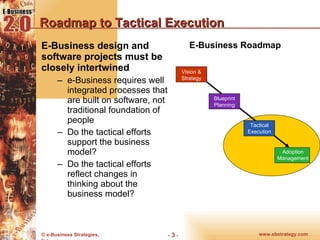
Roadmap to Tactical Execution E-Business design and software projects must be closely intertwined e-Business requires well integrated processes that are built on software, not traditional foundation of people Do the tactical efforts support the business model? Do the tactical efforts reflect changes in thinking about the business model? E-Business Roadmap Vision & Strategy Blueprint Planning Tactical Execution Adoption Management
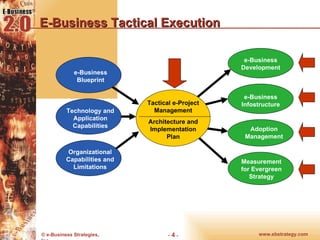
E-Business Tactical Execution Technology and Application Capabilities Organizational Capabilities and Limitations e-Business Blueprint Tactical e-Project Management Architecture and Implementation Plan e-Business Infostructure Adoption Management e-Business Development Measurement for Evergreen Strategy
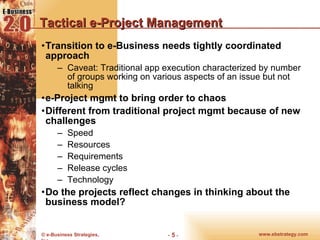
Tactical e-Project Management Transition to e-Business needs tightly coordinated approach Caveat: Traditional app execution characterized by number of groups working on various aspects of an issue but not talking e-Project mgmt to bring order to chaos Different from traditional project mgmt because of new challenges Speed Resources Requirements Release cycles Technology Do the projects reflect changes in thinking about the business model?
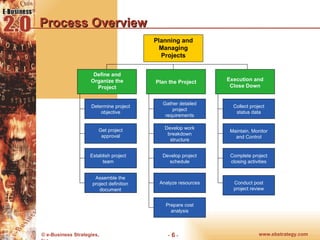
Process Overview Define and Organize the Project Execution and Close Down Plan the Project Establish project team Determine project objective Assemble the project definition document Get project approval Develop work breakdown structure Develop project schedule Gather detailed project requirements Analyze resources Prepare cost analysis Collect project status data Complete project closing activities Planning and Managing Projects Conduct post project review Maintain, Monitor and Control
The Intangibles: Continuous Project Communication A project communication plan necessary for a project to function like a well-oiled machine to keep mgmt, customers, and team members informed of project’s status and milestones at risk of being missed Identifies all persons concerned with the project and develops follow-up activities to keep them involved Assigns communication responsibilities and process for keeping everyone informed
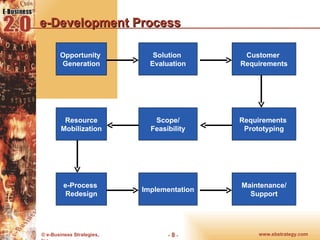
e-Development Process Opportunity  Generation Solution  Evaluation Customer  Requirements Resource Mobilization Scope/ Feasibility Requirements  Prototyping e-Process  Redesign Implementation Maintenance/ Support
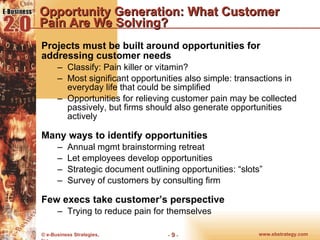
Opportunity Generation: What Customer Pain Are We Solving? Projects must be built around opportunities for addressing customer needs Classify: Pain killer or vitamin? Most significant opportunities also simple: transactions in everyday life that could be simplified Opportunities for relieving customer pain may be collected passively, but firms should also generate opportunities actively Many ways to identify opportunities Annual mgmt brainstorming retreat Let employees develop opportunities Strategic document outlining opportunities: “slots” Survey of customers by consulting firm Few execs take customer’s perspective  Trying to reduce pain for themselves
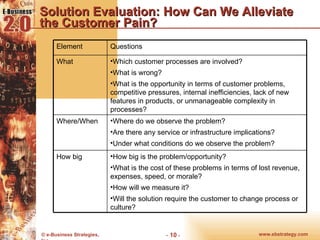
Solution Evaluation: How Can We Alleviate the Customer Pain? How big is the problem/opportunity? What is the cost of these problems in terms of lost revenue, expenses, speed, or morale? How will we measure it? Will the solution require the customer to change process or culture? How big Where do we observe the problem? Are there any service or infrastructure implications? Under what conditions do we observe the problem? Where/When Which customer processes are involved? What is wrong? What is the opportunity in terms of customer problems, competitive pressures, internal inefficiencies, lack of new features in products, or unmanageable complexity in processes? What Questions Element
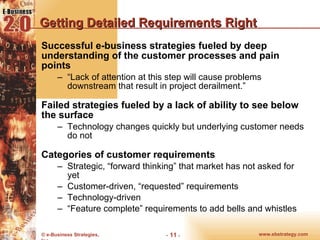
Getting Detailed Requirements Right Successful e-business strategies fueled by deep understanding of the customer processes and pain points “ Lack of attention at this step will cause problems downstream that result in project derailment.” Failed strategies fueled by a lack of ability to see below the surface Technology changes quickly but underlying customer needs do not Categories of customer requirements Strategic, “forward thinking” that market has not asked for yet Customer-driven, “requested” requirements Technology-driven “ Feature complete” requirements to add bells and whistles
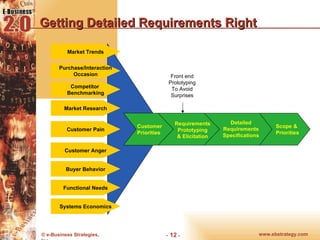
Getting Detailed Requirements Right Detailed Requirements Specifications Front end Prototyping To Avoid Surprises Scope & Priorities Requirements Prototyping & Elicitation Customer Priorities Market Trends Purchase/Interaction Occasion Competitor  Benchmarking Market Research Customer Pain Customer Anger Buyer Behavior Functional Needs Systems Economics
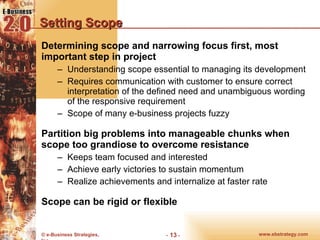
Setting Scope Determining scope and narrowing focus first, most important step in project Understanding scope essential to managing its development Requires communication with customer to ensure correct interpretation of the defined need and unambiguous wording of the responsive requirement Scope of many e-business projects fuzzy Partition big problems into manageable chunks when scope too grandiose to overcome resistance Keeps team focused and interested Achieve early victories to sustain momentum Realize achievements and internalize at faster rate Scope can be rigid or flexible
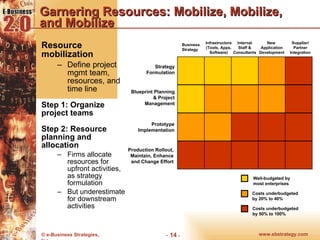
Garnering Resources: Mobilize, Mobilize, and Mobilize Resource mobilization Define project mgmt team, resources, and time line Step 1: Organize project teams Step 2: Resource planning and allocation Firms allocate resources for upfront activities, as strategy formulation  But underestimate for downstream activities Internal Staff & Consultants Strategy Formulation Production Rollout, Maintain, Enhance and Change Effort Infrastructure (Tools, Apps, Software) New  Application Development Supplier/ Partner Integration Well-budgeted by most enterprises Costs underbudgeted by 20% to 40% Costs underbudgeted by 50% to 100% Business Strategy Blueprint Planning & Project Management Prototype Implementation
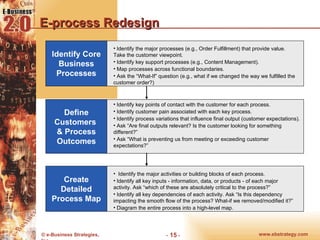
E-process Redesign Identify the major processes (e.g., Order Fulfillment) that provide value. Take the customer viewpoint.  Identify key support processes (e.g., Content Management).  Map processes across functional boundaries. Ask the “What-If” question (e.g., what if we changed the way we fulfilled the customer order?) Identify key points of contact with the customer for each process. Identify customer pain associated with each key process. Identify process variations that influence final output (customer expectations). Ask “Are final outputs relevant? Is the customer looking for something different?” Ask “What is preventing us from meeting or exceeding customer expectations?”  Identify the major activities or building blocks of each process. Identify all key inputs - information, data, or products - of each major activity. Ask “which of these are absolutely critical to the process?” Identify all key dependencies of each activity. Ask “Is this dependency impacting the smooth flow of the process? What-if we removed/modified it?” Diagram the entire process into a high-level map. Identify Core Business Processes Define Customers  & Process Outcomes Create Detailed Process Map
Web Development: Prototype Validation and Implementation Detailed requirements prototyping Detailed architecture design Application development Quality assurance and testing Field testing Release management
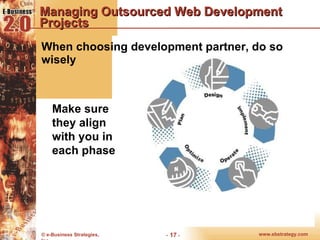
Managing Outsourced Web Development Projects When choosing development partner, do so wisely Make sure they align with you in each phase
Application Service Providers IT managers seeking development solutions to relieve stress of too few qualified personnel to meet too many development needs Enter ASPs, ex. Corio, Breakaway, US Internetworking Provide power of large app frameworks as ERP Maintain apps themselves Growth due to better delivery of apps via IP networks Offer everything from office essentials to massive apps Large servers host apps in data centers, accessed via VPN Attractive for companies with rapidly changing IT needs that don’t require highly customized software solutions Startup companies Large corporations because of time-to-market issues, lack of development resources, and a desire to lower maintenance costs
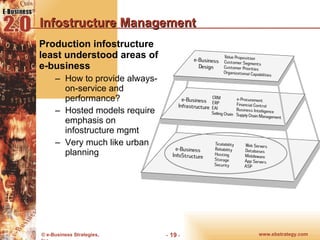
Infostructure Management Production infostructure least understood areas of e-business How to provide always-on-service and performance? Hosted models require emphasis on infostructure mgmt Very much like urban planning
Internet Data Centers Internet creates unpredictable load on network services Newly introduced software can be ten times as popular as predicted New data-driven apps can increase storage system use beyond all projections Data centers need adequate capacity available for 24x7x365, while minimizing capital outlay Enter collocation firms Exodus, Jam Cracker, LoudCloud Group a company’s apps together on dedicated servers in state-of-the-art NOCs
Capacity Planning Online customer impatient Predicting demand levels for network services difficult Complexity of today’s networks make it difficult to isolate the driving force of demand for a particular service Continuous, ongoing capacity planning process necessary Assess current physical infrastructure’s capacity Measure and monitor traffic regularly to verify business model Use business model for long-range scenario planning In capacity planning, don’t think just Web transactions Think about how rich content affects capacity
Scalability Impacts both the # of simultaneous users that can be supported and the service-level performance that users experience Hardware scaling vs. Indirect techniques Lot of hardware capacity may not solve problems with rich multimedia content Caching and Replication necessary to solve these issues
Availability Availability is accessibility of e-business operation: 24 hours a day, 7 days a week, 365 days a year Techniques for maximum uptime Clustering and replication Process and business practices Monitoring service deployments Modularity of infostructure critical to attaining continuous availability
Security and Risk Management Prevention of security threats far easier and less costly than responding Yahoo!, CNN, Amazon attacked in early 2000 Execs must pay attention to their companies’ network security Execs must understand what their firms’ development organizations and hosting vendors are doing to identify and solving potential security problems Security and disaster recovery plans go hand in hand Important to think through various disaster scenarios and have a plan for addressing each one September 11, 2001
Adoption Management Three behavioral responses to overcome when introducing changes: Denial, Anger or Acceptance Successful adoption needs Communication plan Transition mgmt plan Samsonite had conversion problems when implementing its new financial, manufacturing, and distribution apps Key performance indicators Large projects affect change in three stages Stage 1: Jobs redefined, new procedures established, apps fine tuned, and users learn benefits Stage 2: New skills executed, business structure changes, processes integrated, add on technologies implemented  State 3: New tools and processes become almost second nature to users; synergy of people, processes and technology
Measurement for Learning and Improvement How does a company know it is doing well post implementation? What are some key measures important to a new e-business process What should my company measure? Risk Financial Loyalty Fulfillment Customer satisfaction
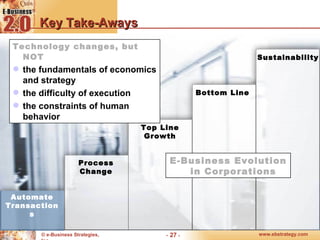
Key Take-Aways Technology changes , but NOT   t he fundamentals of economics and strategy the difficulty of execution t he constraints of human behavior  Automate Transactions Process Change Top Line Growth Bottom Line  Sustainability E-Business Evolution in Corporations
E-Business Strategies, Inc. www.ebstrategy.com [email_address] 678-339-1236 x201 Fax - 678-339-9793

Chp14 Tactical Execution

  • 1.
    Mobilizing the Organization:Tactical Execution Chapter Fourteen
  • 2.
    Introduction Visionary companiesconsistently out-execute competition GE, Wal-Mart Combine winning strategy, talent and execution to support strategy, and integrated transition from old to new ways of doing things This chapter’s focus: Execution How, What and When Fast turnaround of e-business projects will separate winners from also-rans Financial costs of delays or mismanagement huge Lost opportunity costs of being late to market even higher Kmart and example of bad e-business execution
  • 3.
    Roadmap to TacticalExecution E-Business design and software projects must be closely intertwined e-Business requires well integrated processes that are built on software, not traditional foundation of people Do the tactical efforts support the business model? Do the tactical efforts reflect changes in thinking about the business model? E-Business Roadmap Vision & Strategy Blueprint Planning Tactical Execution Adoption Management
  • 4.
    E-Business Tactical ExecutionTechnology and Application Capabilities Organizational Capabilities and Limitations e-Business Blueprint Tactical e-Project Management Architecture and Implementation Plan e-Business Infostructure Adoption Management e-Business Development Measurement for Evergreen Strategy
  • 5.
    Tactical e-Project ManagementTransition to e-Business needs tightly coordinated approach Caveat: Traditional app execution characterized by number of groups working on various aspects of an issue but not talking e-Project mgmt to bring order to chaos Different from traditional project mgmt because of new challenges Speed Resources Requirements Release cycles Technology Do the projects reflect changes in thinking about the business model?
  • 6.
    Process Overview Defineand Organize the Project Execution and Close Down Plan the Project Establish project team Determine project objective Assemble the project definition document Get project approval Develop work breakdown structure Develop project schedule Gather detailed project requirements Analyze resources Prepare cost analysis Collect project status data Complete project closing activities Planning and Managing Projects Conduct post project review Maintain, Monitor and Control
  • 7.
    The Intangibles: ContinuousProject Communication A project communication plan necessary for a project to function like a well-oiled machine to keep mgmt, customers, and team members informed of project’s status and milestones at risk of being missed Identifies all persons concerned with the project and develops follow-up activities to keep them involved Assigns communication responsibilities and process for keeping everyone informed
  • 8.
    e-Development Process Opportunity Generation Solution Evaluation Customer Requirements Resource Mobilization Scope/ Feasibility Requirements Prototyping e-Process Redesign Implementation Maintenance/ Support
  • 9.
    Opportunity Generation: WhatCustomer Pain Are We Solving? Projects must be built around opportunities for addressing customer needs Classify: Pain killer or vitamin? Most significant opportunities also simple: transactions in everyday life that could be simplified Opportunities for relieving customer pain may be collected passively, but firms should also generate opportunities actively Many ways to identify opportunities Annual mgmt brainstorming retreat Let employees develop opportunities Strategic document outlining opportunities: “slots” Survey of customers by consulting firm Few execs take customer’s perspective Trying to reduce pain for themselves
  • 10.
    Solution Evaluation: HowCan We Alleviate the Customer Pain? How big is the problem/opportunity? What is the cost of these problems in terms of lost revenue, expenses, speed, or morale? How will we measure it? Will the solution require the customer to change process or culture? How big Where do we observe the problem? Are there any service or infrastructure implications? Under what conditions do we observe the problem? Where/When Which customer processes are involved? What is wrong? What is the opportunity in terms of customer problems, competitive pressures, internal inefficiencies, lack of new features in products, or unmanageable complexity in processes? What Questions Element
  • 11.
    Getting Detailed RequirementsRight Successful e-business strategies fueled by deep understanding of the customer processes and pain points “ Lack of attention at this step will cause problems downstream that result in project derailment.” Failed strategies fueled by a lack of ability to see below the surface Technology changes quickly but underlying customer needs do not Categories of customer requirements Strategic, “forward thinking” that market has not asked for yet Customer-driven, “requested” requirements Technology-driven “ Feature complete” requirements to add bells and whistles
  • 12.
    Getting Detailed RequirementsRight Detailed Requirements Specifications Front end Prototyping To Avoid Surprises Scope & Priorities Requirements Prototyping & Elicitation Customer Priorities Market Trends Purchase/Interaction Occasion Competitor Benchmarking Market Research Customer Pain Customer Anger Buyer Behavior Functional Needs Systems Economics
  • 13.
    Setting Scope Determiningscope and narrowing focus first, most important step in project Understanding scope essential to managing its development Requires communication with customer to ensure correct interpretation of the defined need and unambiguous wording of the responsive requirement Scope of many e-business projects fuzzy Partition big problems into manageable chunks when scope too grandiose to overcome resistance Keeps team focused and interested Achieve early victories to sustain momentum Realize achievements and internalize at faster rate Scope can be rigid or flexible
  • 14.
    Garnering Resources: Mobilize,Mobilize, and Mobilize Resource mobilization Define project mgmt team, resources, and time line Step 1: Organize project teams Step 2: Resource planning and allocation Firms allocate resources for upfront activities, as strategy formulation But underestimate for downstream activities Internal Staff & Consultants Strategy Formulation Production Rollout, Maintain, Enhance and Change Effort Infrastructure (Tools, Apps, Software) New Application Development Supplier/ Partner Integration Well-budgeted by most enterprises Costs underbudgeted by 20% to 40% Costs underbudgeted by 50% to 100% Business Strategy Blueprint Planning & Project Management Prototype Implementation
  • 15.
    E-process Redesign Identifythe major processes (e.g., Order Fulfillment) that provide value. Take the customer viewpoint. Identify key support processes (e.g., Content Management). Map processes across functional boundaries. Ask the “What-If” question (e.g., what if we changed the way we fulfilled the customer order?) Identify key points of contact with the customer for each process. Identify customer pain associated with each key process. Identify process variations that influence final output (customer expectations). Ask “Are final outputs relevant? Is the customer looking for something different?” Ask “What is preventing us from meeting or exceeding customer expectations?” Identify the major activities or building blocks of each process. Identify all key inputs - information, data, or products - of each major activity. Ask “which of these are absolutely critical to the process?” Identify all key dependencies of each activity. Ask “Is this dependency impacting the smooth flow of the process? What-if we removed/modified it?” Diagram the entire process into a high-level map. Identify Core Business Processes Define Customers & Process Outcomes Create Detailed Process Map
  • 16.
    Web Development: PrototypeValidation and Implementation Detailed requirements prototyping Detailed architecture design Application development Quality assurance and testing Field testing Release management
  • 17.
    Managing Outsourced WebDevelopment Projects When choosing development partner, do so wisely Make sure they align with you in each phase
  • 18.
    Application Service ProvidersIT managers seeking development solutions to relieve stress of too few qualified personnel to meet too many development needs Enter ASPs, ex. Corio, Breakaway, US Internetworking Provide power of large app frameworks as ERP Maintain apps themselves Growth due to better delivery of apps via IP networks Offer everything from office essentials to massive apps Large servers host apps in data centers, accessed via VPN Attractive for companies with rapidly changing IT needs that don’t require highly customized software solutions Startup companies Large corporations because of time-to-market issues, lack of development resources, and a desire to lower maintenance costs
  • 19.
    Infostructure Management Productioninfostructure least understood areas of e-business How to provide always-on-service and performance? Hosted models require emphasis on infostructure mgmt Very much like urban planning
  • 20.
    Internet Data CentersInternet creates unpredictable load on network services Newly introduced software can be ten times as popular as predicted New data-driven apps can increase storage system use beyond all projections Data centers need adequate capacity available for 24x7x365, while minimizing capital outlay Enter collocation firms Exodus, Jam Cracker, LoudCloud Group a company’s apps together on dedicated servers in state-of-the-art NOCs
  • 21.
    Capacity Planning Onlinecustomer impatient Predicting demand levels for network services difficult Complexity of today’s networks make it difficult to isolate the driving force of demand for a particular service Continuous, ongoing capacity planning process necessary Assess current physical infrastructure’s capacity Measure and monitor traffic regularly to verify business model Use business model for long-range scenario planning In capacity planning, don’t think just Web transactions Think about how rich content affects capacity
  • 22.
    Scalability Impacts boththe # of simultaneous users that can be supported and the service-level performance that users experience Hardware scaling vs. Indirect techniques Lot of hardware capacity may not solve problems with rich multimedia content Caching and Replication necessary to solve these issues
  • 23.
    Availability Availability isaccessibility of e-business operation: 24 hours a day, 7 days a week, 365 days a year Techniques for maximum uptime Clustering and replication Process and business practices Monitoring service deployments Modularity of infostructure critical to attaining continuous availability
  • 24.
    Security and RiskManagement Prevention of security threats far easier and less costly than responding Yahoo!, CNN, Amazon attacked in early 2000 Execs must pay attention to their companies’ network security Execs must understand what their firms’ development organizations and hosting vendors are doing to identify and solving potential security problems Security and disaster recovery plans go hand in hand Important to think through various disaster scenarios and have a plan for addressing each one September 11, 2001
  • 25.
    Adoption Management Threebehavioral responses to overcome when introducing changes: Denial, Anger or Acceptance Successful adoption needs Communication plan Transition mgmt plan Samsonite had conversion problems when implementing its new financial, manufacturing, and distribution apps Key performance indicators Large projects affect change in three stages Stage 1: Jobs redefined, new procedures established, apps fine tuned, and users learn benefits Stage 2: New skills executed, business structure changes, processes integrated, add on technologies implemented State 3: New tools and processes become almost second nature to users; synergy of people, processes and technology
  • 26.
    Measurement for Learningand Improvement How does a company know it is doing well post implementation? What are some key measures important to a new e-business process What should my company measure? Risk Financial Loyalty Fulfillment Customer satisfaction
  • 27.
    Key Take-Aways Technologychanges , but NOT t he fundamentals of economics and strategy the difficulty of execution t he constraints of human behavior Automate Transactions Process Change Top Line Growth Bottom Line Sustainability E-Business Evolution in Corporations
  • 28.
    E-Business Strategies, Inc.www.ebstrategy.com [email_address] 678-339-1236 x201 Fax - 678-339-9793

Editor's Notes

  • #2 The E-Business material shall at all times remain the property of E-Business Strategies, Inc. No license under any trade secrets, copyrights, or other rights is granted by this Agreement or any disclosure of Confidential Information hereunder. Any such permitted copies will be considered Confidential Information. Confidential Information of E-Business Strategies, Inc. may not be copied or reproduced by the Recipient without E-Business Strategies, Inc. prior written consent.
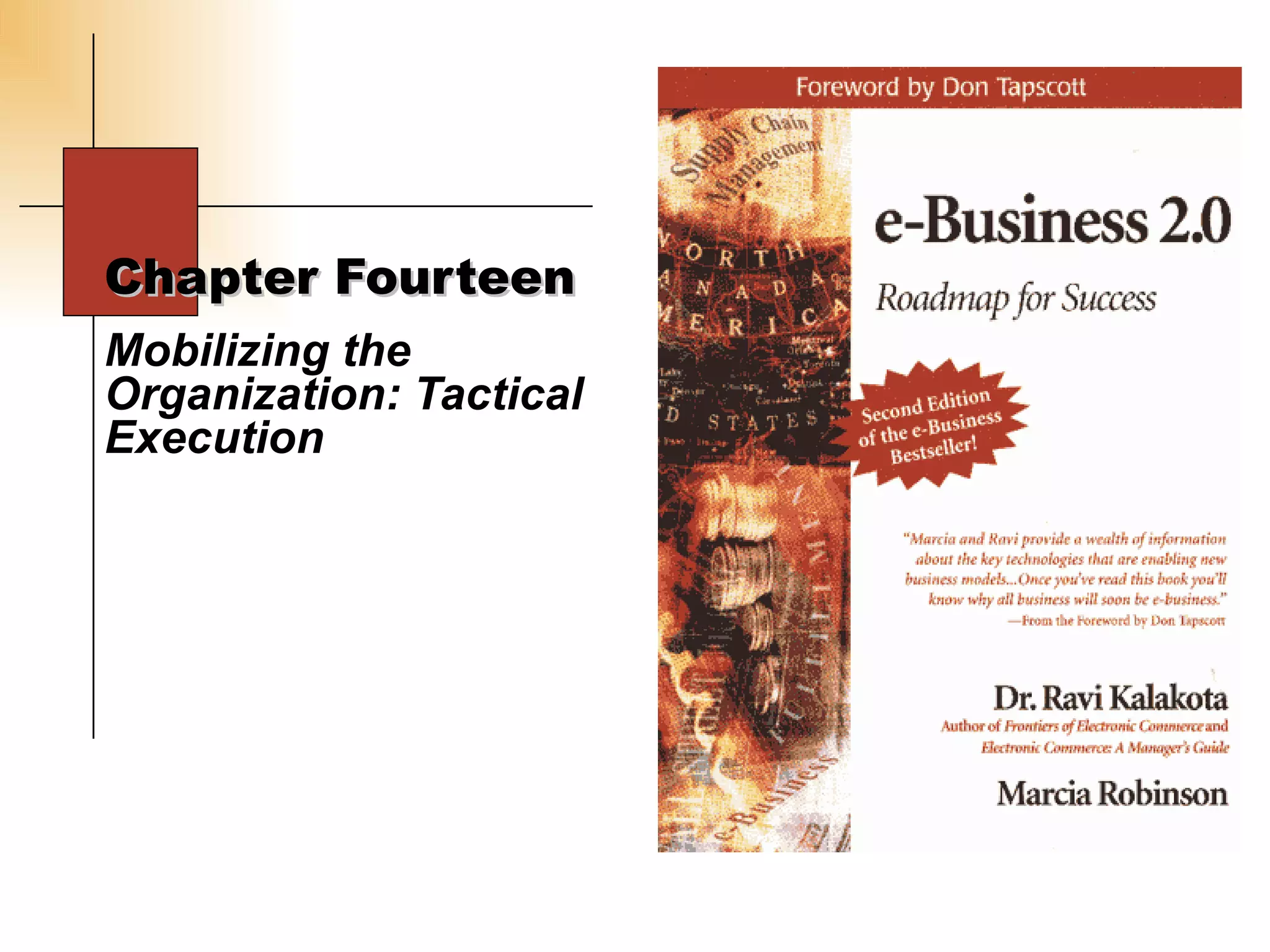
  • #20 eBusiness 2.0: Roadmap for Success by Ravi Kalakota and Marcia Robinson. Copyright Addison Wesley, 2000. This art is used with permission from Addison Wesley.
  • #29 The E-Business material shall at all times remain the property of E-Business Strategies, Inc. No license under any trade secrets, copyrights, or other rights is granted by this Agreement or any disclosure of Confidential Information hereunder. Any such permitted copies will be considered Confidential Information. Confidential Information of E-Business Strategies, Inc. may not be copied or reproduced by the Recipient without E-Business Strategies, Inc. prior written consent. The E-Business material may not be re-sold. It is intended to be used solely for the purpose of accompaniment of the E-Business 2.0 Roadmap for Success book in an instructional manner.