Business Model for
Bio-Battery
Bae Jin Woo (A0102853M)
Heng Chew Chwee (A0098597B)
Hong Chao (A0098568E)
Nuraziz Yosokumoro (A0082045M)
Wang Juan (A0098515W)
Outline
Value Creation
Bio-Battery technology
Market Segment & Customer Selection
Future Market
Value Network
Strategic Control
SWOT Analysis
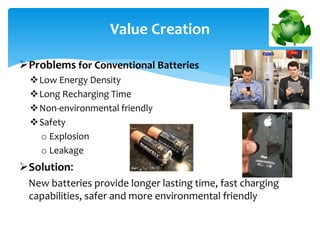
Problems for Conventional Batteries
Low Energy Density
Long Recharging Time
Non-environmental friendly
Safety
o Explosion
o Leakage
Solution:
New batteries provide longer lasting time, fast charging
capabilities, safer and more environmental friendly
Value Creation
Terminology
Terms Meaning
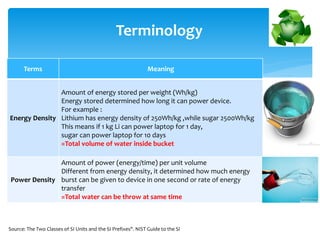
Energy Density
Amount of energy stored per weight (Wh/kg)
Energy stored determined how long it can power device.
For example :
Lithium has energy density of 250Wh/kg ,while sugar 2500Wh/kg
This means if 1 kg Li can power laptop for 1 day,
sugar can power laptop for 10 days
=Total volume of water inside bucket
Power Density
Amount of power (energy/time) per unit volume
Different from energy density, it determined how much energy
burst can be given to device in one second or rate of energy
transfer
=Total water can be throw at same time
Source: The Two Classes of SI Units and the SI Prefixes". NIST Guide to the SI
Bio-Battery Technology
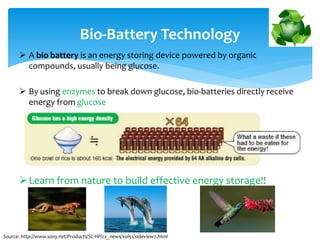
 A bio battery is an energy storing device powered by organic
compounds, usually being glucose.
 By using enzymes to break down glucose, bio-batteries directly receive
energy from glucose
Learn from nature to build effective energy storage!!
Source: http://www.sony.net/Products/SC-HP/cx_news/vol51/sideview2.html
Bio Battery Technology
Source: http://www.sony.net/SonyInfo/News/Press/200708/07-074E/
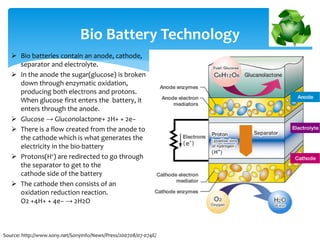
 Bio batteries contain an anode, cathode,
separator and electrolyte.
 In the anode the sugar(glucose) is broken
down through enzymatic oxidation,
producing both electrons and protons.
When glucose first enters the battery, it
enters through the anode.
 Glucose → Gluconolactone+ 2H+ + 2e−
 There is a flow created from the anode to
the cathode which is what generates the
electricity in the bio-battery
 Protons(H⁺) are redirected to go through
the separator to get to the
cathode side of the battery
 The cathode then consists of an
oxidation reduction reaction.
O2 +4H+ + 4e− → 2H2O
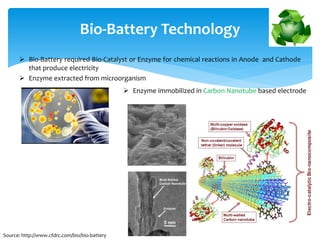
 Bio-Battery required Bio-Catalyst or Enzyme for chemical reactions in Anode and Cathode
that produce electricity
 Enzyme extracted from microorganism
Bio-Battery Technology
 Enzyme immobilized in Carbon Nanotube based electrode
Source: http://www.cfdrc.com/bio/bio-battery
Bio-Battery Development Progress
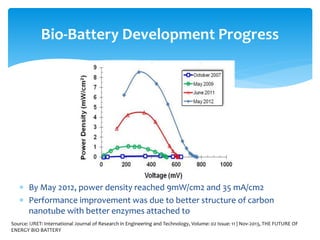
 By May 2012, power density reached 9mW/cm2 and 35 mA/cm2
 Performance improvement was due to better structure of carbon
nanotube with better enzymes attached to
Source: IJRET: International Journal of Research in Engineering and Technology, Volume: 02 Issue: 11 | Nov-2013, THE FUTURE OF
ENERGY BIO BATTERY
Bio-Battery Power Performance
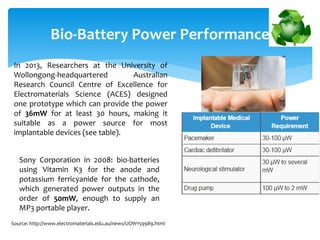
In 2013, Researchers at the University of
Wollongong-headquartered Australian
Research Council Centre of Excellence for
Electromaterials Science (ACES) designed
one prototype which can provide the power
of 36mW for at least 30 hours, making it
suitable as a power source for most
implantable devices (see table).
Sony Corporation in 2008: bio-batteries
using Vitamin K3 for the anode and
potassium ferricyanide for the cathode,
which generated power outputs in the
order of 50mW, enough to supply an
MP3 portable player.
Source: http://www.electromaterials.edu.au/news/UOW159989.html
Source:
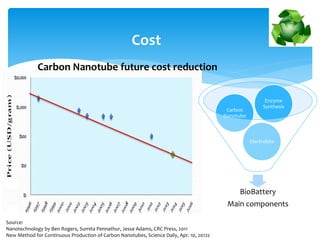
Nanotechnology by Ben Rogers, Sumita Pennathur, Jesse Adams, CRC Press, 2011
New Method for Continuous Production of Carbon Nanotubes, Science Daily, Apr. 10, 2012z
BioBattery
Main components
Electrolyte
Carbon
Nanotube
Enzyme
Synthesis
Cost
Carbon Nanotube future cost reduction
Market Segment & Customers
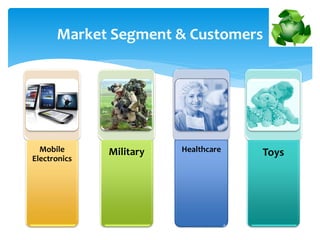
Mobile
Electronics
Military ToysHealthcare
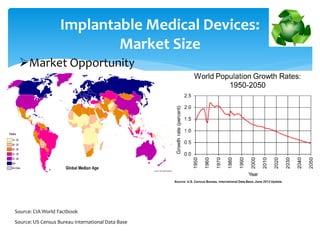
Market Opportunity
Implantable Medical Devices:
Market Size
July 2013
Source: CIA World Factbook
Source: US Census Bureau International Data Base
Implantable Medical Devices:
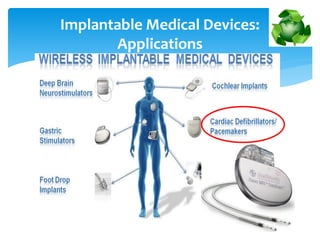
Applications
Implantable Medical Devices:
Targeted Customers
Implantable Medical Devices:
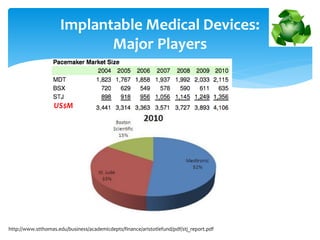
Major Players
http://www.stthomas.edu/business/academicdepts/finance/aristotlefund/pdf/stj_report.pdf
US$M
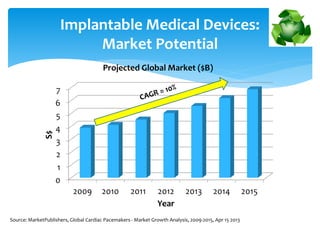
0
1
2
3
4
5
6
7
2009 2010 2011 2012 2013 2014 2015
S$
Year
Projected Global Market ($B)
Implantable Medical Devices:
Market Potential
Source: MarketPublishers, Global Cardiac Pacemakers - Market Growth Analysis, 2009-2015, Apr 15 2013
Implantable Medical Devices:
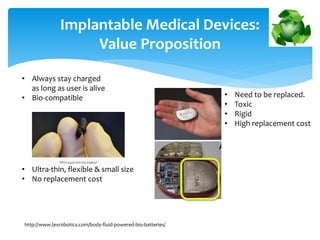
Value Proposition
• Always stay charged
as long as user is alive
• Bio-compatible
• Ultra-thin, flexible & small size
• No replacement cost
• Need to be replaced.
• Toxic
• Rigid
• High replacement cost
http://www.lexrobotics.com/body-fluid-powered-bio-batteries/
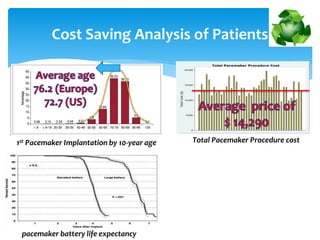
Cost Saving Analysis of Patients
1st Pacemaker Implantation by 10-year age Total Pacemaker Procedure cost
pacemaker battery life expectancy
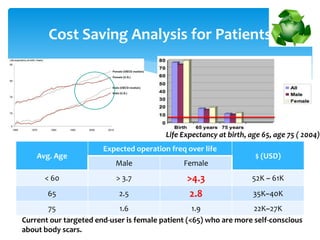
Avg. Age
Expected operation freq over life
$ (USD)
Male Female
< 60 > 3.7 >4.3 52K ~ 61K
65 2.5 2.8 35K~40K
75 1.6 1.9 22K~27K
Cost Saving Analysis for Patients
Life Expectancy at birth, age 65, age 75 ( 2004)
Current our targeted end-user is female patient (<65) who are more self-conscious
about body scars.
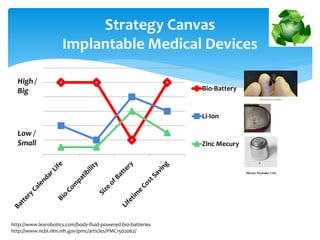
Bio-Battery
Li-Ion
Zinc Mecury
Strategy Canvas
Implantable Medical Devices
High /
Big
Low /
Small
http://www.lexrobotics.com/body-fluid-powered-bio-batteries
http://www.ncbi.nlm.nih.gov/pmc/articles/PMC1502062/
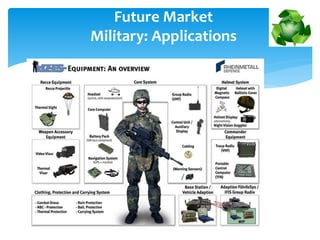
Future Market
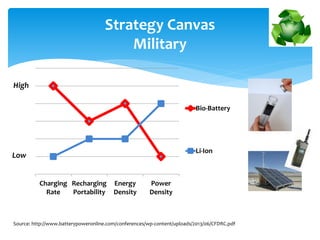
Military: Applications
Strategy Canvas
Military
High
Low
Source: http://www.batterypoweronline.com/conferences/wp-content/uploads/2013/06/CFDRC.pdf
Charging
Rate
Recharging
Portability
Energy
Density
Power
Density
Bio-Battery
Li-Ion
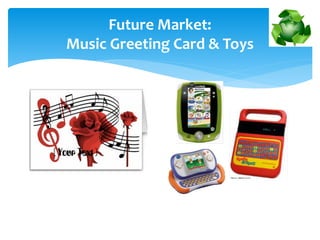
Future Market:
Music Greeting Card & Toys
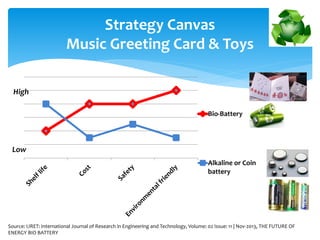
Strategy Canvas
Music Greeting Card & Toys
Source: IJRET: International Journal of Research in Engineering and Technology, Volume: 02 Issue: 11 | Nov-2013, THE FUTURE OF
ENERGY BIO BATTERY
High
Low
Bio-Battery
Alkaline or Coin
battery
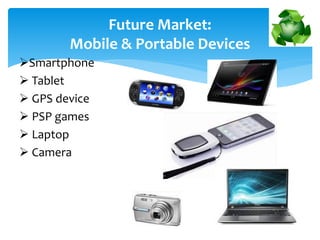
Smartphone
 Tablet
 GPS device
 PSP games
 Laptop
 Camera
Future Market:
Mobile & Portable Devices
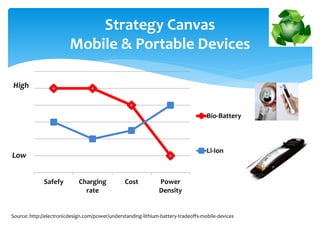
Strategy Canvas
Mobile & Portable Devices
Safefy Charging
rate
Cost Power
Density
Bio-Battery
Li-Ion
Source: http://electronicdesign.com/power/understanding-lithium-battery-tradeoffs-mobile-devices
High
Low
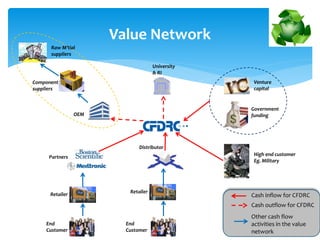
Value Network
Cash inflow for CFDRC
Cash outflow for CFDRC
Other cash flow
activities in the value
network
University
& RI
Government
funding
Venture
capital
Component
suppliers
Raw M’tial
suppliers
OEM
Partners
High end customer
Eg. Military
Distributor
Retailer Retailer
End
Customer
End
Customer
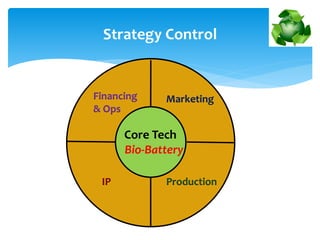
Strategy Control
Core Tech
Bio-Battery
Financing
& Ops
Marketing
ProductionIP
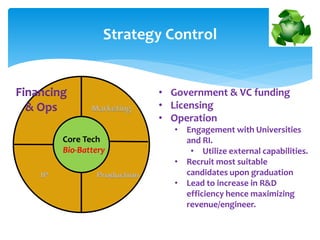
Strategy Control
Core Tech
Bio-Battery
Financing
& Ops Marketing
ProductionIP
• Government & VC funding
• Licensing
• Operation
• Engagement with Universities
and RI.
• Utilize external capabilities.
• Recruit most suitable
candidates upon graduation
• Lead to increase in R&D
efficiency hence maximizing
revenue/engineer.
Strategy Control
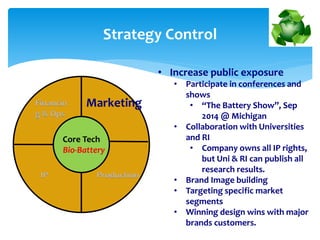
• Increase public exposure
• Participate in conferences and
shows
• “The Battery Show”, Sep
2014 @ Michigan
• Collaboration with Universities
and RI
• Company owns all IP rights,
but Uni & RI can publish all
research results.
• Brand Image building
• Targeting specific market
segments
• Winning design wins with major
brands customers.
Core Tech
Bio-Battery
Marketing
ProductionIP
Financin
g & Ops
Strategy Control
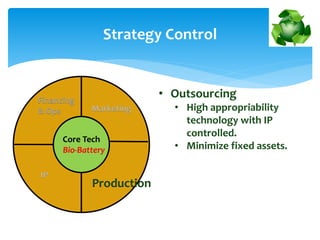
• Outsourcing
• High appropriability
technology with IP
controlled.
• Minimize fixed assets.
Core Tech
Bio-Battery
Financing
& Ops Marketing
Production
IP
Strategy Control
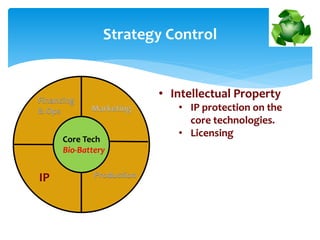
• Intellectual Property
• IP protection on the
core technologies.
• Licensing
Core Tech
Bio-Battery
Financing
& Ops Marketing
ProductionIP
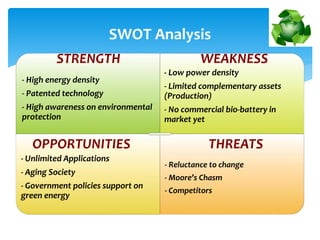
- High energy density
- Patented technology
- High awareness on environmental
protection
- Low power density
- Limited complementary assets
(Production)
- No commercial bio-battery in
market yet
- Unlimited Applications
- Aging Society
- Government policies support on
green energy
- Reluctance to change
- Moore’s Chasm
- Competitors
SWOT Analysis
STRENGTH WEAKNESS
OPPORTUNITIES THREATS
THANK YOU

Biz Model for Bio-Batteries

  • 1.
    Business Model for Bio-Battery BaeJin Woo (A0102853M) Heng Chew Chwee (A0098597B) Hong Chao (A0098568E) Nuraziz Yosokumoro (A0082045M) Wang Juan (A0098515W)
  • 2.
    Outline Value Creation Bio-Battery technology MarketSegment & Customer Selection Future Market Value Network Strategic Control SWOT Analysis
  • 3.
    Problems for ConventionalBatteries Low Energy Density Long Recharging Time Non-environmental friendly Safety o Explosion o Leakage Solution: New batteries provide longer lasting time, fast charging capabilities, safer and more environmental friendly Value Creation
  • 4.
    Terminology Terms Meaning Energy Density Amountof energy stored per weight (Wh/kg) Energy stored determined how long it can power device. For example : Lithium has energy density of 250Wh/kg ,while sugar 2500Wh/kg This means if 1 kg Li can power laptop for 1 day, sugar can power laptop for 10 days =Total volume of water inside bucket Power Density Amount of power (energy/time) per unit volume Different from energy density, it determined how much energy burst can be given to device in one second or rate of energy transfer =Total water can be throw at same time Source: The Two Classes of SI Units and the SI Prefixes". NIST Guide to the SI
  • 5.
    Bio-Battery Technology  Abio battery is an energy storing device powered by organic compounds, usually being glucose.  By using enzymes to break down glucose, bio-batteries directly receive energy from glucose Learn from nature to build effective energy storage!! Source: http://www.sony.net/Products/SC-HP/cx_news/vol51/sideview2.html
  • 6.
    Bio Battery Technology Source:http://www.sony.net/SonyInfo/News/Press/200708/07-074E/  Bio batteries contain an anode, cathode, separator and electrolyte.  In the anode the sugar(glucose) is broken down through enzymatic oxidation, producing both electrons and protons. When glucose first enters the battery, it enters through the anode.  Glucose → Gluconolactone+ 2H+ + 2e−  There is a flow created from the anode to the cathode which is what generates the electricity in the bio-battery  Protons(H⁺) are redirected to go through the separator to get to the cathode side of the battery  The cathode then consists of an oxidation reduction reaction. O2 +4H+ + 4e− → 2H2O
  • 7.
     Bio-Battery requiredBio-Catalyst or Enzyme for chemical reactions in Anode and Cathode that produce electricity  Enzyme extracted from microorganism Bio-Battery Technology  Enzyme immobilized in Carbon Nanotube based electrode Source: http://www.cfdrc.com/bio/bio-battery
  • 8.
    Bio-Battery Development Progress By May 2012, power density reached 9mW/cm2 and 35 mA/cm2  Performance improvement was due to better structure of carbon nanotube with better enzymes attached to Source: IJRET: International Journal of Research in Engineering and Technology, Volume: 02 Issue: 11 | Nov-2013, THE FUTURE OF ENERGY BIO BATTERY
  • 9.
    Bio-Battery Power Performance In2013, Researchers at the University of Wollongong-headquartered Australian Research Council Centre of Excellence for Electromaterials Science (ACES) designed one prototype which can provide the power of 36mW for at least 30 hours, making it suitable as a power source for most implantable devices (see table). Sony Corporation in 2008: bio-batteries using Vitamin K3 for the anode and potassium ferricyanide for the cathode, which generated power outputs in the order of 50mW, enough to supply an MP3 portable player. Source: http://www.electromaterials.edu.au/news/UOW159989.html
  • 10.
    Source: Nanotechnology by BenRogers, Sumita Pennathur, Jesse Adams, CRC Press, 2011 New Method for Continuous Production of Carbon Nanotubes, Science Daily, Apr. 10, 2012z BioBattery Main components Electrolyte Carbon Nanotube Enzyme Synthesis Cost Carbon Nanotube future cost reduction
  • 11.
    Market Segment &Customers Mobile Electronics Military ToysHealthcare
  • 12.
    Market Opportunity Implantable MedicalDevices: Market Size July 2013 Source: CIA World Factbook Source: US Census Bureau International Data Base
  • 13.
  • 14.
  • 15.
    Implantable Medical Devices: MajorPlayers http://www.stthomas.edu/business/academicdepts/finance/aristotlefund/pdf/stj_report.pdf US$M
  • 16.
    0 1 2 3 4 5 6 7 2009 2010 20112012 2013 2014 2015 S$ Year Projected Global Market ($B) Implantable Medical Devices: Market Potential Source: MarketPublishers, Global Cardiac Pacemakers - Market Growth Analysis, 2009-2015, Apr 15 2013
  • 17.
    Implantable Medical Devices: ValueProposition • Always stay charged as long as user is alive • Bio-compatible • Ultra-thin, flexible & small size • No replacement cost • Need to be replaced. • Toxic • Rigid • High replacement cost http://www.lexrobotics.com/body-fluid-powered-bio-batteries/
  • 18.
    Cost Saving Analysisof Patients 1st Pacemaker Implantation by 10-year age Total Pacemaker Procedure cost pacemaker battery life expectancy
  • 19.
    Avg. Age Expected operationfreq over life $ (USD) Male Female < 60 > 3.7 >4.3 52K ~ 61K 65 2.5 2.8 35K~40K 75 1.6 1.9 22K~27K Cost Saving Analysis for Patients Life Expectancy at birth, age 65, age 75 ( 2004) Current our targeted end-user is female patient (<65) who are more self-conscious about body scars.
  • 20.
    Bio-Battery Li-Ion Zinc Mecury Strategy Canvas ImplantableMedical Devices High / Big Low / Small http://www.lexrobotics.com/body-fluid-powered-bio-batteries http://www.ncbi.nlm.nih.gov/pmc/articles/PMC1502062/
  • 21.
  • 22.
  • 23.
  • 24.
    Strategy Canvas Music GreetingCard & Toys Source: IJRET: International Journal of Research in Engineering and Technology, Volume: 02 Issue: 11 | Nov-2013, THE FUTURE OF ENERGY BIO BATTERY High Low Bio-Battery Alkaline or Coin battery
  • 25.
    Smartphone  Tablet  GPSdevice  PSP games  Laptop  Camera Future Market: Mobile & Portable Devices
  • 26.
    Strategy Canvas Mobile &Portable Devices Safefy Charging rate Cost Power Density Bio-Battery Li-Ion Source: http://electronicdesign.com/power/understanding-lithium-battery-tradeoffs-mobile-devices High Low
  • 27.
    Value Network Cash inflowfor CFDRC Cash outflow for CFDRC Other cash flow activities in the value network University & RI Government funding Venture capital Component suppliers Raw M’tial suppliers OEM Partners High end customer Eg. Military Distributor Retailer Retailer End Customer End Customer
  • 28.
  • 29.
    Strategy Control Core Tech Bio-Battery Financing &Ops Marketing ProductionIP • Government & VC funding • Licensing • Operation • Engagement with Universities and RI. • Utilize external capabilities. • Recruit most suitable candidates upon graduation • Lead to increase in R&D efficiency hence maximizing revenue/engineer.
  • 30.
    Strategy Control • Increasepublic exposure • Participate in conferences and shows • “The Battery Show”, Sep 2014 @ Michigan • Collaboration with Universities and RI • Company owns all IP rights, but Uni & RI can publish all research results. • Brand Image building • Targeting specific market segments • Winning design wins with major brands customers. Core Tech Bio-Battery Marketing ProductionIP Financin g & Ops
  • 31.
    Strategy Control • Outsourcing •High appropriability technology with IP controlled. • Minimize fixed assets. Core Tech Bio-Battery Financing & Ops Marketing Production IP
  • 32.
    Strategy Control • IntellectualProperty • IP protection on the core technologies. • Licensing Core Tech Bio-Battery Financing & Ops Marketing ProductionIP
  • 33.
    - High energydensity - Patented technology - High awareness on environmental protection - Low power density - Limited complementary assets (Production) - No commercial bio-battery in market yet - Unlimited Applications - Aging Society - Government policies support on green energy - Reluctance to change - Moore’s Chasm - Competitors SWOT Analysis STRENGTH WEAKNESS OPPORTUNITIES THREATS
  • 34.