www.studymafia.org
Submitted To: Submitted By:
www.studymafia.org www.studymafia.org
Seminar
On
Bio Battery
 Introduction
 What is Bio-Battery
 History
 Working of Bio-Battery
 Need of Bio-Battery
 Types of Bio-Battery
 Future Scope
 Advantages
 Disadvantages
 Applications
 Conclusion
 A bio-battery is an energy storing device that is
powered by organic compounds, usually being
glucose, such as the glucose in human blood.
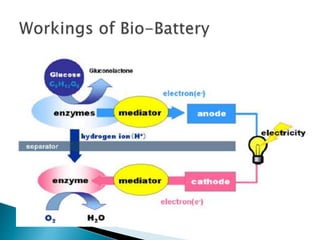
 When enzymes in human bodies break down glucose,
several electrons and protons are released.
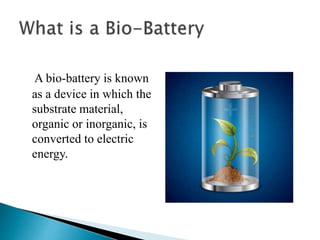
A bio-battery is known
as a device in which the
substrate material,
organic or inorganic, is
converted to electric
energy.
 As an electrical signal can induce a biological reaction;
the reverse in is also true in most of the cases and in this
way biological processes can be used to generate
electricity for powering electrical equipment.
 Even though the Bio fuel cells have been known for
almost a century since the first microbial BFC(Bio fuel
cells) was demonstrated in 1912,the first enzyme-based
bio-fuel cell was reported only in 1964 using glucose
oxidize (GOx) as the anodic catalyst and glucose as the
bio-fuel.
 In the field of electricity, a battery is a device that
converts chemical energy to electrical energy.
 Different types of batteries are used in various electronic
and electrical devices.
 However, these batteries contain certain chemicals such
as compounds of lead and mercury, which are highly
toxic in nature.
 Therefore, bio-batteries have a great potential to be used
as suitable alternatives or even replacements for chemical
batteries in the future.
 Passive System Type
A system in which reactive substance are absorbed in to the
electrodes through the process of natural diffusion.
 Active type System
In this type the reactive substance are introduce by force by
techniques as string, convection.
 Bio-batteries have a very bright future ahead of them as test
productions and research have been increasing over recent
years.
 They serve as a new form of energy that is proving to be
environmentally friendly, as well as successful, in producing
and reserving energy.
 Quick recharging capabilities
 Eco friendly
 Clean, non-toxic source of energy
 Raw material available easily & plenty
 Extremely safe
 Portable & light weight compared to fuel cell
 Compared to conventional batteries, such as lithium
batteries, bio-batteries are less likely to retain most of
their energy.
 This causes a problem when it comes to long term
usage and storage of energy for these batteries.
 Electronic devices
 Medicine
 Defence purposes
 Fuel synthesis
 The Bio batteries are High performing, stable, and
reproducible enzymatic fuel cell technology developed over
last 5 years.
 The Scaled-up demonstration of Bio-Battery powering
electronic circuit (performed at both Power Sources and Army
Science Confs).
 www.studymafia.org
 www.wikipedia.com
 www.google.com
ECE Bio-Battery ppt.pptx

ECE Bio-Battery ppt.pptx

  • 1.
    www.studymafia.org Submitted To: SubmittedBy: www.studymafia.org www.studymafia.org Seminar On Bio Battery
  • 2.
     Introduction  Whatis Bio-Battery  History  Working of Bio-Battery  Need of Bio-Battery  Types of Bio-Battery  Future Scope  Advantages  Disadvantages  Applications  Conclusion
  • 3.
     A bio-batteryis an energy storing device that is powered by organic compounds, usually being glucose, such as the glucose in human blood.  When enzymes in human bodies break down glucose, several electrons and protons are released.
  • 4.
    A bio-battery isknown as a device in which the substrate material, organic or inorganic, is converted to electric energy.
  • 5.
     As anelectrical signal can induce a biological reaction; the reverse in is also true in most of the cases and in this way biological processes can be used to generate electricity for powering electrical equipment.  Even though the Bio fuel cells have been known for almost a century since the first microbial BFC(Bio fuel cells) was demonstrated in 1912,the first enzyme-based bio-fuel cell was reported only in 1964 using glucose oxidize (GOx) as the anodic catalyst and glucose as the bio-fuel.
  • 7.
     In thefield of electricity, a battery is a device that converts chemical energy to electrical energy.  Different types of batteries are used in various electronic and electrical devices.  However, these batteries contain certain chemicals such as compounds of lead and mercury, which are highly toxic in nature.  Therefore, bio-batteries have a great potential to be used as suitable alternatives or even replacements for chemical batteries in the future.
  • 8.
     Passive SystemType A system in which reactive substance are absorbed in to the electrodes through the process of natural diffusion.  Active type System In this type the reactive substance are introduce by force by techniques as string, convection.
  • 9.
     Bio-batteries havea very bright future ahead of them as test productions and research have been increasing over recent years.  They serve as a new form of energy that is proving to be environmentally friendly, as well as successful, in producing and reserving energy.
  • 10.
     Quick rechargingcapabilities  Eco friendly  Clean, non-toxic source of energy  Raw material available easily & plenty  Extremely safe  Portable & light weight compared to fuel cell
  • 11.
     Compared toconventional batteries, such as lithium batteries, bio-batteries are less likely to retain most of their energy.  This causes a problem when it comes to long term usage and storage of energy for these batteries.
  • 12.
     Electronic devices Medicine  Defence purposes  Fuel synthesis
  • 13.
     The Biobatteries are High performing, stable, and reproducible enzymatic fuel cell technology developed over last 5 years.  The Scaled-up demonstration of Bio-Battery powering electronic circuit (performed at both Power Sources and Army Science Confs).
  • 14.

Editor's Notes