A
presentation
ON
BIO BATTERY
A fuel of next generation…..
SUBMITTED BY:-
RENU KUMARI
(10EBKEX045)
CONTENTS:-
What is Bio Battery
Introduction
History
Types of Bio Battery
Need of Bio Battery
How Bio Battery works
Principle of Bio Battery
Glucose
Process
Next Generation Prototype
Applications
Advantages
Disadvantages
What is bio battery??
A bio-battery is an energy
storing device that is
powered by organic
compounds, usually being
glucose, such as the
glucose in human blood.
When enzymes in our
bodies break down glucose,
several electrons and
protons are released.
Bio-Battery generates electricity from renewable
fuels (glucose, sucrose, fructose, etc ) providing a
sustained, on-demand portable power source.
 When enzymes in our bodies break down glucose,
several electrons and protons are released.
 Therefore, by using enzymes to breakdown
glucose, bio-batteries directly receive energy from
glucose.
These batteries then store this energy for later use.
Bio battery use biocatalyst, either bio molecules
such as enzymes or even whole living organism to
catalyze oxidation of bio mass-based materials for
generating electrical energy.
INTRODUCTION
The first enzyme-based bio-fuel cell was
reported only in 1964 using glucose oxidize
(GOx) as the anodic catalyst and glucose as
the bio-fuel.
Even though the Bio fuel cells have been
known for almost a century since the first
microbial BFC(Bio fuel cells) was
demonstrated in 1912.
Biological processes can be used to generate
electricity for powering electrical equipment.
HISTORY
Types of bio battery
Passive system type
A system in which reactive substances
are absorbed in to the electrodes
through a process of natural diffusion.
Active type system
In this type the reactive substance are
introduced by force by technique as
string ,convection.
An electricity shortage is felt most by those who
depend on electricity for heating, cooking, and water
supply.
In these circumstances, a sustained energy crisis may
become a humanitarian crisis.
As it is known that the energy conservation is the
major issue these times so the bio-battery is one of the
energy conservation method.
It can save a lot of power and it is also energy efficient
phenomenon.
Bio-Battery is a renewable energy source which is
again the major requirement of current energy system.
Need of Bio-Battery
How bio battery Works ??
Bio-batteries contain:-
An anode, cathode, separator and electrolyte
which are the basic components to any cell battery.
Between the anode and the cathode lies the
electrolyte which contains a separator.
The main function of the separator is to keep the
cathode and anode separated, to avoid electrical
short circuits.
This system as a whole, allows for a flow of
protons (H+) and electrons (e-) which ultimately
generate electricity.
PRINCIPLE OF BIO BATTERY
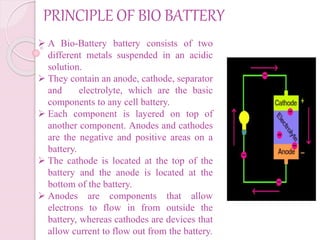
 A Bio-Battery battery consists of two
different metals suspended in an acidic
solution.
 They contain an anode, cathode, separator
and electrolyte, which are the basic
components to any cell battery.
 Each component is layered on top of
another component. Anodes and cathodes
are the negative and positive areas on a
battery.
 The cathode is located at the top of the
battery and the anode is located at the
bottom of the battery.
 Anodes are components that allow
electrons to flow in from outside the
battery, whereas cathodes are devices that
allow current to flow out from the battery.
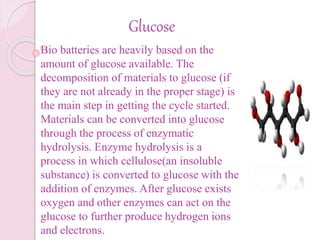
Glucose
Bio batteries are heavily based on the
amount of glucose available. The
decomposition of materials to glucose (if
they are not already in the proper stage) is
the main step in getting the cycle started.
Materials can be converted into glucose
through the process of enzymatic
hydrolysis. Enzyme hydrolysis is a
process in which cellulose(an insoluble
substance) is converted to glucose with the
addition of enzymes. After glucose exists
oxygen and other enzymes can act on the
glucose to further produce hydrogen ions
and electrons.
Process
Similar to how human bodies convert
food to energy using enzymes, bio-
batteries use enzymes to convert
glucose into energy.
Glucose → Gluconolactone +
2H+ + 2e−
Electron and proton travel through the
electrolyte, where the separator
redirects electrons to go through the
mediator to get to the cathode.
O2 +4H+ + 4e− → 2H2O
 Designed and
fabricated using
bipolar plates with
optimized surface
area to volume ratio.
 Improved design and
performance leads to
50times higher
volumetric power
density over existing
prototype.
Next Generation Prototype
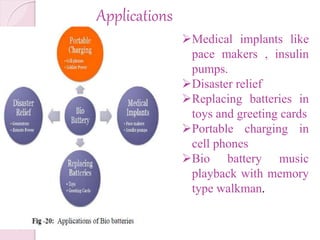
Applications
Medical implants like
pace makers , insulin
pumps.
Disaster relief
Replacing batteries in
toys and greeting cards
Portable charging in
cell phones
Bio battery music
playback with memory
type walkman.
Advantages
Instant recharge
Eco friendly
Raw materials available easily
& plenty.
Portable & light weight
compared to fuel cell.
 Provide a better employment
scope for rural areas.
readily available fuel source.
Disadvantages
Compared to conventional batteries , such as lithium
batteries, bio batteries are less likely to retain most of
their energy.
This causes a problem when it comes to long term
usage and storage of energy for these batteries .
However, researchers are continuing to develop the
battery in order to make it a more practical replacement
for current batteries and sources of energy.
Future
They serve as a new form of energy is
providing to be environmentally friendly, as well
as successful , in producing and reserving energy.
 Although the batteries are still being tested
before being commercially sold, several research
teams and engineers are working to further
advance the development of these batteries.
bio batteryyyyy

bio batteryyyyy

  • 1.
    A presentation ON BIO BATTERY A fuelof next generation….. SUBMITTED BY:- RENU KUMARI (10EBKEX045)
  • 2.
    CONTENTS:- What is BioBattery Introduction History Types of Bio Battery Need of Bio Battery How Bio Battery works Principle of Bio Battery Glucose Process Next Generation Prototype Applications Advantages Disadvantages
  • 3.
    What is biobattery?? A bio-battery is an energy storing device that is powered by organic compounds, usually being glucose, such as the glucose in human blood. When enzymes in our bodies break down glucose, several electrons and protons are released.
  • 4.
    Bio-Battery generates electricityfrom renewable fuels (glucose, sucrose, fructose, etc ) providing a sustained, on-demand portable power source.  When enzymes in our bodies break down glucose, several electrons and protons are released.  Therefore, by using enzymes to breakdown glucose, bio-batteries directly receive energy from glucose. These batteries then store this energy for later use. Bio battery use biocatalyst, either bio molecules such as enzymes or even whole living organism to catalyze oxidation of bio mass-based materials for generating electrical energy. INTRODUCTION
  • 5.
    The first enzyme-basedbio-fuel cell was reported only in 1964 using glucose oxidize (GOx) as the anodic catalyst and glucose as the bio-fuel. Even though the Bio fuel cells have been known for almost a century since the first microbial BFC(Bio fuel cells) was demonstrated in 1912. Biological processes can be used to generate electricity for powering electrical equipment. HISTORY
  • 6.
    Types of biobattery Passive system type A system in which reactive substances are absorbed in to the electrodes through a process of natural diffusion. Active type system In this type the reactive substance are introduced by force by technique as string ,convection.
  • 7.
    An electricity shortageis felt most by those who depend on electricity for heating, cooking, and water supply. In these circumstances, a sustained energy crisis may become a humanitarian crisis. As it is known that the energy conservation is the major issue these times so the bio-battery is one of the energy conservation method. It can save a lot of power and it is also energy efficient phenomenon. Bio-Battery is a renewable energy source which is again the major requirement of current energy system. Need of Bio-Battery
  • 8.
    How bio batteryWorks ?? Bio-batteries contain:- An anode, cathode, separator and electrolyte which are the basic components to any cell battery. Between the anode and the cathode lies the electrolyte which contains a separator. The main function of the separator is to keep the cathode and anode separated, to avoid electrical short circuits. This system as a whole, allows for a flow of protons (H+) and electrons (e-) which ultimately generate electricity.
  • 9.
    PRINCIPLE OF BIOBATTERY  A Bio-Battery battery consists of two different metals suspended in an acidic solution.  They contain an anode, cathode, separator and electrolyte, which are the basic components to any cell battery.  Each component is layered on top of another component. Anodes and cathodes are the negative and positive areas on a battery.  The cathode is located at the top of the battery and the anode is located at the bottom of the battery.  Anodes are components that allow electrons to flow in from outside the battery, whereas cathodes are devices that allow current to flow out from the battery.
  • 10.
    Glucose Bio batteries areheavily based on the amount of glucose available. The decomposition of materials to glucose (if they are not already in the proper stage) is the main step in getting the cycle started. Materials can be converted into glucose through the process of enzymatic hydrolysis. Enzyme hydrolysis is a process in which cellulose(an insoluble substance) is converted to glucose with the addition of enzymes. After glucose exists oxygen and other enzymes can act on the glucose to further produce hydrogen ions and electrons.
  • 11.
    Process Similar to howhuman bodies convert food to energy using enzymes, bio- batteries use enzymes to convert glucose into energy. Glucose → Gluconolactone + 2H+ + 2e− Electron and proton travel through the electrolyte, where the separator redirects electrons to go through the mediator to get to the cathode. O2 +4H+ + 4e− → 2H2O
  • 12.
     Designed and fabricatedusing bipolar plates with optimized surface area to volume ratio.  Improved design and performance leads to 50times higher volumetric power density over existing prototype. Next Generation Prototype
  • 13.
    Applications Medical implants like pacemakers , insulin pumps. Disaster relief Replacing batteries in toys and greeting cards Portable charging in cell phones Bio battery music playback with memory type walkman.
  • 14.
    Advantages Instant recharge Eco friendly Rawmaterials available easily & plenty. Portable & light weight compared to fuel cell.  Provide a better employment scope for rural areas. readily available fuel source.
  • 15.
    Disadvantages Compared to conventionalbatteries , such as lithium batteries, bio batteries are less likely to retain most of their energy. This causes a problem when it comes to long term usage and storage of energy for these batteries . However, researchers are continuing to develop the battery in order to make it a more practical replacement for current batteries and sources of energy.
  • 16.
    Future They serve asa new form of energy is providing to be environmentally friendly, as well as successful , in producing and reserving energy.  Although the batteries are still being tested before being commercially sold, several research teams and engineers are working to further advance the development of these batteries.