Classified by Alfa Laval as: Business
BIO BATTERY
Date of Presentation :21/01/2024
JSPM’S JAYWANTRAO SAWANT
POLYTECHNIC
Department of Mechanical Engineering
Name:Bhagyashree Avinash kadam
Classified by Alfa Laval as: Business
 Project Motivation
 Problem Solved
 Aim
 Introduction
 Literature review
 Block Diagram
 Timeline
 History
 Advantages
 Limitations
 Applications
 Future scope
 Conclusion
 References
Contents
Classified by Alfa Laval as: Business
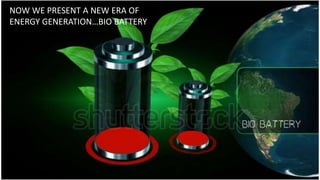
NOW WE PRESENT A NEW ERA OF
ENERGY GENERATION…BIO BATTERY
Classified by Alfa Laval as: Business
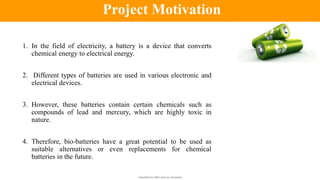
1. In the field of electricity, a battery is a device that converts
chemical energy to electrical energy.
2. Different types of batteries are used in various electronic and
electrical devices.
3. However, these batteries contain certain chemicals such as
compounds of lead and mercury, which are highly toxic in
nature.
4. Therefore, bio-batteries have a great potential to be used as
suitable alternatives or even replacements for chemical
batteries in the future.
Project Motivation
Classified by Alfa Laval as: Business
• Bio-Battery generates electricity from renewable fuels (glucose,
sucrose, fructose, etc. ) : -
1. It allows instant recharge compared to all the other batteries.
2. These batteries keep themselves charged with the help of continuous
supply of glucose or sugar. They do not require any external power
supply.
3. They are used as clean alternate renewable power source due to the
fact that they are source of non-toxic and non-flammable fuel.
4. They do not cause any explosions and they do not cause any leakage
Hence, they are safe to use.
Problem Solved
Classified by Alfa Laval as: Business
• When enzymes in human bodies break down glucose, several
electrons and protons are released. Therefore, by using
enzymes to break down glucose, bio-batteries directly receive
energy from glucose. Then these batteries store this energy for
later use.
Aim
Classified by Alfa Laval as: Business
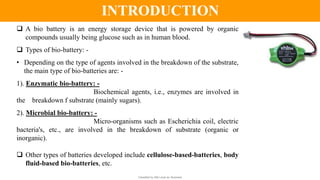
 A bio battery is an energy storage device that is powered by organic
compounds usually being glucose such as in human blood.
 Types of bio-battery: -
• Depending on the type of agents involved in the breakdown of the substrate,
the main type of bio-batteries are: -
1). Enzymatic bio-battery: -
Biochemical agents, i.e., enzymes are involved in
the breakdown f substrate (mainly sugars).
2). Microbial bio-battery: -
Micro-organisms such as Escherichia coil, electric
bacteria's, etc., are involved in the breakdown of substrate (organic or
inorganic).
 Other types of batteries developed include cellulose-based-batteries, body
fluid-based bio-batteries, etc.
INTRODUCTION
Classified by Alfa Laval as: Business
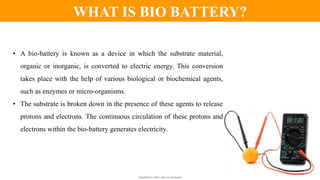
• A bio-battery is known as a device in which the substrate material,
organic or inorganic, is converted to electric energy. This conversion
takes place with the help of various biological or biochemical agents,
such as enzymes or micro-organisms.
• The substrate is broken down in the presence of these agents to release
protons and electrons. The continuous circulation of these protons and
electrons within the bio-battery generates electricity.
WHAT IS BIO BATTERY?
Classified by Alfa Laval as: Business
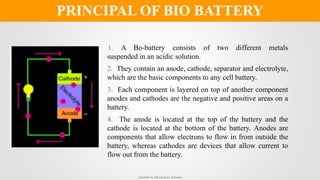
1. A Bo-battery consists of two different metals
suspended in an acidic solution.
2. They contain an anode, cathode, separator and electrolyte,
which are the basic components to any cell battery.
3. Each component is layered on top of another component
anodes and cathodes are the negative and positive areas on a
battery.
4. The anode is located at the top of the battery and the
cathode is located at the bottom of the battery. Anodes are
components that allow electrons to flow in from outside the
battery, whereas cathodes are devices that allow current to
flow out from the battery.
PRINCIPAL OF BIO BATTERY
Classified by Alfa Laval as: Business
MECHANISM OF BIO BATTERY
Classified by Alfa Laval as: Business
Block Diagram
Classified by Alfa Laval as: Business
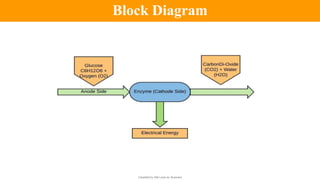
1. Bio batteries are heavily based on the amount of glucose available.
2. This glucose (sugar) can be provided from nearly anything, including
soda, waste materials or the glucose in living organisms.
3. The decomposition of materials to glucoses is the main step in getting
the cycle started
4. Once glucose is present, oxygen and other enzymes can act on it to
further produce protons and electrons.
GLUCOSE
Classified by Alfa Laval as: Business
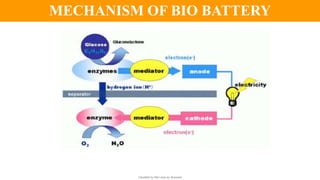
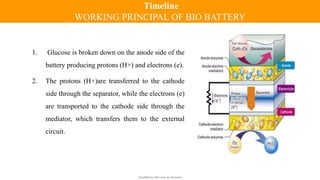
1. Glucose is broken down on the anode side of the
battery producing protons (H+) and electrons (e).
2. The protons (H+)are transferred to the cathode
side through the separator, while the electrons (e)
are transported to the cathode side through the
mediator, which transfers them to the external
circuit.
Timeline
WORKING PRINCIPAL OF BIO BATTERY
Classified by Alfa Laval as: Business
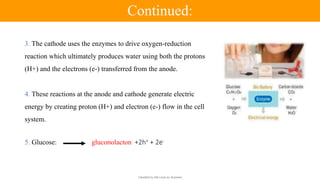
3. The cathode uses the enzymes to drive oxygen-reduction
reaction which ultimately produces water using both the protons
(H+) and the electrons (e-) transferred from the anode.
4. These reactions at the anode and cathode generate electric
energy by creating proton (H+) and electron (e-) flow in the cell
system.
5. Glucose: gluconolacton +2h+ + 2e-
Continued:
Classified by Alfa Laval as: Business
6. The anode and the cathode lies the electrolyte which contains a separator.
7. The main function of the separator is to keep the cathode and anode
separated, to avoid electrical short circuits.
This system allows for a flow of protons(h+) and electrons (e-)which ultimately
generate electricity.
8. The movement of protons has a moving force that pushes, this movement is
called current. When this moving force (current) is measured.
Continued:
Classified by Alfa Laval as: Business
1. 1912, the first microbial BFC1964, the first enzyme-based bio-fuel cell
2. 2003, Bio battery using Human Blood & 2005, Bio battery using Human
Urine
3. TOKYO, August 23, 2007- Sony announced the development of a bio battery
that generates electricity from carbohydrates (sugar) utilizing enzymes as its
catalyst, through the application of power generation principles found in living
organisms.
4. July 17, 2013,Microbial fuel cell (MFC)
History
Classified by Alfa Laval as: Business
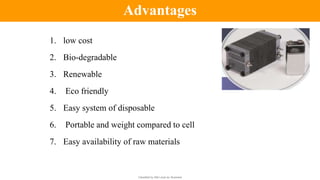
1. low cost
2. Bio-degradable
3. Renewable
4. Eco friendly
5. Easy system of disposable
6. Portable and weight compared to cell
7. Easy availability of raw materials
Advantages
Classified by Alfa Laval as: Business
1. Compared to conventional batteries, such as lithium batteries, bio-
batteries are less likely to retain most of their energy. The bio-
battery retains less energy as compared to the conventional
batteries such as lithium-based batteries.
2. They are not a good choice for the long-term use and storage.
Limitations
Classified by Alfa Laval as: Business
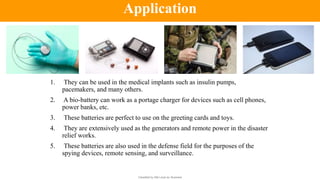
1. They can be used in the medical implants such as insulin pumps,
pacemakers, and many others.
2. A bio-battery can work as a portage charger for devices such as cell phones,
power banks, etc.
3. These batteries are perfect to use on the greeting cards and toys.
4. They are extensively used as the generators and remote power in the disaster
relief works.
5. These batteries are also used in the defense field for the purposes of the
spying devices, remote sensing, and surveillance.
Application
Classified by Alfa Laval as: Business
1. They serve as a new form of energy that is proving to be environment
friendly, as well as successful, in producing and reserving energy. Although
the batteries are still being tested before being commercially sold, several
research teams and engineers are working to further advance the development
of these batteries.
2. We can integrate small cellphones and batteries on a plastic card. The
technology can even be applied to laptops,desktops,mp3 players, televisions,
cars etc.
3. Very bright future ahead. Alternative source of energy
4. Medical benefits
Future scope
Classified by Alfa Laval as: Business
• These batteries come with a high energy density and can use at the
room temperature easily. It can be used as a clean alternative
renewable source of power because they are sources of non-
flammable and non-toxic fuel. These batteries are completely
renewable, non-polluting and environmentally friendly.
Conclusion
Classified by Alfa Laval as: Business
1. https://www.slideshare.net/kottesruthi/bio-battery-ppt
2. https://studymafia.org/bio-battery-seminar-ppt-with-pdf-report/
3. http://www.123seminarsonly.com/EC/Bio-Battery.html
4. https://www.mdpi.com/journal/batteries/special_issues/Bio_Batteries
References
Classified by Alfa Laval as: Business
Thank
You!

Bio battery power point presentation slide

  • 1.
    Classified by AlfaLaval as: Business BIO BATTERY Date of Presentation :21/01/2024 JSPM’S JAYWANTRAO SAWANT POLYTECHNIC Department of Mechanical Engineering Name:Bhagyashree Avinash kadam
  • 2.
    Classified by AlfaLaval as: Business  Project Motivation  Problem Solved  Aim  Introduction  Literature review  Block Diagram  Timeline  History  Advantages  Limitations  Applications  Future scope  Conclusion  References Contents
  • 3.
    Classified by AlfaLaval as: Business NOW WE PRESENT A NEW ERA OF ENERGY GENERATION…BIO BATTERY
  • 4.
    Classified by AlfaLaval as: Business 1. In the field of electricity, a battery is a device that converts chemical energy to electrical energy. 2. Different types of batteries are used in various electronic and electrical devices. 3. However, these batteries contain certain chemicals such as compounds of lead and mercury, which are highly toxic in nature. 4. Therefore, bio-batteries have a great potential to be used as suitable alternatives or even replacements for chemical batteries in the future. Project Motivation
  • 5.
    Classified by AlfaLaval as: Business • Bio-Battery generates electricity from renewable fuels (glucose, sucrose, fructose, etc. ) : - 1. It allows instant recharge compared to all the other batteries. 2. These batteries keep themselves charged with the help of continuous supply of glucose or sugar. They do not require any external power supply. 3. They are used as clean alternate renewable power source due to the fact that they are source of non-toxic and non-flammable fuel. 4. They do not cause any explosions and they do not cause any leakage Hence, they are safe to use. Problem Solved
  • 6.
    Classified by AlfaLaval as: Business • When enzymes in human bodies break down glucose, several electrons and protons are released. Therefore, by using enzymes to break down glucose, bio-batteries directly receive energy from glucose. Then these batteries store this energy for later use. Aim
  • 7.
    Classified by AlfaLaval as: Business  A bio battery is an energy storage device that is powered by organic compounds usually being glucose such as in human blood.  Types of bio-battery: - • Depending on the type of agents involved in the breakdown of the substrate, the main type of bio-batteries are: - 1). Enzymatic bio-battery: - Biochemical agents, i.e., enzymes are involved in the breakdown f substrate (mainly sugars). 2). Microbial bio-battery: - Micro-organisms such as Escherichia coil, electric bacteria's, etc., are involved in the breakdown of substrate (organic or inorganic).  Other types of batteries developed include cellulose-based-batteries, body fluid-based bio-batteries, etc. INTRODUCTION
  • 8.
    Classified by AlfaLaval as: Business • A bio-battery is known as a device in which the substrate material, organic or inorganic, is converted to electric energy. This conversion takes place with the help of various biological or biochemical agents, such as enzymes or micro-organisms. • The substrate is broken down in the presence of these agents to release protons and electrons. The continuous circulation of these protons and electrons within the bio-battery generates electricity. WHAT IS BIO BATTERY?
  • 9.
    Classified by AlfaLaval as: Business 1. A Bo-battery consists of two different metals suspended in an acidic solution. 2. They contain an anode, cathode, separator and electrolyte, which are the basic components to any cell battery. 3. Each component is layered on top of another component anodes and cathodes are the negative and positive areas on a battery. 4. The anode is located at the top of the battery and the cathode is located at the bottom of the battery. Anodes are components that allow electrons to flow in from outside the battery, whereas cathodes are devices that allow current to flow out from the battery. PRINCIPAL OF BIO BATTERY
  • 10.
    Classified by AlfaLaval as: Business MECHANISM OF BIO BATTERY
  • 11.
    Classified by AlfaLaval as: Business Block Diagram
  • 12.
    Classified by AlfaLaval as: Business 1. Bio batteries are heavily based on the amount of glucose available. 2. This glucose (sugar) can be provided from nearly anything, including soda, waste materials or the glucose in living organisms. 3. The decomposition of materials to glucoses is the main step in getting the cycle started 4. Once glucose is present, oxygen and other enzymes can act on it to further produce protons and electrons. GLUCOSE
  • 13.
    Classified by AlfaLaval as: Business 1. Glucose is broken down on the anode side of the battery producing protons (H+) and electrons (e). 2. The protons (H+)are transferred to the cathode side through the separator, while the electrons (e) are transported to the cathode side through the mediator, which transfers them to the external circuit. Timeline WORKING PRINCIPAL OF BIO BATTERY
  • 14.
    Classified by AlfaLaval as: Business 3. The cathode uses the enzymes to drive oxygen-reduction reaction which ultimately produces water using both the protons (H+) and the electrons (e-) transferred from the anode. 4. These reactions at the anode and cathode generate electric energy by creating proton (H+) and electron (e-) flow in the cell system. 5. Glucose: gluconolacton +2h+ + 2e- Continued:
  • 15.
    Classified by AlfaLaval as: Business 6. The anode and the cathode lies the electrolyte which contains a separator. 7. The main function of the separator is to keep the cathode and anode separated, to avoid electrical short circuits. This system allows for a flow of protons(h+) and electrons (e-)which ultimately generate electricity. 8. The movement of protons has a moving force that pushes, this movement is called current. When this moving force (current) is measured. Continued:
  • 16.
    Classified by AlfaLaval as: Business 1. 1912, the first microbial BFC1964, the first enzyme-based bio-fuel cell 2. 2003, Bio battery using Human Blood & 2005, Bio battery using Human Urine 3. TOKYO, August 23, 2007- Sony announced the development of a bio battery that generates electricity from carbohydrates (sugar) utilizing enzymes as its catalyst, through the application of power generation principles found in living organisms. 4. July 17, 2013,Microbial fuel cell (MFC) History
  • 17.
    Classified by AlfaLaval as: Business 1. low cost 2. Bio-degradable 3. Renewable 4. Eco friendly 5. Easy system of disposable 6. Portable and weight compared to cell 7. Easy availability of raw materials Advantages
  • 18.
    Classified by AlfaLaval as: Business 1. Compared to conventional batteries, such as lithium batteries, bio- batteries are less likely to retain most of their energy. The bio- battery retains less energy as compared to the conventional batteries such as lithium-based batteries. 2. They are not a good choice for the long-term use and storage. Limitations
  • 19.
    Classified by AlfaLaval as: Business 1. They can be used in the medical implants such as insulin pumps, pacemakers, and many others. 2. A bio-battery can work as a portage charger for devices such as cell phones, power banks, etc. 3. These batteries are perfect to use on the greeting cards and toys. 4. They are extensively used as the generators and remote power in the disaster relief works. 5. These batteries are also used in the defense field for the purposes of the spying devices, remote sensing, and surveillance. Application
  • 20.
    Classified by AlfaLaval as: Business 1. They serve as a new form of energy that is proving to be environment friendly, as well as successful, in producing and reserving energy. Although the batteries are still being tested before being commercially sold, several research teams and engineers are working to further advance the development of these batteries. 2. We can integrate small cellphones and batteries on a plastic card. The technology can even be applied to laptops,desktops,mp3 players, televisions, cars etc. 3. Very bright future ahead. Alternative source of energy 4. Medical benefits Future scope
  • 21.
    Classified by AlfaLaval as: Business • These batteries come with a high energy density and can use at the room temperature easily. It can be used as a clean alternative renewable source of power because they are sources of non- flammable and non-toxic fuel. These batteries are completely renewable, non-polluting and environmentally friendly. Conclusion
  • 22.
    Classified by AlfaLaval as: Business 1. https://www.slideshare.net/kottesruthi/bio-battery-ppt 2. https://studymafia.org/bio-battery-seminar-ppt-with-pdf-report/ 3. http://www.123seminarsonly.com/EC/Bio-Battery.html 4. https://www.mdpi.com/journal/batteries/special_issues/Bio_Batteries References
  • 23.
    Classified by AlfaLaval as: Business Thank You!