BIO-BATTERIES
BY : AMOGHA. A.K.
EEE- DEPARTMENT
• Introduction
• Problem Statement
• Literature Survey
• What is Bio-Battery?
• History
• Need of Bio-Battery
• Types of Bio-Battery
• Construction
• Working of Bio-Battery
• Applications
• Advantages & Disadvantages
• Future Scope
• Conclusion
• References
CONTENTS
BIO-BATTERIES
Non-chemical
Non- hazardous
Non-flammable
Environment friendly
Introduction
The conventional batteries like lithium-
ion batteries & alkaline batteries etc are
not eco-friendly.
Bio-Batteries are eco-friendly .
Problem Statement
 Nicolas. D has worked on microbial fuel cells that are low
power devices which are harvested at their output .
 Kenji Kano has researched on enzymatic bio-batteries.
 Seokheun Sean Choi has studied on paper bio-battery.
Literature Survey
Bio-Battery is an
electric generation that
utilizes energy sources
such as carbohydrates,
proteins, Amino acid
and fat by digesting
enzymes.
What is Bio-Battery ?
The first microbial “Bio Fuel Cells”
(BFC) was demonstrated in 1912.
The first enzyme-based bio-fuel cell
was reported in 1964 using glucose
oxidize (GOx) as the anodic catalyst
& glucose as the bio –fuel.
History
• As we know that energy conservation is the
major issue , the bio-battery is one of the
energy conservation method.
• Bio-batteries are the alternative for clean
renewable energy power source.
Need of bio-battery
Enzymatic bio-battery
 Enzymes are involved in breakdown of
glucose.
Microbial bio-battery
 Micro-organisms like Escherichia Coli, Electric
bacteria etc are involved in breaking of glucose.
Types of bio-battery
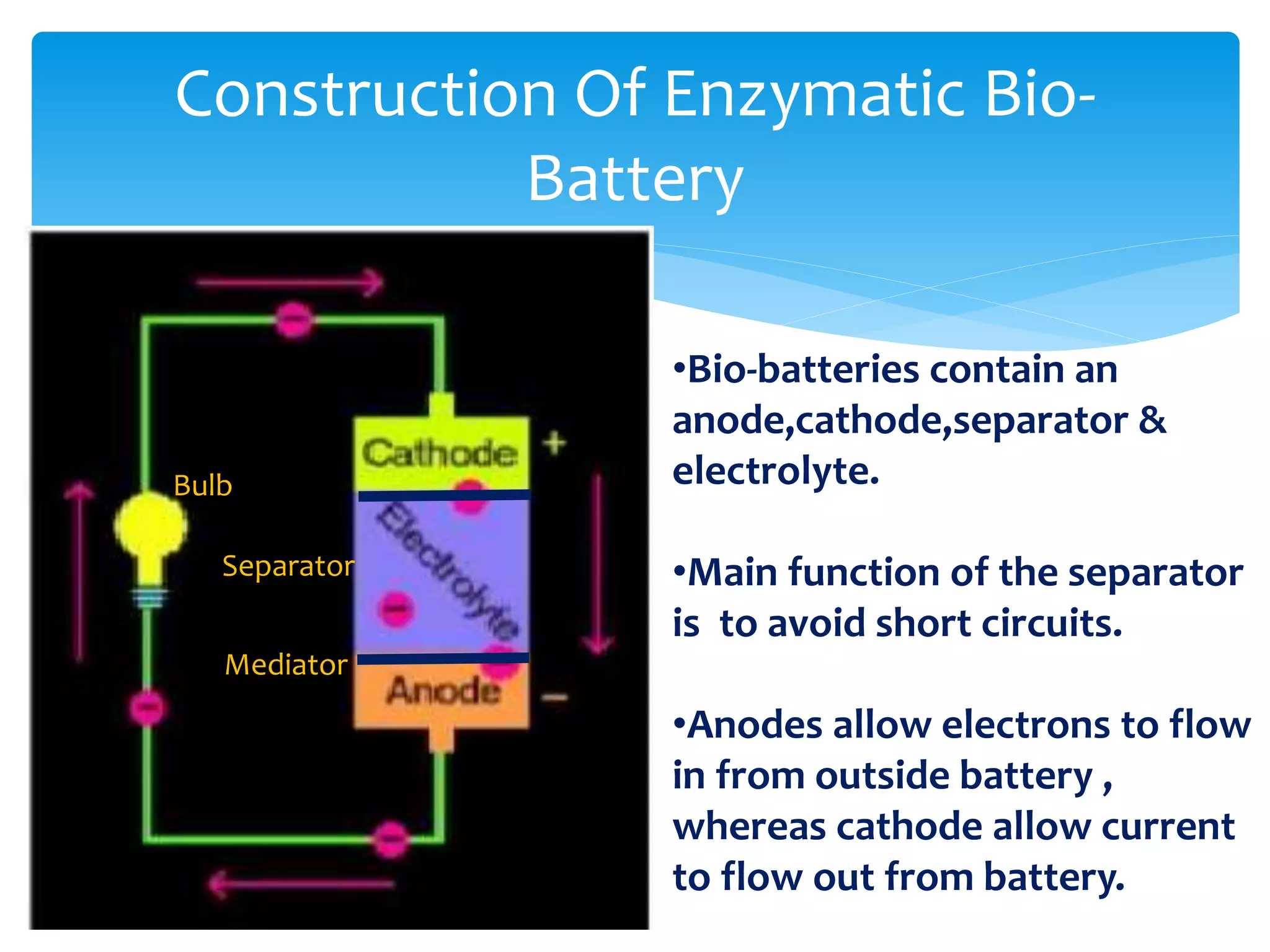
Construction Of Enzymatic Bio-
Battery
•Bio-batteries contain an
anode,cathode,separator &
electrolyte.
•Main function of the separator
is to avoid short circuits.
•Anodes allow electrons to flow
in from outside battery ,
whereas cathode allow current
to flow out from battery.
Bulb
Mediator
Separator
• Glucose is broken at anode
• Protons are transferred to
cathode via separator.
• Electrons are transported
to cathode by mediator.
• Cathode uses enzymes for
reduction reaction.
• The reaction generates
electrical energy.
Working of Enzymatic bio-battery
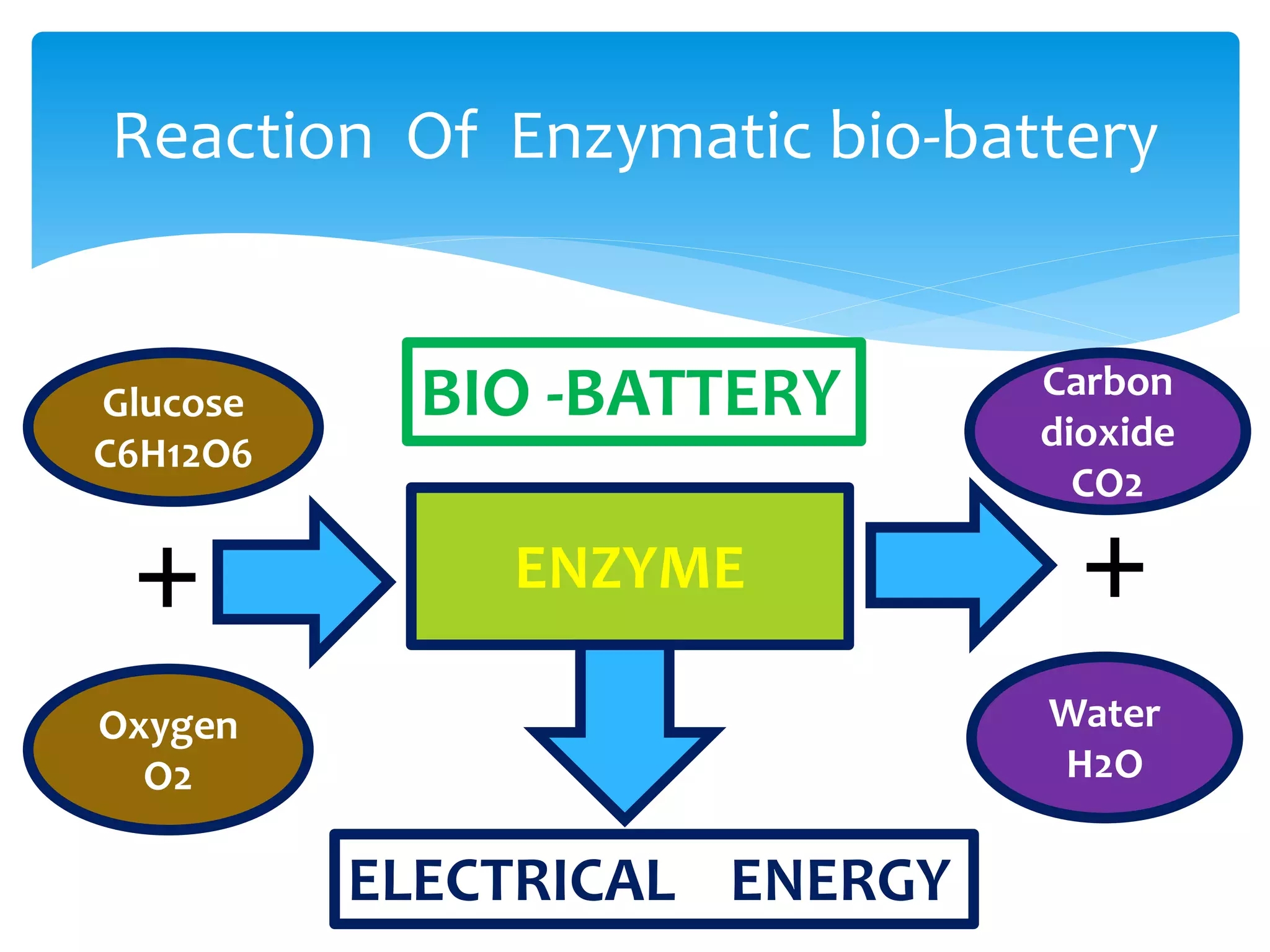
Reaction Of Enzymatic bio-battery
Glucose
C6H12O6
Oxygen
O2
Carbon
dioxide
CO2
Water
H2O
ENZYME
BIO -BATTERY
ELECTRICAL ENERGY
+ +
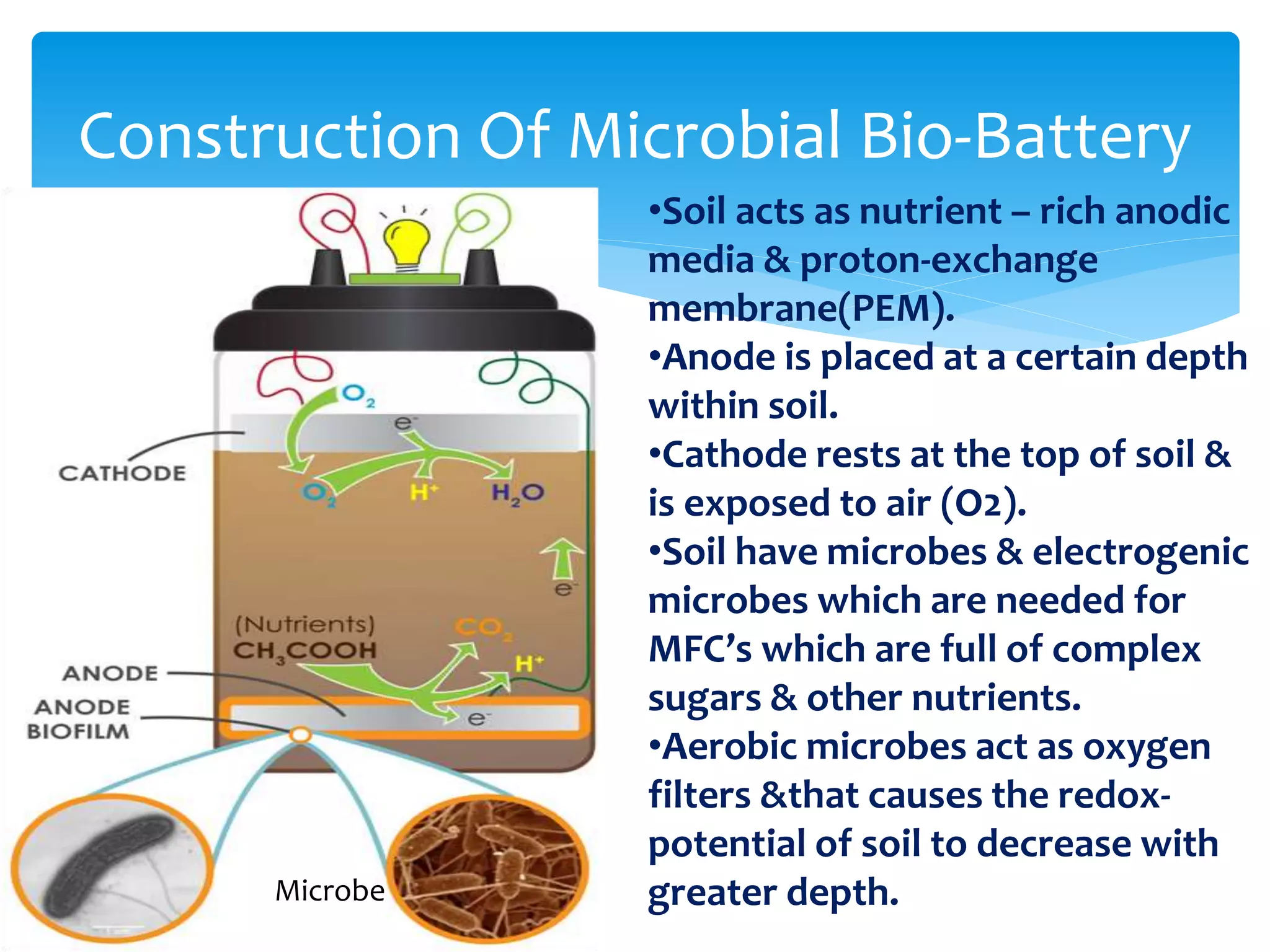
Principle Of Microbial Bio-Battery
The bacteria live at anode & convert
reactants like glucose, acetate &
waste water into CO2, protons & e-.
Under aerobic conditions, bacteria
use oxygen/nitrate as a e- acceptor
to produce water.
In absence of O2, bacteria switch
from e- acceptor to an insoluble
acceptor.
Electron transfer take place via
membrane .
Construction Of Microbial Bio-Battery
•Soil acts as nutrient – rich anodic
media & proton-exchange
membrane(PEM).
•Anode is placed at a certain depth
within soil.
•Cathode rests at the top of soil &
is exposed to air (O2).
•Soil have microbes & electrogenic
microbes which are needed for
MFC’s which are full of complex
sugars & other nutrients.
•Aerobic microbes act as oxygen
filters &that causes the redox-
potential of soil to decrease with
greater depth.
Microbe
Reaction Of Microbial Bio-Battery
Microbial
Fuel Cell
Load
O2+
organic
matter
Reactants
CO2 +H2O
Products
Electrical
Energy
GRAPH: Comparison Of Energy
Densities Of Ordinary Batteries & Bio-
Batteries
Battery type Energy density Voltage
Unit MJ/Kg Ah/kg Wh/kg V
 Primary Batteries
 AA alkaline battery 0.58 107 160 1.50
 Li-MnO2 battery 0.90 83 250 3.00
 Rechargeable Batteries
 Lead acid battery 0.14 19 40 2.11
 NiMH battery 0.36 80 100 1.25
 Lithium- ion battery 0.54 42 150 3.60
 Bio-Batteries
 100% methanol 19.7 5030 2515 0.50
 100% glucose 15.5 3574 1787 0.50
 100% maltodextrin 17.0 3970 1985 0.50
TABLE: Comparison Of Energy
Densities Of Ordinary Batteries & Bio-
Batteries
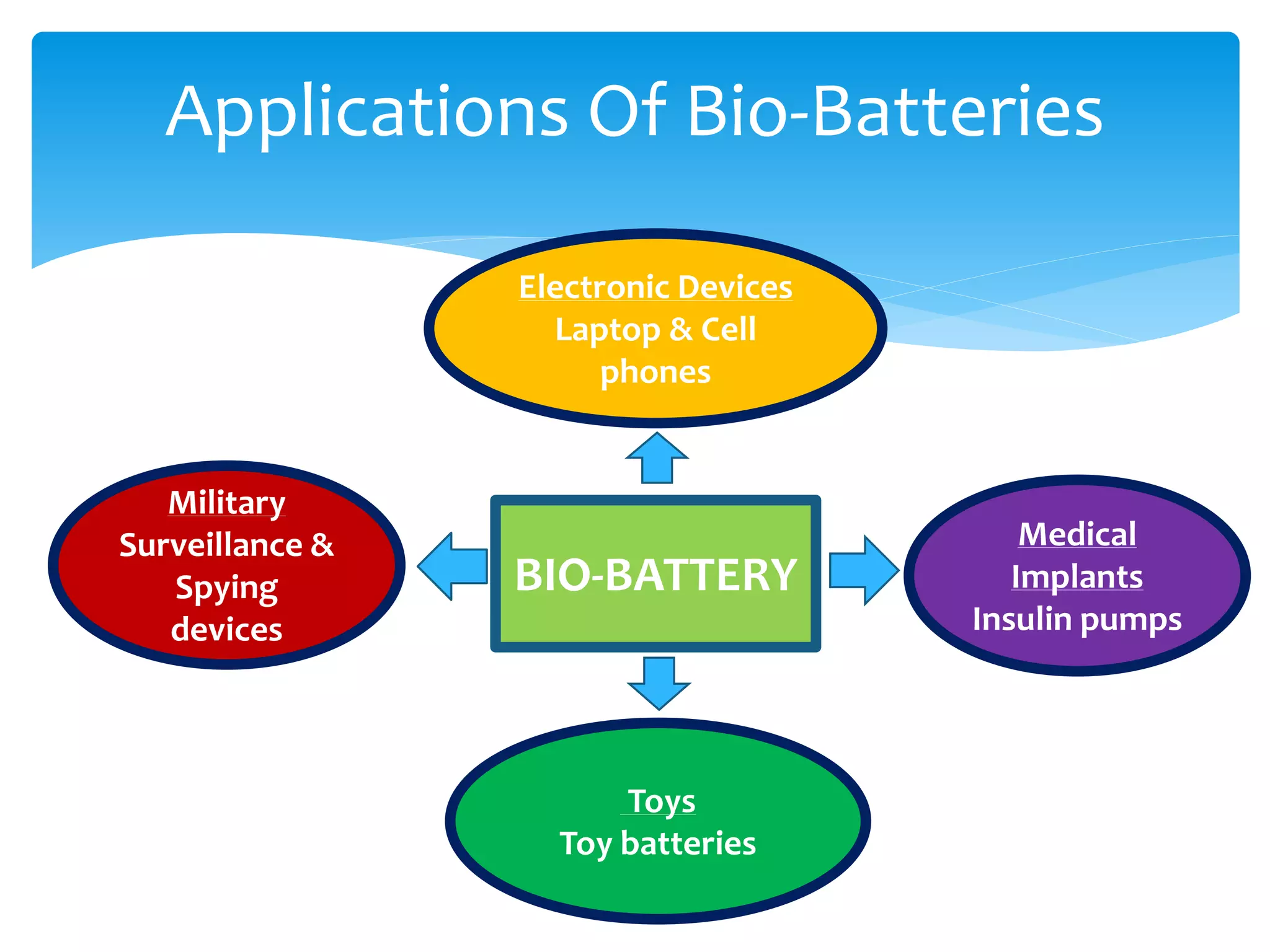
Applications Of Bio-Batteries
Military
Surveillance &
Spying
devices
Medical
Implants
Insulin pumps
Toys
Toy batteries
Electronic Devices
Laptop & Cell
phones
BIO BATTERY
BIO-BATTERY
• Eco-friendly
• Raw materials are easily available.
• Non-Explosive
• Biodegradable
• Safe batteries
Advantages Of Bio-Battery
The bio-batteries are less likely to
retain most of the energy during
long term usage.
Disadvantages Of Bio-Battery
Future Scope
Bio-batteries have a very bright
future ahead , as they serve a new
form of energy that is proving to be
environmental friendly, as well as
successful, in producing and reserving
energy.
Non-toxic
Eco-friendly
Contribution for safe earth
planet.
Conclusion
 IEEE MEMS, Jan 2017, Seokheun Sean Choi :Journal
of Advanced Materials Technologies
 A.A. Yazdi :Journal of Power Sources,Jan 2017
 http://www.qrg.northwestern.edu/projects/vss/doc
s/power/2-how-do-batteries-work.htmln
 www.fespa.com/news/blogs/laurel.../photosynthesi
s-bio batteries.html
 www.studymafia.org
References
THANK YOU ALL & HAVE A

Bio batteries

  • 1.
    BIO-BATTERIES BY : AMOGHA.A.K. EEE- DEPARTMENT
  • 2.
    • Introduction • ProblemStatement • Literature Survey • What is Bio-Battery? • History • Need of Bio-Battery • Types of Bio-Battery • Construction • Working of Bio-Battery • Applications • Advantages & Disadvantages • Future Scope • Conclusion • References CONTENTS
  • 3.
  • 4.
    The conventional batterieslike lithium- ion batteries & alkaline batteries etc are not eco-friendly. Bio-Batteries are eco-friendly . Problem Statement
  • 5.
     Nicolas. Dhas worked on microbial fuel cells that are low power devices which are harvested at their output .  Kenji Kano has researched on enzymatic bio-batteries.  Seokheun Sean Choi has studied on paper bio-battery. Literature Survey
  • 6.
    Bio-Battery is an electricgeneration that utilizes energy sources such as carbohydrates, proteins, Amino acid and fat by digesting enzymes. What is Bio-Battery ?
  • 7.
    The first microbial“Bio Fuel Cells” (BFC) was demonstrated in 1912. The first enzyme-based bio-fuel cell was reported in 1964 using glucose oxidize (GOx) as the anodic catalyst & glucose as the bio –fuel. History
  • 8.
    • As weknow that energy conservation is the major issue , the bio-battery is one of the energy conservation method. • Bio-batteries are the alternative for clean renewable energy power source. Need of bio-battery
  • 9.
    Enzymatic bio-battery  Enzymesare involved in breakdown of glucose. Microbial bio-battery  Micro-organisms like Escherichia Coli, Electric bacteria etc are involved in breaking of glucose. Types of bio-battery
  • 10.
    Construction Of EnzymaticBio- Battery •Bio-batteries contain an anode,cathode,separator & electrolyte. •Main function of the separator is to avoid short circuits. •Anodes allow electrons to flow in from outside battery , whereas cathode allow current to flow out from battery. Bulb Mediator Separator
  • 11.
    • Glucose isbroken at anode • Protons are transferred to cathode via separator. • Electrons are transported to cathode by mediator. • Cathode uses enzymes for reduction reaction. • The reaction generates electrical energy. Working of Enzymatic bio-battery
  • 12.
    Reaction Of Enzymaticbio-battery Glucose C6H12O6 Oxygen O2 Carbon dioxide CO2 Water H2O ENZYME BIO -BATTERY ELECTRICAL ENERGY + +
  • 13.
    Principle Of MicrobialBio-Battery The bacteria live at anode & convert reactants like glucose, acetate & waste water into CO2, protons & e-. Under aerobic conditions, bacteria use oxygen/nitrate as a e- acceptor to produce water. In absence of O2, bacteria switch from e- acceptor to an insoluble acceptor. Electron transfer take place via membrane .
  • 14.
    Construction Of MicrobialBio-Battery •Soil acts as nutrient – rich anodic media & proton-exchange membrane(PEM). •Anode is placed at a certain depth within soil. •Cathode rests at the top of soil & is exposed to air (O2). •Soil have microbes & electrogenic microbes which are needed for MFC’s which are full of complex sugars & other nutrients. •Aerobic microbes act as oxygen filters &that causes the redox- potential of soil to decrease with greater depth. Microbe
  • 15.
    Reaction Of MicrobialBio-Battery Microbial Fuel Cell Load O2+ organic matter Reactants CO2 +H2O Products Electrical Energy
  • 16.
    GRAPH: Comparison OfEnergy Densities Of Ordinary Batteries & Bio- Batteries
  • 17.
    Battery type Energydensity Voltage Unit MJ/Kg Ah/kg Wh/kg V  Primary Batteries  AA alkaline battery 0.58 107 160 1.50  Li-MnO2 battery 0.90 83 250 3.00  Rechargeable Batteries  Lead acid battery 0.14 19 40 2.11  NiMH battery 0.36 80 100 1.25  Lithium- ion battery 0.54 42 150 3.60  Bio-Batteries  100% methanol 19.7 5030 2515 0.50  100% glucose 15.5 3574 1787 0.50  100% maltodextrin 17.0 3970 1985 0.50 TABLE: Comparison Of Energy Densities Of Ordinary Batteries & Bio- Batteries
  • 18.
    Applications Of Bio-Batteries Military Surveillance& Spying devices Medical Implants Insulin pumps Toys Toy batteries Electronic Devices Laptop & Cell phones BIO BATTERY BIO-BATTERY
  • 19.
    • Eco-friendly • Rawmaterials are easily available. • Non-Explosive • Biodegradable • Safe batteries Advantages Of Bio-Battery
  • 20.
    The bio-batteries areless likely to retain most of the energy during long term usage. Disadvantages Of Bio-Battery
  • 21.
    Future Scope Bio-batteries havea very bright future ahead , as they serve a new form of energy that is proving to be environmental friendly, as well as successful, in producing and reserving energy.
  • 22.
  • 23.
     IEEE MEMS,Jan 2017, Seokheun Sean Choi :Journal of Advanced Materials Technologies  A.A. Yazdi :Journal of Power Sources,Jan 2017  http://www.qrg.northwestern.edu/projects/vss/doc s/power/2-how-do-batteries-work.htmln  www.fespa.com/news/blogs/laurel.../photosynthesi s-bio batteries.html  www.studymafia.org References
  • 24.
    THANK YOU ALL& HAVE A