Pharmaceutical Organic Chemistry III
Reactions of Synthetic
Importance
Presented by
SOWMIYA PERINBARAJ
Assistant Professor
Dept. of Pharmaceutical Chemistry
SVCP
CLEMMENSEN REDUCTION
Definition
❖ Clemmensen Reduction was first reported by Clemmensen Park Davis
in 1913.
❖ The reduction of Carbonyl groups of aldehydes or ketones into
corresponding hydrocarbon or methylene group in presence of zinc
amalgam and excess con. HCl is known as Clemmensen reduction.
❖ALDEHYDES (-CHO)/ KETONES (-C=O)
[H]
❖ HYDROCARBONS (-CH2 )
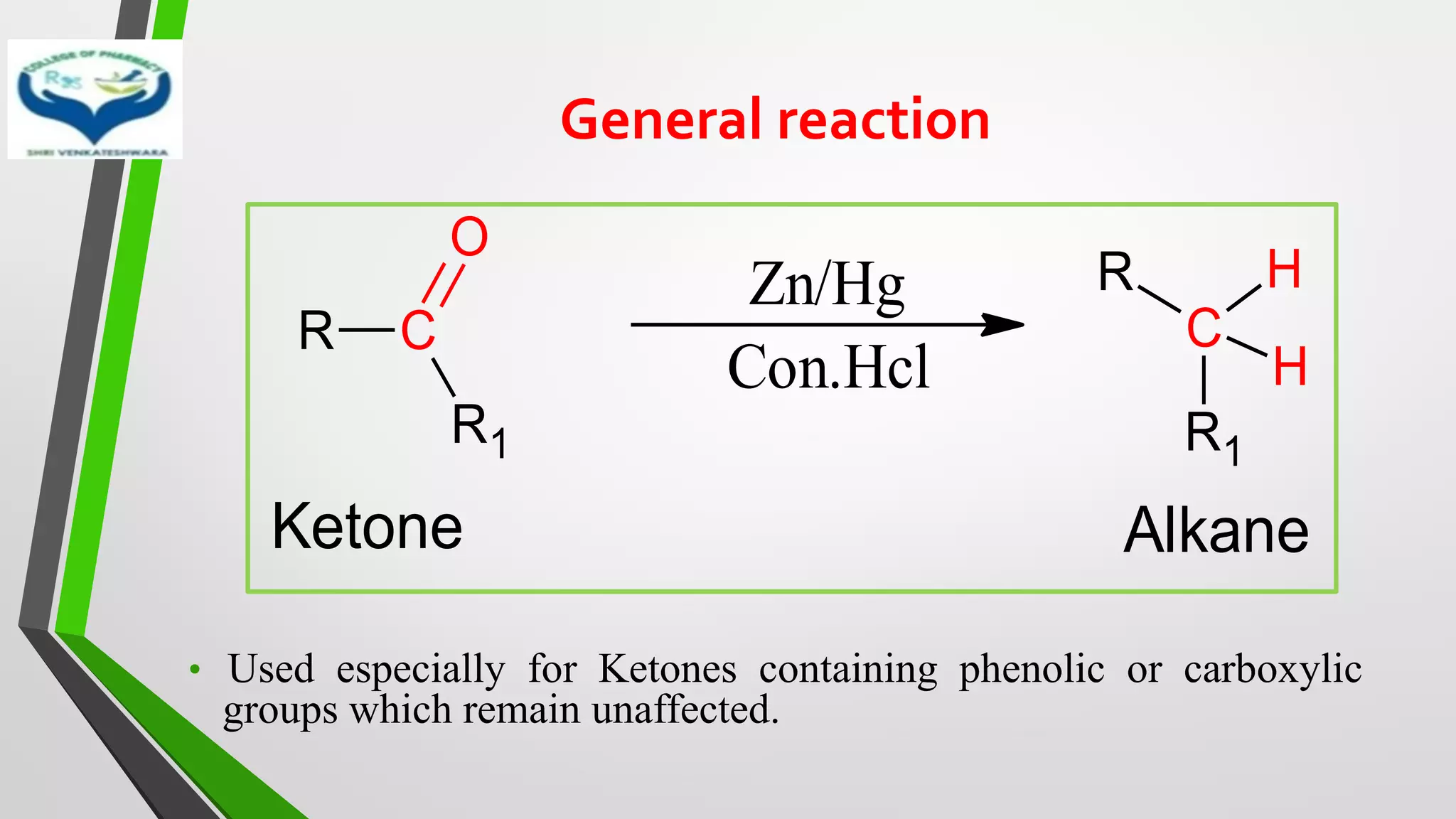
General reaction
• Used especially for Ketones containing phenolic or carboxylic
groups which remain unaffected.
R C
R1
O
Zn/Hg
Con.Hcl
R
C
R1
H
H
Ketone Alkane
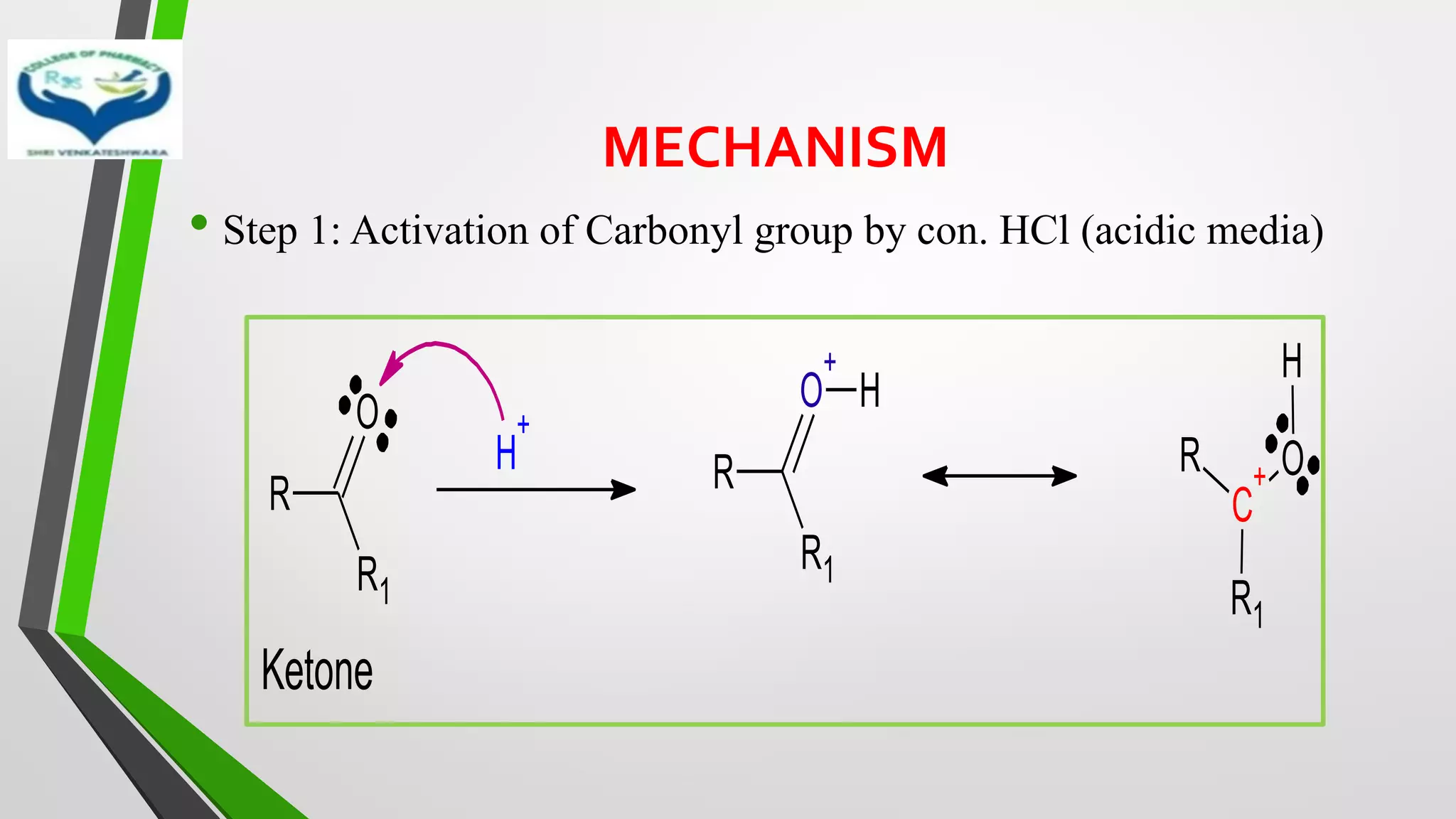
MECHANISM
• Step 1: Activation of Carbonyl group by con. HCl (acidic media)
R
R1
O
H
+
R
R1
O
+
H
R
C
+
R1
O
H
Ketone
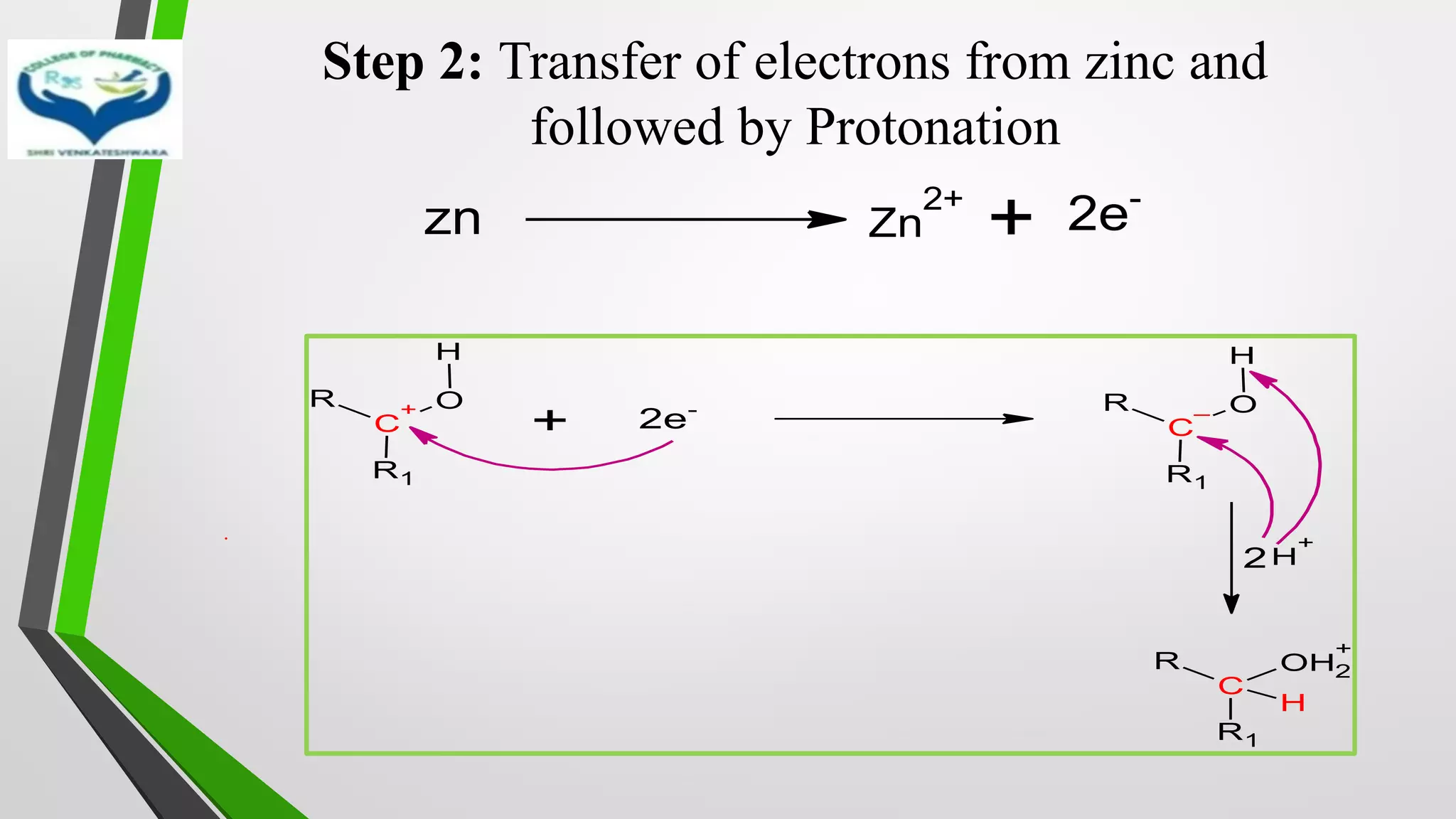
Step 2: Transfer of electrons from zinc and
followed by Protonation
R
C
+
R1
O
H
+ 2e- R
C
–
R1
O
H
H
+
2
R
C
R1
OH2
+
H
Zn
2+
zn + 2e-
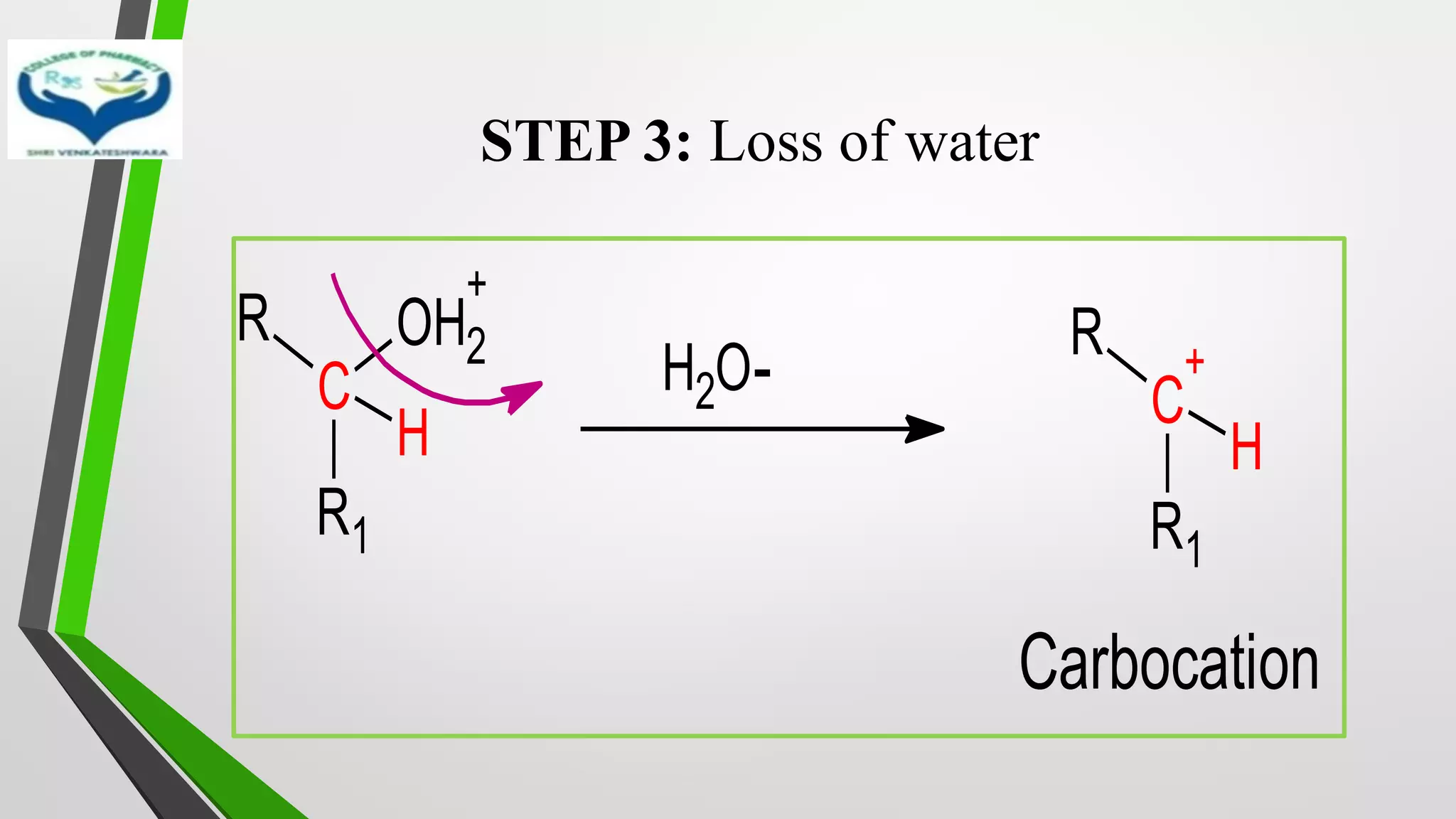
STEP 3: Loss of water
R
C
R1
OH2
+
H
O
H2 - R
C
+
R1
H
Carbocation
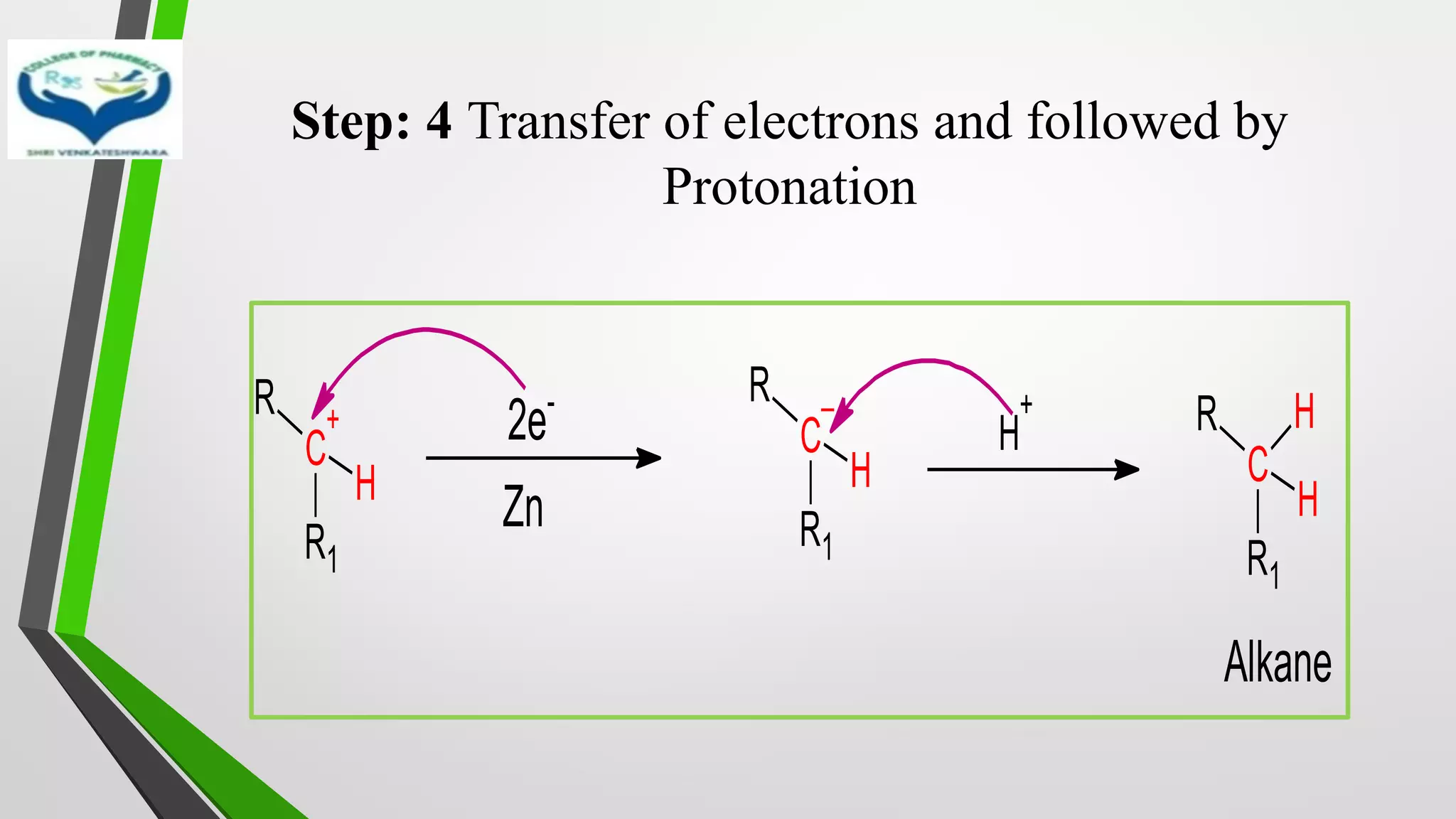
Step: 4 Transfer of electrons and followed by
Protonation
R
C
+
R1
H
2e-
Zn
R
C
–
R1
H
H
+ R
C
R1
H
H
Alkane
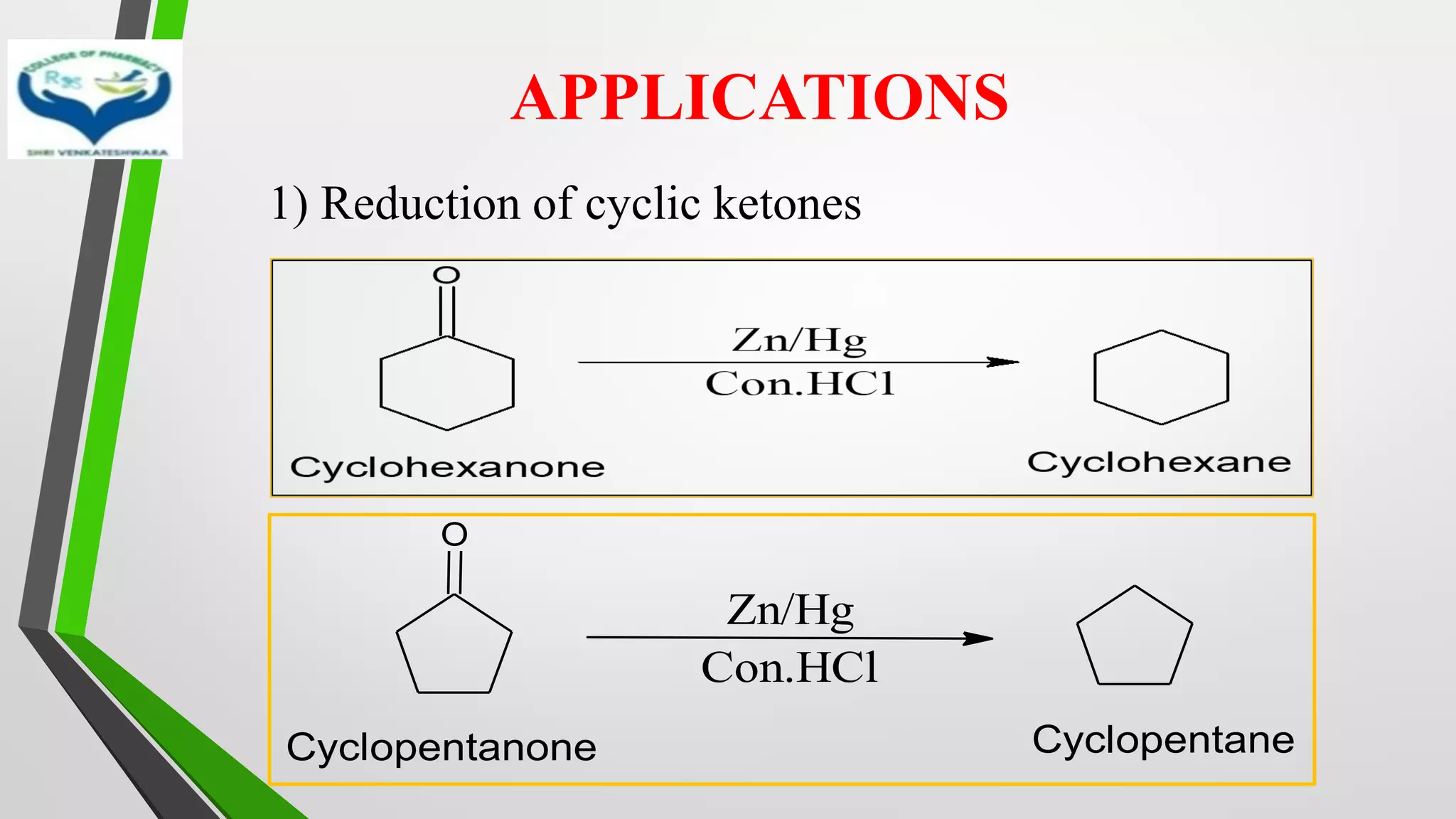
APPLICATIONS
1) Reduction of cyclic ketones
O
Zn/Hg
Con.HCl
Cyclopentanone Cyclopentane
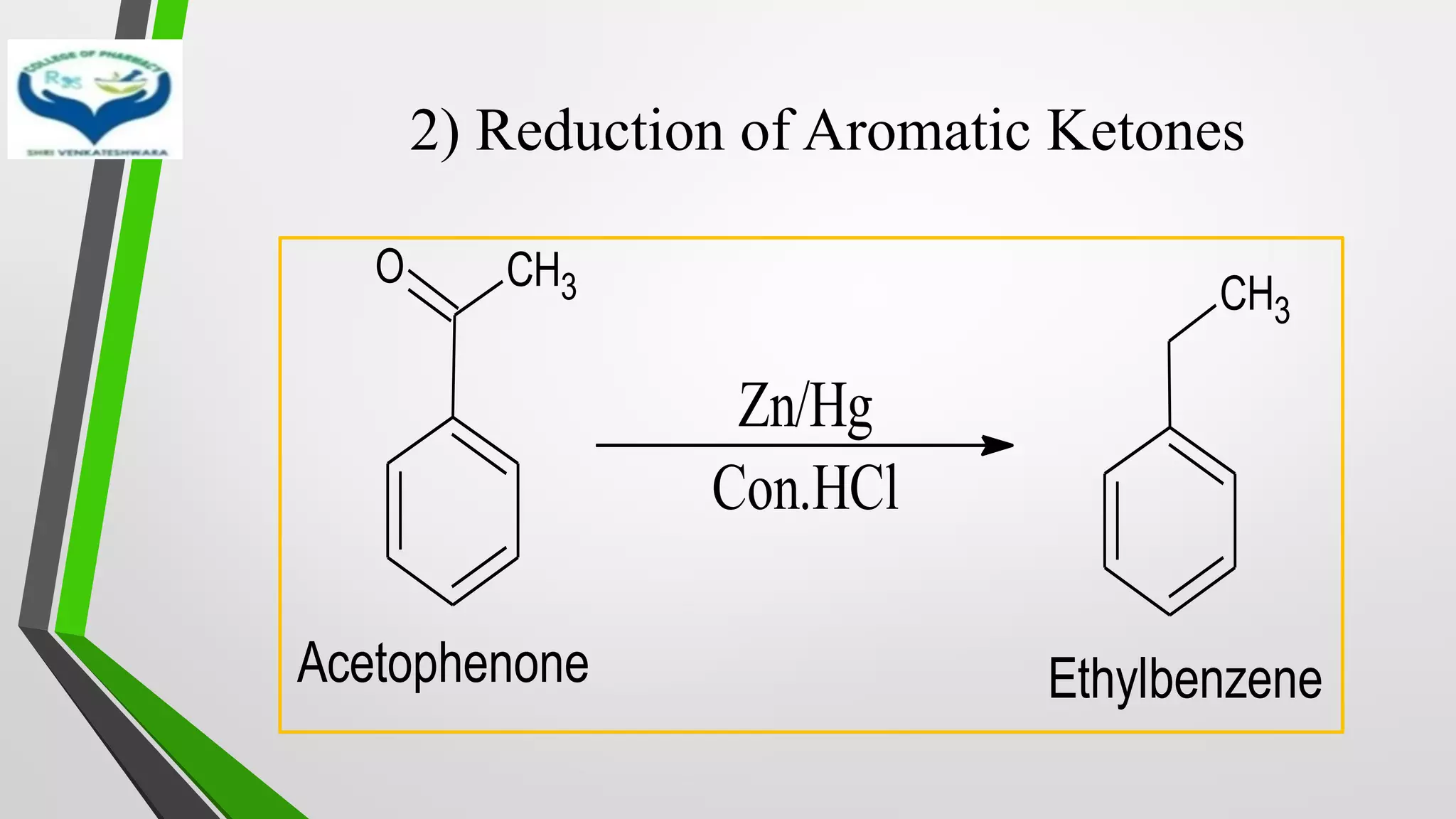
2) Reduction of Aromatic Ketones
CH3
O
Zn/Hg
Con.HCl
CH3
Acetophenone Ethylbenzene
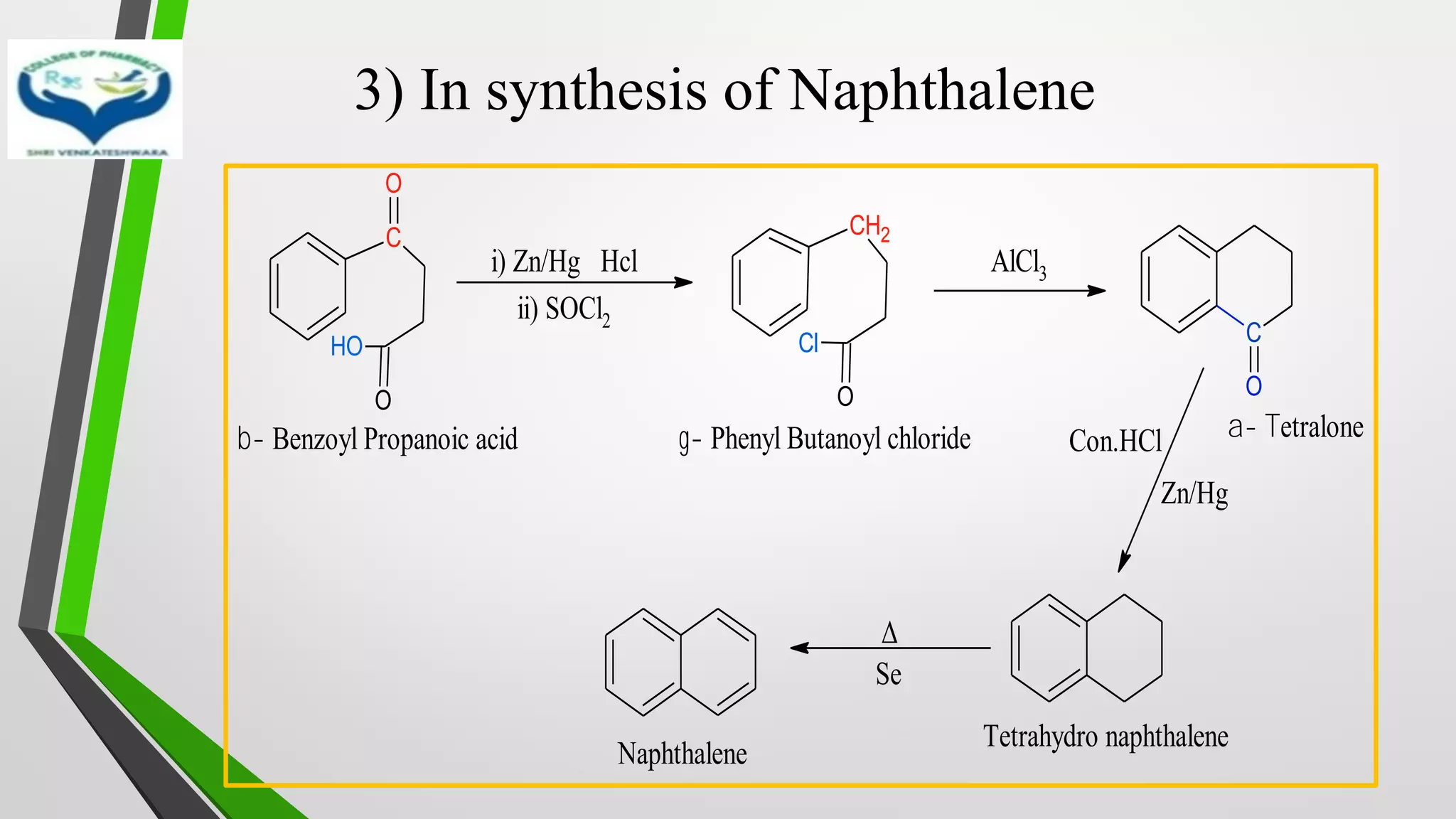
3) In synthesis of Naphthalene
i) Zn/Hg Hcl
ii) SOCl2
AlCl3
C
O
O
O
H
CH2
O
Cl C
O
b- Benzoyl Propanoic acid g- Phenyl Butanoyl chloride a- Tetralone
Con.HCl
Zn/Hg
Δ
Se
Tetrahydro naphthalene
Naphthalene
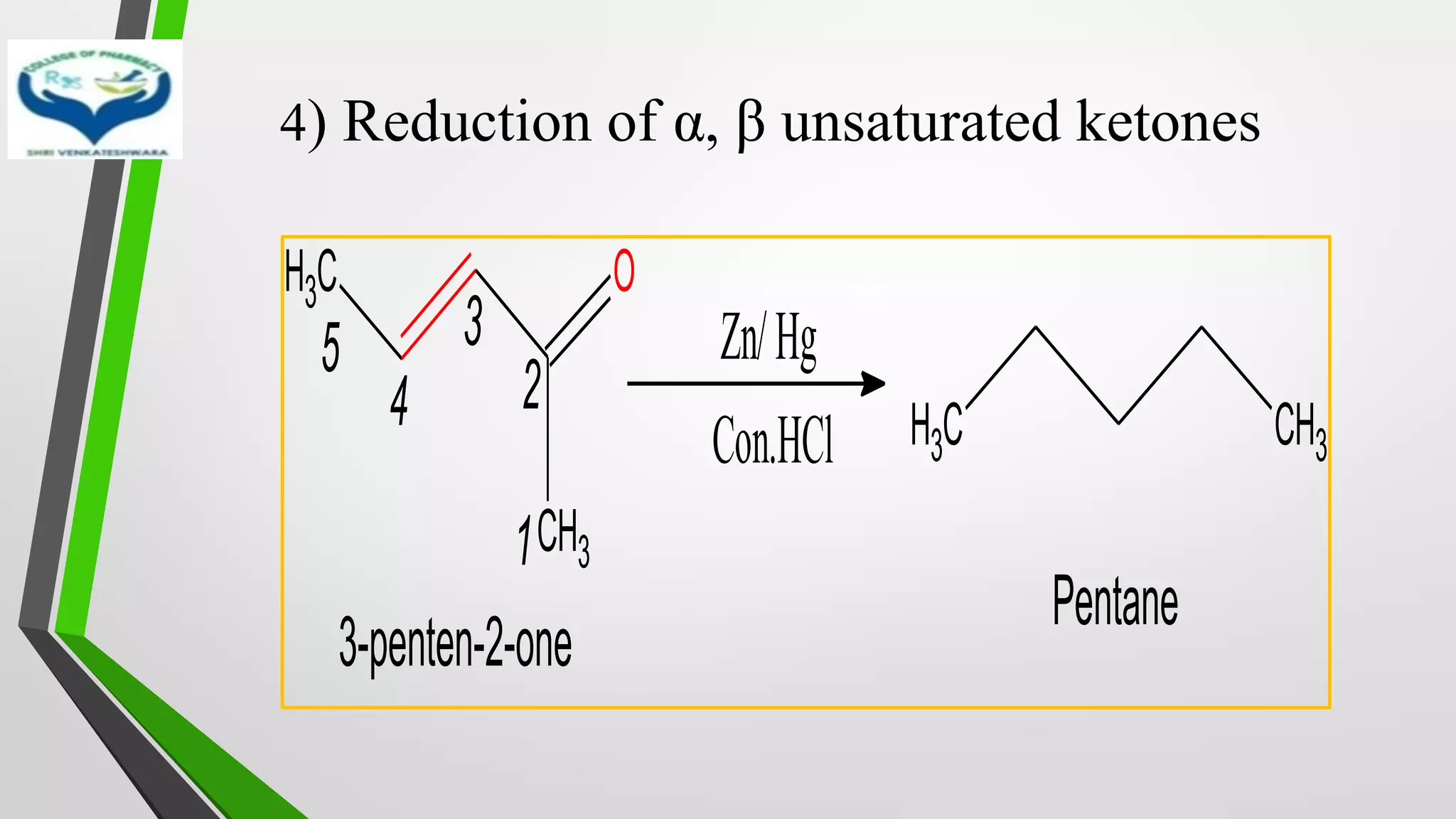
4) Reduction of α, β unsaturated ketones
C
H3
CH3
O
Zn/Hg
Con.HCl C
H3 CH3
3-penten-2-one
Pentane
1
2
3
4
5
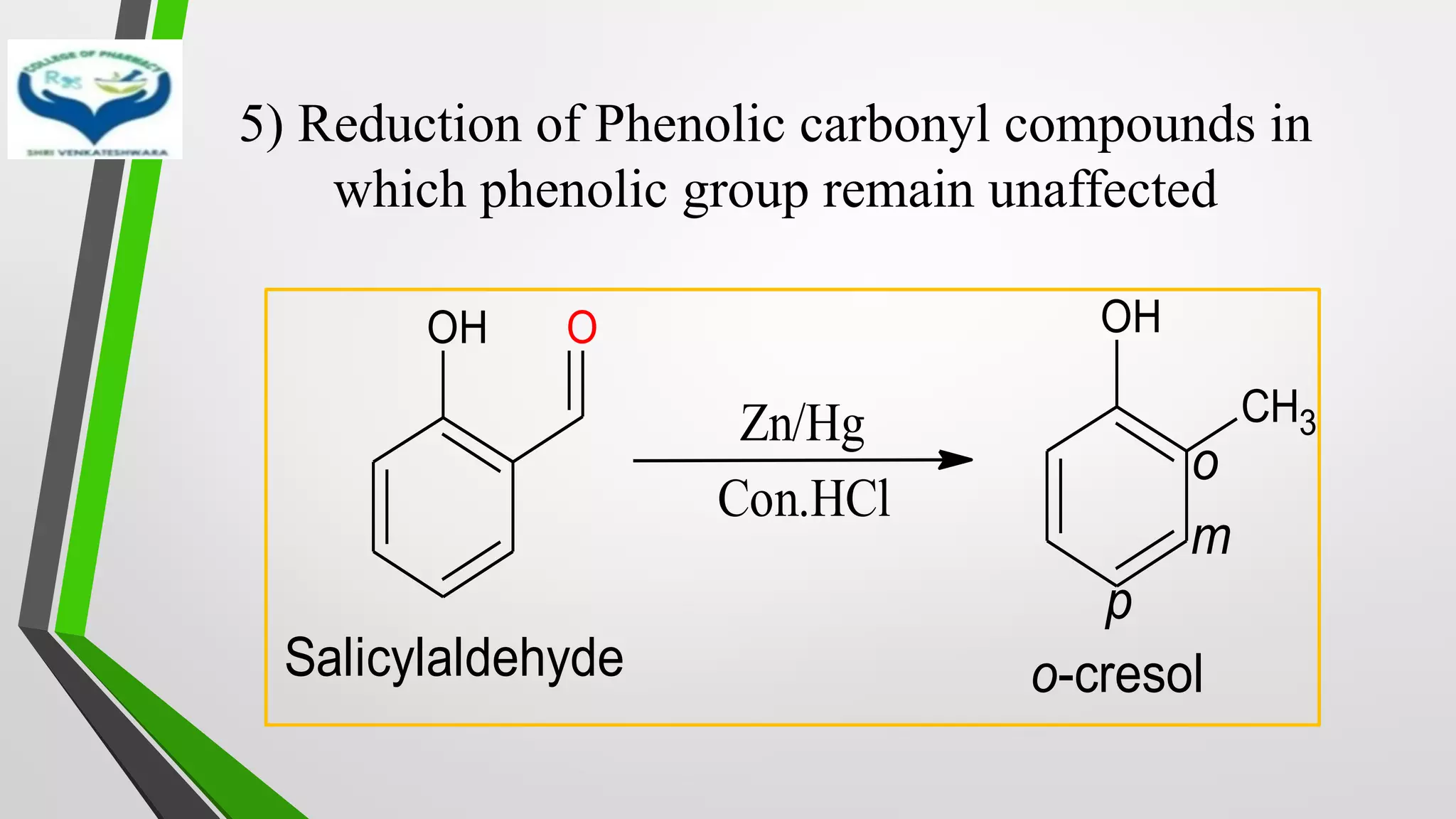
5) Reduction of Phenolic carbonyl compounds in
which phenolic group remain unaffected
OH O
Zn/Hg
Con.HCl
OH
CH3
Salicylaldehyde o-cresol
o
m
p
METAL HYDRIDE
REDUCTION
INTRODUCTION
• Reduction of metal hydrides proceeds by transfer of hydride ion[H-] to the
substrate.
• Selectively reduce a number of functional groups such as
✓Carbonyl
✓Carboxylic acid
✓Nitro
✓Ester in presence C=C double bounds
• Mostly used metal hydride reducing agents are sodium borohydride
(NaBH4) and lithium aluminium hydride (LiAlH4)
• LiAlH4 – Stong reducing agent
• NaBH4 – Mild reducing agent
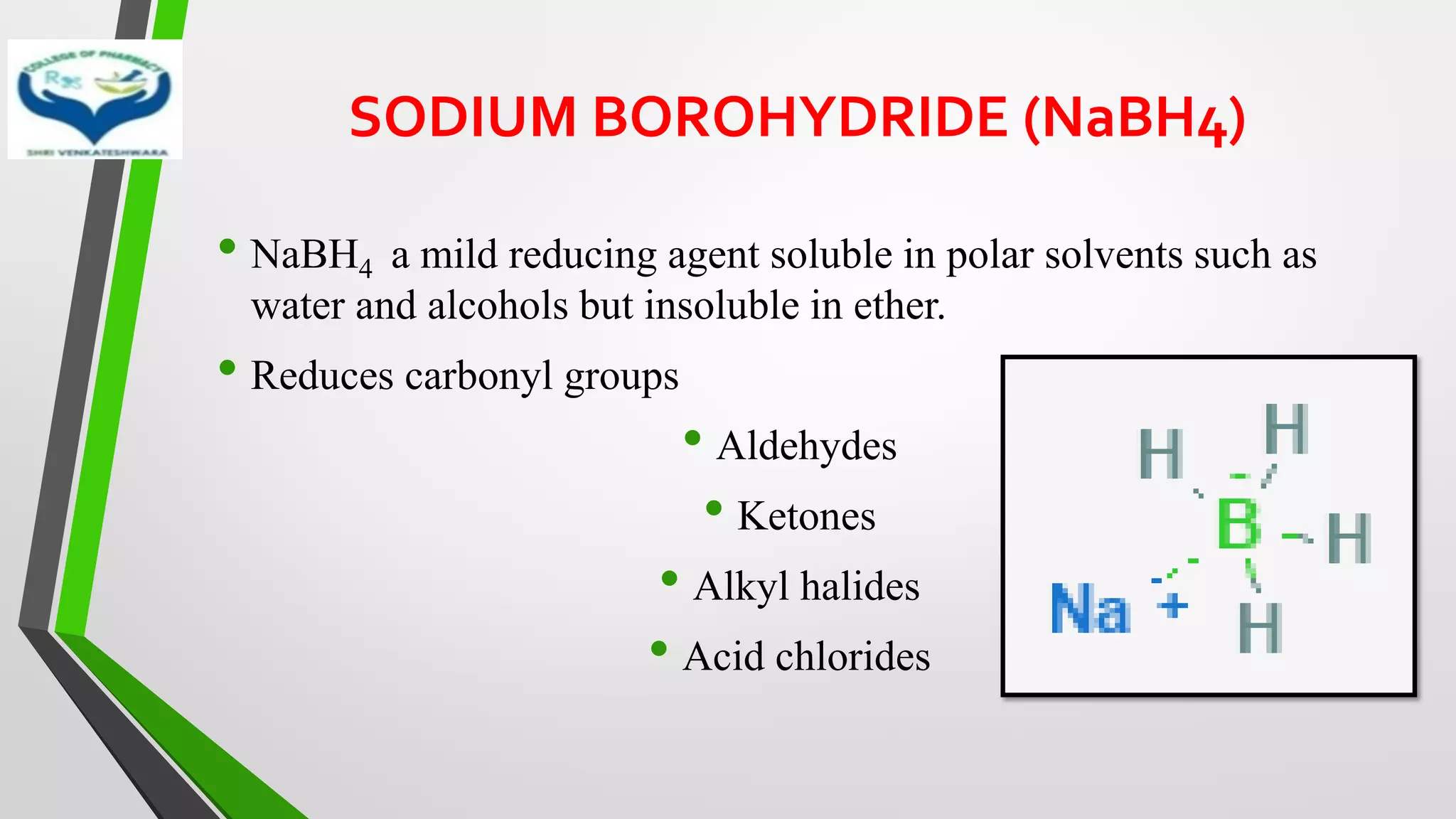
SODIUM BOROHYDRIDE (NaBH4)
• NaBH4 a mild reducing agent soluble in polar solvents such as
water and alcohols but insoluble in ether.
• Reduces carbonyl groups
• Aldehydes
• Ketones
• Alkyl halides
• Acid chlorides
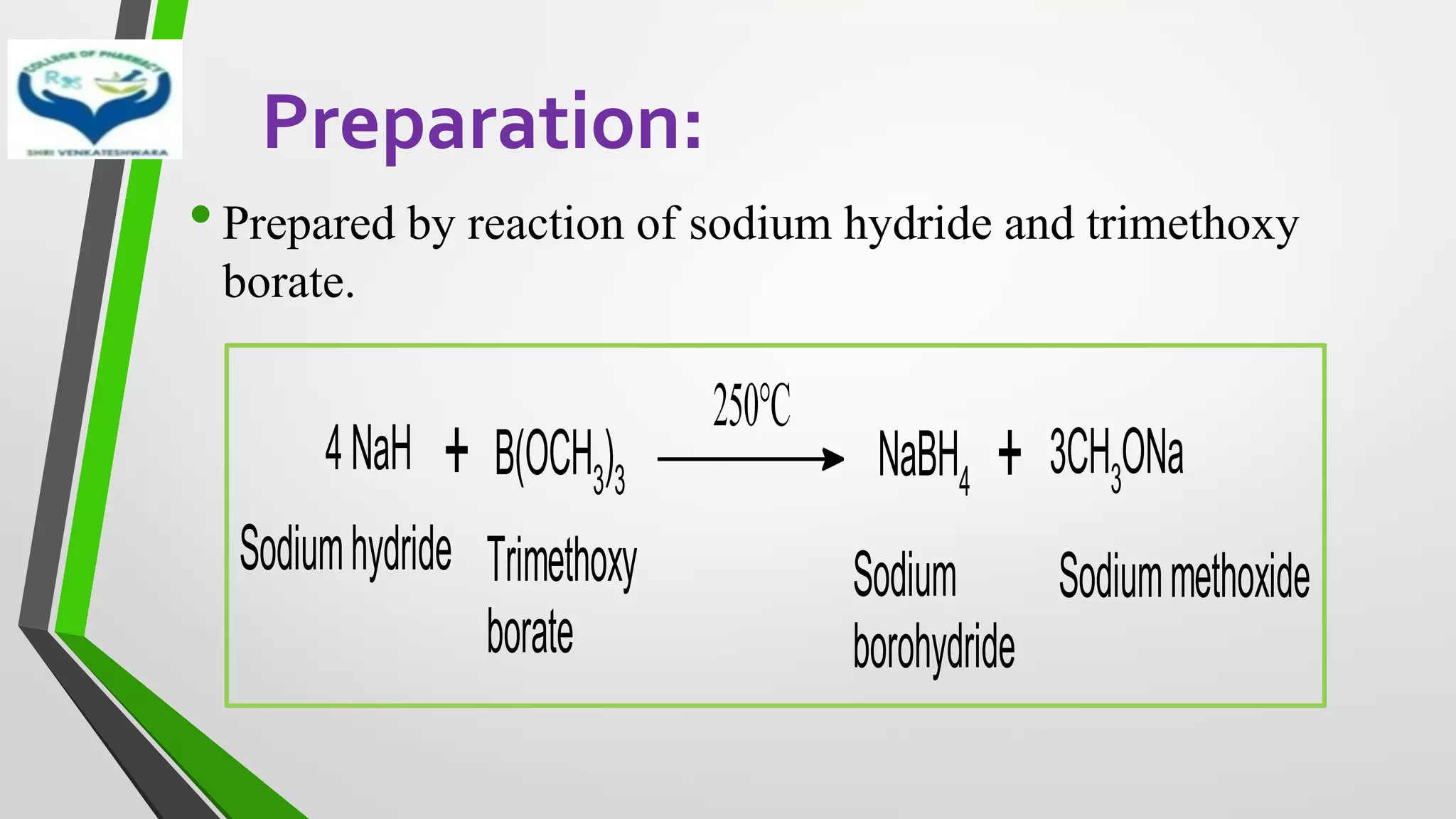
Preparation:
•Prepared by reaction of sodium hydride and trimethoxy
borate.
+
4NaH B(OCH3)3
250°C
NaBH4 + 3CH3ONa
Sodiumhydride Trimethoxy
borate
Sodium
borohydride
Sodiummethoxide
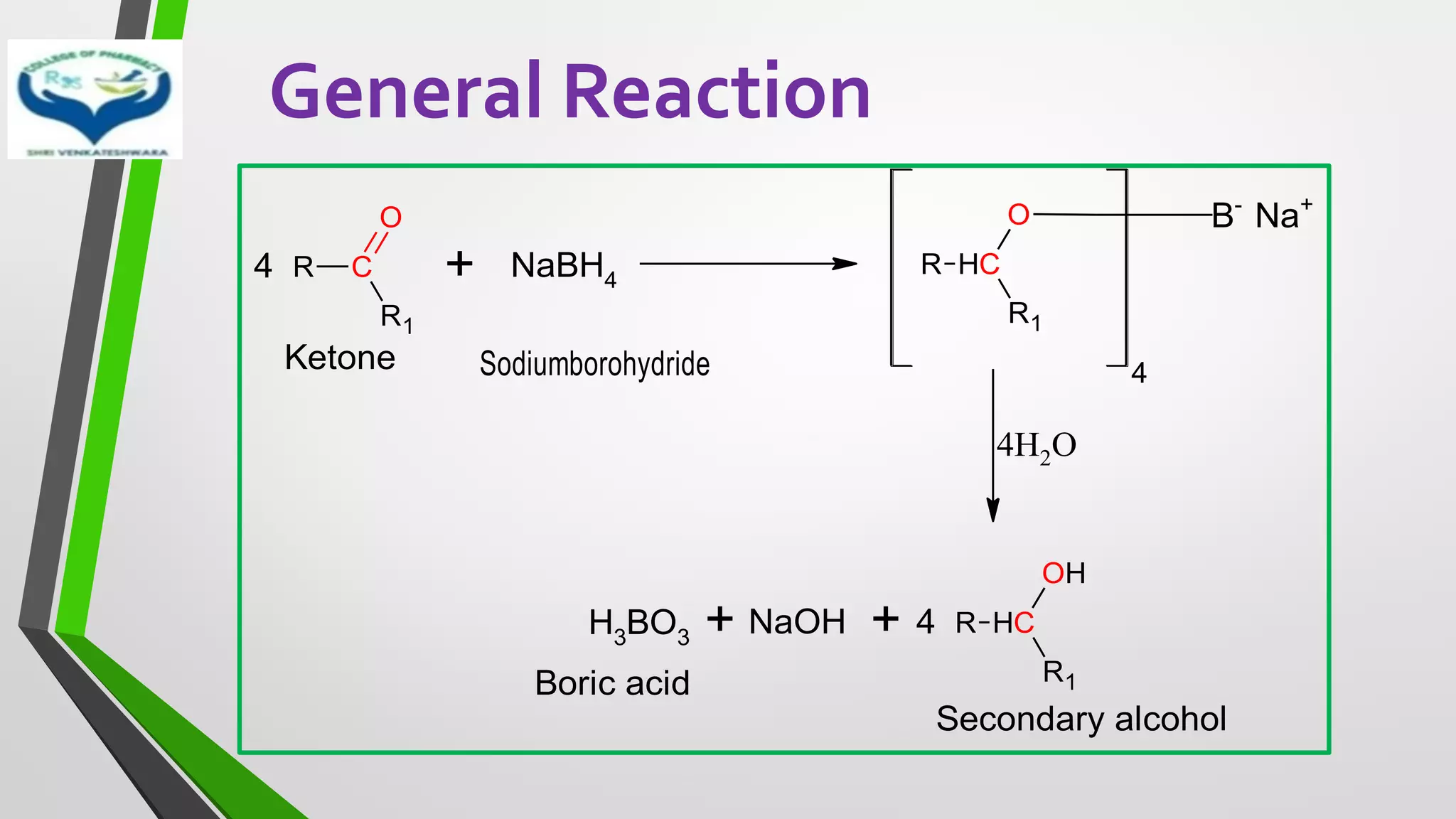
General Reaction
R C
R1
O
4 + NaBH4
R C
H
R1
O
4
B-
Na+
4H2O
R C
H
R1
OH
4
+
+
H3BO3
NaOH
Ketone
Secondary alcohol
Boric acid
Sodiumborohydride
Mechanism
• Step 1: Transfer of hydride ion [H-], powerful nucleophile from
NaBH4 to the carbonyl group with simultaneous binding of
carbonyl oxygen with boron
R C
R1
O
+ NaBH4
R C
R1
O
Na+
BH4
-
H-
R C
H
R1
O BH3
–
Na
+
Complex
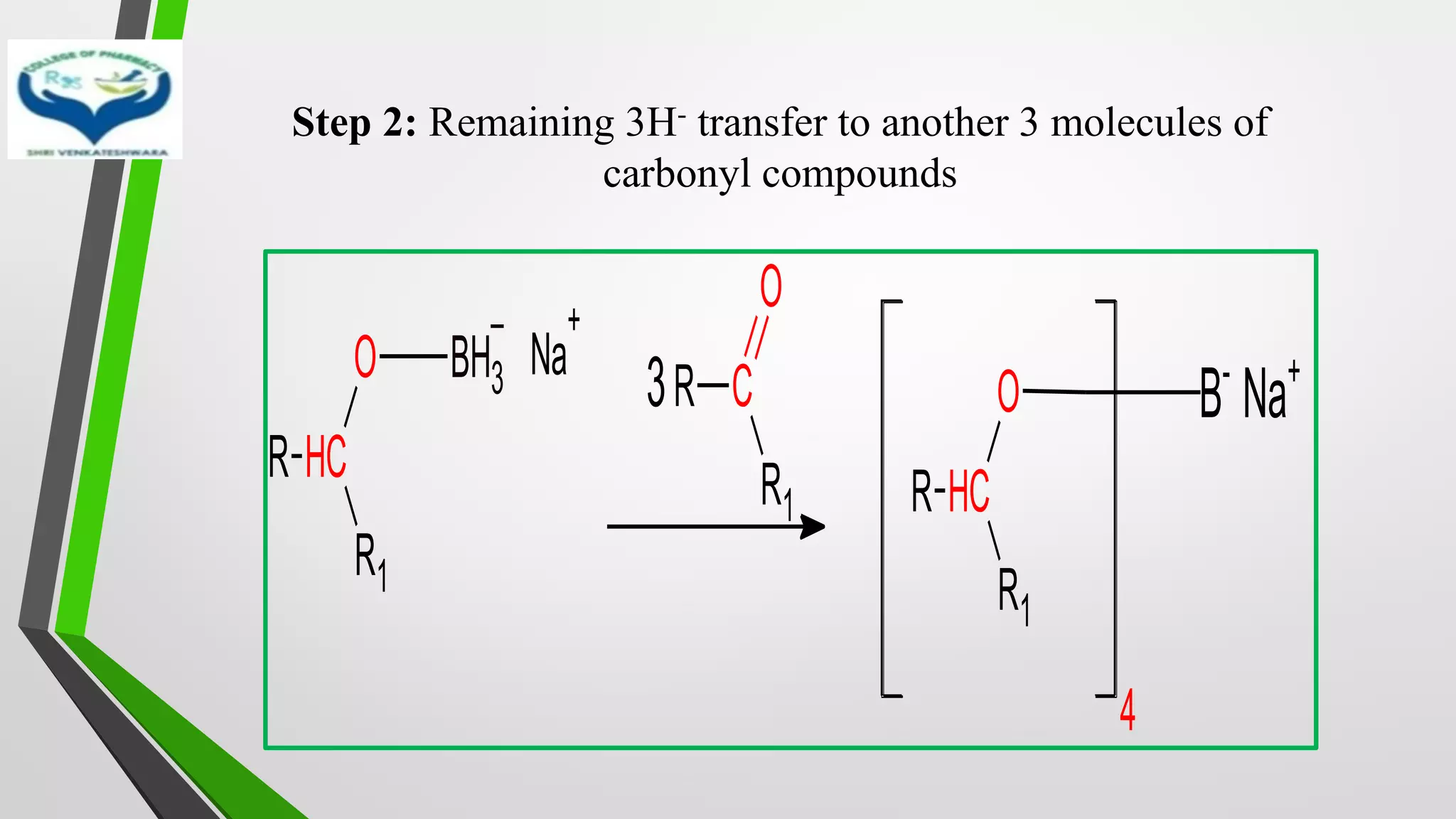
Step 2: Remaining 3H- transfer to another 3 molecules of
carbonyl compounds
R C
H
R1
O BH3
–
Na
+
R C
R1
O
3
R C
H
R1
O
4
B-
Na+
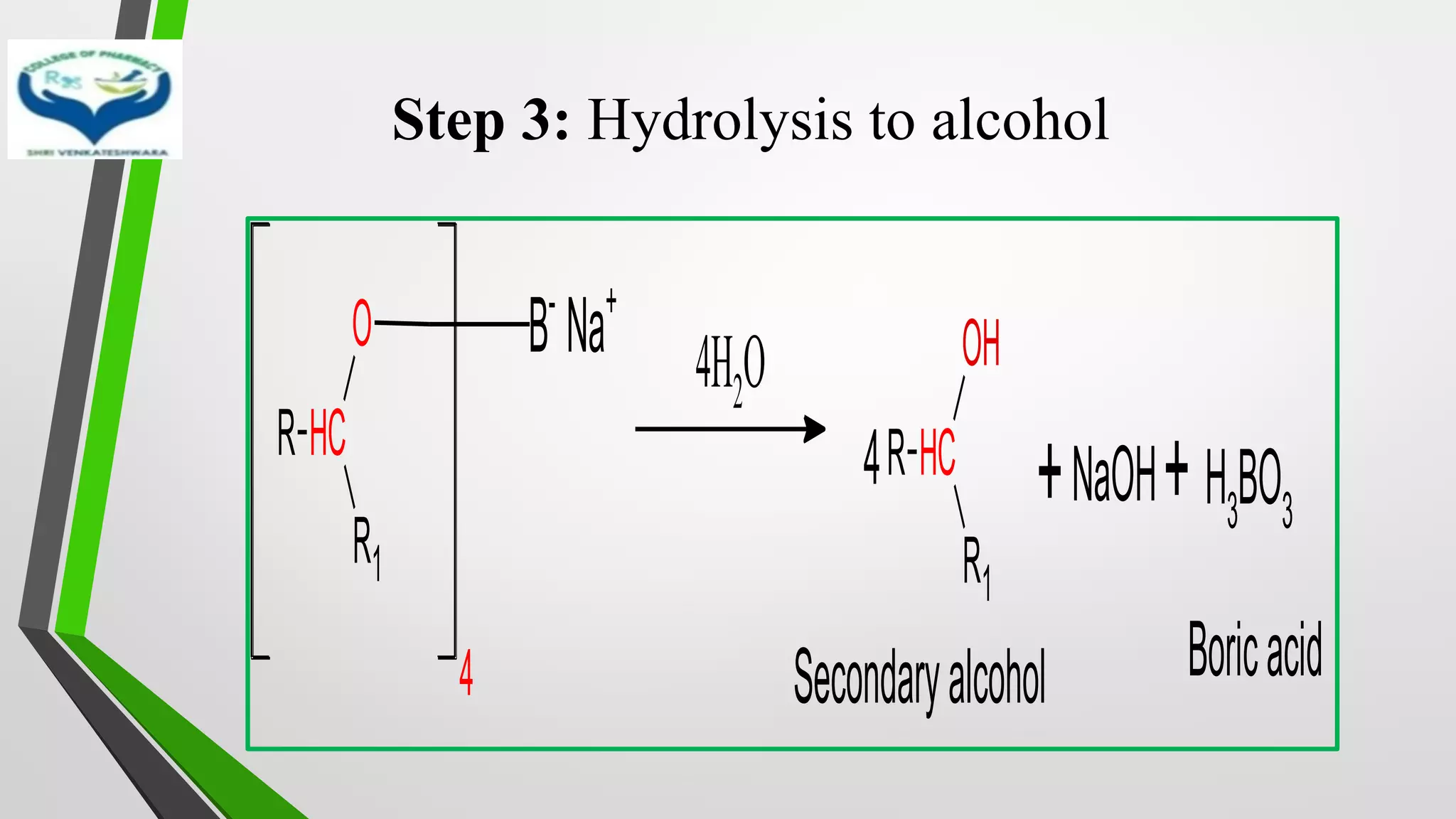
Step 3: Hydrolysis to alcohol
R C
H
R1
O
4
B-
Na+
4H2O
R C
H
R1
OH
4
Secondaryalcohol
+ H3BO3
NaOH
Boricacid
+
APPLICATIONS
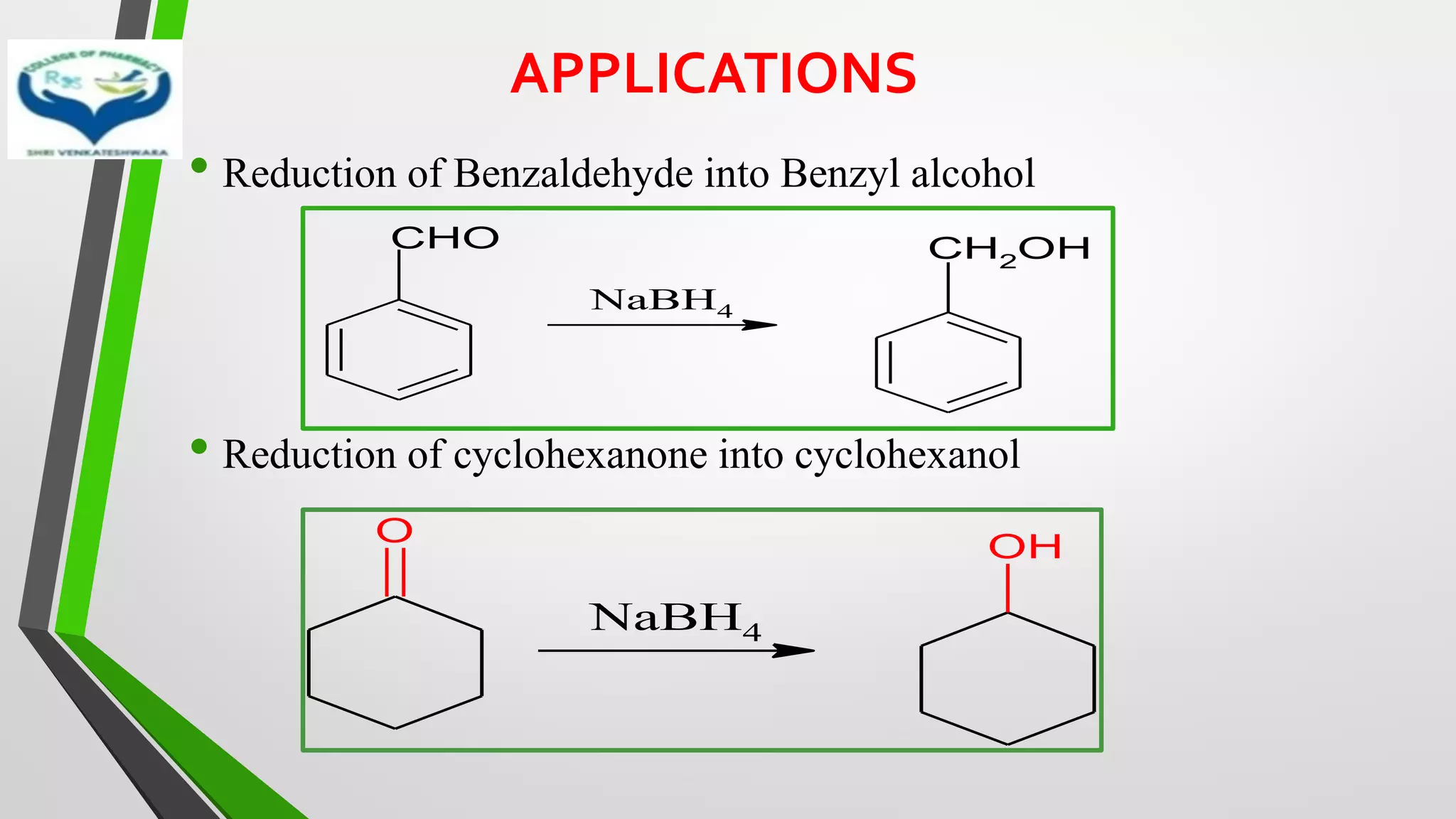
• Reduction of Benzaldehyde into Benzyl alcohol
• Reduction of cyclohexanone into cyclohexanol
NaBH4
CHO CH2OH
O
NaBH4
OH
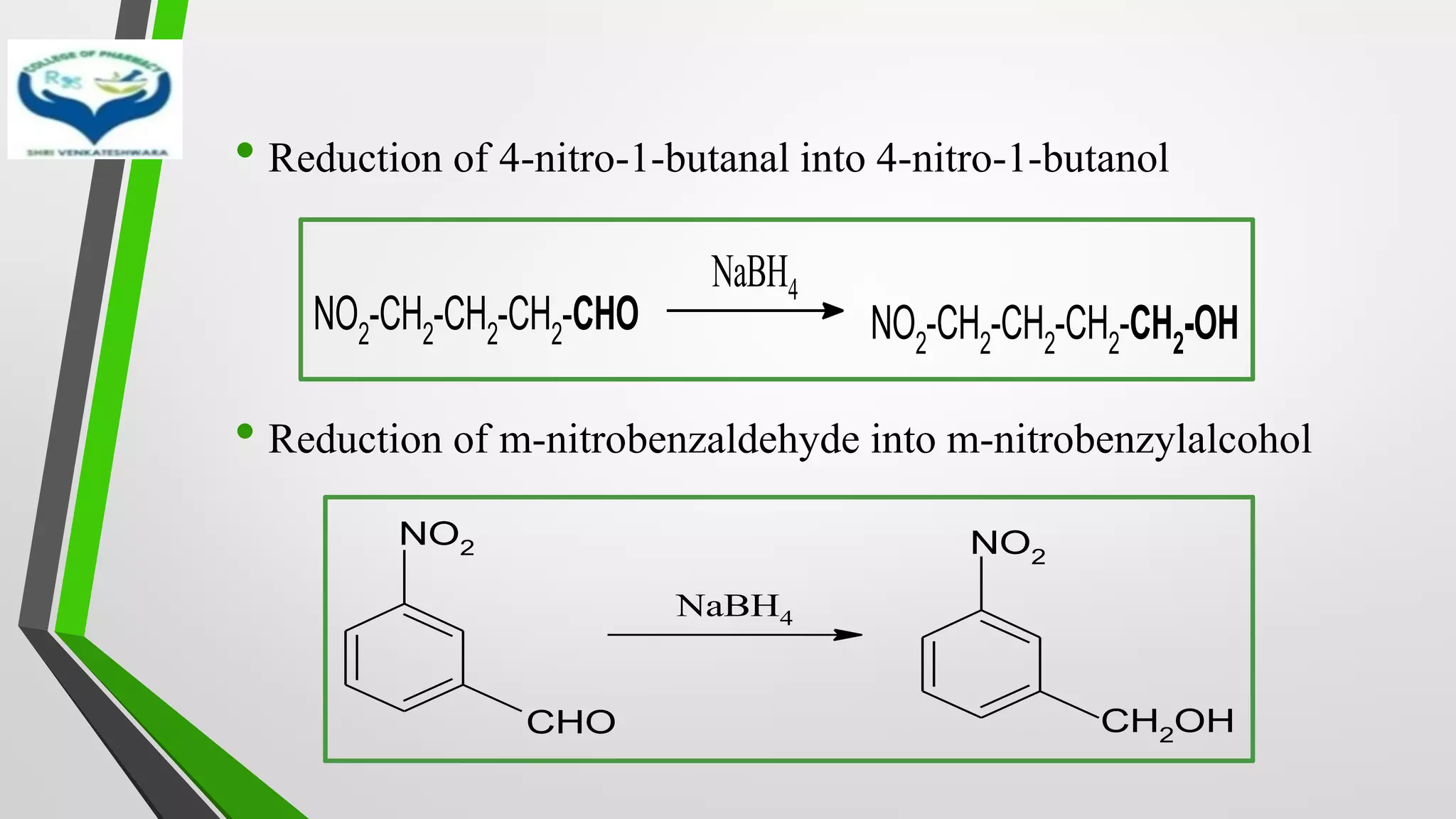
• Reduction of 4-nitro-1-butanal into 4-nitro-1-butanol
• Reduction of m-nitrobenzaldehyde into m-nitrobenzylalcohol
NO2-CH2-CH2-CH2-CHO
NaBH4
NO2-CH2-CH2-CH2-CH2-OH
NO2
CHO
NaBH4
NO2
CH2OH
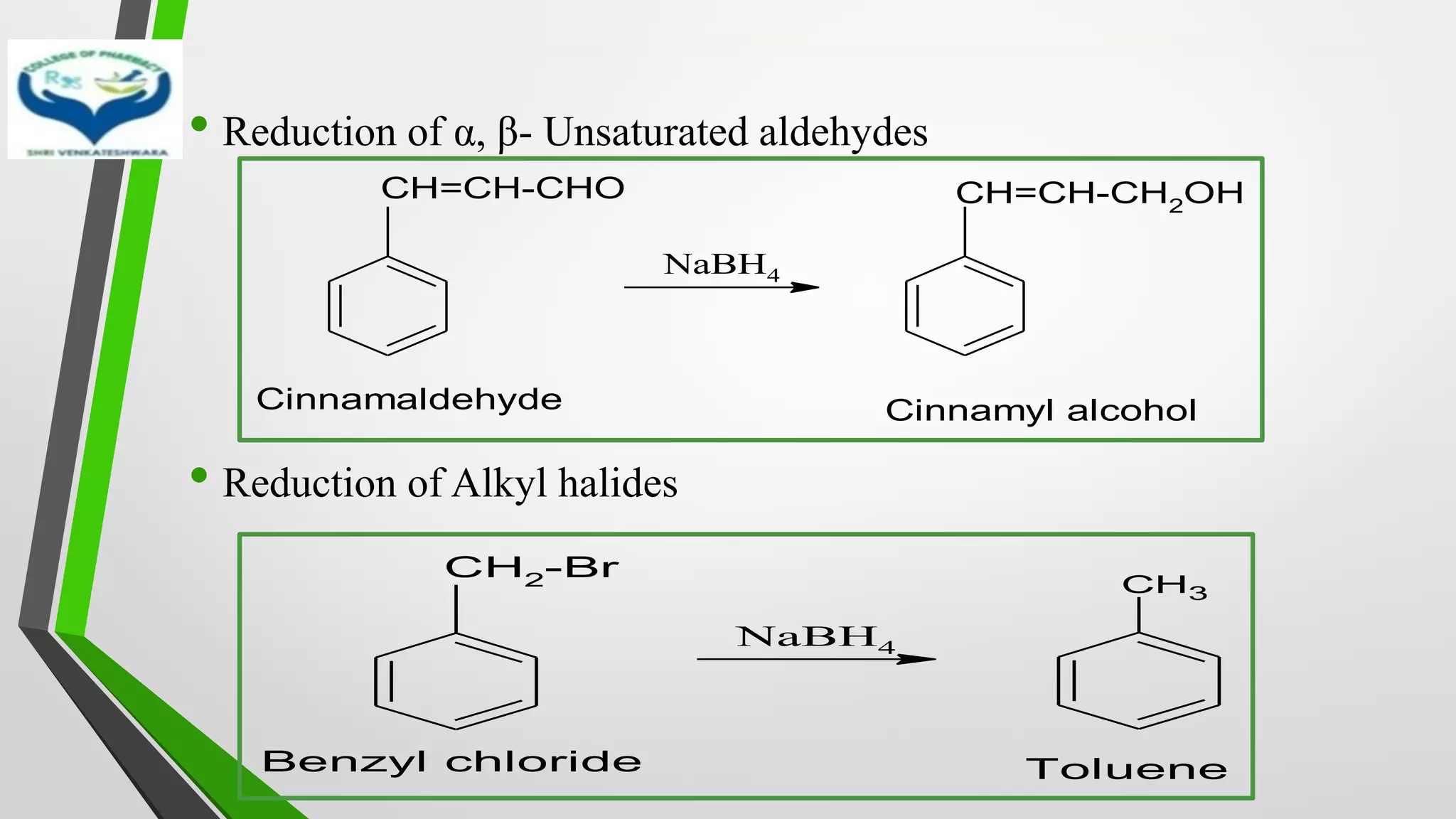
• Reduction of α, β- Unsaturated aldehydes
• Reduction of Alkyl halides
CH=CH-CHO
NaBH4
CH=CH-CH2OH
Cinnamaldehyde Cinnamyl alcohol
CH2-Br
NaBH4
CH3
Benzyl chloride Toluene
• Reduction of acid chloride
C=O-Cl
NaBH4
CH2-OH
Benzyl alcohol
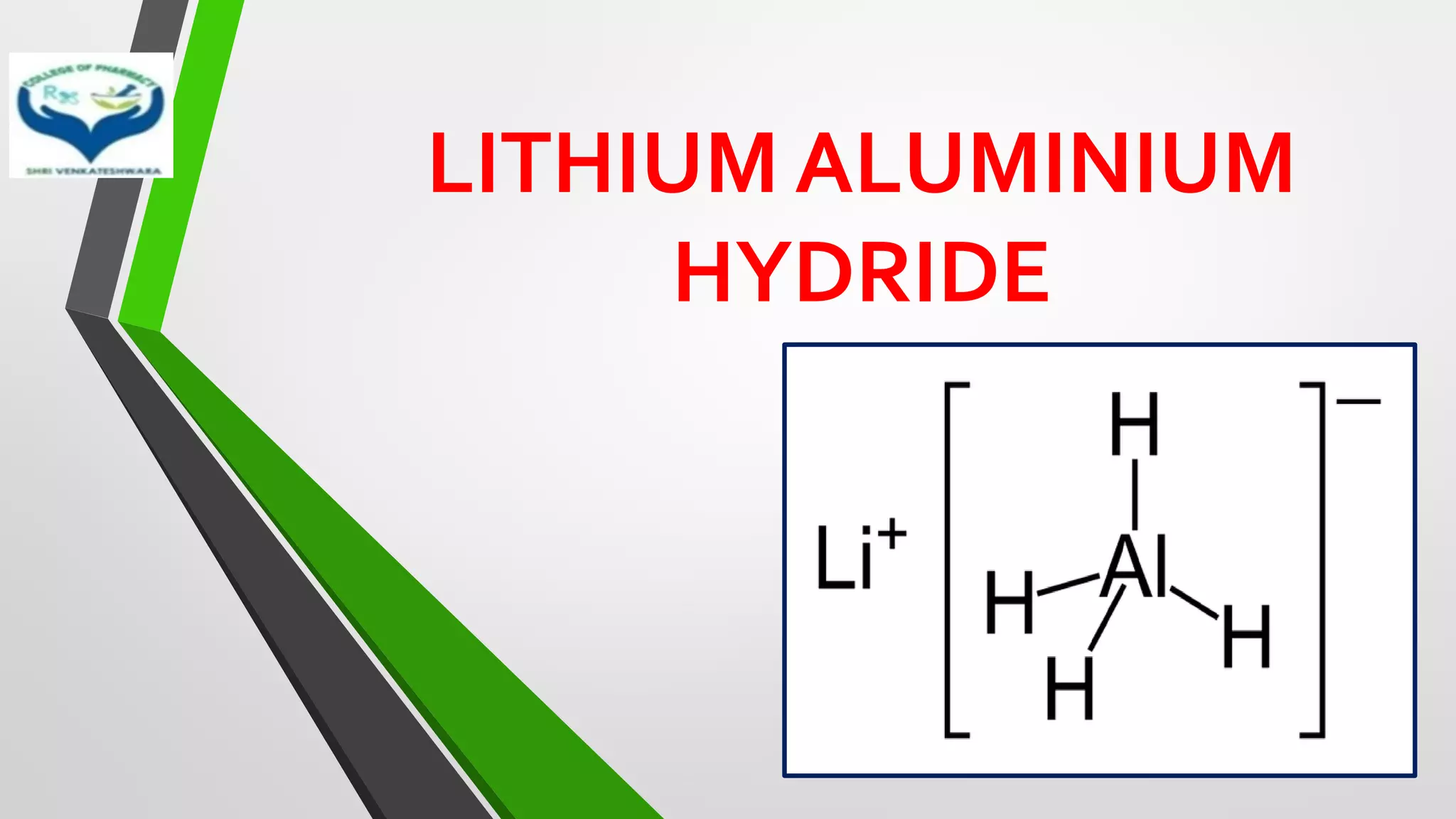
LITHIUM ALUMINIUM
HYDRIDE
INTRODUCTION
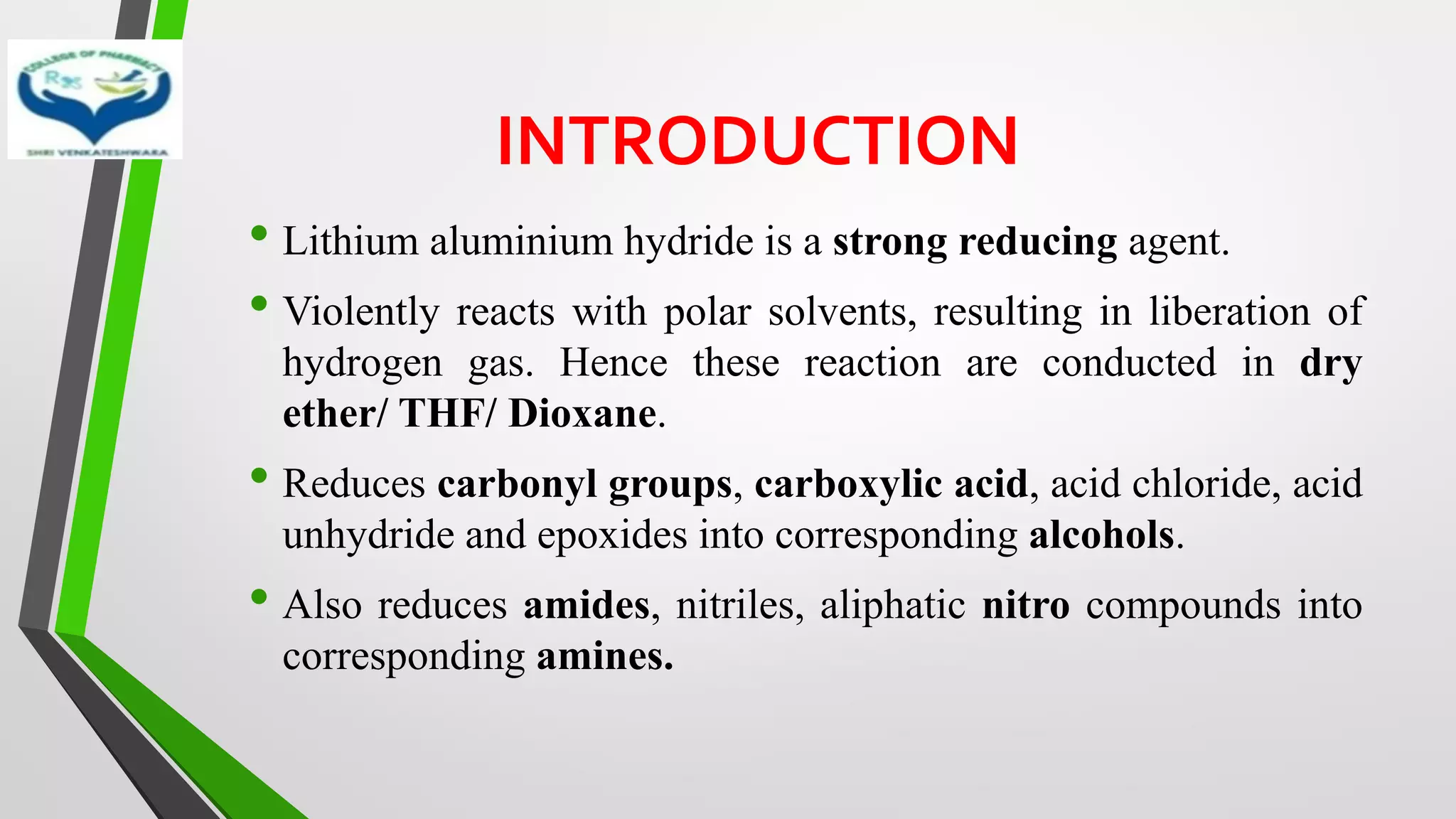
• Lithium aluminium hydride is a strong reducing agent.
• Violently reacts with polar solvents, resulting in liberation of
hydrogen gas. Hence these reaction are conducted in dry
ether/ THF/ Dioxane.
• Reduces carbonyl groups, carboxylic acid, acid chloride, acid
unhydride and epoxides into corresponding alcohols.
• Also reduces amides, nitriles, aliphatic nitro compounds into
corresponding amines.
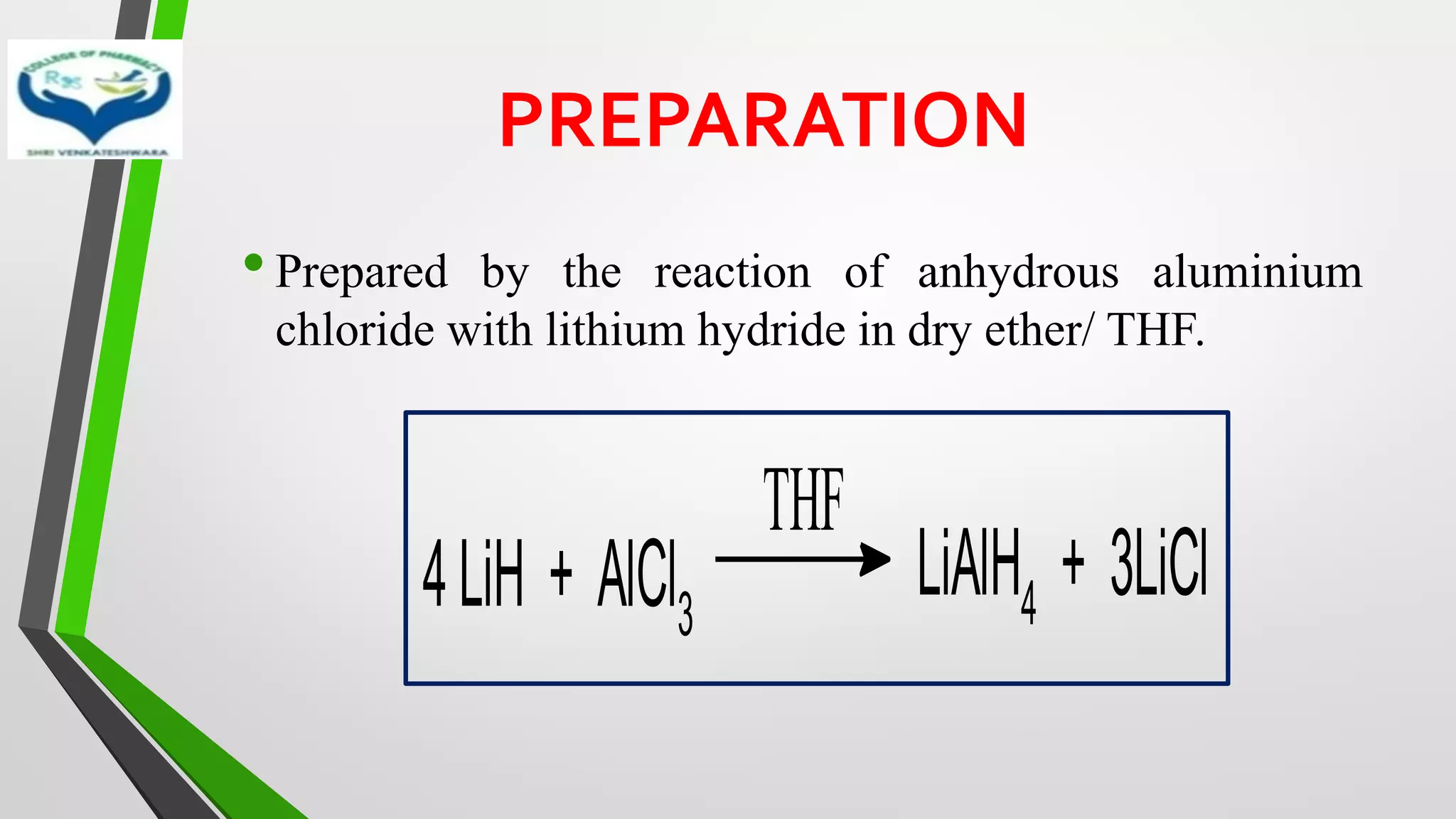
PREPARATION
•Prepared by the reaction of anhydrous aluminium
chloride with lithium hydride in dry ether/ THF.
4LiH + AlCl3
THF
LiAlH4 + 3LiCl
GENERAL REACTION
R C
R1
O
4 + LiAlH4
R C
H
R1
O
4
Al-
Li+
4H2O
R C
H
R1
OH
4
+
+
LiCl
Ketone
Secondary alcohol
Lithium aluminium
hydride
ether
AlCl3
MECHANISM
• Step 1: Transfer of hydride ion [H-], powerful nucleophile from
LiAlH4 to the carbonyl group with simultaneous binding of
carbonyl oxygen with boron
R C
R1
O
+ LiAlH4
R C
R1
O
Li+
AlH4
-
H-
R C
H
R1
O
Complex
AlH3
-
Li+
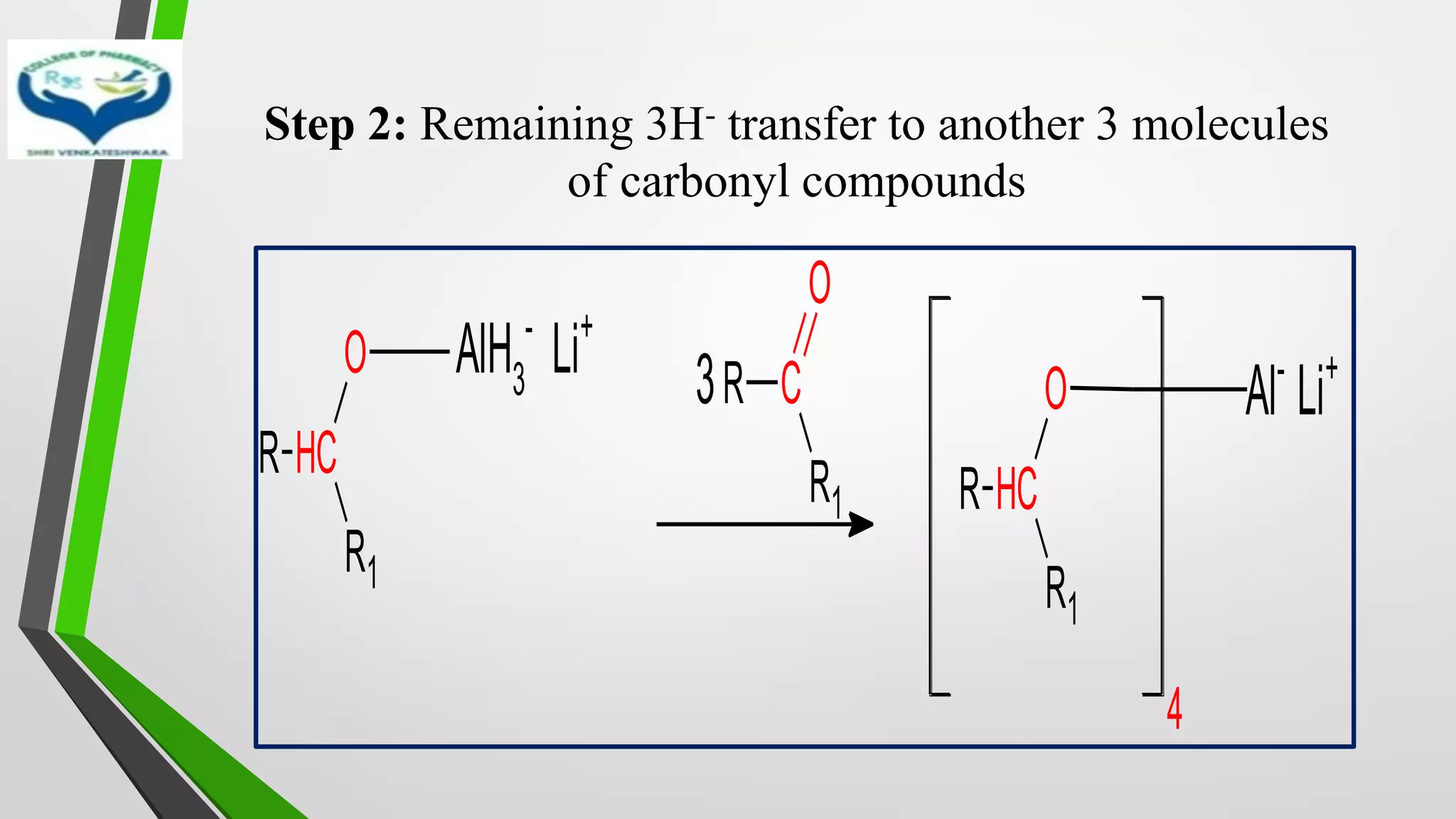
Step 2: Remaining 3H- transfer to another 3 molecules
of carbonyl compounds
R C
H
R1
O
R C
R1
O
3
R C
H
R1
O
4
Al-
Li+
AlH3
-
Li+
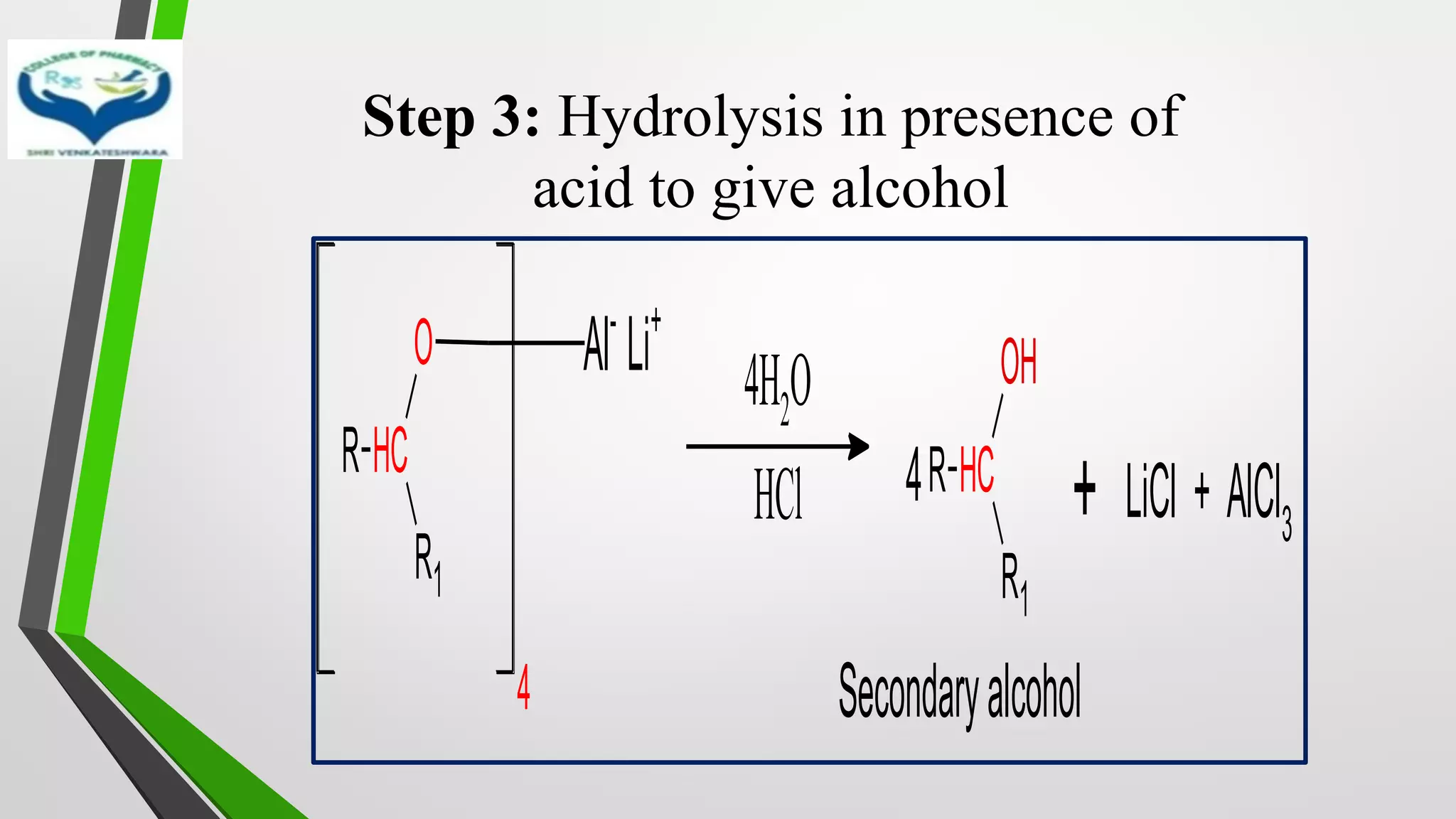
Step 3: Hydrolysis in presence of
acid to give alcohol
R C
H
R1
O
4
Al-
Li+
R C
H
R1
OH
4
Secondaryalcohol
+
4H2O
HCl LiCl + AlCl3
APPLICATIONS
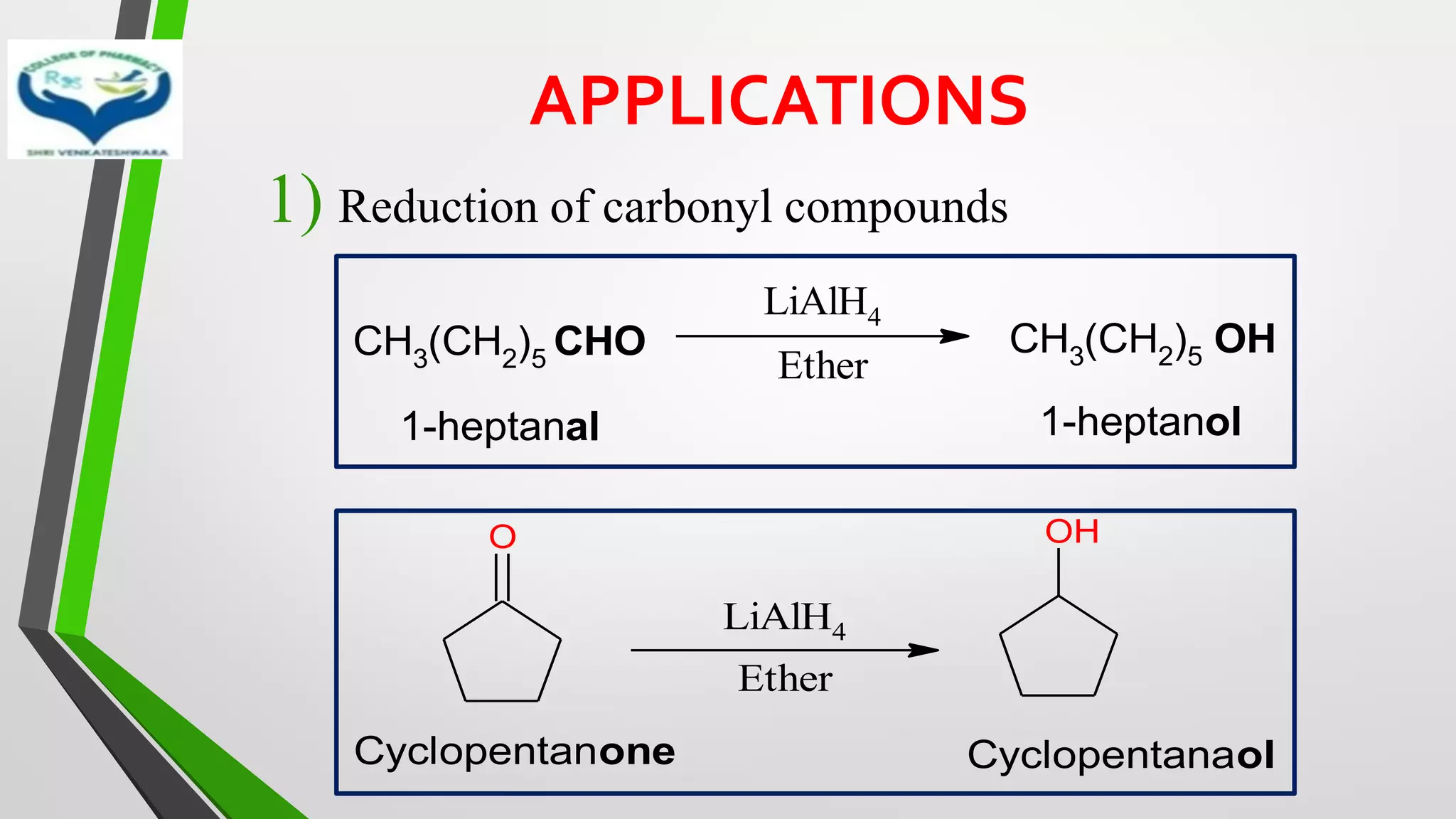
1) Reduction of carbonyl compounds
CH3(CH2)5 CHO
LiAlH4
Ether
CH3(CH2)5 OH
1-heptanal 1-heptanol
O
LiAlH4
Ether
OH
Cyclopentanone Cyclopentanaol
2) Reduction of Carboxylic acids
CH3CH2COOH
LiAlH4
Ether
Propanoic acid
CH3CH2CH2OH
Propanol
3) Reduction of amides
C
H3
NH2
O
CH3-CH2-NH2
Acetamide ethylamine
LiAlH4
Ether
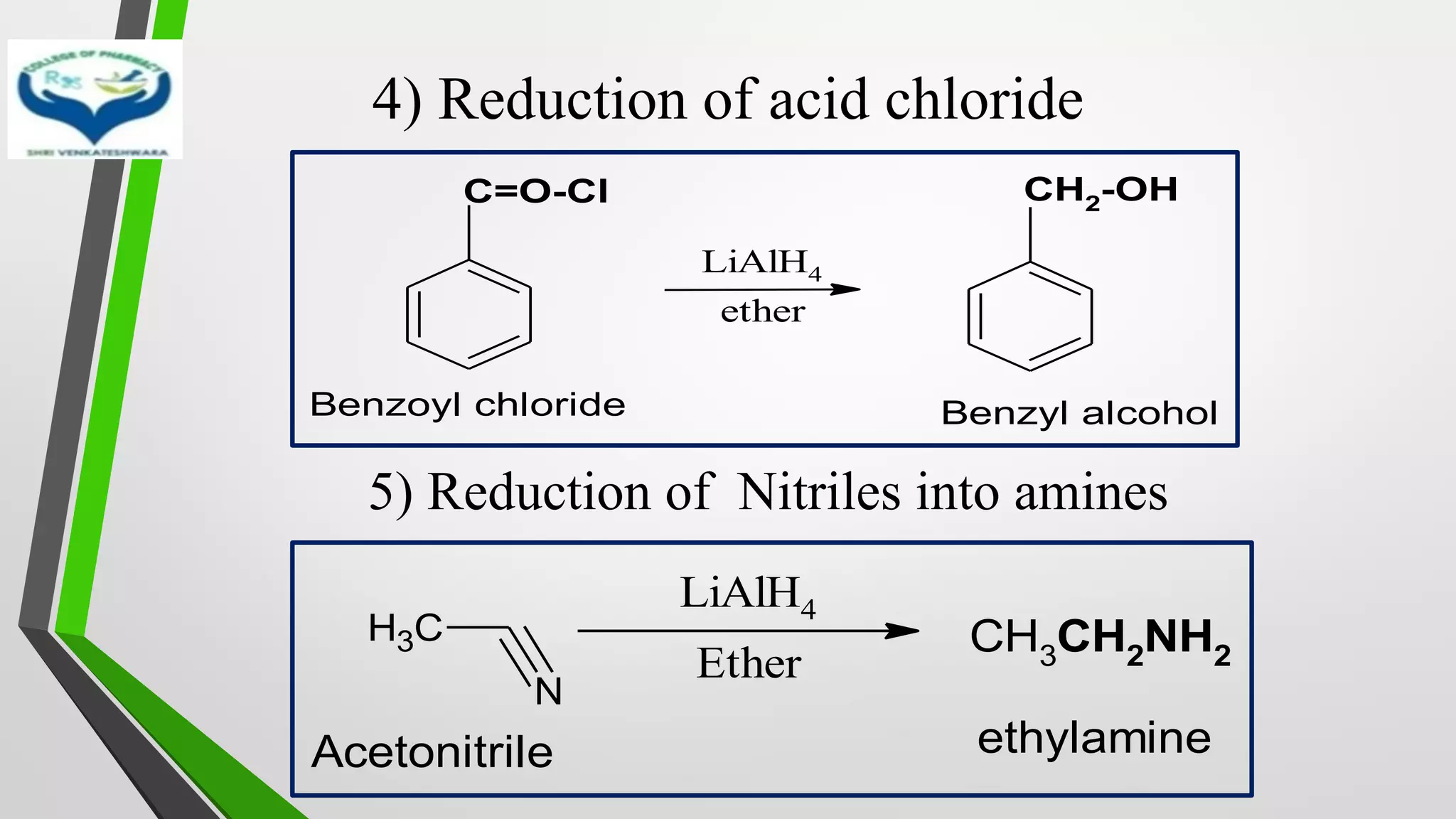
4) Reduction of acid chloride
5) Reduction of Nitriles into amines
C
H3
N
LiAlH4
Ether
CH3CH2NH2
Acetonitrile ethylamine
C=O-Cl CH2-OH
Benzoyl chloride Benzyl alcohol
LiAlH4
ether
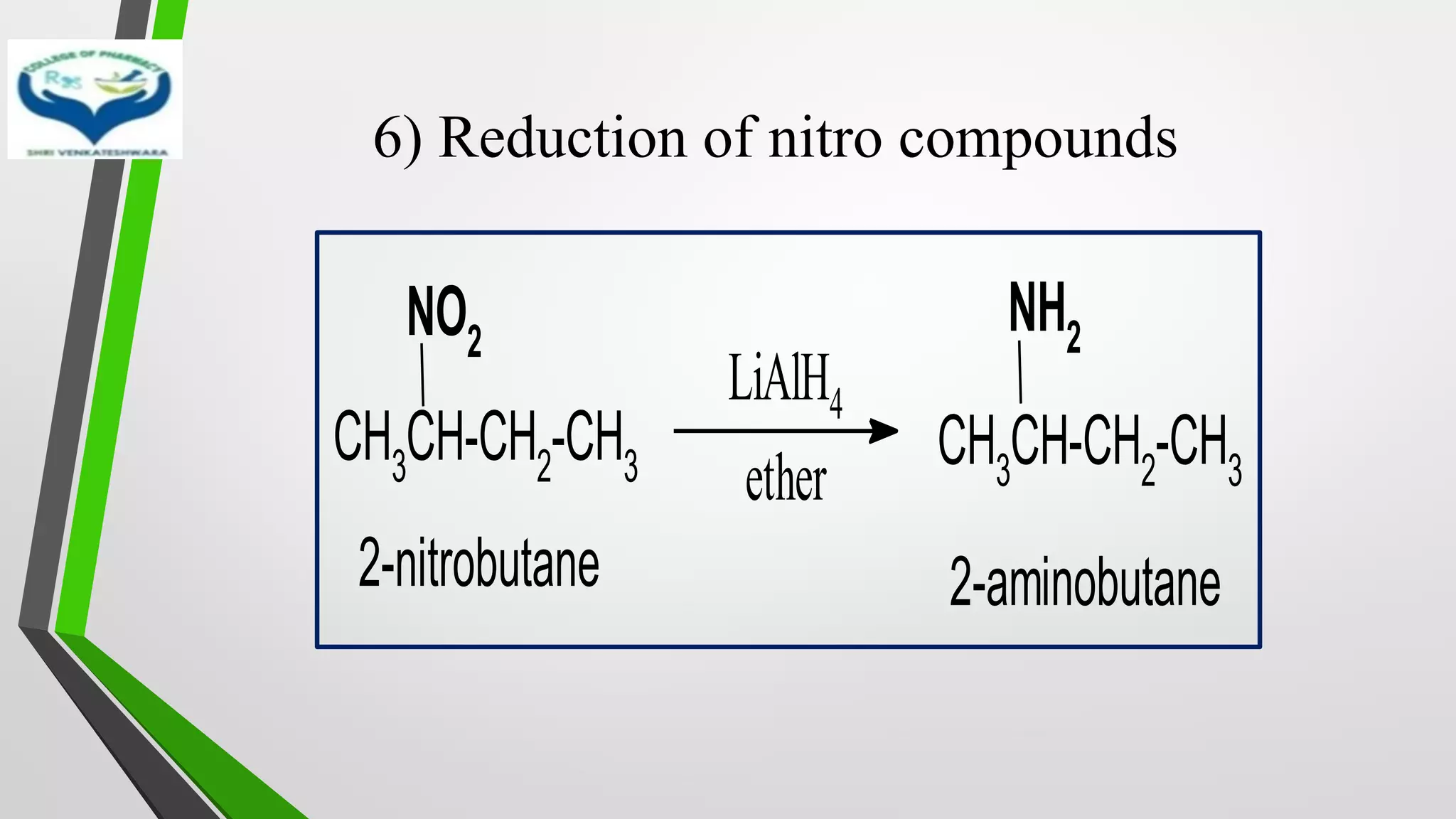
6) Reduction of nitro compounds
CH3CH-CH2-CH3
NO2
LiAlH4
ether
CH3CH-CH2-CH3
NH2
2-nitrobutane 2-aminobutane

Reactions of synthetic importance

  • 1.
    Pharmaceutical Organic ChemistryIII Reactions of Synthetic Importance Presented by SOWMIYA PERINBARAJ Assistant Professor Dept. of Pharmaceutical Chemistry SVCP
  • 2.
  • 3.
    Definition ❖ Clemmensen Reductionwas first reported by Clemmensen Park Davis in 1913. ❖ The reduction of Carbonyl groups of aldehydes or ketones into corresponding hydrocarbon or methylene group in presence of zinc amalgam and excess con. HCl is known as Clemmensen reduction. ❖ALDEHYDES (-CHO)/ KETONES (-C=O) [H] ❖ HYDROCARBONS (-CH2 )
  • 4.
    General reaction • Usedespecially for Ketones containing phenolic or carboxylic groups which remain unaffected. R C R1 O Zn/Hg Con.Hcl R C R1 H H Ketone Alkane
  • 5.
    MECHANISM • Step 1:Activation of Carbonyl group by con. HCl (acidic media) R R1 O H + R R1 O + H R C + R1 O H Ketone
  • 6.
    Step 2: Transferof electrons from zinc and followed by Protonation R C + R1 O H + 2e- R C – R1 O H H + 2 R C R1 OH2 + H Zn 2+ zn + 2e-
  • 7.
    STEP 3: Lossof water R C R1 OH2 + H O H2 - R C + R1 H Carbocation
  • 8.
    Step: 4 Transferof electrons and followed by Protonation R C + R1 H 2e- Zn R C – R1 H H + R C R1 H H Alkane
  • 9.
    APPLICATIONS 1) Reduction ofcyclic ketones O Zn/Hg Con.HCl Cyclopentanone Cyclopentane
  • 10.
    2) Reduction ofAromatic Ketones CH3 O Zn/Hg Con.HCl CH3 Acetophenone Ethylbenzene
  • 11.
    3) In synthesisof Naphthalene i) Zn/Hg Hcl ii) SOCl2 AlCl3 C O O O H CH2 O Cl C O b- Benzoyl Propanoic acid g- Phenyl Butanoyl chloride a- Tetralone Con.HCl Zn/Hg Δ Se Tetrahydro naphthalene Naphthalene
  • 12.
    4) Reduction ofα, β unsaturated ketones C H3 CH3 O Zn/Hg Con.HCl C H3 CH3 3-penten-2-one Pentane 1 2 3 4 5
  • 13.
    5) Reduction ofPhenolic carbonyl compounds in which phenolic group remain unaffected OH O Zn/Hg Con.HCl OH CH3 Salicylaldehyde o-cresol o m p
  • 14.
  • 15.
    INTRODUCTION • Reduction ofmetal hydrides proceeds by transfer of hydride ion[H-] to the substrate. • Selectively reduce a number of functional groups such as ✓Carbonyl ✓Carboxylic acid ✓Nitro ✓Ester in presence C=C double bounds • Mostly used metal hydride reducing agents are sodium borohydride (NaBH4) and lithium aluminium hydride (LiAlH4) • LiAlH4 – Stong reducing agent • NaBH4 – Mild reducing agent
  • 16.
    SODIUM BOROHYDRIDE (NaBH4) •NaBH4 a mild reducing agent soluble in polar solvents such as water and alcohols but insoluble in ether. • Reduces carbonyl groups • Aldehydes • Ketones • Alkyl halides • Acid chlorides
  • 17.
    Preparation: •Prepared by reactionof sodium hydride and trimethoxy borate. + 4NaH B(OCH3)3 250°C NaBH4 + 3CH3ONa Sodiumhydride Trimethoxy borate Sodium borohydride Sodiummethoxide
  • 18.
    General Reaction R C R1 O 4+ NaBH4 R C H R1 O 4 B- Na+ 4H2O R C H R1 OH 4 + + H3BO3 NaOH Ketone Secondary alcohol Boric acid Sodiumborohydride
  • 19.
    Mechanism • Step 1:Transfer of hydride ion [H-], powerful nucleophile from NaBH4 to the carbonyl group with simultaneous binding of carbonyl oxygen with boron R C R1 O + NaBH4 R C R1 O Na+ BH4 - H- R C H R1 O BH3 – Na + Complex
  • 20.
    Step 2: Remaining3H- transfer to another 3 molecules of carbonyl compounds R C H R1 O BH3 – Na + R C R1 O 3 R C H R1 O 4 B- Na+
  • 21.
    Step 3: Hydrolysisto alcohol R C H R1 O 4 B- Na+ 4H2O R C H R1 OH 4 Secondaryalcohol + H3BO3 NaOH Boricacid +
  • 22.
    APPLICATIONS • Reduction ofBenzaldehyde into Benzyl alcohol • Reduction of cyclohexanone into cyclohexanol NaBH4 CHO CH2OH O NaBH4 OH
  • 23.
    • Reduction of4-nitro-1-butanal into 4-nitro-1-butanol • Reduction of m-nitrobenzaldehyde into m-nitrobenzylalcohol NO2-CH2-CH2-CH2-CHO NaBH4 NO2-CH2-CH2-CH2-CH2-OH NO2 CHO NaBH4 NO2 CH2OH
  • 24.
    • Reduction ofα, β- Unsaturated aldehydes • Reduction of Alkyl halides CH=CH-CHO NaBH4 CH=CH-CH2OH Cinnamaldehyde Cinnamyl alcohol CH2-Br NaBH4 CH3 Benzyl chloride Toluene
  • 25.
    • Reduction ofacid chloride C=O-Cl NaBH4 CH2-OH Benzyl alcohol
  • 26.
  • 27.
    INTRODUCTION • Lithium aluminiumhydride is a strong reducing agent. • Violently reacts with polar solvents, resulting in liberation of hydrogen gas. Hence these reaction are conducted in dry ether/ THF/ Dioxane. • Reduces carbonyl groups, carboxylic acid, acid chloride, acid unhydride and epoxides into corresponding alcohols. • Also reduces amides, nitriles, aliphatic nitro compounds into corresponding amines.
  • 28.
    PREPARATION •Prepared by thereaction of anhydrous aluminium chloride with lithium hydride in dry ether/ THF. 4LiH + AlCl3 THF LiAlH4 + 3LiCl
  • 29.
    GENERAL REACTION R C R1 O 4+ LiAlH4 R C H R1 O 4 Al- Li+ 4H2O R C H R1 OH 4 + + LiCl Ketone Secondary alcohol Lithium aluminium hydride ether AlCl3
  • 30.
    MECHANISM • Step 1:Transfer of hydride ion [H-], powerful nucleophile from LiAlH4 to the carbonyl group with simultaneous binding of carbonyl oxygen with boron R C R1 O + LiAlH4 R C R1 O Li+ AlH4 - H- R C H R1 O Complex AlH3 - Li+
  • 31.
    Step 2: Remaining3H- transfer to another 3 molecules of carbonyl compounds R C H R1 O R C R1 O 3 R C H R1 O 4 Al- Li+ AlH3 - Li+
  • 32.
    Step 3: Hydrolysisin presence of acid to give alcohol R C H R1 O 4 Al- Li+ R C H R1 OH 4 Secondaryalcohol + 4H2O HCl LiCl + AlCl3
  • 33.
    APPLICATIONS 1) Reduction ofcarbonyl compounds CH3(CH2)5 CHO LiAlH4 Ether CH3(CH2)5 OH 1-heptanal 1-heptanol O LiAlH4 Ether OH Cyclopentanone Cyclopentanaol
  • 34.
    2) Reduction ofCarboxylic acids CH3CH2COOH LiAlH4 Ether Propanoic acid CH3CH2CH2OH Propanol 3) Reduction of amides C H3 NH2 O CH3-CH2-NH2 Acetamide ethylamine LiAlH4 Ether
  • 35.
    4) Reduction ofacid chloride 5) Reduction of Nitriles into amines C H3 N LiAlH4 Ether CH3CH2NH2 Acetonitrile ethylamine C=O-Cl CH2-OH Benzoyl chloride Benzyl alcohol LiAlH4 ether
  • 36.
    6) Reduction ofnitro compounds CH3CH-CH2-CH3 NO2 LiAlH4 ether CH3CH-CH2-CH3 NH2 2-nitrobutane 2-aminobutane