Dissolving Metal Reductions
Theability of certain metals to donate electrons to electrophilic or unsaturated
functional groups has proven useful in several reductive procedures. The facility
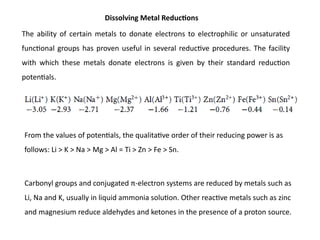
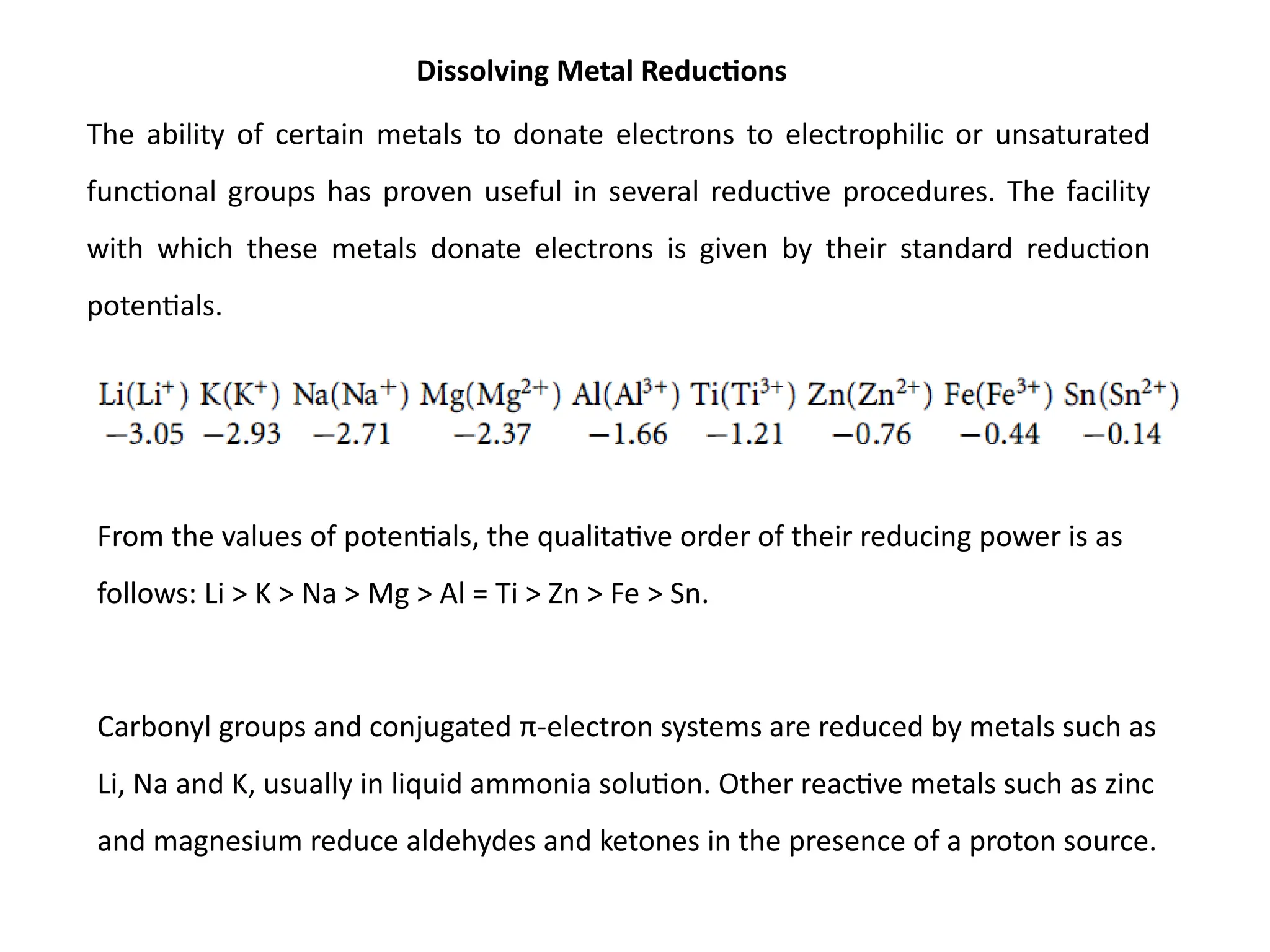
with which these metals donate electrons is given by their standard reduction
potentials.
From the values of potentials, the qualitative order of their reducing power is as
follows: Li > K > Na > Mg > Al = Ti > Zn > Fe > Sn.
Carbonyl groups and conjugated π-electron systems are reduced by metals such as
Li, Na and K, usually in liquid ammonia solution. Other reactive metals such as zinc
and magnesium reduce aldehydes and ketones in the presence of a proton source.
2.
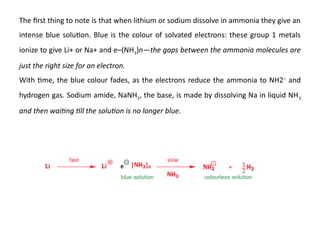
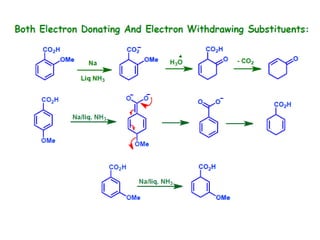
The first thingto note is that when lithium or sodium dissolve in ammonia they give an
intense blue solution. Blue is the colour of solvated electrons: these group 1 metals
ionize to give Li+ or Na+ and e–(NH3)n—the gaps between the ammonia molecules are
just the right size for an electron.
With time, the blue colour fades, as the electrons reduce the ammonia to NH2–
and
hydrogen gas. Sodium amide, NaNH2, the base, is made by dissolving Na in liquid NH3
and then waiting till the solution is no longer blue.
3.
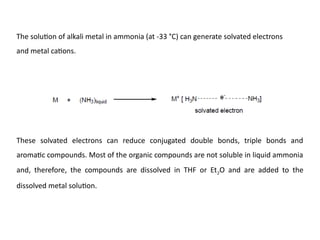
The solution ofalkali metal in ammonia (at -33 °C) can generate solvated electrons
and metal cations.
These solvated electrons can reduce conjugated double bonds, triple bonds and
aromatic compounds. Most of the organic compounds are not soluble in liquid ammonia
and, therefore, the compounds are dissolved in THF or Et2O and are added to the
dissolved metal solution.
4.
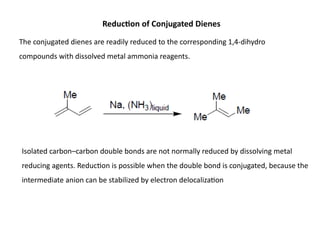
Reduction of ConjugatedDienes
The conjugated dienes are readily reduced to the corresponding 1,4-dihydro
compounds with dissolved metal ammonia reagents.
Isolated carbon–carbon double bonds are not normally reduced by dissolving metal
reducing agents. Reduction is possible when the double bond is conjugated, because the
intermediate anion can be stabilized by electron delocalization
5.
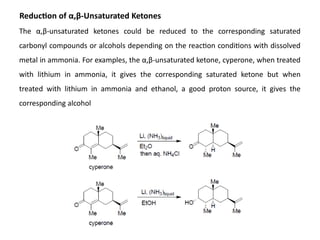
Reduction of α,β-UnsaturatedKetones
The α,β-unsaturated ketones could be reduced to the corresponding saturated
carbonyl compounds or alcohols depending on the reaction conditions with dissolved
metal in ammonia. For examples, the α,β-unsaturated ketone, cyperone, when treated
with lithium in ammonia, it gives the corresponding saturated ketone but when
treated with lithium in ammonia and ethanol, a good proton source, it gives the
corresponding alcohol
6.
The first stepin the reduction of α,β-unsaturated ketones is the formation of the radical
anion A, which subsequently abstracts a proton from the ammonia or from added
alcohol to give B. After addition of another electron, the enolate anion D is formed. In
the absence of a stronger acid, this enolate remains unprotonated and resists addition of
another electron, which would correspond to further reduction. Acidification with
ammonium chloride then leads to the saturated ketone product. The reaction of
ammonium ions with solvated electrons apparently destroys the reducing system before
further reduction of the ketone to the alcohol can take place.
In the presence of proton donor (e.g. ethanol) sufficiently strong to protonate the
enolate anion, however, the ketone is generated in the reducing medium and is reduced
further to the saturated alcohol. The formation of enolate anions such as D during
metal–ammonia reduction of α,β-unsaturated ketones is shown by their ready trapping
with electrophiles such as iodomethane.
A B
C D E
7.
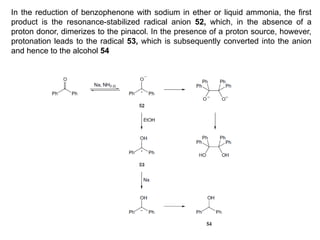
In the reductionof benzophenone with sodium in ether or liquid ammonia, the first
product is the resonance-stabilized radical anion 52, which, in the absence of a
proton donor, dimerizes to the pinacol. In the presence of a proton source, however,
protonation leads to the radical 53, which is subsequently converted into the anion
and hence to the alcohol 54
8.
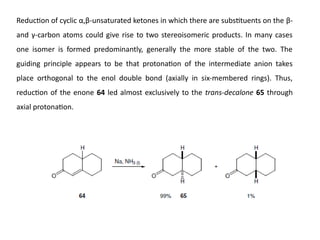
Reduction of cyclicα,β-unsaturated ketones in which there are substituents on the β-
and γ-carbon atoms could give rise to two stereoisomeric products. In many cases
one isomer is formed predominantly, generally the more stable of the two. The
guiding principle appears to be that protonation of the intermediate anion takes
place orthogonal to the enol double bond (axially in six-membered rings). Thus,
reduction of the enone 64 led almost exclusively to the trans-decalone 65 through
axial protonation.
9.
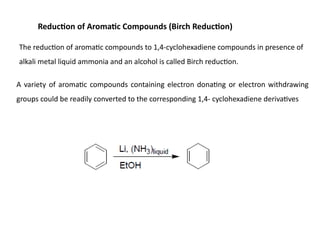
Reduction of AromaticCompounds (Birch Reduction)
The reduction of aromatic compounds to 1,4-cyclohexadiene compounds in presence of
alkali metal liquid ammonia and an alcohol is called Birch reduction.
A variety of aromatic compounds containing electron donating or electron withdrawing
groups could be readily converted to the corresponding 1,4- cyclohexadiene derivatives
10.
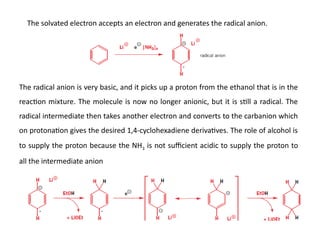
The solvated electronaccepts an electron and generates the radical anion.
The radical anion is very basic, and it picks up a proton from the ethanol that is in the
reaction mixture. The molecule is now no longer anionic, but it is still a radical. The
radical intermediate then takes another electron and converts to the carbanion which
on protonation gives the desired 1,4-cyclohexadiene derivatives. The role of alcohol is
to supply the proton because the NH3 is not sufficient acidic to supply the proton to
all the intermediate anion
11.
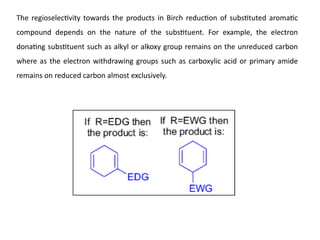
The regioselectivity towardsthe products in Birch reduction of substituted aromatic
compound depends on the nature of the substituent. For example, the electron
donating substituent such as alkyl or alkoxy group remains on the unreduced carbon
where as the electron withdrawing groups such as carboxylic acid or primary amide
remains on reduced carbon almost exclusively.
12.
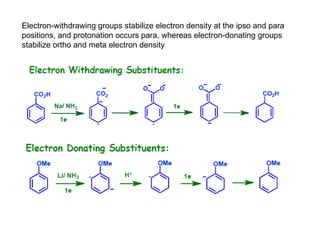
Electron-withdrawing groups stabilizeelectron density at the ipso and para
positions, and protonation occurs para, whereas electron-donating groups
stabilize ortho and meta electron density
13.
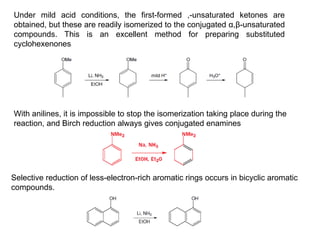
Under mild acidconditions, the first-formed ,-unsaturated ketones are
obtained, but these are readily isomerized to the conjugated α,β-unsaturated
compounds. This is an excellent method for preparing substituted
cyclohexenones
With anilines, it is impossible to stop the isomerization taking place during the
reaction, and Birch reduction always gives conjugated enamines
Selective reduction of less-electron-rich aromatic rings occurs in bicyclic aromatic
compounds.
15.
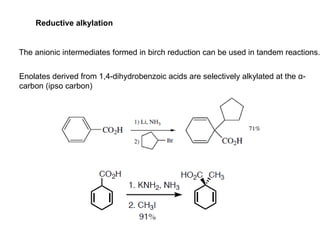
Reductive alkylation
The anionicintermediates formed in birch reduction can be used in tandem reactions.
Enolates derived from 1,4-dihydrobenzoic acids are selectively alkylated at the α-
carbon (ipso carbon)
16.
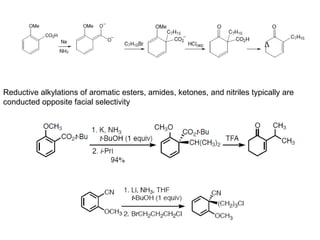
∆
Reductive alkylations ofaromatic esters, amides, ketones, and nitriles typically are
conducted opposite facial selectivity
17.
Reduction of Alkynes
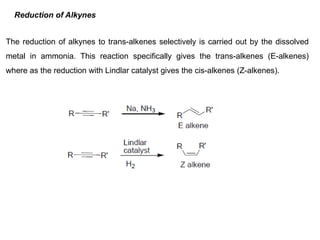
Thereduction of alkynes to trans-alkenes selectively is carried out by the dissolved
metal in ammonia. This reaction specifically gives the trans-alkenes (E-alkenes)
where as the reduction with Lindlar catalyst gives the cis-alkenes (Z-alkenes).
18.
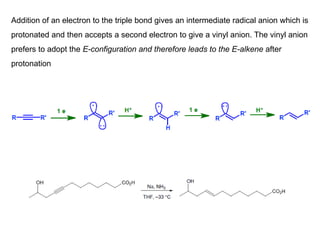
Addition of anelectron to the triple bond gives an intermediate radical anion which is
protonated and then accepts a second electron to give a vinyl anion. The vinyl anion
prefers to adopt the E-configuration and therefore leads to the E-alkene after
protonation



![Polymer [ बहुलक ] Chemistry Notes PDF - Irfanullah Mehar - JJ Sir Chemistry.pdf](https://cdn.slidesharecdn.com/ss_thumbnails/polymerchemistrynotespdf-irfanullahmehar-jjsirchemistry-260210172118-3f9b37f7-thumbnail.jpg?width=640&height=640&fit=bounds)


