Aslam O Aliakum
I am Fahad Abdullah
&
My Group Fellows Name are
Arslan Ameen
Muhammad Shuban
Umair Khalid
Shahbaz
Our Group Topics
Depreciation is an accounting method of allocating the cost of a Tangible
Asset over its useful life. Businesses depreciate long-term assets for both
tax and accounting purposes.
Depreciation = (Cost - Residual value) / Useful life
What Is Depreciation?
1-Ascertainment Of True Profits
2-Reporting Of True And Fair Financial Position Of a Business
3-Replacement Of Assets
4-Saving In Taxes
Advantages Of Depreciation
When an asset is purchased, it is nothing more than a payment in
advance for for the use of asset. Depreciation is the cost of using
a fixed asset. To determine true and correct amount of profit or loss,
depreciation must be treated as revenue expenses and debited
to profit and loss account.
1-Ascertainment Of True Profits
2 - R epo rt ing Of True A nd Fa ir Fina ncia l
Po sit io n Of A Business
The value of assets decrease over a period of time on account of
various factors. In order to present a true state of affairs of the
business, the assets should be shown in the balance sheet, at their
true and fair values. If the depreciation is not provided then the asset
will appear in the balance sheet at the original value. So, in order to
show the true financial position of a business, depreciation is
required to be charged on the assets.
3. Replacement Of Assets
Assets used in the business need to be replaced after the expiry of
their useful life. Depreciation can be taken as a source of fund for
replacing worn out asset by a new asset. Thus, depreciation
charges help in accumulating funds for the replacement of an
asset.
The profit and loss account will show more profits if
depreciation is not charged on asset. So, the business needs to
pay more income tax to the government. Depreciation charges
on assets save the amount of tax equivalent to tax rate. Since it
is shown as expense in the profit and loss account, it reduces
the amount of the profit.
4. Saving In Taxes
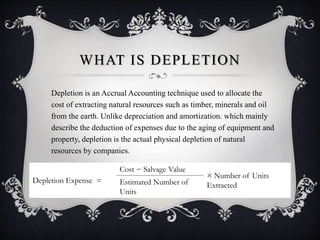
Depletion is an Accrual Accounting technique used to allocate the
cost of extracting natural resources such as timber, minerals and oil
from the earth. Unlike depreciation and amortization. which mainly
describe the deduction of expenses due to the aging of equipment and
property, depletion is the actual physical depletion of natural
resources by companies.
WHAT IS DEPLETION
Depletion Expense =
Cost − Salvage Value
× Number of Units
ExtractedEstimated Number of
Units
What Is 'Amortization?
Amortization is the paying off of debt with a fixed repayment schedule in regular
installments over a period of time for example with a mortgage or a car loan. It also refers
to the spreading out of capital expenses for intangible assets over a specific period of time
(usually over the asset's useful life) for
accounting and tax purposes.
A = payment Amount per period
P = initial Principal (loan amount)
r = interest rate per period
n = total number of payments or periods
Here are some things on which Amortization depends
1-Amortization of Loans
2-Amortization of Intangible Assets
AMORTIZATION OF LOANS
On auto loan and home loan payments, at the beginning of the loan
term, most of the monthly payment goes toward interest. With each
subsequent payment, a greater percentage of the payment goes toward
the loan's principal. For example, on a five-year $20,000 auto loan at
6% interest, the first payment of $386.66 allocates $286.66 to
principal and $100 to interest. The last monthly payment allocates
$384.73 to principal and $1.92 to interest.
AMORTIZATION OF INTANGIBLE
ASSETS
To illustrate the amortization of an intangible asset, imagine XYZ Biotech
spends $30 million dollars on a patent with a useful life of 15 years.
Theoretically, to account for the expense over a 15-year period, XYZ
Biotech records $2 million each year as an amortization expense.
Presentation (1)

Presentation (1)

  • 2.
    Aslam O Aliakum Iam Fahad Abdullah & My Group Fellows Name are Arslan Ameen Muhammad Shuban Umair Khalid Shahbaz
  • 3.
  • 5.
    Depreciation is anaccounting method of allocating the cost of a Tangible Asset over its useful life. Businesses depreciate long-term assets for both tax and accounting purposes. Depreciation = (Cost - Residual value) / Useful life What Is Depreciation?
  • 6.
    1-Ascertainment Of TrueProfits 2-Reporting Of True And Fair Financial Position Of a Business 3-Replacement Of Assets 4-Saving In Taxes Advantages Of Depreciation
  • 7.
    When an assetis purchased, it is nothing more than a payment in advance for for the use of asset. Depreciation is the cost of using a fixed asset. To determine true and correct amount of profit or loss, depreciation must be treated as revenue expenses and debited to profit and loss account. 1-Ascertainment Of True Profits
  • 8.
    2 - Repo rt ing Of True A nd Fa ir Fina ncia l Po sit io n Of A Business The value of assets decrease over a period of time on account of various factors. In order to present a true state of affairs of the business, the assets should be shown in the balance sheet, at their true and fair values. If the depreciation is not provided then the asset will appear in the balance sheet at the original value. So, in order to show the true financial position of a business, depreciation is required to be charged on the assets.
  • 9.
    3. Replacement OfAssets Assets used in the business need to be replaced after the expiry of their useful life. Depreciation can be taken as a source of fund for replacing worn out asset by a new asset. Thus, depreciation charges help in accumulating funds for the replacement of an asset.
  • 10.
    The profit andloss account will show more profits if depreciation is not charged on asset. So, the business needs to pay more income tax to the government. Depreciation charges on assets save the amount of tax equivalent to tax rate. Since it is shown as expense in the profit and loss account, it reduces the amount of the profit. 4. Saving In Taxes
  • 12.
    Depletion is anAccrual Accounting technique used to allocate the cost of extracting natural resources such as timber, minerals and oil from the earth. Unlike depreciation and amortization. which mainly describe the deduction of expenses due to the aging of equipment and property, depletion is the actual physical depletion of natural resources by companies. WHAT IS DEPLETION Depletion Expense = Cost − Salvage Value × Number of Units ExtractedEstimated Number of Units
  • 14.
    What Is 'Amortization? Amortizationis the paying off of debt with a fixed repayment schedule in regular installments over a period of time for example with a mortgage or a car loan. It also refers to the spreading out of capital expenses for intangible assets over a specific period of time (usually over the asset's useful life) for accounting and tax purposes. A = payment Amount per period P = initial Principal (loan amount) r = interest rate per period n = total number of payments or periods Here are some things on which Amortization depends 1-Amortization of Loans 2-Amortization of Intangible Assets
  • 15.
    AMORTIZATION OF LOANS Onauto loan and home loan payments, at the beginning of the loan term, most of the monthly payment goes toward interest. With each subsequent payment, a greater percentage of the payment goes toward the loan's principal. For example, on a five-year $20,000 auto loan at 6% interest, the first payment of $386.66 allocates $286.66 to principal and $100 to interest. The last monthly payment allocates $384.73 to principal and $1.92 to interest.
  • 16.
    AMORTIZATION OF INTANGIBLE ASSETS Toillustrate the amortization of an intangible asset, imagine XYZ Biotech spends $30 million dollars on a patent with a useful life of 15 years. Theoretically, to account for the expense over a 15-year period, XYZ Biotech records $2 million each year as an amortization expense.