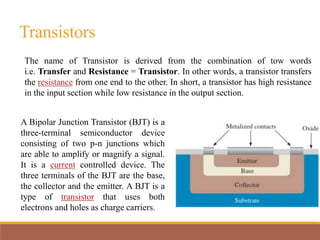
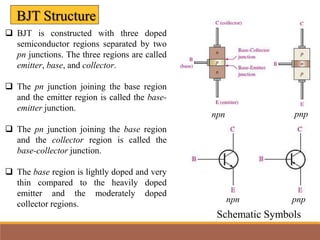
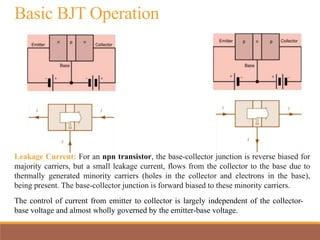
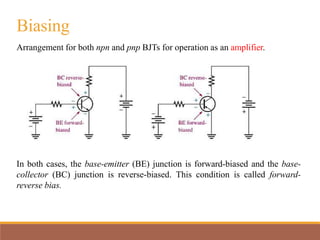
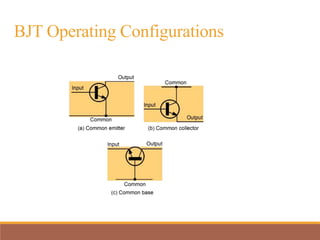
This document discusses bipolar junction transistors (BJTs). It describes the basic structure of a BJT, which consists of an emitter, base, and collector separated by two PN junctions. A BJT is a current-controlled device that uses both electrons and holes as charge carriers. The document explains how BJTs work, including leakage current, biasing arrangements, transistor currents, input/output characteristics, and operational regions. BJTs can be used as amplifiers when biased in the linear active region.