
Bipolar I disorder
Dr. Mohamed Abdelghani
M.B.B.Ch., M.Sc., M.D. Psych.
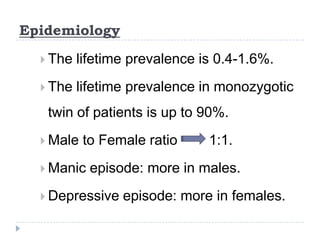
Epidemiology
 The lifetime prevalence is 0.4-1.6%.
 The lifetime prevalence in monozygotic
twin of patients is up to 90%.
 Male to Female ratio 1:1.
 Manic episode: more in males.
 Depressive episode: more in females.
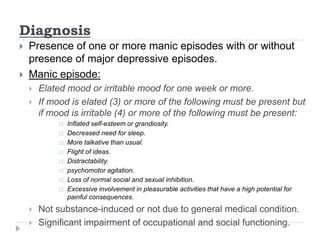
Diagnosis
 Presence of one or more manic episodes with or without
presence of major depressive episodes.
 Manic episode:
 Elated mood or irritable mood for one week or more.
 If mood is elated (3) or more of the following must be present but
if mood is irritable (4) or more of the following must be present:
 Inflated self-esteem or grandiosity.
 Decreased need for sleep.
 More talkative than usual.
 Flight of ideas.
 Distractability.
 psychomotor agitation.
 Loss of normal social and sexual inhibition.
 Excessive involvement in pleasurable activities that have a high potential for
painful consequences.
 Not substance-induced or not due to general medical condition.
 Significant impairment of occupational and social functioning.
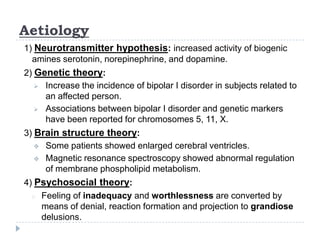
Aetiology
1) Neurotransmitter hypothesis: increased activity of biogenic
amines serotonin, norepinephrine, and dopamine.
2) Genetic theory:
 Increase the incidence of bipolar I disorder in subjects related to
an affected person.
 Associations between bipolar I disorder and genetic markers
have been reported for chromosomes 5, 11, X.
3) Brain structure theory:
 Some patients showed enlarged cerebral ventricles.
 Magnetic resonance spectroscopy showed abnormal regulation
of membrane phospholipid metabolism.
4) Psychosocial theory:
o Feeling of inadequacy and worthlessness are converted by
means of denial, reaction formation and projection to grandiose
delusions.
Differential diagnosis
1. Bipolar II disorder:
 Major depressive episodes with hypomanic episodes.
2. Cyclothymic disorder:
 Numerous episodes of hypomania and numerous
episodes of depressive symptoms for at least 2 years.
 The symptoms are not sufficient to diagnose manic
episodes or major depressive episodes.
 Significant social and occupational impairment.
3. Secondary mood disorder:
 Substance-induced mood disorder.
 Mood disorder due to general medical condition.
Treatment
I. Hospitalization
II. Psychopharmacotherapy
III. E.C.T.
IV. Psychotherapy
Psychopharmacotherapy
A. For manic episodes: “Mood stabilizers”
1)Lithium:
 It is the standard treatment of bipolar disorder.
 Therapeutic blood level is 0.8-1.2 mEq/litre.
 Toxic levels start after 1.5 mEq/litre.
2)Anti-convulsants:
 Valproate, Carbamazepine, oxacarbazepine,....
3)Atypical antipsychotics:
 All except Clozapine.
B. For major depressive episode:
 Lamotrigine
 Olanzapine plus Flouxetine “Symbyax”
 Quetiapine
 Antidepressant drugs should be used with
caution to avoid switching to mania.
Electroconvulsive therapy
 At least equal to lithium in the treatment of acute and
severe manic episodes.
 Limited to:
1. Acute suicide.
2. Severe mania with psychotic symptoms.
3. Catatonia.
4. Failure of medical ttt “Resistent Bipolar”.
Psychotherapy
1) Cognitive therapy: to increase compliance with
pharmacotherapy.
2) Supportive therapy: with chronic patients who
may have significant interepisodic residual
symptoms and social dysfunction.
3) Family therapy: if patient’s disorder is disrupting
the family stability, and because the disorder is
strongly familial.
http://www.slideshare.net/mabdelghaniAvailable at:
Thank u

Bipolar disorder for undergraduates

  • 1.
    Bipolar I disorder Dr.Mohamed Abdelghani M.B.B.Ch., M.Sc., M.D. Psych.
  • 2.
    Epidemiology  The lifetimeprevalence is 0.4-1.6%.  The lifetime prevalence in monozygotic twin of patients is up to 90%.  Male to Female ratio 1:1.  Manic episode: more in males.  Depressive episode: more in females.
  • 3.
    Diagnosis  Presence ofone or more manic episodes with or without presence of major depressive episodes.  Manic episode:  Elated mood or irritable mood for one week or more.  If mood is elated (3) or more of the following must be present but if mood is irritable (4) or more of the following must be present:  Inflated self-esteem or grandiosity.  Decreased need for sleep.  More talkative than usual.  Flight of ideas.  Distractability.  psychomotor agitation.  Loss of normal social and sexual inhibition.  Excessive involvement in pleasurable activities that have a high potential for painful consequences.  Not substance-induced or not due to general medical condition.  Significant impairment of occupational and social functioning.
  • 4.
    Aetiology 1) Neurotransmitter hypothesis:increased activity of biogenic amines serotonin, norepinephrine, and dopamine. 2) Genetic theory:  Increase the incidence of bipolar I disorder in subjects related to an affected person.  Associations between bipolar I disorder and genetic markers have been reported for chromosomes 5, 11, X. 3) Brain structure theory:  Some patients showed enlarged cerebral ventricles.  Magnetic resonance spectroscopy showed abnormal regulation of membrane phospholipid metabolism. 4) Psychosocial theory: o Feeling of inadequacy and worthlessness are converted by means of denial, reaction formation and projection to grandiose delusions.
  • 5.
    Differential diagnosis 1. BipolarII disorder:  Major depressive episodes with hypomanic episodes. 2. Cyclothymic disorder:  Numerous episodes of hypomania and numerous episodes of depressive symptoms for at least 2 years.  The symptoms are not sufficient to diagnose manic episodes or major depressive episodes.  Significant social and occupational impairment. 3. Secondary mood disorder:  Substance-induced mood disorder.  Mood disorder due to general medical condition.
  • 6.
  • 7.
    Psychopharmacotherapy A. For manicepisodes: “Mood stabilizers” 1)Lithium:  It is the standard treatment of bipolar disorder.  Therapeutic blood level is 0.8-1.2 mEq/litre.  Toxic levels start after 1.5 mEq/litre. 2)Anti-convulsants:  Valproate, Carbamazepine, oxacarbazepine,.... 3)Atypical antipsychotics:  All except Clozapine.
  • 8.
    B. For majordepressive episode:  Lamotrigine  Olanzapine plus Flouxetine “Symbyax”  Quetiapine  Antidepressant drugs should be used with caution to avoid switching to mania.
  • 9.
    Electroconvulsive therapy  Atleast equal to lithium in the treatment of acute and severe manic episodes.  Limited to: 1. Acute suicide. 2. Severe mania with psychotic symptoms. 3. Catatonia. 4. Failure of medical ttt “Resistent Bipolar”.
  • 10.
    Psychotherapy 1) Cognitive therapy:to increase compliance with pharmacotherapy. 2) Supportive therapy: with chronic patients who may have significant interepisodic residual symptoms and social dysfunction. 3) Family therapy: if patient’s disorder is disrupting the family stability, and because the disorder is strongly familial.
  • 11.