
بسم الله الرحمن الرحيميا أيها الناس اتقوا ربكم الذى خلقكم من نفس واحدة و خلق منها زوجها وبث منهما رجالا كثيرا و نساء و اتقوا الله الذى تساءلون به و الارحام ان الله كان عليكم رقيباالنساء 1
Aggressive BehaviourIn ChildrenPresented ByMohamed Abdelghani
IntroductionAggression is "the maladaptive behavior which leads to the damage or destruction of some goal entity.” (Alia-Klein et al., 2008).
Many behaviors are aggressive even though they do not involve physical injury.
Verbal aggression is one example.
Others include coercion, intimidation, and premeditated social ostracism of others (Lewis, 2005).Aggressive Behaviour In ChildrenPSYCHOSOCIAL ASPECT
I- FAMILY-RELATED RISK FACTORSA. Sexual and Physical AbuseB. Parental Violence C. Broken HomeD. Parental CharacteristicsE. Mental Disorders of ParentsF. Perceived Parenting Styles(Barnow and        Freyberger, 2003).
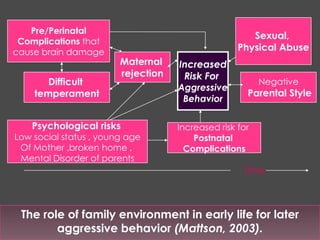
Sexual, Physical AbusePre/PerinatalComplications thatcause brain damageMaternal rejectionIncreasedRisk For AggressiveBehaviorDifficult temperamentNegativeParental StylePsychological risksLow social status , young ageOf Mother ,broken home , Mental Disorder of parentsIncreased risk for Postnatal ComplicationsTimeThe role of family environment in early life for later aggressive behavior (Mattson, 2003).
II- Community-Related Risk FactorsA- Peers:Peer groups appear to be a place for consolidation of aggressive behaviors for youth, later on (Loeber & Hay, 1994).B- School Factors:Disorganized school structures with lax discipline, enforcement of rules and crowded physical space(Flannery, 1997).C- Neighborhood Factors: include poverty, gang involvement, availability of drugs and low neighborhood attachment (Maguin et al., 1995).
III- Television, Rock Music and Videos, and Computer and Video GamesTelevision and Movie Violence Correlation between media violence and aggression (0.3) is greater than that of condom nonuse and sexually (HIV) infection (0.2), or environmental tobacco smoke and lung cancer (0.15)(Christopher, 2007).Rock Music and Music VideosGreat exposure was associated with being 3.0 times more likely to hit a teacher, 2.6 times to be arrested, and 1.6 times to have an incident of STD and drug abuse (Kader, 2006).
Computer and Video GamesViolent video games causes increased aggression or aggressive play immediately after the video game (Benseley and Van Eenwyk, 2001).Aggressive Behaviour In ChildrenGENETIC ASPECT
The influence of genetic factors appears to increase over the course of development and is followed by a concomitant decrease in shared environmental factors (Blonigen & Krueger, 2007).Furthermore, genetic effects may be moderated by gender differences, as well as interactions with adverse environmental factors (Blonigen & Krueger, 2007).
Genetic Effects on Aggressive BehaviorGenetic factors play at least some role in the etiology of aggression (DiLalla, 2002).
Studies of children using parental reports have noted substantial genetic contributions to aggressive behaviors among twins across a wide developmental span (ages 7–16) (Eley et al., 1999).II- Gender DifferencesSeveral studies conclude that males exhibit higher mean levels of aggression than females (Hudziak et al., 2005).
In a longitudinal study of twins ages 3-12, gender differences were evident after age 7, with greater genetic contributions for males and larger shared environmental contributions for females (van Beijsterveldt et al., 2004).Aggressive Behaviour In ChildrenNEURAL ASPECT
I- ACETYLCHOLINE :♦ ACh generally has facilitatory effects on aggressive behavior (Gay and Leaf, 1986).♦ In most cases, the primary target is the hypothalamus (Brudzynski, 1994).II- DOPAMINE :◊ The studies showed that dopamine facilitates aggressive behavior (Siegel, 2005).◊ Van Erp and Miczek (2003) reported increased dopamine levels in the prefrontal cortex during aggressive encounters.
III- SEROTONIN:Serotonin suppresses several different forms of aggressive behavior (Siegel, 2005).A strategy using knockout mice genetically engineered to disrupt the neuronal nitric acid sythase gene, which inhibits aggression, by acting through 5-HT1A and 5- HT1B receptors leading to a dramatic increase in aggressive behavior (Chiavegatto et al., 2004).
IV- PEPTIDES :■ Include opioid peptides, substance P (SP), and cholecystokinin (CCK)■ Opioid peptides have antiaggressive properties (Siegel, 2005).■ SP have an excitatory action on neurons (Otsuka and Yoshioka, 1993).■ CCK potentiates defensive rage behavior elicited from the medial hypothalamus (Siegel, 2005).
Aggressive Behaviour In ChildrenNeural Areas & Circuits Mediating Aggressive Behavior
Brain areas affecting aggressive behaviorThe periaqueductal gray of the midbrain (PAG)
Hypothalamus
Septal nuclei
Amygdala
Prefrontal cortex
Bed nucleus of the striaterminalis (BNST)
Nucleus accumbens(Gregg and Siegel, 2001).Summary of functional anatomical connections relevant for aggressive behavior (Gregg, 2003).
Peri-aqueductal Gray Of The MidbrainThe organizing center for the expression of all the behavioral components of the aggressive response (Ogawa et al., 2005).Sends commands to effector regions in the brainstem, which send commands to the muscles and glands, producing the components of defensive rage (e.g., pupillary dilation, increased heart rate, vocalization) (Gregg, 2003).
Efferent projections from PAG (Gregg, 2003)

Child Aggressive Behavior

  • 1.
    بسم الله الرحمنالرحيميا أيها الناس اتقوا ربكم الذى خلقكم من نفس واحدة و خلق منها زوجها وبث منهما رجالا كثيرا و نساء و اتقوا الله الذى تساءلون به و الارحام ان الله كان عليكم رقيباالنساء 1
  • 2.
  • 3.
    IntroductionAggression is "themaladaptive behavior which leads to the damage or destruction of some goal entity.” (Alia-Klein et al., 2008).
  • 4.
    Many behaviors areaggressive even though they do not involve physical injury.
  • 5.
  • 6.
    Others include coercion,intimidation, and premeditated social ostracism of others (Lewis, 2005).Aggressive Behaviour In ChildrenPSYCHOSOCIAL ASPECT
  • 7.
    I- FAMILY-RELATED RISKFACTORSA. Sexual and Physical AbuseB. Parental Violence C. Broken HomeD. Parental CharacteristicsE. Mental Disorders of ParentsF. Perceived Parenting Styles(Barnow and Freyberger, 2003).
  • 8.
    Sexual, Physical AbusePre/PerinatalComplicationsthatcause brain damageMaternal rejectionIncreasedRisk For AggressiveBehaviorDifficult temperamentNegativeParental StylePsychological risksLow social status , young ageOf Mother ,broken home , Mental Disorder of parentsIncreased risk for Postnatal ComplicationsTimeThe role of family environment in early life for later aggressive behavior (Mattson, 2003).
  • 9.
    II- Community-Related RiskFactorsA- Peers:Peer groups appear to be a place for consolidation of aggressive behaviors for youth, later on (Loeber & Hay, 1994).B- School Factors:Disorganized school structures with lax discipline, enforcement of rules and crowded physical space(Flannery, 1997).C- Neighborhood Factors: include poverty, gang involvement, availability of drugs and low neighborhood attachment (Maguin et al., 1995).
  • 10.
    III- Television, RockMusic and Videos, and Computer and Video GamesTelevision and Movie Violence Correlation between media violence and aggression (0.3) is greater than that of condom nonuse and sexually (HIV) infection (0.2), or environmental tobacco smoke and lung cancer (0.15)(Christopher, 2007).Rock Music and Music VideosGreat exposure was associated with being 3.0 times more likely to hit a teacher, 2.6 times to be arrested, and 1.6 times to have an incident of STD and drug abuse (Kader, 2006).
  • 11.
    Computer and VideoGamesViolent video games causes increased aggression or aggressive play immediately after the video game (Benseley and Van Eenwyk, 2001).Aggressive Behaviour In ChildrenGENETIC ASPECT
  • 12.
    The influence ofgenetic factors appears to increase over the course of development and is followed by a concomitant decrease in shared environmental factors (Blonigen & Krueger, 2007).Furthermore, genetic effects may be moderated by gender differences, as well as interactions with adverse environmental factors (Blonigen & Krueger, 2007).
  • 13.
    Genetic Effects onAggressive BehaviorGenetic factors play at least some role in the etiology of aggression (DiLalla, 2002).
  • 14.
    Studies of childrenusing parental reports have noted substantial genetic contributions to aggressive behaviors among twins across a wide developmental span (ages 7–16) (Eley et al., 1999).II- Gender DifferencesSeveral studies conclude that males exhibit higher mean levels of aggression than females (Hudziak et al., 2005).
  • 15.
    In a longitudinalstudy of twins ages 3-12, gender differences were evident after age 7, with greater genetic contributions for males and larger shared environmental contributions for females (van Beijsterveldt et al., 2004).Aggressive Behaviour In ChildrenNEURAL ASPECT
  • 16.
    I- ACETYLCHOLINE :♦ACh generally has facilitatory effects on aggressive behavior (Gay and Leaf, 1986).♦ In most cases, the primary target is the hypothalamus (Brudzynski, 1994).II- DOPAMINE :◊ The studies showed that dopamine facilitates aggressive behavior (Siegel, 2005).◊ Van Erp and Miczek (2003) reported increased dopamine levels in the prefrontal cortex during aggressive encounters.
  • 17.
    III- SEROTONIN:Serotonin suppressesseveral different forms of aggressive behavior (Siegel, 2005).A strategy using knockout mice genetically engineered to disrupt the neuronal nitric acid sythase gene, which inhibits aggression, by acting through 5-HT1A and 5- HT1B receptors leading to a dramatic increase in aggressive behavior (Chiavegatto et al., 2004).
  • 18.
    IV- PEPTIDES :■Include opioid peptides, substance P (SP), and cholecystokinin (CCK)■ Opioid peptides have antiaggressive properties (Siegel, 2005).■ SP have an excitatory action on neurons (Otsuka and Yoshioka, 1993).■ CCK potentiates defensive rage behavior elicited from the medial hypothalamus (Siegel, 2005).
  • 19.
    Aggressive Behaviour InChildrenNeural Areas & Circuits Mediating Aggressive Behavior
  • 20.
    Brain areas affectingaggressive behaviorThe periaqueductal gray of the midbrain (PAG)
  • 21.
  • 22.
  • 23.
  • 24.
  • 25.
    Bed nucleus ofthe striaterminalis (BNST)
  • 26.
    Nucleus accumbens(Gregg andSiegel, 2001).Summary of functional anatomical connections relevant for aggressive behavior (Gregg, 2003).
  • 27.
    Peri-aqueductal Gray OfThe MidbrainThe organizing center for the expression of all the behavioral components of the aggressive response (Ogawa et al., 2005).Sends commands to effector regions in the brainstem, which send commands to the muscles and glands, producing the components of defensive rage (e.g., pupillary dilation, increased heart rate, vocalization) (Gregg, 2003).
  • 28.
    Efferent projections fromPAG (Gregg, 2003)