Try to imagine yourself and your work situationDo you feel overwhelmed with your work demands?
Do you seem not to receive enough support from the organization?
Do you seem physically exhausted and “wiped out”?
Do you seem tired all the time?
Do  you seem careless in relationship to service recipients / patients?
Do you report feelings of incompetence when doing work tasks?
Do you seem frustrated because of the work?
Do you seem to have lost your enthusiasm for the job? People that are burned out report the followingIf you report the following“I’m  frustrated.  It’s getting  impossible  to do a good  job, and  the situation  just keeps getting worse.”
“I have lost my enthusiasm for work I really liked.”
“I’m feeling overwhelmed, overloaded, overworked and trapped. There’s no way out.”You might susceptible for or might even experience
Burnout SyndromeBy Mohamed AbdelghaniSpecialist Of Psychiatry
DefinitionA psychological complex phenomenon related to stressful working environment, long-term exhaustion and diminished interest. First coined by Herbert Freudenbergerin his 1974 Staff burnout, based on the 1960 novel A Burnt-Out Caseby Graham Greene.According to Maslach; Burnout syndrome is characterized by three dimensions: 1) Emotional exhaustion (depletion of emotional resources to contact with other people, feelings of frustration, anger and dissatisfaction). 2) Depersonalization (negative feelings and dehumanization of the relationships with the persons who expect personal “investment”). 3) Reduced personal accomplishment (a tendency to evaluate oneself negatively, particularly with regard to work).
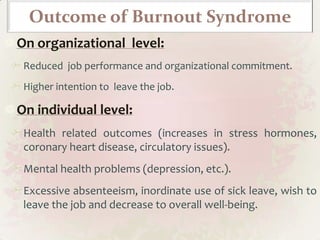
Outcome of Burnout SyndromeOn organizational  level:Reduced  job performance and organizational commitment. Higher intention to  leave the job.On individual level: Health related outcomes (increases in stress hormones, coronary heart disease, circulatory issues). Mental health problems (depression, etc.).Excessive absenteeism, inordinate use of sick leave, wish to leave the job and decrease to overall well-being.
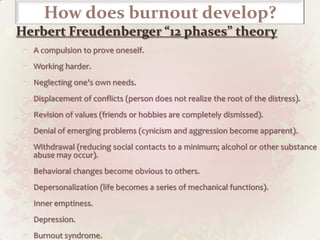
How does burnout develop?Herbert Freudenberger “12 phases” theoryA compulsion to prove oneself.Working harder. Neglecting one's own needs.Displacement of conflicts (person does not realize the root of the distress).Revision of values (friends or hobbies are completely dismissed).Denial of emerging problems (cynicism and aggression become apparent).Withdrawal (reducing social contacts to a minimum; alcohol or other substance abuse may occur).Behavioral changes become obvious to others.Depersonalization (life becomes a series of mechanical functions).Inner emptiness.Depression.Burnout syndrome.
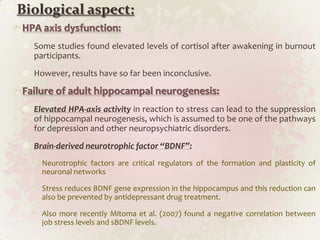
Biological aspect:HPA axis dysfunction:Some studies found elevated levels of cortisol after awakening in burnout participants.However, results have so far been inconclusive.Failure of adult hippocampal neurogenesis: Elevated HPA-axis activityin reaction to stress can lead to the suppression of hippocampal neurogenesis, which is assumed to be one of the pathways for depression and other neuropsychiatric disorders. Brain-derived neurotrophic factor “BDNF”:Neurotrophic factors are critical regulators of the formation and plasticity of neuronal networksStress reduces BDNF gene expression in the hippocampus and this reduction can also be prevented by antidepressant drug treatment.Also more recently Mitoma et al. (2007) found a negative correlation between job stress levels and sBDNF levels.
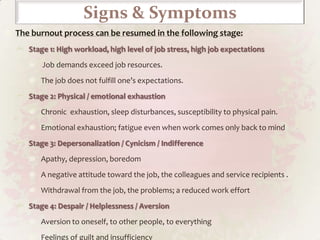
Signs & SymptomsThe burnout process can be resumed in the following stage: Stage 1: High workload, high level of job stress, high job expectations Job demands exceed job resources. The job does not fulfill one’s expectations. Stage 2: Physical / emotional exhaustion Chronic  exhaustion, sleep disturbances, susceptibility to physical pain. Emotional exhaustion; fatigue even when work comes only back to mind  Stage 3: Depersonalization / Cynicism / Indifference Apathy, depression, boredom A negative attitude toward the job, the colleagues and service recipients .Withdrawal from the job, the problems; a reduced work effort Stage 4: Despair / Helplessness / Aversion Aversion to oneself, to other people, to everything Feelings of guilt and insufficiency
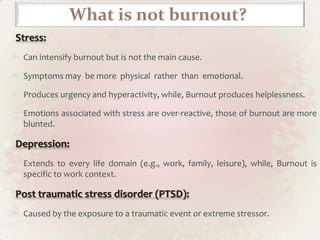
What is not burnout? Stress:Can intensify burnout but is not the main cause.Symptoms may  be more  physical  rather  than  emotional.Produces urgency and hyperactivity, while, Burnout produces helplessness.Emotions associated with stress are over-reactive, those of burnout are more blunted. Depression:Extends to every life domain (e.g., work, family, leisure), while, Burnout is specific to work context.Post traumatic stress disorder (PTSD): Caused by the exposure to a traumatic event or extreme stressor.

Burnout syndrome

  • 2.
    Try to imagineyourself and your work situationDo you feel overwhelmed with your work demands?
  • 3.
    Do you seemnot to receive enough support from the organization?
  • 4.
    Do you seemphysically exhausted and “wiped out”?
  • 5.
    Do you seemtired all the time?
  • 6.
    Do youseem careless in relationship to service recipients / patients?
  • 7.
    Do you reportfeelings of incompetence when doing work tasks?
  • 8.
    Do you seemfrustrated because of the work?
  • 9.
    Do you seemto have lost your enthusiasm for the job? People that are burned out report the followingIf you report the following“I’m frustrated. It’s getting impossible to do a good job, and the situation just keeps getting worse.”
  • 10.
    “I have lostmy enthusiasm for work I really liked.”
  • 11.
    “I’m feeling overwhelmed,overloaded, overworked and trapped. There’s no way out.”You might susceptible for or might even experience
  • 12.
    Burnout SyndromeBy MohamedAbdelghaniSpecialist Of Psychiatry
  • 14.
    DefinitionA psychological complexphenomenon related to stressful working environment, long-term exhaustion and diminished interest. First coined by Herbert Freudenbergerin his 1974 Staff burnout, based on the 1960 novel A Burnt-Out Caseby Graham Greene.According to Maslach; Burnout syndrome is characterized by three dimensions: 1) Emotional exhaustion (depletion of emotional resources to contact with other people, feelings of frustration, anger and dissatisfaction). 2) Depersonalization (negative feelings and dehumanization of the relationships with the persons who expect personal “investment”). 3) Reduced personal accomplishment (a tendency to evaluate oneself negatively, particularly with regard to work).
  • 15.
    Outcome of BurnoutSyndromeOn organizational level:Reduced job performance and organizational commitment. Higher intention to leave the job.On individual level: Health related outcomes (increases in stress hormones, coronary heart disease, circulatory issues). Mental health problems (depression, etc.).Excessive absenteeism, inordinate use of sick leave, wish to leave the job and decrease to overall well-being.
  • 17.
    How does burnoutdevelop?Herbert Freudenberger “12 phases” theoryA compulsion to prove oneself.Working harder. Neglecting one's own needs.Displacement of conflicts (person does not realize the root of the distress).Revision of values (friends or hobbies are completely dismissed).Denial of emerging problems (cynicism and aggression become apparent).Withdrawal (reducing social contacts to a minimum; alcohol or other substance abuse may occur).Behavioral changes become obvious to others.Depersonalization (life becomes a series of mechanical functions).Inner emptiness.Depression.Burnout syndrome.
  • 18.
    Biological aspect:HPA axisdysfunction:Some studies found elevated levels of cortisol after awakening in burnout participants.However, results have so far been inconclusive.Failure of adult hippocampal neurogenesis: Elevated HPA-axis activityin reaction to stress can lead to the suppression of hippocampal neurogenesis, which is assumed to be one of the pathways for depression and other neuropsychiatric disorders. Brain-derived neurotrophic factor “BDNF”:Neurotrophic factors are critical regulators of the formation and plasticity of neuronal networksStress reduces BDNF gene expression in the hippocampus and this reduction can also be prevented by antidepressant drug treatment.Also more recently Mitoma et al. (2007) found a negative correlation between job stress levels and sBDNF levels.
  • 20.
    Signs & SymptomsTheburnout process can be resumed in the following stage: Stage 1: High workload, high level of job stress, high job expectations Job demands exceed job resources. The job does not fulfill one’s expectations. Stage 2: Physical / emotional exhaustion Chronic exhaustion, sleep disturbances, susceptibility to physical pain. Emotional exhaustion; fatigue even when work comes only back to mind Stage 3: Depersonalization / Cynicism / Indifference Apathy, depression, boredom A negative attitude toward the job, the colleagues and service recipients .Withdrawal from the job, the problems; a reduced work effort Stage 4: Despair / Helplessness / Aversion Aversion to oneself, to other people, to everything Feelings of guilt and insufficiency
  • 21.
    What is notburnout? Stress:Can intensify burnout but is not the main cause.Symptoms may be more physical rather than emotional.Produces urgency and hyperactivity, while, Burnout produces helplessness.Emotions associated with stress are over-reactive, those of burnout are more blunted. Depression:Extends to every life domain (e.g., work, family, leisure), while, Burnout is specific to work context.Post traumatic stress disorder (PTSD): Caused by the exposure to a traumatic event or extreme stressor.
  • 23.
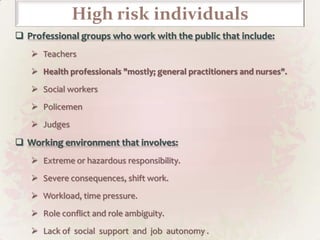
    High risk individualsProfessionalgroups who work with the public that include:
  • 24.
  • 25.
    Health professionals "mostly;general practitioners and nurses".
  • 26.
  • 27.
  • 28.
  • 29.
  • 30.
    Extreme or hazardousresponsibility.
  • 31.
  • 32.
  • 33.
    Role conflict androle ambiguity.
  • 34.
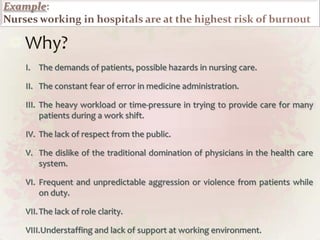
    Lack of social support and job autonomy .Example: Nurses working in hospitals are at the highest risk of burnoutWhy?The demands of patients, possible hazards in nursing care.The constant fear of error in medicine administration.The heavy workload or time-pressure in trying to provide care for many patients during a work shift.The lack of respect from the public. The dislike of the traditional domination of physicians in the health care system. Frequent and unpredictable aggression or violence from patients while on duty. The lack of role clarity. Understaffing and lack of support at working environment.
  • 36.
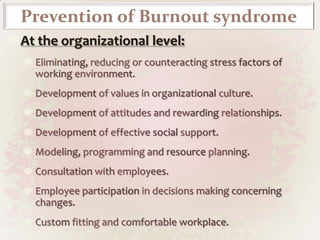
    Prevention of BurnoutsyndromeAt the organizational level:Eliminating, reducing or counteracting stress factors of working environment.Development of values in organizational culture. Development of attitudes and rewarding relationships. Development of effective social support. Modeling, programming and resource planning. Consultation with employees. Employee participation in decisions making concerning changes. Custom fitting and comfortable workplace.
  • 37.
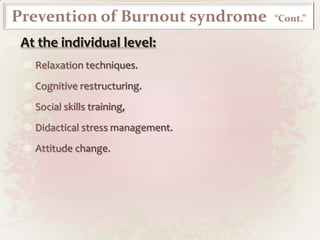
    Prevention of Burnoutsyndrome “cont.”Prevention of Burnout syndrome “Cont.”At the individual level:Relaxation techniques.Cognitive restructuring. Social skills training, Didactical stress management. Attitude change.
  • 38.
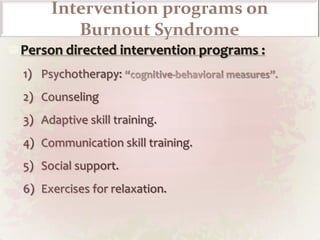
    Intervention programs onBurnout SyndromePerson directed intervention programs :Psychotherapy: “cognitive-behavioral measures”.Counseling Adaptive skill training. Communication skill training. Social support.Exercises for relaxation.
  • 39.
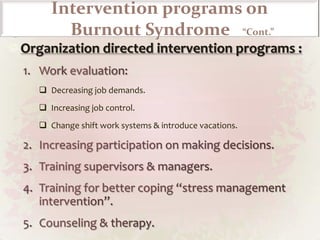
    Intervention programs onburnout syndrome “cont.”:Intervention programs on Burnout Syndrome “Cont.”Organization directed intervention programs :Work evaluation:Decreasing job demands.
  • 40.
  • 41.
    Change shift worksystems & introduce vacations.Increasing participation on making decisions.Training supervisors & managers.Training for better coping “stress management intervention”.Counseling & therapy.