1
Pharmacological Management
of
Bipolar Disorder
By :-
Saurabh Jaiswal
PG-JR2, Psychiatry
2
Mood is a pervasive and sustained feeling tone that is experienced internally and
that influences a person's behaviour and perception of the world.
Affect is the external expression of mood. Mood can be normal, elevated, or
depressed.
Mood disorders are a group of clinical conditions characterized by a loss of that
sense of control and a subjective experience of great distress.
Patients with elevated mood demonstrate expansiveness, flight of ideas,
decreased sleep, and grandiose ideas. Patients with depressed mood experience a
loss of energy and interest, feelings of guilt, difficulty in concentrating, loss of
appetite, and thoughts of death or suicide. Other signs and symptoms of mood
disorders include change in activity level, cognitive abilities, speech, and
vegetative functions .
Patients afflicted with only major depressive episodes are said to have major
depressive disorder or unipolar depression. Patients with both manic and
depressive episodes or patients with manic episodes alone are said to have
bipolar disorder.
INTRODUCTION
3
Bipolar I Disorder:
The DSM-IV-TR criteria for a manic episode requires the presence of a distinct
period of abnormal mood lasting at least 1 week and includes separate bipolar I
disorder diagnoses for a single manic episode and a recurrent episode, based on
the symptoms of the most recent episode .
The designation bipolar I disorder is synonymous with what was formerly known
as bipolar disorder, a syndrome in which a complete set of mania symptoms
occurs during the course of the disorder.
4
Bipolar II Disorder:
The diagnostic criteria for bipolar II disorder is characterized by depressive
episodes and hypomanic episodes during the course of the disorder, but the
episodes of manic-like symptoms do not quite meet the diagnostic criteria for a
full manic syndrome.
Evidence also indicates that patients with bipolar II disorder are at greater risk of
both attempting and completing suicide than patients with bipolar I disorder and
major depressive disorder.
Manic episodes clearly precipitated by antidepressant treatment (e.g.,
pharmacotherapy, electroconvulsive therapy [ECT]) indicate bipolar III disorder.
5
Evolving Spectrum of Bipolar Disorders by Akiskal:
Bipolar 1/2: Schizobipolar disorder
Bipolar I: Core manic-depressive illness
Bipolar I1/2: Depression with protracted hypomania
Bipolar II: Depression with discrete spontaneous hypomanic episodes
Bipolar II1/2: Depression superimposed on cyclothymic temperament
Bipolar III: Depression plus induced hypomania (i.e., hypomania occurring
solely in association with antidepressant or other somatic treatment)
Bipolar III1/2: Prominent mood swings occurring in the context of
substance or alcohol use or abuse
Bipolar IV: Depression superimposed on a hyperthymic temperament
6
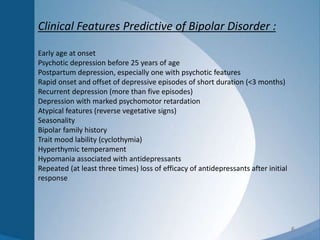
Clinical Features Predictive of Bipolar Disorder :
Early age at onset
Psychotic depression before 25 years of age
Postpartum depression, especially one with psychotic features
Rapid onset and offset of depressive episodes of short duration (<3 months)
Recurrent depression (more than five episodes)
Depression with marked psychomotor retardation
Atypical features (reverse vegetative signs)
Seasonality
Bipolar family history
Trait mood lability (cyclothymia)
Hyperthymic temperament
Hypomania associated with antidepressants
Repeated (at least three times) loss of efficacy of antidepressants after initial
response
7
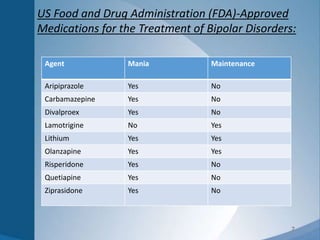
US Food and Drug Administration (FDA)-Approved
Medications for the Treatment of Bipolar Disorders:
Agent Mania Maintenance
Aripiprazole Yes No
Carbamazepine Yes No
Divalproex Yes No
Lamotrigine No Yes
Lithium Yes Yes
Olanzapine Yes Yes
Risperidone Yes No
Quetiapine Yes No
Ziprasidone Yes No
8
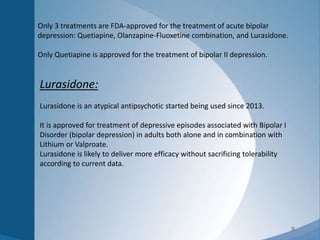
Lurasidone:
Lurasidone is an atypical antipsychotic started being used since 2013.
It is approved for treatment of depressive episodes associated with Bipolar I
Disorder (bipolar depression) in adults both alone and in combination with
Lithium or Valproate.
Lurasidone is likely to deliver more efficacy without sacrificing tolerability
according to current data.
Only 3 treatments are FDA-approved for the treatment of acute bipolar
depression: Quetiapine, Olanzapine-Fluoxetine combination, and Lurasidone.
Only Quetiapine is approved for the treatment of bipolar II depression.
9
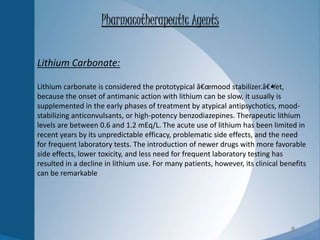
Lithium Carbonate:
Lithium carbonate is considered the prototypical รขโ‚ฌล“mood stabilizer.รขโ‚ฌโ€ขYet,
because the onset of antimanic action with lithium can be slow, it usually is
supplemented in the early phases of treatment by atypical antipsychotics, mood-
stabilizing anticonvulsants, or high-potency benzodiazepines. Therapeutic lithium
levels are between 0.6 and 1.2 mEq/L. The acute use of lithium has been limited in
recent years by its unpredictable efficacy, problematic side effects, and the need
for frequent laboratory tests. The introduction of newer drugs with more favorable
side effects, lower toxicity, and less need for frequent laboratory testing has
resulted in a decline in lithium use. For many patients, however, its clinical benefits
can be remarkable
Pharmacotherapeutic Agents
10
Valproate:
Valproate (valproic acid or divalproex sodium ) has surpassed lithium in use for
acute mania. Unlike lithium, Valproate is only indicated for acute mania, although
most experts agree it also has prophylactic effects. Typical dose levels of valproic
acid are 750 to 2,500 mg per day, achieving blood levels between 50 and 120
ยตg/mL. Rapid oral loading with 15 to 20 mg/kg of divalproex sodium from day 1 of
treatment has been well tolerated and associated with a rapid onset of response.
A number of laboratory tests are required during valproate treatment.
11
Carbamazepine and Oxcarbazepine:
Carbamazepine has been used worldwide for decades as a first-line treatment for
acute mania, but has only gained approval in the United States in 2004. Typical
doses of carbamazepine to treat acute mania range between 600 and 1,800 mg
per day associated with blood levels of between 4 and 12 ยตg/mL. The keto
congener of carbamazepine, oxcarbazepine, may possess similar antimanic
properties. Higher doses than those of carbamazepine are required, because
1,500 mg of oxcarbazepine approximates 1,000 mg of carbamazepine
12
Clonazepam and Lorazepam:
The high-potency benzodiazepine anticonvulsants used in acute mania include
clonazepam and lorazepam . Both may be effective and are widely used for
adjunctive treatment of acute manic agitation, insomnia, aggression, and
dysphoria, as well as panic. The safety and the benign side effect profile of these
agents render them ideal adjuncts to lithium, carbamazepine, or valproate.
13
Atypical and Typical Antipsychotics:
All of the atypical antipsychotics :โ€olanzapine, risperidone, quetiapine,
ziprasidone, and aripiprazoleโ€ have demonstrated antimanic efficacy and are FDA
approved for this indication. Compared with older agents, such as haloperidol
and chlorpromazine , atypical antipsychotics have a lesser liability for excitatory
postsynaptic potential and tardive dyskinesia; many do not increase prolactin.
However, they have a wide range of substantial to no risk for weight gain with its
associated problems of insulin resistance, diabetes, hyperlipidemia,
hypercholesteremia, and cardiovascular impairment. Some patients, however,
require maintenance treatment with an antipsychotic medication.
14
Treatment Options
Goals of Treatment
โ€ข Control symptoms to allow a return to usual levels of psychosocial
functioning.
โ€ข Rapidly control agitation, aggression, and impulsivity.
1. Acute Manic or Mixed Episodes
15
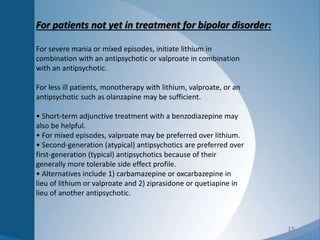
For patients not yet in treatment for bipolar disorder:
For severe mania or mixed episodes, initiate lithium in
combination with an antipsychotic or valproate in combination
with an antipsychotic.
For less ill patients, monotherapy with lithium, valproate, or an
antipsychotic such as olanzapine may be sufficient.
โ€ข Short-term adjunctive treatment with a benzodiazepine may
also be helpful.
โ€ข For mixed episodes, valproate may be preferred over lithium.
โ€ข Second-generation (atypical) antipsychotics are preferred over
first-generation (typical) antipsychotics because of their
generally more tolerable side effect profile.
โ€ข Alternatives include 1) carbamazepine or oxcarbazepine in
lieu of lithium or valproate and 2) ziprasidone or quetiapine in
lieu of another antipsychotic.
16
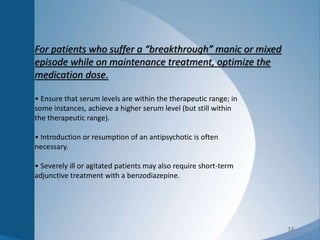
For patients who suffer a โ€œbreakthroughโ€ manic or mixed
episode while on maintenance treatment, optimize the
medication dose.
โ€ข Ensure that serum levels are within the therapeutic range; in
some instances, achieve a higher serum level (but still within
the therapeutic range).
โ€ข Introduction or resumption of an antipsychotic is often
necessary.
โ€ข Severely ill or agitated patients may also require short-term
adjunctive treatment with a benzodiazepine.
17
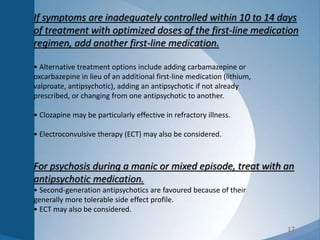
If symptoms are inadequately controlled within 10 to 14 days
of treatment with optimized doses of the first-line medication
regimen, add another first-line medication.
โ€ข Alternative treatment options include adding carbamazepine or
oxcarbazepine in lieu of an additional first-line medication (lithium,
valproate, antipsychotic), adding an antipsychotic if not already
prescribed, or changing from one antipsychotic to another.
โ€ข Clozapine may be particularly effective in refractory illness.
โ€ข Electroconvulsive therapy (ECT) may also be considered.
For psychosis during a manic or mixed episode, treat with an
antipsychotic medication.
โ€ข Second-generation antipsychotics are favoured because of their
generally more tolerable side effect profile.
โ€ข ECT may also be considered.
18
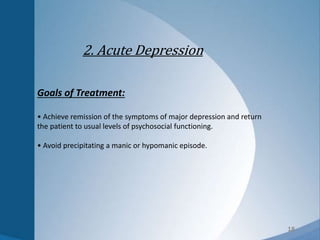
2. Acute Depression
Goals of Treatment:
โ€ข Achieve remission of the symptoms of major depression and return
the patient to usual levels of psychosocial functioning.
โ€ข Avoid precipitating a manic or hypomanic episode.
19
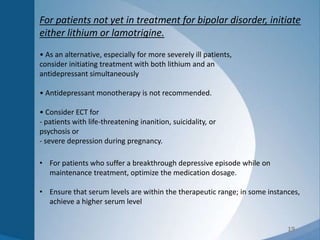
For patients not yet in treatment for bipolar disorder, initiate
either lithium or lamotrigine.
โ€ข As an alternative, especially for more severely ill patients,
consider initiating treatment with both lithium and an
antidepressant simultaneously
โ€ข Antidepressant monotherapy is not recommended.
โ€ข Consider ECT for
- patients with life-threatening inanition, suicidality, or
psychosis or
- severe depression during pregnancy.
โ€ข For patients who suffer a breakthrough depressive episode while on
maintenance treatment, optimize the medication dosage.
โ€ข Ensure that serum levels are within the therapeutic range; in some instances,
achieve a higher serum level
20
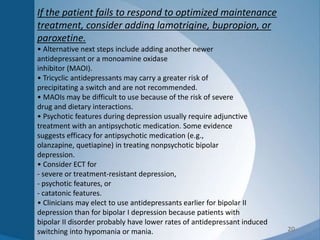
If the patient fails to respond to optimized maintenance
treatment, consider adding lamotrigine, bupropion, or
paroxetine.
โ€ข Alternative next steps include adding another newer
antidepressant or a monoamine oxidase
inhibitor (MAOI).
โ€ข Tricyclic antidepressants may carry a greater risk of
precipitating a switch and are not recommended.
โ€ข MAOIs may be difficult to use because of the risk of severe
drug and dietary interactions.
โ€ข Psychotic features during depression usually require adjunctive
treatment with an antipsychotic medication. Some evidence
suggests efficacy for antipsychotic medication (e.g.,
olanzapine, quetiapine) in treating nonpsychotic bipolar
depression.
โ€ข Consider ECT for
- severe or treatment-resistant depression,
- psychotic features, or
- catatonic features.
โ€ข Clinicians may elect to use antidepressants earlier for bipolar II
depression than for bipolar I depression because patients with
bipolar II disorder probably have lower rates of antidepressant induced
switching into hypomania or mania.
21
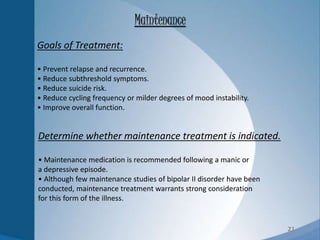
Maintenance
Goals of Treatment:
โ€ข Prevent relapse and recurrence.
โ€ข Reduce subthreshold symptoms.
โ€ข Reduce suicide risk.
โ€ข Reduce cycling frequency or milder degrees of mood instability.
โ€ข Improve overall function.
Determine whether maintenance treatment is indicated.
โ€ข Maintenance medication is recommended following a manic or
a depressive episode.
โ€ข Although few maintenance studies of bipolar II disorder have been
conducted, maintenance treatment warrants strong consideration
for this form of the illness.
22
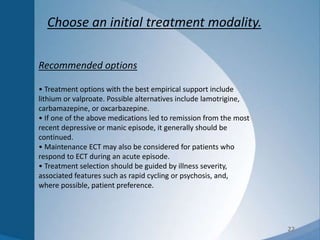
Choose an initial treatment modality.
Recommended options
โ€ข Treatment options with the best empirical support include
lithium or valproate. Possible alternatives include lamotrigine,
carbamazepine, or oxcarbazepine.
โ€ข If one of the above medications led to remission from the most
recent depressive or manic episode, it generally should be
continued.
โ€ข Maintenance ECT may also be considered for patients who
respond to ECT during an acute episode.
โ€ข Treatment selection should be guided by illness severity,
associated features such as rapid cycling or psychosis, and,
where possible, patient preference.
23
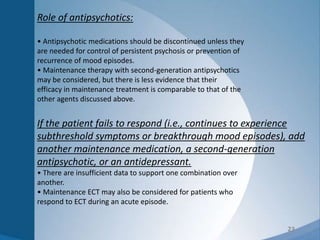
Role of antipsychotics:
โ€ข Antipsychotic medications should be discontinued unless they
are needed for control of persistent psychosis or prevention of
recurrence of mood episodes.
โ€ข Maintenance therapy with second-generation antipsychotics
may be considered, but there is less evidence that their
efficacy in maintenance treatment is comparable to that of the
other agents discussed above.
If the patient fails to respond (i.e., continues to experience
subthreshold symptoms or breakthrough mood episodes), add
another maintenance medication, a second-generation
antipsychotic, or an antidepressant.
โ€ข There are insufficient data to support one combination over
another.
โ€ข Maintenance ECT may also be considered for patients who
respond to ECT during an acute episode.
24

Bipolar disorder

  • 1.
    1 Pharmacological Management of Bipolar Disorder By:- Saurabh Jaiswal PG-JR2, Psychiatry
  • 2.
    2 Mood is apervasive and sustained feeling tone that is experienced internally and that influences a person's behaviour and perception of the world. Affect is the external expression of mood. Mood can be normal, elevated, or depressed. Mood disorders are a group of clinical conditions characterized by a loss of that sense of control and a subjective experience of great distress. Patients with elevated mood demonstrate expansiveness, flight of ideas, decreased sleep, and grandiose ideas. Patients with depressed mood experience a loss of energy and interest, feelings of guilt, difficulty in concentrating, loss of appetite, and thoughts of death or suicide. Other signs and symptoms of mood disorders include change in activity level, cognitive abilities, speech, and vegetative functions . Patients afflicted with only major depressive episodes are said to have major depressive disorder or unipolar depression. Patients with both manic and depressive episodes or patients with manic episodes alone are said to have bipolar disorder. INTRODUCTION
  • 3.
    3 Bipolar I Disorder: TheDSM-IV-TR criteria for a manic episode requires the presence of a distinct period of abnormal mood lasting at least 1 week and includes separate bipolar I disorder diagnoses for a single manic episode and a recurrent episode, based on the symptoms of the most recent episode . The designation bipolar I disorder is synonymous with what was formerly known as bipolar disorder, a syndrome in which a complete set of mania symptoms occurs during the course of the disorder.
  • 4.
    4 Bipolar II Disorder: Thediagnostic criteria for bipolar II disorder is characterized by depressive episodes and hypomanic episodes during the course of the disorder, but the episodes of manic-like symptoms do not quite meet the diagnostic criteria for a full manic syndrome. Evidence also indicates that patients with bipolar II disorder are at greater risk of both attempting and completing suicide than patients with bipolar I disorder and major depressive disorder. Manic episodes clearly precipitated by antidepressant treatment (e.g., pharmacotherapy, electroconvulsive therapy [ECT]) indicate bipolar III disorder.
  • 5.
    5 Evolving Spectrum ofBipolar Disorders by Akiskal: Bipolar 1/2: Schizobipolar disorder Bipolar I: Core manic-depressive illness Bipolar I1/2: Depression with protracted hypomania Bipolar II: Depression with discrete spontaneous hypomanic episodes Bipolar II1/2: Depression superimposed on cyclothymic temperament Bipolar III: Depression plus induced hypomania (i.e., hypomania occurring solely in association with antidepressant or other somatic treatment) Bipolar III1/2: Prominent mood swings occurring in the context of substance or alcohol use or abuse Bipolar IV: Depression superimposed on a hyperthymic temperament
  • 6.
    6 Clinical Features Predictiveof Bipolar Disorder : Early age at onset Psychotic depression before 25 years of age Postpartum depression, especially one with psychotic features Rapid onset and offset of depressive episodes of short duration (<3 months) Recurrent depression (more than five episodes) Depression with marked psychomotor retardation Atypical features (reverse vegetative signs) Seasonality Bipolar family history Trait mood lability (cyclothymia) Hyperthymic temperament Hypomania associated with antidepressants Repeated (at least three times) loss of efficacy of antidepressants after initial response
  • 7.
    7 US Food andDrug Administration (FDA)-Approved Medications for the Treatment of Bipolar Disorders: Agent Mania Maintenance Aripiprazole Yes No Carbamazepine Yes No Divalproex Yes No Lamotrigine No Yes Lithium Yes Yes Olanzapine Yes Yes Risperidone Yes No Quetiapine Yes No Ziprasidone Yes No
  • 8.
    8 Lurasidone: Lurasidone is anatypical antipsychotic started being used since 2013. It is approved for treatment of depressive episodes associated with Bipolar I Disorder (bipolar depression) in adults both alone and in combination with Lithium or Valproate. Lurasidone is likely to deliver more efficacy without sacrificing tolerability according to current data. Only 3 treatments are FDA-approved for the treatment of acute bipolar depression: Quetiapine, Olanzapine-Fluoxetine combination, and Lurasidone. Only Quetiapine is approved for the treatment of bipolar II depression.
  • 9.
    9 Lithium Carbonate: Lithium carbonateis considered the prototypical รขโ‚ฌล“mood stabilizer.รขโ‚ฌโ€ขYet, because the onset of antimanic action with lithium can be slow, it usually is supplemented in the early phases of treatment by atypical antipsychotics, mood- stabilizing anticonvulsants, or high-potency benzodiazepines. Therapeutic lithium levels are between 0.6 and 1.2 mEq/L. The acute use of lithium has been limited in recent years by its unpredictable efficacy, problematic side effects, and the need for frequent laboratory tests. The introduction of newer drugs with more favorable side effects, lower toxicity, and less need for frequent laboratory testing has resulted in a decline in lithium use. For many patients, however, its clinical benefits can be remarkable Pharmacotherapeutic Agents
  • 10.
    10 Valproate: Valproate (valproic acidor divalproex sodium ) has surpassed lithium in use for acute mania. Unlike lithium, Valproate is only indicated for acute mania, although most experts agree it also has prophylactic effects. Typical dose levels of valproic acid are 750 to 2,500 mg per day, achieving blood levels between 50 and 120 ยตg/mL. Rapid oral loading with 15 to 20 mg/kg of divalproex sodium from day 1 of treatment has been well tolerated and associated with a rapid onset of response. A number of laboratory tests are required during valproate treatment.
  • 11.
    11 Carbamazepine and Oxcarbazepine: Carbamazepinehas been used worldwide for decades as a first-line treatment for acute mania, but has only gained approval in the United States in 2004. Typical doses of carbamazepine to treat acute mania range between 600 and 1,800 mg per day associated with blood levels of between 4 and 12 ยตg/mL. The keto congener of carbamazepine, oxcarbazepine, may possess similar antimanic properties. Higher doses than those of carbamazepine are required, because 1,500 mg of oxcarbazepine approximates 1,000 mg of carbamazepine
  • 12.
    12 Clonazepam and Lorazepam: Thehigh-potency benzodiazepine anticonvulsants used in acute mania include clonazepam and lorazepam . Both may be effective and are widely used for adjunctive treatment of acute manic agitation, insomnia, aggression, and dysphoria, as well as panic. The safety and the benign side effect profile of these agents render them ideal adjuncts to lithium, carbamazepine, or valproate.
  • 13.
    13 Atypical and TypicalAntipsychotics: All of the atypical antipsychotics :โ€olanzapine, risperidone, quetiapine, ziprasidone, and aripiprazoleโ€ have demonstrated antimanic efficacy and are FDA approved for this indication. Compared with older agents, such as haloperidol and chlorpromazine , atypical antipsychotics have a lesser liability for excitatory postsynaptic potential and tardive dyskinesia; many do not increase prolactin. However, they have a wide range of substantial to no risk for weight gain with its associated problems of insulin resistance, diabetes, hyperlipidemia, hypercholesteremia, and cardiovascular impairment. Some patients, however, require maintenance treatment with an antipsychotic medication.
  • 14.
    14 Treatment Options Goals ofTreatment โ€ข Control symptoms to allow a return to usual levels of psychosocial functioning. โ€ข Rapidly control agitation, aggression, and impulsivity. 1. Acute Manic or Mixed Episodes
  • 15.
    15 For patients notyet in treatment for bipolar disorder: For severe mania or mixed episodes, initiate lithium in combination with an antipsychotic or valproate in combination with an antipsychotic. For less ill patients, monotherapy with lithium, valproate, or an antipsychotic such as olanzapine may be sufficient. โ€ข Short-term adjunctive treatment with a benzodiazepine may also be helpful. โ€ข For mixed episodes, valproate may be preferred over lithium. โ€ข Second-generation (atypical) antipsychotics are preferred over first-generation (typical) antipsychotics because of their generally more tolerable side effect profile. โ€ข Alternatives include 1) carbamazepine or oxcarbazepine in lieu of lithium or valproate and 2) ziprasidone or quetiapine in lieu of another antipsychotic.
  • 16.
    16 For patients whosuffer a โ€œbreakthroughโ€ manic or mixed episode while on maintenance treatment, optimize the medication dose. โ€ข Ensure that serum levels are within the therapeutic range; in some instances, achieve a higher serum level (but still within the therapeutic range). โ€ข Introduction or resumption of an antipsychotic is often necessary. โ€ข Severely ill or agitated patients may also require short-term adjunctive treatment with a benzodiazepine.
  • 17.
    17 If symptoms areinadequately controlled within 10 to 14 days of treatment with optimized doses of the first-line medication regimen, add another first-line medication. โ€ข Alternative treatment options include adding carbamazepine or oxcarbazepine in lieu of an additional first-line medication (lithium, valproate, antipsychotic), adding an antipsychotic if not already prescribed, or changing from one antipsychotic to another. โ€ข Clozapine may be particularly effective in refractory illness. โ€ข Electroconvulsive therapy (ECT) may also be considered. For psychosis during a manic or mixed episode, treat with an antipsychotic medication. โ€ข Second-generation antipsychotics are favoured because of their generally more tolerable side effect profile. โ€ข ECT may also be considered.
  • 18.
    18 2. Acute Depression Goalsof Treatment: โ€ข Achieve remission of the symptoms of major depression and return the patient to usual levels of psychosocial functioning. โ€ข Avoid precipitating a manic or hypomanic episode.
  • 19.
    19 For patients notyet in treatment for bipolar disorder, initiate either lithium or lamotrigine. โ€ข As an alternative, especially for more severely ill patients, consider initiating treatment with both lithium and an antidepressant simultaneously โ€ข Antidepressant monotherapy is not recommended. โ€ข Consider ECT for - patients with life-threatening inanition, suicidality, or psychosis or - severe depression during pregnancy. โ€ข For patients who suffer a breakthrough depressive episode while on maintenance treatment, optimize the medication dosage. โ€ข Ensure that serum levels are within the therapeutic range; in some instances, achieve a higher serum level
  • 20.
    20 If the patientfails to respond to optimized maintenance treatment, consider adding lamotrigine, bupropion, or paroxetine. โ€ข Alternative next steps include adding another newer antidepressant or a monoamine oxidase inhibitor (MAOI). โ€ข Tricyclic antidepressants may carry a greater risk of precipitating a switch and are not recommended. โ€ข MAOIs may be difficult to use because of the risk of severe drug and dietary interactions. โ€ข Psychotic features during depression usually require adjunctive treatment with an antipsychotic medication. Some evidence suggests efficacy for antipsychotic medication (e.g., olanzapine, quetiapine) in treating nonpsychotic bipolar depression. โ€ข Consider ECT for - severe or treatment-resistant depression, - psychotic features, or - catatonic features. โ€ข Clinicians may elect to use antidepressants earlier for bipolar II depression than for bipolar I depression because patients with bipolar II disorder probably have lower rates of antidepressant induced switching into hypomania or mania.
  • 21.
    21 Maintenance Goals of Treatment: โ€ขPrevent relapse and recurrence. โ€ข Reduce subthreshold symptoms. โ€ข Reduce suicide risk. โ€ข Reduce cycling frequency or milder degrees of mood instability. โ€ข Improve overall function. Determine whether maintenance treatment is indicated. โ€ข Maintenance medication is recommended following a manic or a depressive episode. โ€ข Although few maintenance studies of bipolar II disorder have been conducted, maintenance treatment warrants strong consideration for this form of the illness.
  • 22.
    22 Choose an initialtreatment modality. Recommended options โ€ข Treatment options with the best empirical support include lithium or valproate. Possible alternatives include lamotrigine, carbamazepine, or oxcarbazepine. โ€ข If one of the above medications led to remission from the most recent depressive or manic episode, it generally should be continued. โ€ข Maintenance ECT may also be considered for patients who respond to ECT during an acute episode. โ€ข Treatment selection should be guided by illness severity, associated features such as rapid cycling or psychosis, and, where possible, patient preference.
  • 23.
    23 Role of antipsychotics: โ€ขAntipsychotic medications should be discontinued unless they are needed for control of persistent psychosis or prevention of recurrence of mood episodes. โ€ข Maintenance therapy with second-generation antipsychotics may be considered, but there is less evidence that their efficacy in maintenance treatment is comparable to that of the other agents discussed above. If the patient fails to respond (i.e., continues to experience subthreshold symptoms or breakthrough mood episodes), add another maintenance medication, a second-generation antipsychotic, or an antidepressant. โ€ข There are insufficient data to support one combination over another. โ€ข Maintenance ECT may also be considered for patients who respond to ECT during an acute episode.
  • 24.

Editor's Notes

  • #2ย Update on best practices for Managing Bipolar Depression by Gary S Sachs, Terence A. Ketter (CME Institute)
  • #3ย Update on best practices for Managing Bipolar Depression by Gary S Sachs, Terence A. Ketter (CME Institute)
  • #4ย Update on best practices for Managing Bipolar Depression by Gary S Sachs, Terence A. Ketter (CME Institute)
  • #5ย Update on best practices for Managing Bipolar Depression by Gary S Sachs, Terence A. Ketter (CME Institute)
  • #6ย Update on best practices for Managing Bipolar Depression by Gary S Sachs, Terence A. Ketter (CME Institute)
  • #7ย Update on best practices for Managing Bipolar Depression by Gary S Sachs, Terence A. Ketter (CME Institute)
  • #8ย Update on best practices for Managing Bipolar Depression by Gary S Sachs, Terence A. Ketter (CME Institute)
  • #9ย Update on best practices for Managing Bipolar Depression by Gary S Sachs, Terence A. Ketter (CME Institute)
  • #10ย Update on best practices for Managing Bipolar Depression by Gary S Sachs, Terence A. Ketter (CME Institute)
  • #11ย Update on best practices for Managing Bipolar Depression by Gary S Sachs, Terence A. Ketter (CME Institute)
  • #12ย Update on best practices for Managing Bipolar Depression by Gary S Sachs, Terence A. Ketter (CME Institute)
  • #13ย Update on best practices for Managing Bipolar Depression by Gary S Sachs, Terence A. Ketter (CME Institute)
  • #14ย Update on best practices for Managing Bipolar Depression by Gary S Sachs, Terence A. Ketter (CME Institute)
  • #15ย Update on best practices for Managing Bipolar Depression by Gary S Sachs, Terence A. Ketter (CME Institute)
  • #16ย Update on best practices for Managing Bipolar Depression by Gary S Sachs, Terence A. Ketter (CME Institute)
  • #17ย Update on best practices for Managing Bipolar Depression by Gary S Sachs, Terence A. Ketter (CME Institute)
  • #18ย Update on best practices for Managing Bipolar Depression by Gary S Sachs, Terence A. Ketter (CME Institute)
  • #19ย Update on best practices for Managing Bipolar Depression by Gary S Sachs, Terence A. Ketter (CME Institute)
  • #20ย Update on best practices for Managing Bipolar Depression by Gary S Sachs, Terence A. Ketter (CME Institute)
  • #21ย Update on best practices for Managing Bipolar Depression by Gary S Sachs, Terence A. Ketter (CME Institute)
  • #22ย Update on best practices for Managing Bipolar Depression by Gary S Sachs, Terence A. Ketter (CME Institute)
  • #23ย Update on best practices for Managing Bipolar Depression by Gary S Sachs, Terence A. Ketter (CME Institute)
  • #24ย Update on best practices for Managing Bipolar Depression by Gary S Sachs, Terence A. Ketter (CME Institute)
  • #25ย Update on best practices for Managing Bipolar Depression by Gary S Sachs, Terence A. Ketter (CME Institute)