Environmental
biology
*biotic factors*
BY,
K.M.Bharthe
INTRODUCTION
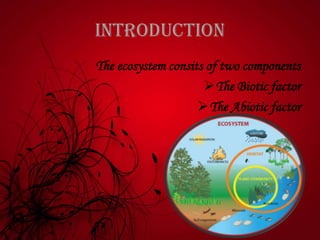
The ecosystem consits of two components
The Biotic factor
The Abiotic factor
INTRODUCTION
Let’s deal elaborately about Biotic factor.
The biotic factor deals with the interaction among
various living organisms.
Under natural conditions, organisms live together
influencing each other’s life directly or indirectly.
Vital processes such as Growth,Nuitrition and
Reproduction depend very much on this interactions.
Some examples of interactions are-
Pollination,grazing,Parasitism and Symbiosis.
Types of interactions
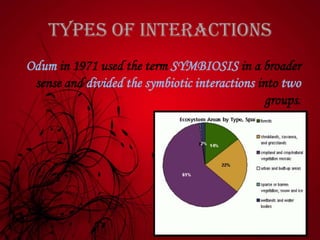
Odum in 1971 used the term SYMBIOSIS in a broader
sense and divided the symbiotic interactions into two
groups.
Now, Let’s deal about all its types one by one…
To start with, *Positive Interactions*
It is dived into two-
Mutualism and Commensalism.
*…Let’s journey into Mutualism…*
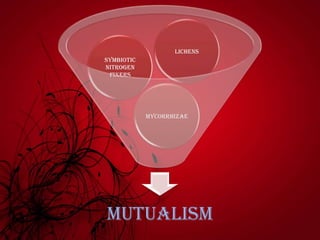
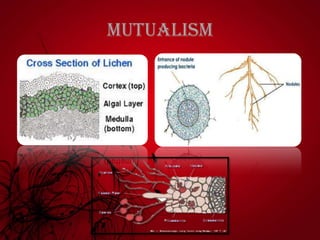
Mutualism
Mycorrhizae
Symbiotic
Nitrogen
fixers
Lichens
Mutualism
Here both the species derive benefit by entering into
some sort of physical exchange…
Symbiotic nitrogen fixers-
Bacterium Rhizobium forms nodules in the roots of
leguminous plants and lives Symbiotically.
The bacteria obtains nutrition from the plant and in
turn fixes nitrogen for it.
Mutualism
• Micorrhizae- It is a mutual association
between a fungus and root of higher plant.
• It may be divided into two…
• ECTOTROPHIC-where fungal hyphae are natural
substitutes for root hairs absorbing water and
nutrients from the soil. Eg: Pines and Oakes.
• ENDOTROPHIC-where fungi occur internal to root
tissue. Eg: Orchids and members of Ericaceaehe.
Mutualism
• Lichens -
• The contact is close,permanent and obligatory.
• It is between fungi of group basidomycetes/Ascomycetes
and an algae of blue green species
• The body is made up of matrix formed by fungus within
which algae is embedded.
• The algae manufactures food and the fungus is concerned
with reproduction and making moisture and minerals
available.
• Neither two of it can grow independently alone.
• They are found abundantly on rock surfaces.
Mutualism
*…Let’s journey into Commensalism…*
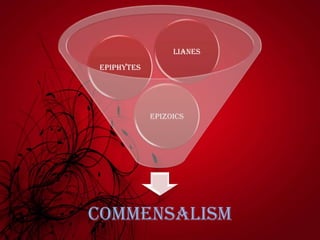
COMMENSALISM
Epizoics
Epiphytes
Lianes
Commensalism
It refers to association betwwen membes of different species only.
One is benefitted without any effect on the other.
LIANES-
 They are common in dense forests of moist tropical climates.
 They maintain no relationships with the trees upon which they
grow.
 On the basis of the type of device used for climbing their
support, They may be classified as LEANERS,THORN
LINANES, TWINERS and TENDRIL LINANES
 Eg: Species of Bauhinia, Ficus and Tinospora.
Commensalism
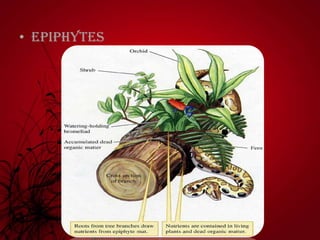
• Epiphytes-
They grow perched on other plants and use them only
as supporters and not for food or water supply.
They grow on trees,shrubs or larger submerged
plants,either on their trnks or leaves.
They differ from linanes in that they are not rooted
into the soil.
They are most common in tropical rain forsts.
Eg: Orchids, Usnea and Alectoria.
• Epiphytes
Commensalism
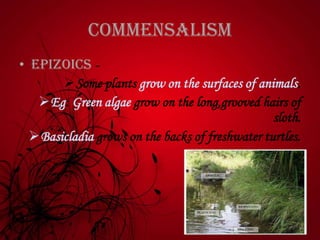
• Epizoics -
Some plants grow on the surfaces of animals.
Eg: Green algae grow on the long,grooved hairs of
sloth.
Basicladia grows on the backs of freshwater turtles.
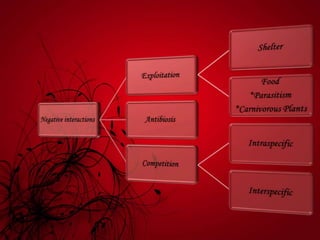
Lets continue with, *Negative interactions*
It is dived into three-
Exploitation ,Antibiosis and Competition.
*…Let’s journey into Exploitation…*
Exploitation
Here one species harms the other by making its direct
or indirect use for support, shelter or food… Thus it
may be in respect of shelter or food.
Shelter-
The Parasitic birds like cuckoo and cowbird never
build their own nests and female lays eggs in the
nests established by birds of another usually small
species.
Exploitation
Food-
The various relationships in respect of food belong to:
1. Parasitism-
• A parasite is an organism living on or in the body of
another organism and deriving its food more or less
permanently from its tissues.
Parasitism Examples
Cuscuta, a vascular plant grows on other plants by
twining its young stem around the host stem from
which adventitious roots develop that finally
penetrate through the stem of the host, establishing
relationship with its conducting elements.
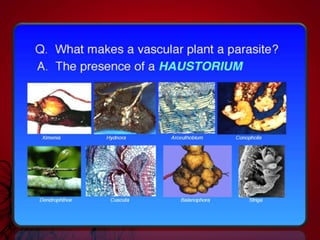
These specialized roots are called haustoria.
They depend on the host for food and nourishment
Parasitism Examples
Orabanche and Epifagus are found on roots of higher
plants.
Rafflesia is found on the roots of vitis.
Viscum album and Loranthus sp are partial stem
parasites. They grow rooted in branches of host trees.
Santalum album is a partial stem parasite. Their roots are
attached to host plants.
Majority of parasites are microorganisms of which
fungi,bacteria,mycoplasmas,rickettsias and virus parasite
plants as well as animals.
Exploitation
Food-
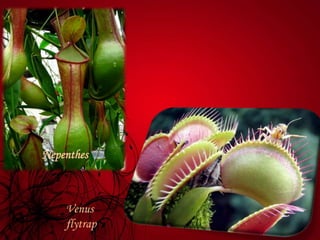
2.Carnivorous plants:
 A number of plants such as Nepenthes, Darlingtonia, Drosera,
Utricularia, Dionaea consume insects and other small animals for
their foods.
 They are also known as insectivorous plants.
 They are adapted in remarkable ways to attract,catch and digest
their victims.
 Their leaves or foliar appendages produce proteolytic enzymes for

digestion of the insects.
 The carnivorus habitat in plants is said to be an incidental feature of
their nutrition, since they posses green leaves and carry out


photosynthesis.
Nepenthes
Venus
flytrap
*…Let’s journey into Antibiosis…*
Antibiosis
• The term ANTIBIOSIS refers to the complete or partial
inhibition or death of one organism by another through
the production of some substances or environmental
conditions as a result of metabolic pathways.
• Here none of them derives benefit.
• The phenomenon of antibiosis is much common among
microbial world.
• Production of chemicals that are antagonistic to
microbes- the ANTIBIOTICS is well known.
Antibiosis
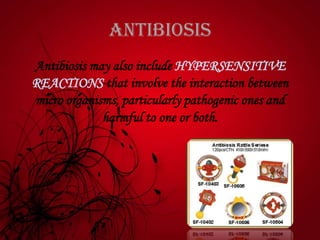
Antibiosis may also include HYPERSENSITIVE
REACTIONS that involve the interaction between
micro organisms, particularly pathogenic ones and
harmful to one or both.
Antibiosis
Bacteria, actinomycetes and fungi produce numerous
antimicrobial substances that are wide spread in
nature.
Antagonistic substances are also reported in some
algae. Eg: Chlorella vulgaris inhibits the growth of
diatom, Nitxschia frustrulum.
Microcystis,a blue green algae produces hyroxylamine,
a toxin, which causes death of fish and cattle.
*…Let’s journey into Competition…*
competition
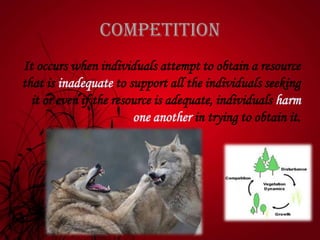
It occurs when individuals attempt to obtain a resource
that is inadequate to support all the individuals seeking
it or even if the resource is adequate, individuals harm
one another in trying to obtain it.
competition
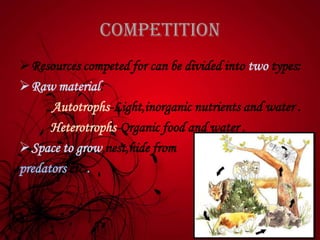
Resources competed for can be divided into two types:
Raw material:
Autotrophs-Light,inorganic nutrients and water .
Heterotrophs-Organic food and water .
Space to grow,nest,hide from
predators etc..
competition
It may be
INTRASPECIFIC: Occuring between members of
same species of the population
IntERSPECIFIC: Occuring between different
species of a population but of the same trophic level.
If we work together, we can achieve our goal of living
in an environment-friendly and green atmosphere.
Thanks
for
watching

Biotic factors

  • 1.
  • 2.
    INTRODUCTION The ecosystem consitsof two components The Biotic factor The Abiotic factor
  • 3.
    INTRODUCTION Let’s deal elaboratelyabout Biotic factor. The biotic factor deals with the interaction among various living organisms. Under natural conditions, organisms live together influencing each other’s life directly or indirectly. Vital processes such as Growth,Nuitrition and Reproduction depend very much on this interactions. Some examples of interactions are- Pollination,grazing,Parasitism and Symbiosis.
  • 4.
    Types of interactions Odumin 1971 used the term SYMBIOSIS in a broader sense and divided the symbiotic interactions into two groups.
  • 6.
    Now, Let’s dealabout all its types one by one… To start with, *Positive Interactions* It is dived into two- Mutualism and Commensalism. *…Let’s journey into Mutualism…*
  • 7.
  • 8.
    Mutualism Here both thespecies derive benefit by entering into some sort of physical exchange… Symbiotic nitrogen fixers- Bacterium Rhizobium forms nodules in the roots of leguminous plants and lives Symbiotically. The bacteria obtains nutrition from the plant and in turn fixes nitrogen for it.
  • 9.
    Mutualism • Micorrhizae- Itis a mutual association between a fungus and root of higher plant. • It may be divided into two… • ECTOTROPHIC-where fungal hyphae are natural substitutes for root hairs absorbing water and nutrients from the soil. Eg: Pines and Oakes. • ENDOTROPHIC-where fungi occur internal to root tissue. Eg: Orchids and members of Ericaceaehe.
  • 10.
    Mutualism • Lichens - •The contact is close,permanent and obligatory. • It is between fungi of group basidomycetes/Ascomycetes and an algae of blue green species • The body is made up of matrix formed by fungus within which algae is embedded. • The algae manufactures food and the fungus is concerned with reproduction and making moisture and minerals available. • Neither two of it can grow independently alone. • They are found abundantly on rock surfaces.
  • 11.
  • 12.
    *…Let’s journey intoCommensalism…*
  • 13.
  • 14.
    Commensalism It refers toassociation betwwen membes of different species only. One is benefitted without any effect on the other. LIANES-  They are common in dense forests of moist tropical climates.  They maintain no relationships with the trees upon which they grow.  On the basis of the type of device used for climbing their support, They may be classified as LEANERS,THORN LINANES, TWINERS and TENDRIL LINANES  Eg: Species of Bauhinia, Ficus and Tinospora.
  • 15.
    Commensalism • Epiphytes- They growperched on other plants and use them only as supporters and not for food or water supply. They grow on trees,shrubs or larger submerged plants,either on their trnks or leaves. They differ from linanes in that they are not rooted into the soil. They are most common in tropical rain forsts. Eg: Orchids, Usnea and Alectoria.
  • 16.
  • 17.
    Commensalism • Epizoics - Someplants grow on the surfaces of animals. Eg: Green algae grow on the long,grooved hairs of sloth. Basicladia grows on the backs of freshwater turtles.
  • 19.
    Lets continue with,*Negative interactions* It is dived into three- Exploitation ,Antibiosis and Competition. *…Let’s journey into Exploitation…*
  • 20.
    Exploitation Here one speciesharms the other by making its direct or indirect use for support, shelter or food… Thus it may be in respect of shelter or food. Shelter- The Parasitic birds like cuckoo and cowbird never build their own nests and female lays eggs in the nests established by birds of another usually small species.
  • 21.
    Exploitation Food- The various relationshipsin respect of food belong to: 1. Parasitism- • A parasite is an organism living on or in the body of another organism and deriving its food more or less permanently from its tissues.
  • 22.
    Parasitism Examples Cuscuta, avascular plant grows on other plants by twining its young stem around the host stem from which adventitious roots develop that finally penetrate through the stem of the host, establishing relationship with its conducting elements. These specialized roots are called haustoria. They depend on the host for food and nourishment
  • 24.
    Parasitism Examples Orabanche andEpifagus are found on roots of higher plants. Rafflesia is found on the roots of vitis. Viscum album and Loranthus sp are partial stem parasites. They grow rooted in branches of host trees. Santalum album is a partial stem parasite. Their roots are attached to host plants. Majority of parasites are microorganisms of which fungi,bacteria,mycoplasmas,rickettsias and virus parasite plants as well as animals.
  • 25.
    Exploitation Food- 2.Carnivorous plants:  Anumber of plants such as Nepenthes, Darlingtonia, Drosera, Utricularia, Dionaea consume insects and other small animals for their foods.  They are also known as insectivorous plants.  They are adapted in remarkable ways to attract,catch and digest their victims.  Their leaves or foliar appendages produce proteolytic enzymes for digestion of the insects.  The carnivorus habitat in plants is said to be an incidental feature of their nutrition, since they posses green leaves and carry out photosynthesis.
  • 26.
  • 27.
  • 28.
    Antibiosis • The termANTIBIOSIS refers to the complete or partial inhibition or death of one organism by another through the production of some substances or environmental conditions as a result of metabolic pathways. • Here none of them derives benefit. • The phenomenon of antibiosis is much common among microbial world. • Production of chemicals that are antagonistic to microbes- the ANTIBIOTICS is well known.
  • 29.
    Antibiosis Antibiosis may alsoinclude HYPERSENSITIVE REACTIONS that involve the interaction between micro organisms, particularly pathogenic ones and harmful to one or both.
  • 30.
    Antibiosis Bacteria, actinomycetes andfungi produce numerous antimicrobial substances that are wide spread in nature. Antagonistic substances are also reported in some algae. Eg: Chlorella vulgaris inhibits the growth of diatom, Nitxschia frustrulum. Microcystis,a blue green algae produces hyroxylamine, a toxin, which causes death of fish and cattle.
  • 31.
    *…Let’s journey intoCompetition…*
  • 32.
    competition It occurs whenindividuals attempt to obtain a resource that is inadequate to support all the individuals seeking it or even if the resource is adequate, individuals harm one another in trying to obtain it.
  • 33.
    competition Resources competed forcan be divided into two types: Raw material: Autotrophs-Light,inorganic nutrients and water . Heterotrophs-Organic food and water . Space to grow,nest,hide from predators etc..
  • 34.
    competition It may be INTRASPECIFIC:Occuring between members of same species of the population IntERSPECIFIC: Occuring between different species of a population but of the same trophic level.
  • 38.
    If we worktogether, we can achieve our goal of living in an environment-friendly and green atmosphere.
  • 39.