B. Sc. II (Sem III)
Paper no. VIII
Plant Ecology
Dr. . R. D. Madhekar
Assistant professor,
S. B. E. S. College of Science,
Aurangabad
Unit: 1 Plant and environment:
A) Climatic factors :
a) Light as an ecological factor, global radiation and
photosynthetically active radiation
b) Temperature as an ecological factor
c)Water as an ecological factor, physicochemical
properties of water
B)Edaphic factor :
Soil formation -soil profile, physicochemical properties of
soil, major soil types of India, soil erosion and soil
conservation
Ecology
 Two components of nature:
Living Organisms (Biotic factor) and their
surrounding environment (Abiotic factor).
 Both these are much complex, dynamic,
interdedependent, mutually reactive and
interrelated.
 Ecology (Oekologie) :
Oikos – House or place to live
Logos – study or discussion
 Literally, it is the study of organisms at home, in
their native environment.
Cont.
Term was first introduced by Reiter in
1868.
Ernst Haeckel (1869) : The knowledge
of the sum of the relations of
organisms to the surrounding outer
world, to organic and inorganic
conditions of existence.
It is the science that seeks to describe and explain the
relationship between living organisms (Biotic factor) and
their environment (Abiotic factor).
Scope of ecology
 Solution for varied nature of human life needs
knowledge of ecology.
 Contributing very much to socio-economical,
political and other policies of the world.
 Plays important role in in human welfare,
agriculture (crop rotation, weed control etc.),
management of grassland and forestry, biological
surveys, pest control, fishery biology, conservation
of soil, forest, wildlife, water supplies etc.
 International problem of environmental pollution
also needs ecological assistance.
 Any external force, substance or condition, which
surrounds and affect the life of an organism in any
way called as environmental factors or ecological
factors or simply as factors.
 Vary with time (temporal variation) and space (spatial
variation).
 It may be Abiotic or Biotic.
 Often intricately mixed and interdependent.
 Sum of all these factors makes the environment of an
organism
 Two groups: 1. Direct 2. Indirect
Environmental factors
Four categories of environmental factors :
1. Climatic/Aerial : Light, Atmospheric Temperature,
Rainfall (Precipitation), Humidity of air,
Atmosphere (Gases and wind)
2. Topographic/Physiographic : Factors related with
the physical geography of the earth like Altitude,
direction of mountain chains and valleys, steepness
and exposure of slopes etc.
3. Edaphic : deals with the formation of the soil,
physical and chemical properties of soil and
related aspects
4. Biotic : interactions between different forms of life
Light : as an ecological factor
 Of the huge amount, earth receives very small
proportion (One in two billion parts).
 Only source of light energy.
 Basic requirement for existence of life on earth.
 Main source is sun – vast, hot
gaseous mass.
 In centre core, hydrogen
continuously converting in to
Helium. Exoergenic reaction.
 Radiating heat in the form of
electromagnetic waves : solar
radiation.
Solar spectrum
Gamma
rays
X-rays UV Infrared
Micro-
waves
Radio
waves
Visible light
Violet-Indigo-Blue-Green-Yellow-Orange-Red
Insolation and terrestrial radiation
Heat Budget of the Earth
Spatial Variations in Light Intensity
Light intensity reaching the earth’s surface is influenced by
factors such as
1. Atmosphere, including gases, suspended solid particles :
small proportion of Shorter wavelength get absorbed.
2. Water layers :
 In water medium, intensity of light decreases
progressively with increase of water depth.
 About 10% of the sunlight falling on the surface of water
is reflected and 90% of that penetrate water.
 There is a selective absorption of light at various depth
in water.
 The rays of longer wavelength absorbed near the surface
and in general light wave of shorter wavelength
penetrate deeper.
Depending upon penetration of light , three zones of ocean :
3. Layers of vegetation, as in forest :
In dense forest ,the tree leaves completely check the
penetration of light and less than 1% of total light reaches
the surface.
4. Topographic factors as direction and slope of the
land surfaces.
 Light intensities are closely related with
atmospheric temperature and moisture (relative
humidity).
Temporal variations in Light :
 Light intensity during summer is much higher than
that in winter.
 Periodical fluctuation in the light intensity is due
to the change in angles of radiations reaching the
earth.
Importance of light to plants
 Affects almost all aspects of plant life directly or
indirectly.
 It controls plant structure, form, shape, physiology,
growth, reproduction, development and local
distribution.
 On the basis of light factor, plants classified as
1. Sciophytes/Photophobic
2. Heliophytes/Photophilous.
 Essential factor in formation of chlorophyll pigment.
 Strong influence on number and position of
chloroplast.
 Significant role in photosynthesis.
 Inhibits production of growth hormone (auxins).
Cont.
 Also influences certain chemical compounds in plants
which affect differentiation of specialised tissues and
organ.
 Light intensity influences the structure of leaf
(dorsiventral and isobilateral leaf).
 Development of flowers, fruits and seeds greatly
affected by light intensity.
 Influences seed germination.
 Important factor in distribution of plants.
 Light affect the respiration in plants indirectly, as in
light respiratory substrates synthesised.
Photoperiodism
Phototrophism Opening and closing
of stomata
Temperature as an ecological factor
 One of the important and changeable ecological factor.
 Should not be confused with the heat, both are
related.
 It is measure of intensity of heat in terms of
standardised unit and commonly expressed as degrees
on either the Fahrenheit or Celsius scale.
 Form of energy necessary for existence of life.
 Heating and cooling of atmospheric air occurs in three
ways :
1. Radiation
2. Conduction
3. Convection
Cont.
 The amount of insolation reaching the earth’s surface
and its effectiveness per unit area depends on
1. The angle of incidence or the inclination of
sunrays.
2. The duration of sunshine or day length
3. Transparency of the atmosphere.
 These factors also influence temperature values of
the area.
 The total annual inclination is maximum within the
tropics, beyond which gradually decreases towards
the pole.
 Three latitudinal zones on the earth :
1. Tropical 2. Temperate 3. Polar
Factors Controlling Temperature
 Shape of the earth and its
rotation and revolution
 Latitude :
 Insolation responsible for
variation in temperature, in
latitudinal zones on the
earth.
 Through inclination (angle
of incidence) of sun’s rays
and duration, affects
temperature of
atmosphere.
 Altitude : As one goes higher,
the temperature gradually
decreases and the air
becomes cooler. The normal
lapse rate is 1 0C for every
165 m of ascent.
 Land and water : Differential heating of land and water
surfaces cause variation in the temperature of the air
above.
 Ocean currents : warm currents raise the temperature of
coastal areas, where as cooler currents lower them.
 Slope features (Topographic features) : Direction of slope and
it’s angle control the amount of solar radiation received at
place.
Temperature fluctuations in different environments
 Fluctuates both daily and seasonally.
 Fresh water, marine and terrestrial environments are
subjected to varied response.
 Fluctuations are comparatively less in aquatic environment
than in the terrestrial environment .
 Aquatic environment :
 Increase in depth often increase the temperature fluctuations.
 Distinct difference in the response of living organism of fresh
water and sea to temperature fluctuations.
Thermal
Stratification
 Minimum temperature : sea is -3 0C and in freshwater
never goes below 0 0C .
 Maximum temperature in ocean generally goes up
to 36 0C while in freshwater it may go higher.
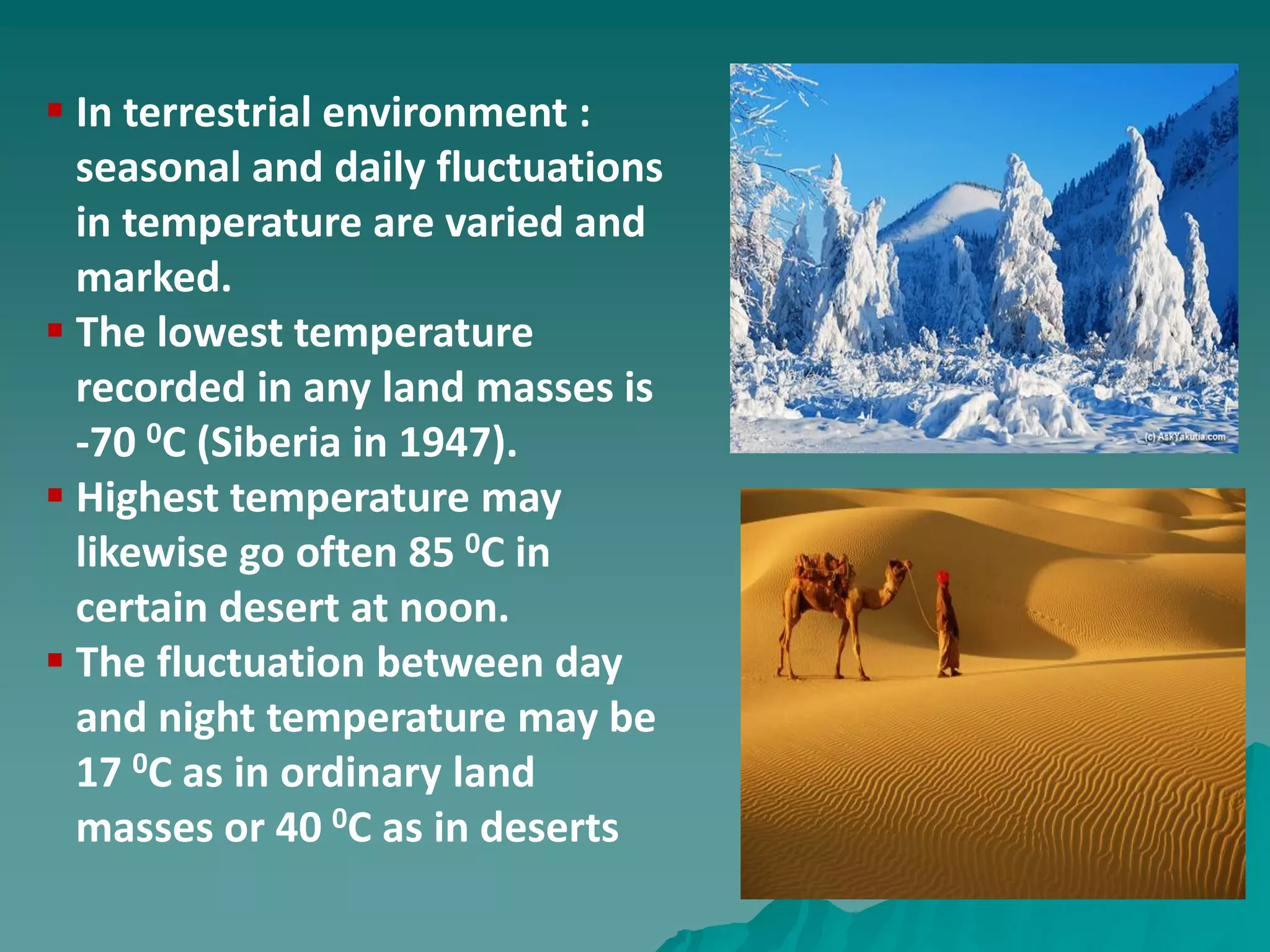
 In terrestrial environment :
seasonal and daily fluctuations
in temperature are varied and
marked.
 The lowest temperature
recorded in any land masses is
-70 0C (Siberia in 1947).
 Highest temperature may
likewise go often 85 0C in
certain desert at noon.
 The fluctuation between day
and night temperature may be
17 0C as in ordinary land
masses or 40 0C as in deserts
Range of temperature tolerance
 Normal life persists between -10 0C to +50 0C.
 Organisms which can tolerate very large fluctuations in
temperature : Eurythermal .
 Small fluctuations : Stenothermal.
 In organisms, all metabolic processes necessary for life
starts at minimum temperature : Optimum temperature.
 Metabolic rate increases with the increase in temperature ,
reaches maximum level and then ceases : Maximum
temperature.
Depending upon heat tolerating capacity, plants can be
divided as
1. Megatherms 2. Microtherms
3. Mesotherms 4. Hekistotherms
Importance of Temperature to Plants
 Important ecological factor which penetrate every part
of the biosphere.
 Influences all the forms of life exerting its actions by
increasing or decreasing, the vital activities of organisms
like behaviour, metabolism, growth and reproduction,
death.
1. Effect on metabolism :
influenced by temperature as it regulate the activity of
enzymes.
2. Effect on reproduction :
Thermoperiodism and phenology.
3. Effect on growth and development :
 Both extremely low and high temperature have
adverse effect on the growth of plants.
 Low temperature bring about the cold injuries such
as desiccation, chilling injury and freezing injury.
 Extremely high temperatures cause stunting and
final death of plants.
Thermal adaptations of the Plants
 Developed during the course of evolution to
overcome the harmful effect of extreme temperature.
1. formation of heat resistance spores, cysts, seeds etc.
2. Removal of water from tissue
3. Increase in osmotic concentration
Water as an ecological factor
 The layer of water on the surface of earth : Hydrosphere.
 71 % of the total earth’s surface covered by water and
therefore earth is sometimes called as “Water Planet”.
 Continents may be considered as large islands rising from
the oceans.
Realms of water
1. Water in the
ocean’s
2. water in the
atmosphere
3. Water on the
land
4. Water in the
biosphere
1. Water in the oceans
 Salinity and temperature are two important features
which determines the movement of large masses of
water, their characteristics and types, and also type of
marine flora and fauna.
 Temperature of water surface varies considerably
throughout the world.
 Also varies with the depth.
 Varies from below – 5 0C to over 33 0C.
 Salinity is due to presence of number of dissolved salts
(NaCl, MgCl2, MgSO4 and K2SO4).
 Avg. Salinity : 3.5%.
 Sea water is storehouse of minerals.
2. Water in the atmosphere
 Water vapours present in the air gives measure of
humidity.
 Atmospheric moisture determines the weather and
climate.
 Comes from the heating of surface water in oceans,
lakes etc. by sun rays.
 Condensation of water vapour may occur in different
forms and also results in to precipitation in form of
rainfall and snowfall.
3. Water on the land
 Precipitation of atmospheric water results in water
falling on land surfaces and oceans.
 Runs down the slope of land in the form of streams
and rivers or may get stored on the land surfaces in
the form of ice-sheets.
 Surface water is the most accessible source of for
human needs.
 The amount of surface water in a region depends
upon the total precipitation and seasonal distribution,
and also on the nature of rocks and soils on the land
surfaces.
4. Water in the biosphere
 Important factor of environment in sustaining all
forms of life.
 Plants absorbs nutrients from soil moisture and
ground water.
 Excess water evaporates as water vapour from aerial
plant surfaces through transpiration.
 Animals also use water for their metabolism, growth
and reproduction.
 Water plays an important role in all biological process
of organisms.
 Thus water circulates not only through atmosphere
and lithosphere, but also through biosphere.
Structure of water molecule
 In a water molecule two hydrogen atoms form single polar
covalent bonds with an oxygen atom.
 Because oxygen is more electronegative, the region around
oxygen has a partial negative charge.
 The region near the two hydrogen atoms has a partial
positive charge.
 A water molecule is a polar molecule with opposite ends of
the molecule with opposite charges, attracts each other
forming hydrogen bond.
 Hold water molecules
together
 Each water molecule
can form a maximum of
4 hydrogen bonds
 The hydrogen bonds
joining water molecules
are weak, about 1/20th
as strong as covalent
bonds.
 They form, break, and
reform with great
frequency
 Extraordinary Properties
that are a result of
hydrogen bonds.
– Cohesive behavior
– Resists changes in
temperature
– High heat of
vaporization
– Expands when it freezes
– Versatile solvent
Hydrogen bond
Physical properties of water
1. Exists in three forms :gaseous, solid and liquid.
2. Extremely inert body in relation to most other chemical
substances.
3. Unique thermal properties
A. High heat capacity :
 due to this, temperature of the biosphere is relatively
stable.
B. Latent heat of melting and evaporation :
 Moderate the temperature of the biosphere.
 Play basic role in in evaporation of water and in
precipitation as rain and dew in the hydrological cycle.
C. Thermal conductivity :
 Poor thermal conductor compared to metals but among
the common liquids, it is excellent
D. Expansion before freezing :
 Most dense at 4oC.
 Contracts until 4oC.
 Expands from 4oC to 0oC.
 Thus ice always floats on
the top of lake or stream.
 Very unusual for an
aquatic ecosystem ever
to freeze solid, unless it is
very small.
4. Universal solvent :
 No other compound compares to the water as a solvent.
 More things, in fact, can be dissolved in water than any
other liquid.
(inorganic and organic chemicals, natural elements).
 Only medium by which these constituents can pass from
the abiotic portion of the ecosystem in to the living
portion.
5. Surface Tension :
 Greatest of all common liquids.
 Pollen, dust and water striders
remain on the surface of water
though they are denser than water.
 Allows soil to contain significant
amount of water through capillary
action.
6. Cohesion and adhesion :
 Cohesion : responsible for
the transport of the water
column in plants
 Plays a key role in the
transport of water against
gravity in plants
 Adhesion : contributes
too, as water adheres
to the wall of the
vessels.
7. Viscosity :
 Allows organisms to swim using relative simple
movements.
 Protects the aquatic animals and plants from mechanical
disturbances.
8. Buoyancy :
 Organisms can exists without specialised supportive
structures.
9. Transparency :
 Enables the penetration of light to the depths where it is
ultimately absorbed.
10. Pressure :
 Influences solubility, ionic dissociation and surface tension.
11. Salinity :
 Various amount of different salts such as Na, K, Mg, Cl,
SO4, PO4, CO3, HCO3, NO3 etc
Chemical Properties of water
Solubility of gases in water :
 Most of the gases dissolve readily in water.
 Concentration varies between zero to theoretically
maximum (Saturation).
 A gas May show a deficit or it may be supersaturated.
 The saturation level of any gas in water depends on
several variables like temperature, salinity, the
concentration of the gas in the atmosphere and its
relative solubility in water.
A. Oxygen :
 Most critical factor in an aquatic environment. Its
concentration in water is governed by
temperature and salinity.
B. Nitrogen :
 Significantly less soluble in water than oxygen.
 Fairly inert chemically and does not react with
water.
 Some bacteria, fungi, blue-green algae and so on
can use it to satisfy their nitrogen requirements.
 Other bacteria can produce it through reduction
of nitrate under conditions of very low oxygen
concentration.
C. Carbon Dioxide :
 One of the essential raw material required for the
photosynthesis in green plants.
 Produced by the decomposition of organic matter and
respiratory activity of aquatic plants and animals.
CO2 + H2O H2CO3 H+ + HCO3
-
2H++ CO3
- -
Carbonic
Acid
Bicarbonate
Carbonate
D. Hydrogen Sulphide :
 May present in significant amount at the deeper layers
of many water bodies including ponds, lakes and some
estuaries.
 Released by decaying organic matter.
 As it is toxic, if concentration of the gas builds up, all
life but anaerobic bacteria excluded from the area.
(e.g. Deeper strata of the black sea.)

Climatic factors

  • 1.
    B. Sc. II(Sem III) Paper no. VIII Plant Ecology Dr. . R. D. Madhekar Assistant professor, S. B. E. S. College of Science, Aurangabad
  • 2.
    Unit: 1 Plantand environment: A) Climatic factors : a) Light as an ecological factor, global radiation and photosynthetically active radiation b) Temperature as an ecological factor c)Water as an ecological factor, physicochemical properties of water B)Edaphic factor : Soil formation -soil profile, physicochemical properties of soil, major soil types of India, soil erosion and soil conservation
  • 3.
    Ecology  Two componentsof nature: Living Organisms (Biotic factor) and their surrounding environment (Abiotic factor).  Both these are much complex, dynamic, interdedependent, mutually reactive and interrelated.  Ecology (Oekologie) : Oikos – House or place to live Logos – study or discussion  Literally, it is the study of organisms at home, in their native environment.
  • 4.
    Cont. Term was firstintroduced by Reiter in 1868. Ernst Haeckel (1869) : The knowledge of the sum of the relations of organisms to the surrounding outer world, to organic and inorganic conditions of existence. It is the science that seeks to describe and explain the relationship between living organisms (Biotic factor) and their environment (Abiotic factor).
  • 5.
    Scope of ecology Solution for varied nature of human life needs knowledge of ecology.  Contributing very much to socio-economical, political and other policies of the world.  Plays important role in in human welfare, agriculture (crop rotation, weed control etc.), management of grassland and forestry, biological surveys, pest control, fishery biology, conservation of soil, forest, wildlife, water supplies etc.  International problem of environmental pollution also needs ecological assistance.
  • 7.
     Any externalforce, substance or condition, which surrounds and affect the life of an organism in any way called as environmental factors or ecological factors or simply as factors.  Vary with time (temporal variation) and space (spatial variation).  It may be Abiotic or Biotic.  Often intricately mixed and interdependent.  Sum of all these factors makes the environment of an organism  Two groups: 1. Direct 2. Indirect Environmental factors
  • 8.
    Four categories ofenvironmental factors : 1. Climatic/Aerial : Light, Atmospheric Temperature, Rainfall (Precipitation), Humidity of air, Atmosphere (Gases and wind) 2. Topographic/Physiographic : Factors related with the physical geography of the earth like Altitude, direction of mountain chains and valleys, steepness and exposure of slopes etc. 3. Edaphic : deals with the formation of the soil, physical and chemical properties of soil and related aspects 4. Biotic : interactions between different forms of life
  • 9.
    Light : asan ecological factor  Of the huge amount, earth receives very small proportion (One in two billion parts).  Only source of light energy.  Basic requirement for existence of life on earth.  Main source is sun – vast, hot gaseous mass.  In centre core, hydrogen continuously converting in to Helium. Exoergenic reaction.  Radiating heat in the form of electromagnetic waves : solar radiation.
  • 10.
    Solar spectrum Gamma rays X-rays UVInfrared Micro- waves Radio waves Visible light Violet-Indigo-Blue-Green-Yellow-Orange-Red
  • 11.
  • 12.
    Heat Budget ofthe Earth
  • 13.
    Spatial Variations inLight Intensity Light intensity reaching the earth’s surface is influenced by factors such as 1. Atmosphere, including gases, suspended solid particles : small proportion of Shorter wavelength get absorbed. 2. Water layers :  In water medium, intensity of light decreases progressively with increase of water depth.  About 10% of the sunlight falling on the surface of water is reflected and 90% of that penetrate water.  There is a selective absorption of light at various depth in water.  The rays of longer wavelength absorbed near the surface and in general light wave of shorter wavelength penetrate deeper.
  • 14.
    Depending upon penetrationof light , three zones of ocean : 3. Layers of vegetation, as in forest : In dense forest ,the tree leaves completely check the penetration of light and less than 1% of total light reaches the surface.
  • 15.
    4. Topographic factorsas direction and slope of the land surfaces.  Light intensities are closely related with atmospheric temperature and moisture (relative humidity). Temporal variations in Light :  Light intensity during summer is much higher than that in winter.  Periodical fluctuation in the light intensity is due to the change in angles of radiations reaching the earth.
  • 16.
    Importance of lightto plants  Affects almost all aspects of plant life directly or indirectly.  It controls plant structure, form, shape, physiology, growth, reproduction, development and local distribution.  On the basis of light factor, plants classified as 1. Sciophytes/Photophobic 2. Heliophytes/Photophilous.  Essential factor in formation of chlorophyll pigment.  Strong influence on number and position of chloroplast.  Significant role in photosynthesis.  Inhibits production of growth hormone (auxins).
  • 17.
    Cont.  Also influencescertain chemical compounds in plants which affect differentiation of specialised tissues and organ.  Light intensity influences the structure of leaf (dorsiventral and isobilateral leaf).  Development of flowers, fruits and seeds greatly affected by light intensity.  Influences seed germination.  Important factor in distribution of plants.  Light affect the respiration in plants indirectly, as in light respiratory substrates synthesised.
  • 18.
  • 19.
    Phototrophism Opening andclosing of stomata
  • 20.
    Temperature as anecological factor  One of the important and changeable ecological factor.  Should not be confused with the heat, both are related.  It is measure of intensity of heat in terms of standardised unit and commonly expressed as degrees on either the Fahrenheit or Celsius scale.  Form of energy necessary for existence of life.  Heating and cooling of atmospheric air occurs in three ways : 1. Radiation 2. Conduction 3. Convection
  • 21.
    Cont.  The amountof insolation reaching the earth’s surface and its effectiveness per unit area depends on 1. The angle of incidence or the inclination of sunrays. 2. The duration of sunshine or day length 3. Transparency of the atmosphere.  These factors also influence temperature values of the area.  The total annual inclination is maximum within the tropics, beyond which gradually decreases towards the pole.  Three latitudinal zones on the earth : 1. Tropical 2. Temperate 3. Polar
  • 22.
    Factors Controlling Temperature Shape of the earth and its rotation and revolution  Latitude :  Insolation responsible for variation in temperature, in latitudinal zones on the earth.  Through inclination (angle of incidence) of sun’s rays and duration, affects temperature of atmosphere.
  • 23.
     Altitude :As one goes higher, the temperature gradually decreases and the air becomes cooler. The normal lapse rate is 1 0C for every 165 m of ascent.  Land and water : Differential heating of land and water surfaces cause variation in the temperature of the air above.  Ocean currents : warm currents raise the temperature of coastal areas, where as cooler currents lower them.  Slope features (Topographic features) : Direction of slope and it’s angle control the amount of solar radiation received at place.
  • 24.
    Temperature fluctuations indifferent environments  Fluctuates both daily and seasonally.  Fresh water, marine and terrestrial environments are subjected to varied response.  Fluctuations are comparatively less in aquatic environment than in the terrestrial environment .  Aquatic environment :  Increase in depth often increase the temperature fluctuations.  Distinct difference in the response of living organism of fresh water and sea to temperature fluctuations.
  • 25.
    Thermal Stratification  Minimum temperature: sea is -3 0C and in freshwater never goes below 0 0C .  Maximum temperature in ocean generally goes up to 36 0C while in freshwater it may go higher.
  • 26.
     In terrestrialenvironment : seasonal and daily fluctuations in temperature are varied and marked.  The lowest temperature recorded in any land masses is -70 0C (Siberia in 1947).  Highest temperature may likewise go often 85 0C in certain desert at noon.  The fluctuation between day and night temperature may be 17 0C as in ordinary land masses or 40 0C as in deserts
  • 27.
    Range of temperaturetolerance  Normal life persists between -10 0C to +50 0C.  Organisms which can tolerate very large fluctuations in temperature : Eurythermal .  Small fluctuations : Stenothermal.  In organisms, all metabolic processes necessary for life starts at minimum temperature : Optimum temperature.  Metabolic rate increases with the increase in temperature , reaches maximum level and then ceases : Maximum temperature. Depending upon heat tolerating capacity, plants can be divided as 1. Megatherms 2. Microtherms 3. Mesotherms 4. Hekistotherms
  • 28.
    Importance of Temperatureto Plants  Important ecological factor which penetrate every part of the biosphere.  Influences all the forms of life exerting its actions by increasing or decreasing, the vital activities of organisms like behaviour, metabolism, growth and reproduction, death. 1. Effect on metabolism : influenced by temperature as it regulate the activity of enzymes. 2. Effect on reproduction : Thermoperiodism and phenology.
  • 29.
    3. Effect ongrowth and development :  Both extremely low and high temperature have adverse effect on the growth of plants.  Low temperature bring about the cold injuries such as desiccation, chilling injury and freezing injury.  Extremely high temperatures cause stunting and final death of plants.
  • 30.
    Thermal adaptations ofthe Plants  Developed during the course of evolution to overcome the harmful effect of extreme temperature. 1. formation of heat resistance spores, cysts, seeds etc. 2. Removal of water from tissue 3. Increase in osmotic concentration
  • 31.
    Water as anecological factor
  • 32.
     The layerof water on the surface of earth : Hydrosphere.  71 % of the total earth’s surface covered by water and therefore earth is sometimes called as “Water Planet”.  Continents may be considered as large islands rising from the oceans.
  • 33.
    Realms of water 1.Water in the ocean’s 2. water in the atmosphere 3. Water on the land 4. Water in the biosphere
  • 34.
    1. Water inthe oceans  Salinity and temperature are two important features which determines the movement of large masses of water, their characteristics and types, and also type of marine flora and fauna.  Temperature of water surface varies considerably throughout the world.  Also varies with the depth.  Varies from below – 5 0C to over 33 0C.  Salinity is due to presence of number of dissolved salts (NaCl, MgCl2, MgSO4 and K2SO4).  Avg. Salinity : 3.5%.  Sea water is storehouse of minerals.
  • 35.
    2. Water inthe atmosphere  Water vapours present in the air gives measure of humidity.  Atmospheric moisture determines the weather and climate.  Comes from the heating of surface water in oceans, lakes etc. by sun rays.  Condensation of water vapour may occur in different forms and also results in to precipitation in form of rainfall and snowfall.
  • 36.
    3. Water onthe land  Precipitation of atmospheric water results in water falling on land surfaces and oceans.  Runs down the slope of land in the form of streams and rivers or may get stored on the land surfaces in the form of ice-sheets.  Surface water is the most accessible source of for human needs.  The amount of surface water in a region depends upon the total precipitation and seasonal distribution, and also on the nature of rocks and soils on the land surfaces.
  • 37.
    4. Water inthe biosphere  Important factor of environment in sustaining all forms of life.  Plants absorbs nutrients from soil moisture and ground water.  Excess water evaporates as water vapour from aerial plant surfaces through transpiration.  Animals also use water for their metabolism, growth and reproduction.  Water plays an important role in all biological process of organisms.  Thus water circulates not only through atmosphere and lithosphere, but also through biosphere.
  • 38.
    Structure of watermolecule  In a water molecule two hydrogen atoms form single polar covalent bonds with an oxygen atom.  Because oxygen is more electronegative, the region around oxygen has a partial negative charge.  The region near the two hydrogen atoms has a partial positive charge.  A water molecule is a polar molecule with opposite ends of the molecule with opposite charges, attracts each other forming hydrogen bond.
  • 39.
     Hold watermolecules together  Each water molecule can form a maximum of 4 hydrogen bonds  The hydrogen bonds joining water molecules are weak, about 1/20th as strong as covalent bonds.  They form, break, and reform with great frequency  Extraordinary Properties that are a result of hydrogen bonds. – Cohesive behavior – Resists changes in temperature – High heat of vaporization – Expands when it freezes – Versatile solvent Hydrogen bond
  • 40.
    Physical properties ofwater 1. Exists in three forms :gaseous, solid and liquid. 2. Extremely inert body in relation to most other chemical substances. 3. Unique thermal properties A. High heat capacity :  due to this, temperature of the biosphere is relatively stable. B. Latent heat of melting and evaporation :  Moderate the temperature of the biosphere.  Play basic role in in evaporation of water and in precipitation as rain and dew in the hydrological cycle. C. Thermal conductivity :  Poor thermal conductor compared to metals but among the common liquids, it is excellent
  • 41.
    D. Expansion beforefreezing :  Most dense at 4oC.  Contracts until 4oC.  Expands from 4oC to 0oC.  Thus ice always floats on the top of lake or stream.  Very unusual for an aquatic ecosystem ever to freeze solid, unless it is very small.
  • 42.
    4. Universal solvent:  No other compound compares to the water as a solvent.  More things, in fact, can be dissolved in water than any other liquid. (inorganic and organic chemicals, natural elements).  Only medium by which these constituents can pass from the abiotic portion of the ecosystem in to the living portion. 5. Surface Tension :  Greatest of all common liquids.  Pollen, dust and water striders remain on the surface of water though they are denser than water.  Allows soil to contain significant amount of water through capillary action.
  • 43.
    6. Cohesion andadhesion :  Cohesion : responsible for the transport of the water column in plants  Plays a key role in the transport of water against gravity in plants  Adhesion : contributes too, as water adheres to the wall of the vessels.
  • 44.
    7. Viscosity : Allows organisms to swim using relative simple movements.  Protects the aquatic animals and plants from mechanical disturbances. 8. Buoyancy :  Organisms can exists without specialised supportive structures. 9. Transparency :  Enables the penetration of light to the depths where it is ultimately absorbed. 10. Pressure :  Influences solubility, ionic dissociation and surface tension. 11. Salinity :  Various amount of different salts such as Na, K, Mg, Cl, SO4, PO4, CO3, HCO3, NO3 etc
  • 45.
    Chemical Properties ofwater Solubility of gases in water :  Most of the gases dissolve readily in water.  Concentration varies between zero to theoretically maximum (Saturation).  A gas May show a deficit or it may be supersaturated.  The saturation level of any gas in water depends on several variables like temperature, salinity, the concentration of the gas in the atmosphere and its relative solubility in water.
  • 46.
    A. Oxygen : Most critical factor in an aquatic environment. Its concentration in water is governed by temperature and salinity. B. Nitrogen :  Significantly less soluble in water than oxygen.  Fairly inert chemically and does not react with water.  Some bacteria, fungi, blue-green algae and so on can use it to satisfy their nitrogen requirements.  Other bacteria can produce it through reduction of nitrate under conditions of very low oxygen concentration.
  • 47.
    C. Carbon Dioxide:  One of the essential raw material required for the photosynthesis in green plants.  Produced by the decomposition of organic matter and respiratory activity of aquatic plants and animals. CO2 + H2O H2CO3 H+ + HCO3 - 2H++ CO3 - - Carbonic Acid Bicarbonate Carbonate
  • 48.
    D. Hydrogen Sulphide:  May present in significant amount at the deeper layers of many water bodies including ponds, lakes and some estuaries.  Released by decaying organic matter.  As it is toxic, if concentration of the gas builds up, all life but anaerobic bacteria excluded from the area. (e.g. Deeper strata of the black sea.)