Presented by :- Manas Ranjan Tripathi
P.G.T. Biology
School :- Kendriya Vidyalaya Hasimara
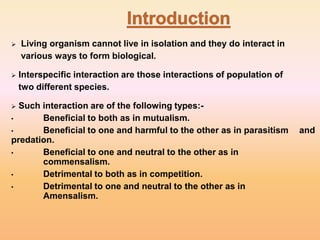
 Living organism cannot live in isolation and they do interact in
various ways to form biological.
 Interspecific interaction are those interactions of population of
two different species.
 Such interaction are of the following types:-
• Beneficial to both as in mutualism.
• Beneficial to one and harmful to the other as in parasitism and
predation.
• Beneficial to one and neutral to the other as in
commensalism.
• Detrimental to both as in competition.
• Detrimental to one and neutral to the other as in
Amensalism.
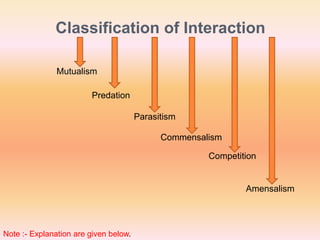
Classification of Interaction
Mutualism
Predation
Parasitism
Commensalism
Competition
Amensalism
Note :- Explanation are given below.
Topic :- Mutualism
It is defined as the interspecific interaction in which both the interacting
species are benefitted.
Examples are as follow:-
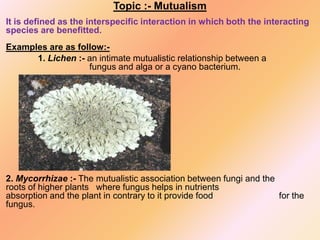
1. Lichen :- an intimate mutualistic relationship between a
fungus and alga or a cyano bacterium.
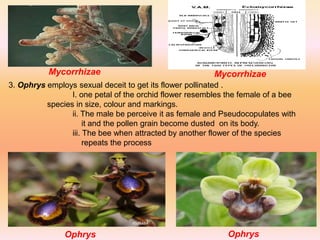
2. Mycorrhizae :- The mutualistic association between fungi and the
roots of higher plants where fungus helps in nutrients
absorption and the plant in contrary to it provide food for the
fungus.
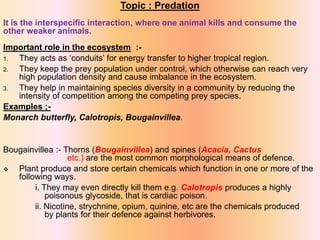
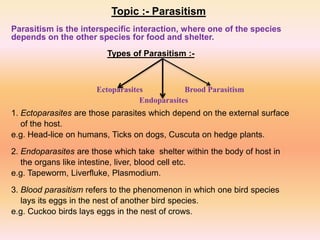
3. Ophrys employs sexual deceit to get its flower pollinated .
I. one petal of the orchid flower resembles the female of a bee
species in size, colour and markings.
ii. The male be perceive it as female and Pseudocopulates with
it and the pollen grain become dusted on its body.
iii. The bee when attracted by another flower of the species
repeats the process
Mycorrhizae
Ophrys Ophrys
Mycorrhizae
Topic : Predation
It is the interspecific interaction, where one animal kills and consume the
other weaker animals.
Important role in the ecosystem :-
1. They acts as ‘conduits’ for energy transfer to higher tropical region.
2. They keep the prey population under control, which otherwise can reach very
high population density and cause imbalance in the ecosystem.
3. They help in maintaining species diversity in a community by reducing the
intensity of competition among the competing prey species.
Examples ;-
Monarch butterfly, Calotropis, Bougainvillea.
Bougainvillea :- Thorns (Bougainvillea) and spines (Acacia, Cactus
etc.) are the most common morphological means of defence.
 Plant produce and store certain chemicals which function in one or more of the
following ways.
i. They may even directly kill them e.g. Calotropis produces a highly
poisonous glycoside, that is cardiac poison.
ii. Nicotine, strychnine, opium, quinine, etc are the chemicals produced
by plants for their defence against herbivores.
Topic :- Parasitism
Parasitism is the interspecific interaction, where one of the species
depends on the other species for food and shelter.
Types of Parasitism :-
1. Ectoparasites are those parasites which depend on the external surface
of the host.
e.g. Head-lice on humans, Ticks on dogs, Cuscuta on hedge plants.
2. Endoparasites are those which take shelter within the body of host in
the organs like intestine, liver, blood cell etc.
e.g. Tapeworm, Liverfluke, Plasmodium.
3. Blood parasitism refers to the phenomenon in which one bird species
lays its eggs in the nest of another bird species.
e.g. Cuckoo birds lays eggs in the nest of crows.
Ectoparasites
Endoparasites
Brood Parasitism
Topic :- Commensalism
Commensalism is defined as the interspecific interaction where one
species is benefitted while the other species is neither benefitted nor
harmed.
Examples :-
1. Orchids grow as epiphytes on mango or other fruit trees.
 Orchids are benefitted by getting a shelter, while trees is neither
benefitted nor harmed.
2. Barnacles growing on the whale and sucker fisher are attached to shark
gets shelter and food (benefited to move to where food is available). While
both the large fishes remains neutral.
3. The cattle egrets always forage near to where the cattle are growing.
* As the cattle animals stir up, the insects are flushed out
from the vegetation.
* The egrets are benefitted by this as otherwise it might be
difficult for the birds to detect and catch the insects.
4. The clown fish living among sea anemone get protection form their `
predator that stay away from the stinging tentacle of the sea anemone
Topic :- Competition
Competition is the type of interaction either among individuals of the same
species or between individuals/populations of different species.
I. Completely unrelated species can also compete for the same source.
e.g. In certain shallow lakes of South America, the visiting
flamingoes and the native fishes compete for the same
zooplanktons as their food.
II. Resources need not be limiting for competition to occur, the feeding
efficiency of one species might be reduced due to the interfering and
inhibitory presence of the other species.
e.g. Abingdon tortoise in Galapagos island become extinct within
a decade after goats were introduced into the island.
Topic :- Amensalism
Interaction between two different species, in which one species is harmed
and the other is neither benefitted nor harmed.
 Inhibition is mostly achieved by secreting antibiotics substance :-
A. Penicilium inhibits growth of various bacteria by secreting penicillin
B. Streptomycin is secreted by Streptomyces gresius which checks
growth of various other bacteria.
C. Barley, sorghum, sunflower etc. don’t allow weeds to grow near them
by secreting allochemics from roots. Hence, called smoother crops.
 Animal ammensalism also occurs when a large animal by mistake steps on
a smaller animal /plant killing it without getting any benefit from the act.
 Self-ammensalism is seen in wild variety of Grevillea robusta that inhibits
growth of its own seedlings through an allochemic secreted by its roots.
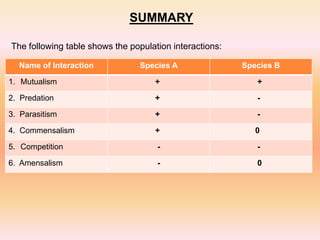
SUMMARY
The following table shows the population interactions:
Name of Interaction Species A Species B
1. Mutualism + +
2. Predation + -
3. Parasitism + -
4. Commensalism + 0
5. Competition - -
6. Amensalism - 0
Conclusion :-
M.r.tripathi (biology xii  populaiton interction)

M.r.tripathi (biology xii populaiton interction)

  • 1.
    Presented by :-Manas Ranjan Tripathi P.G.T. Biology School :- Kendriya Vidyalaya Hasimara
  • 2.
     Living organismcannot live in isolation and they do interact in various ways to form biological.  Interspecific interaction are those interactions of population of two different species.  Such interaction are of the following types:- • Beneficial to both as in mutualism. • Beneficial to one and harmful to the other as in parasitism and predation. • Beneficial to one and neutral to the other as in commensalism. • Detrimental to both as in competition. • Detrimental to one and neutral to the other as in Amensalism.
  • 3.
  • 4.
    Topic :- Mutualism Itis defined as the interspecific interaction in which both the interacting species are benefitted. Examples are as follow:- 1. Lichen :- an intimate mutualistic relationship between a fungus and alga or a cyano bacterium. 2. Mycorrhizae :- The mutualistic association between fungi and the roots of higher plants where fungus helps in nutrients absorption and the plant in contrary to it provide food for the fungus.
  • 5.
    3. Ophrys employssexual deceit to get its flower pollinated . I. one petal of the orchid flower resembles the female of a bee species in size, colour and markings. ii. The male be perceive it as female and Pseudocopulates with it and the pollen grain become dusted on its body. iii. The bee when attracted by another flower of the species repeats the process Mycorrhizae Ophrys Ophrys Mycorrhizae
  • 6.
    Topic : Predation Itis the interspecific interaction, where one animal kills and consume the other weaker animals. Important role in the ecosystem :- 1. They acts as ‘conduits’ for energy transfer to higher tropical region. 2. They keep the prey population under control, which otherwise can reach very high population density and cause imbalance in the ecosystem. 3. They help in maintaining species diversity in a community by reducing the intensity of competition among the competing prey species. Examples ;- Monarch butterfly, Calotropis, Bougainvillea. Bougainvillea :- Thorns (Bougainvillea) and spines (Acacia, Cactus etc.) are the most common morphological means of defence.  Plant produce and store certain chemicals which function in one or more of the following ways. i. They may even directly kill them e.g. Calotropis produces a highly poisonous glycoside, that is cardiac poison. ii. Nicotine, strychnine, opium, quinine, etc are the chemicals produced by plants for their defence against herbivores.
  • 8.
    Topic :- Parasitism Parasitismis the interspecific interaction, where one of the species depends on the other species for food and shelter. Types of Parasitism :- 1. Ectoparasites are those parasites which depend on the external surface of the host. e.g. Head-lice on humans, Ticks on dogs, Cuscuta on hedge plants. 2. Endoparasites are those which take shelter within the body of host in the organs like intestine, liver, blood cell etc. e.g. Tapeworm, Liverfluke, Plasmodium. 3. Blood parasitism refers to the phenomenon in which one bird species lays its eggs in the nest of another bird species. e.g. Cuckoo birds lays eggs in the nest of crows. Ectoparasites Endoparasites Brood Parasitism
  • 9.
    Topic :- Commensalism Commensalismis defined as the interspecific interaction where one species is benefitted while the other species is neither benefitted nor harmed. Examples :- 1. Orchids grow as epiphytes on mango or other fruit trees.  Orchids are benefitted by getting a shelter, while trees is neither benefitted nor harmed. 2. Barnacles growing on the whale and sucker fisher are attached to shark gets shelter and food (benefited to move to where food is available). While both the large fishes remains neutral. 3. The cattle egrets always forage near to where the cattle are growing. * As the cattle animals stir up, the insects are flushed out from the vegetation. * The egrets are benefitted by this as otherwise it might be difficult for the birds to detect and catch the insects. 4. The clown fish living among sea anemone get protection form their ` predator that stay away from the stinging tentacle of the sea anemone
  • 10.
    Topic :- Competition Competitionis the type of interaction either among individuals of the same species or between individuals/populations of different species. I. Completely unrelated species can also compete for the same source. e.g. In certain shallow lakes of South America, the visiting flamingoes and the native fishes compete for the same zooplanktons as their food. II. Resources need not be limiting for competition to occur, the feeding efficiency of one species might be reduced due to the interfering and inhibitory presence of the other species. e.g. Abingdon tortoise in Galapagos island become extinct within a decade after goats were introduced into the island.
  • 11.
    Topic :- Amensalism Interactionbetween two different species, in which one species is harmed and the other is neither benefitted nor harmed.  Inhibition is mostly achieved by secreting antibiotics substance :- A. Penicilium inhibits growth of various bacteria by secreting penicillin B. Streptomycin is secreted by Streptomyces gresius which checks growth of various other bacteria. C. Barley, sorghum, sunflower etc. don’t allow weeds to grow near them by secreting allochemics from roots. Hence, called smoother crops.  Animal ammensalism also occurs when a large animal by mistake steps on a smaller animal /plant killing it without getting any benefit from the act.  Self-ammensalism is seen in wild variety of Grevillea robusta that inhibits growth of its own seedlings through an allochemic secreted by its roots.
  • 12.
    SUMMARY The following tableshows the population interactions: Name of Interaction Species A Species B 1. Mutualism + + 2. Predation + - 3. Parasitism + - 4. Commensalism + 0 5. Competition - - 6. Amensalism - 0
  • 13.