GENETICALLY
MODIFIED FOODS
J. Nesa Aurlene
First Year Post Graduate
Dept. of Public Health
Dentistry
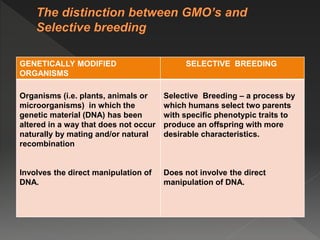
GENETICALLY MODIFIED
ORGANISMS
SELECTIVE BREEDING
Organisms (i.e. plants, animals or
microorganisms) in which the
genetic material (DNA) has been
altered in a way that does not occur
naturally by mating and/or natural
recombination
Involves the direct manipulation of
DNA.
Selective Breeding – a process by
which humans select two parents
with specific phenotypic traits to
produce an offspring with more
desirable characteristics.
Does not involve the direct
manipulation of DNA.
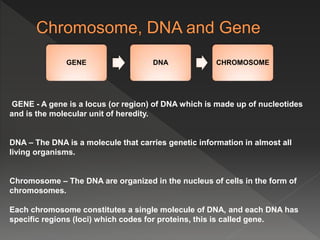
GENE DNA CHROMOSOME
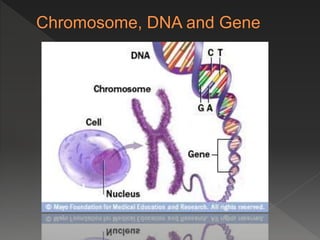
GENE - A gene is a locus (or region) of DNA which is made up of nucleotides
and is the molecular unit of heredity.
DNA – The DNA is a molecule that carries genetic information in almost all
living organisms.
Chromosome – The DNA are organized in the nucleus of cells in the form of
chromosomes.
Each chromosome constitutes a single molecule of DNA, and each DNA has
specific regions (loci) which codes for proteins, this is called gene.
 Phenotype - is the composite of an organism's observable
characteristics or traits, such as its appearance and development.
 A phenotype results from the expression of an organism's genes as
well as the influence of environmental factors and the interactions
between the two.
 Genotype - This is the "internally coded, inheritable information"
carried by all living organisms.
 Genome - A genome is an organism’s complete set of DNA, including all
of its genes. Each genome contains all of the information needed to build
and maintain that organism.
 In humans, a copy of the entire genome—more than 3 billion DNA base
pairs—is contained in all cells that have a nucleus
 1859 - Charles Darwin published the first edition of “On
the Origin of Species”
 1865 - Gregor Mendel discovered that heredity
transmitted in units
 1869 - Frederick Miescher isolated DNA
 1902 - Walter Sutton developed chromosome theory of
inheritance
 1911 - Thomas Hunt Morgan showed chromosomes carry
genes
 1941 - George Beadle and Edward Tatum Hypothesized
one gene one enzyme theory
 1953 - Francis H. Crick and James D. Watson described
the double helix structure of DNA
 1973 - Stanley Cohen and Herbert Boyer invented DNA
cloning
 1980 Jon W. Gordon et al. made first transgenic
mice
 1990 Human genome project was launched
 1993 FDA approved the use of Bovine
somatotropin (bST) to increase milk production in
dairy cows
 1983 First Genetically Modified plants with anti-
biotic resistance (tobaccos and petunias) produced
 1990 China commercialized Genetically
Modified tobacco
 1994 FDA approved the sale of the first GM
food, the FLAVR SAVR tomato
GLOBAL FOOD SECURITY
Why are GM foods needed?
1) Expanding population
2) Decrease in arable land
3) Prolonged time take for improvement of
crop quality through selective breeding.
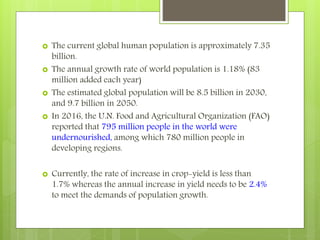
 The current global human population is approximately 7.35
billion.
 The annual growth rate of world population is 1.18% (83
million added each year)
 The estimated global population will be 8.5 billion in 2030,
and 9.7 billion in 2050.
 In 2016, the U.N. Food and Agricultural Organization (FAO)
reported that 795 million people in the world were
undernourished, among which 780 million people in
developing regions.
 Currently, the rate of increase in crop-yield is less than
1.7% whereas the annual increase in yield needs to be 2.4%
to meet the demands of population growth.
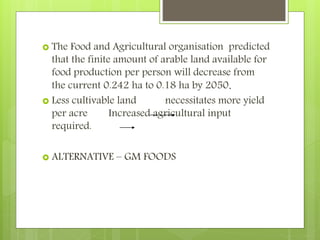
 The Food and Agricultural organisation predicted
that the finite amount of arable land available for
food production per person will decrease from
the current 0.242 ha to 0.18 ha by 2050.
 Less cultivable land necessitates more yield
per acre Increased agricultural input
required.
 ALTERNATIVE – GM FOODS
Techniques
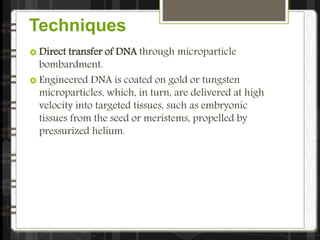
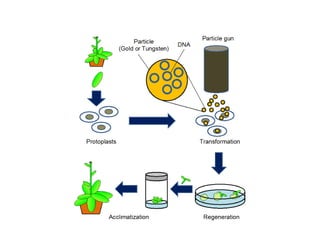
 Direct transfer of DNA through microparticle
bombardment.
 Engineered DNA is coated on gold or tungsten
microparticles, which, in turn, are delivered at high
velocity into targeted tissues, such as embryonic
tissues from the seed or meristems, propelled by
pressurized helium.
Techniques
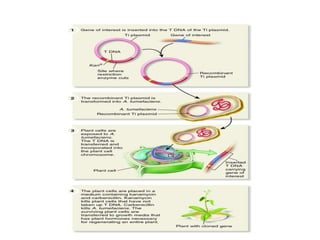
 Indirect transfer of DNA through bacterial vehicle-
 The soil bacterium A. tumefaciens alters the genome of a
plant and induces plants to produce amino acids required
for its growth.
 The bacteria possesses Ti (tumor inducing) plasmid which is
responsible for gene insertion.
 By hijacking the Ti plasmid from the bacterium it is possible
to introduce exogenous genes ( gene of interest) into a plant
cell.
Techniques
 Direct editing of genomic DNA - In 2012, the “CRISPR-Cas9”
system was developed.
 It is a genome editing tool.
 Cas9 is a DNA endonuclease originally found in bacteria,
where it protects the host bacteria from invading DNA
molecules (e.g. viruses).
 The endonuclease is guided to the invading/targeting DNA by
a special “guide RNA” (gRNA), whose sequence is
complementary to the invading sequence.
 Cas9 utilizes its two active sites to cleave both strands of the
double-stranded DNA.
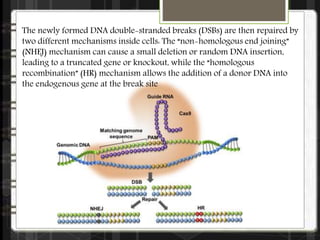
The newly formed DNA double-stranded breaks (DSBs) are then repaired by
two different mechanisms inside cells: The “non-homologous end joining”
(NHEJ) mechanism can cause a small deletion or random DNA insertion,
leading to a truncated gene or knockout, while the “homologous
recombination” (HR) mechanism allows the addition of a donor DNA into
the endogenous gene at the break site
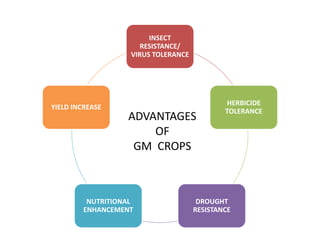
INSECT
RESISTANCE/
VIRUS TOLERANCE
HERBICIDE
TOLERANCE
DROUGHT
RESISTANCE
NUTRITIONAL
ENHANCEMENT
YIELD INCREASE
ADVANTAGES
OF
GM CROPS
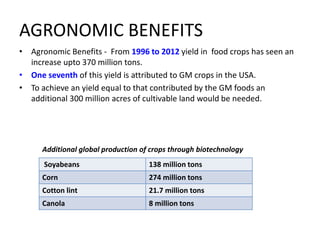
AGRONOMIC BENEFITS
• Agronomic Benefits - From 1996 to 2012 yield in food crops has seen an
increase upto 370 million tons.
• One seventh of this yield is attributed to GM crops in the USA.
• To achieve an yield equal to that contributed by the GM foods an
additional 300 million acres of cultivable land would be needed.
Soyabeans 138 million tons
Corn 274 million tons
Cotton lint 21.7 million tons
Canola 8 million tons
Additional global production of crops through biotechnology
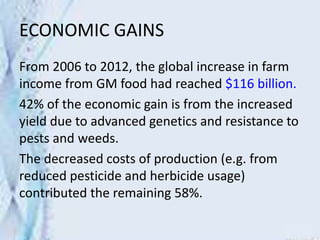
ECONOMIC GAINS
From 2006 to 2012, the global increase in farm
income from GM food had reached $116 billion.
42% of the economic gain is from the increased
yield due to advanced genetics and resistance to
pests and weeds.
The decreased costs of production (e.g. from
reduced pesticide and herbicide usage)
contributed the remaining 58%.
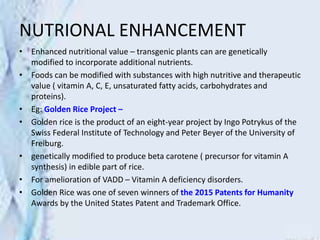
NUTRIONAL ENHANCEMENT
• Enhanced nutritional value – transgenic plants can are genetically
modified to incorporate additional nutrients.
• Foods can be modified with substances with high nutritive and therapeutic
value ( vitamin A, C, E, unsaturated fatty acids, carbohydrates and
proteins).
• Eg: Golden Rice Project –
• Golden rice is the product of an eight-year project by Ingo Potrykus of the
Swiss Federal Institute of Technology and Peter Beyer of the University of
Freiburg.
• genetically modified to produce beta carotene ( precursor for vitamin A
synthesis) in edible part of rice.
• For amelioration of VADD – Vitamin A deficiency disorders.
• Golden Rice was one of seven winners of the 2015 Patents for Humanity
Awards by the United States Patent and Trademark Office.
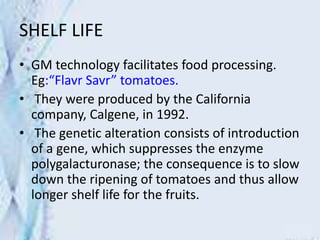
SHELF LIFE
• GM technology facilitates food processing.
Eg:“Flavr Savr” tomatoes.
• They were produced by the California
company, Calgene, in 1992.
• The genetic alteration consists of introduction
of a gene, which suppresses the enzyme
polygalacturonase; the consequence is to slow
down the ripening of tomatoes and thus allow
longer shelf life for the fruits.
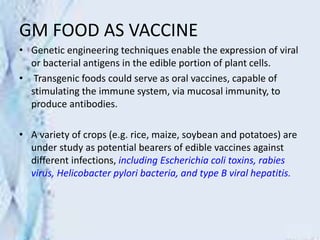
GM FOOD AS VACCINE
• Genetic engineering techniques enable the expression of viral
or bacterial antigens in the edible portion of plant cells.
• Transgenic foods could serve as oral vaccines, capable of
stimulating the immune system, via mucosal immunity, to
produce antibodies.
• A variety of crops (e.g. rice, maize, soybean and potatoes) are
under study as potential bearers of edible vaccines against
different infections, including Escherichia coli toxins, rabies
virus, Helicobacter pylori bacteria, and type B viral hepatitis.
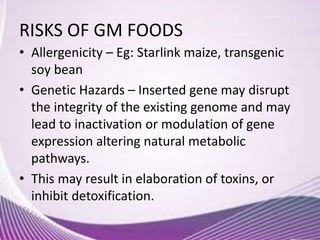
RISKS OF GM FOODS
• Allergenicity – Eg: Starlink maize, transgenic
soy bean
• Genetic Hazards – Inserted gene may disrupt
the integrity of the existing genome and may
lead to inactivation or modulation of gene
expression altering natural metabolic
pathways.
• This may result in elaboration of toxins, or
inhibit detoxification.
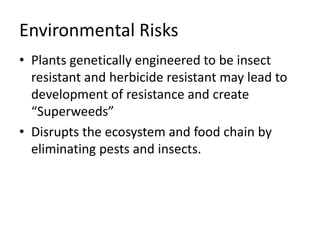
Environmental Risks
• Plants genetically engineered to be insect
resistant and herbicide resistant may lead to
development of resistance and create
“Superweeds”
• Disrupts the ecosystem and food chain by
eliminating pests and insects.
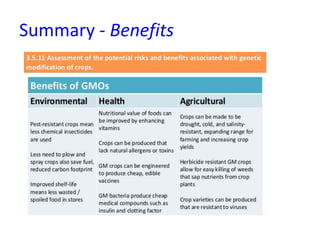
Summary - Benefits
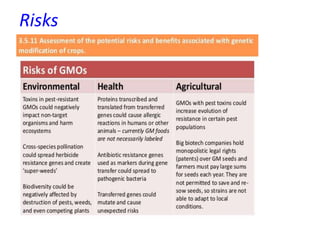
Risks
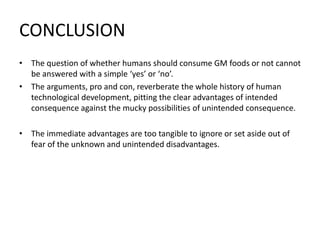
CONCLUSION
• The question of whether humans should consume GM foods or not cannot
be answered with a simple ‘yes’ or ‘no’.
• The arguments, pro and con, reverberate the whole history of human
technological development, pitting the clear advantages of intended
consequence against the mucky possibilities of unintended consequence.
• The immediate advantages are too tangible to ignore or set aside out of
fear of the unknown and unintended disadvantages.
References
• Genetically modified foods: A critical review of their promise and problems Food
Science and Human Wellness Volume 5, Issue 3, September 2016, Pages 116–123
• A hard look at GM crops Nature, 497 (7447) (2013), pp. 24–26
• Commercialization of transgenic plants: potential ecological risks Bioscience, 47 (2)
(1997), pp. 86–96
• Golden rice.org – The Golden rice project
• Genome, Genotype, phenotype – Scitable by nature Education
• Techniques of genetic engineering – biotechnologyforums.com
THANK YOU

Genetically modified foods

  • 1.
    GENETICALLY MODIFIED FOODS J. NesaAurlene First Year Post Graduate Dept. of Public Health Dentistry
  • 2.
    GENETICALLY MODIFIED ORGANISMS SELECTIVE BREEDING Organisms(i.e. plants, animals or microorganisms) in which the genetic material (DNA) has been altered in a way that does not occur naturally by mating and/or natural recombination Involves the direct manipulation of DNA. Selective Breeding – a process by which humans select two parents with specific phenotypic traits to produce an offspring with more desirable characteristics. Does not involve the direct manipulation of DNA.
  • 3.
    GENE DNA CHROMOSOME GENE- A gene is a locus (or region) of DNA which is made up of nucleotides and is the molecular unit of heredity. DNA – The DNA is a molecule that carries genetic information in almost all living organisms. Chromosome – The DNA are organized in the nucleus of cells in the form of chromosomes. Each chromosome constitutes a single molecule of DNA, and each DNA has specific regions (loci) which codes for proteins, this is called gene.
  • 5.
     Phenotype -is the composite of an organism's observable characteristics or traits, such as its appearance and development.  A phenotype results from the expression of an organism's genes as well as the influence of environmental factors and the interactions between the two.  Genotype - This is the "internally coded, inheritable information" carried by all living organisms.  Genome - A genome is an organism’s complete set of DNA, including all of its genes. Each genome contains all of the information needed to build and maintain that organism.  In humans, a copy of the entire genome—more than 3 billion DNA base pairs—is contained in all cells that have a nucleus
  • 6.
     1859 -Charles Darwin published the first edition of “On the Origin of Species”  1865 - Gregor Mendel discovered that heredity transmitted in units  1869 - Frederick Miescher isolated DNA  1902 - Walter Sutton developed chromosome theory of inheritance  1911 - Thomas Hunt Morgan showed chromosomes carry genes  1941 - George Beadle and Edward Tatum Hypothesized one gene one enzyme theory  1953 - Francis H. Crick and James D. Watson described the double helix structure of DNA  1973 - Stanley Cohen and Herbert Boyer invented DNA cloning
  • 7.
     1980 JonW. Gordon et al. made first transgenic mice  1990 Human genome project was launched  1993 FDA approved the use of Bovine somatotropin (bST) to increase milk production in dairy cows  1983 First Genetically Modified plants with anti- biotic resistance (tobaccos and petunias) produced  1990 China commercialized Genetically Modified tobacco  1994 FDA approved the sale of the first GM food, the FLAVR SAVR tomato
  • 8.
    GLOBAL FOOD SECURITY Whyare GM foods needed? 1) Expanding population 2) Decrease in arable land 3) Prolonged time take for improvement of crop quality through selective breeding.
  • 9.
     The currentglobal human population is approximately 7.35 billion.  The annual growth rate of world population is 1.18% (83 million added each year)  The estimated global population will be 8.5 billion in 2030, and 9.7 billion in 2050.  In 2016, the U.N. Food and Agricultural Organization (FAO) reported that 795 million people in the world were undernourished, among which 780 million people in developing regions.  Currently, the rate of increase in crop-yield is less than 1.7% whereas the annual increase in yield needs to be 2.4% to meet the demands of population growth.
  • 10.
     The Foodand Agricultural organisation predicted that the finite amount of arable land available for food production per person will decrease from the current 0.242 ha to 0.18 ha by 2050.  Less cultivable land necessitates more yield per acre Increased agricultural input required.  ALTERNATIVE – GM FOODS
  • 11.
    Techniques  Direct transferof DNA through microparticle bombardment.  Engineered DNA is coated on gold or tungsten microparticles, which, in turn, are delivered at high velocity into targeted tissues, such as embryonic tissues from the seed or meristems, propelled by pressurized helium.
  • 13.
    Techniques  Indirect transferof DNA through bacterial vehicle-  The soil bacterium A. tumefaciens alters the genome of a plant and induces plants to produce amino acids required for its growth.  The bacteria possesses Ti (tumor inducing) plasmid which is responsible for gene insertion.  By hijacking the Ti plasmid from the bacterium it is possible to introduce exogenous genes ( gene of interest) into a plant cell.
  • 15.
    Techniques  Direct editingof genomic DNA - In 2012, the “CRISPR-Cas9” system was developed.  It is a genome editing tool.  Cas9 is a DNA endonuclease originally found in bacteria, where it protects the host bacteria from invading DNA molecules (e.g. viruses).  The endonuclease is guided to the invading/targeting DNA by a special “guide RNA” (gRNA), whose sequence is complementary to the invading sequence.  Cas9 utilizes its two active sites to cleave both strands of the double-stranded DNA.
  • 16.
    The newly formedDNA double-stranded breaks (DSBs) are then repaired by two different mechanisms inside cells: The “non-homologous end joining” (NHEJ) mechanism can cause a small deletion or random DNA insertion, leading to a truncated gene or knockout, while the “homologous recombination” (HR) mechanism allows the addition of a donor DNA into the endogenous gene at the break site
  • 18.
  • 19.
    AGRONOMIC BENEFITS • AgronomicBenefits - From 1996 to 2012 yield in food crops has seen an increase upto 370 million tons. • One seventh of this yield is attributed to GM crops in the USA. • To achieve an yield equal to that contributed by the GM foods an additional 300 million acres of cultivable land would be needed. Soyabeans 138 million tons Corn 274 million tons Cotton lint 21.7 million tons Canola 8 million tons Additional global production of crops through biotechnology
  • 20.
    ECONOMIC GAINS From 2006to 2012, the global increase in farm income from GM food had reached $116 billion. 42% of the economic gain is from the increased yield due to advanced genetics and resistance to pests and weeds. The decreased costs of production (e.g. from reduced pesticide and herbicide usage) contributed the remaining 58%.
  • 21.
    NUTRIONAL ENHANCEMENT • Enhancednutritional value – transgenic plants can are genetically modified to incorporate additional nutrients. • Foods can be modified with substances with high nutritive and therapeutic value ( vitamin A, C, E, unsaturated fatty acids, carbohydrates and proteins). • Eg: Golden Rice Project – • Golden rice is the product of an eight-year project by Ingo Potrykus of the Swiss Federal Institute of Technology and Peter Beyer of the University of Freiburg. • genetically modified to produce beta carotene ( precursor for vitamin A synthesis) in edible part of rice. • For amelioration of VADD – Vitamin A deficiency disorders. • Golden Rice was one of seven winners of the 2015 Patents for Humanity Awards by the United States Patent and Trademark Office.
  • 22.
    SHELF LIFE • GMtechnology facilitates food processing. Eg:“Flavr Savr” tomatoes. • They were produced by the California company, Calgene, in 1992. • The genetic alteration consists of introduction of a gene, which suppresses the enzyme polygalacturonase; the consequence is to slow down the ripening of tomatoes and thus allow longer shelf life for the fruits.
  • 23.
    GM FOOD ASVACCINE • Genetic engineering techniques enable the expression of viral or bacterial antigens in the edible portion of plant cells. • Transgenic foods could serve as oral vaccines, capable of stimulating the immune system, via mucosal immunity, to produce antibodies. • A variety of crops (e.g. rice, maize, soybean and potatoes) are under study as potential bearers of edible vaccines against different infections, including Escherichia coli toxins, rabies virus, Helicobacter pylori bacteria, and type B viral hepatitis.
  • 24.
    RISKS OF GMFOODS • Allergenicity – Eg: Starlink maize, transgenic soy bean • Genetic Hazards – Inserted gene may disrupt the integrity of the existing genome and may lead to inactivation or modulation of gene expression altering natural metabolic pathways. • This may result in elaboration of toxins, or inhibit detoxification.
  • 25.
    Environmental Risks • Plantsgenetically engineered to be insect resistant and herbicide resistant may lead to development of resistance and create “Superweeds” • Disrupts the ecosystem and food chain by eliminating pests and insects.
  • 26.
  • 27.
  • 28.
    CONCLUSION • The questionof whether humans should consume GM foods or not cannot be answered with a simple ‘yes’ or ‘no’. • The arguments, pro and con, reverberate the whole history of human technological development, pitting the clear advantages of intended consequence against the mucky possibilities of unintended consequence. • The immediate advantages are too tangible to ignore or set aside out of fear of the unknown and unintended disadvantages.
  • 29.
    References • Genetically modifiedfoods: A critical review of their promise and problems Food Science and Human Wellness Volume 5, Issue 3, September 2016, Pages 116–123 • A hard look at GM crops Nature, 497 (7447) (2013), pp. 24–26 • Commercialization of transgenic plants: potential ecological risks Bioscience, 47 (2) (1997), pp. 86–96 • Golden rice.org – The Golden rice project • Genome, Genotype, phenotype – Scitable by nature Education • Techniques of genetic engineering – biotechnologyforums.com
  • 30.