
DNA Technology 2
Genetic
Engineering
ppt. by Robin D. Seamon
HOOK VIDEO: Nova: Cracking your genetic code 55 minutes
VIDEO: Genetic Engineering will Change Everything
Forever: CRISPR (14 min)
VIDEO
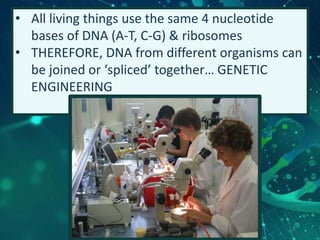
• All living things use the same 4 nucleotide
bases of DNA (A-T, C-G) & ribosomes
• THEREFORE, DNA from different organisms can
be joined or ‘spliced’ together… GENETIC
ENGINEERING
3
G E N E T I C E N G I N E E R I N G
• Recombinant DNA technology
• Gene manipulation
1. genes are engineered by scientists into
organisms such as microbes or bacteria, for
mass-production
2. insertion of select genes into organisms to
improve their genotype
4
Genetic Engineering
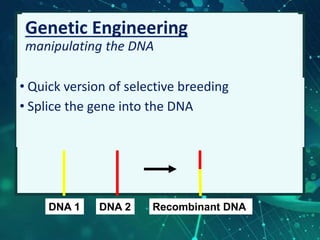
manipulating the DNA
• Quick version of selective breeding
• Splice the gene into the DNA
DNA 1 DNA 2 Recombinant DNA
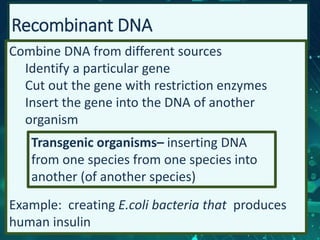
Recombinant DNA
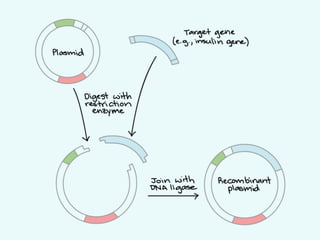
Combine DNA from different sources
Identify a particular gene
Cut out the gene with restriction enzymes
Insert the gene into the DNA of another
organism
Example: creating E.coli bacteria that produces
human insulin
Transgenic organisms– inserting DNA
from one species from one species into
another (of another species)
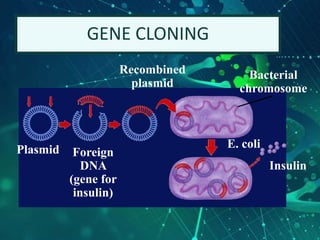
GENE CLONING
Plasmid Foreign
DNA
(gene for
insulin)
Recombined
plasmid
Bacterial
chromosome
E. coli
Insulin
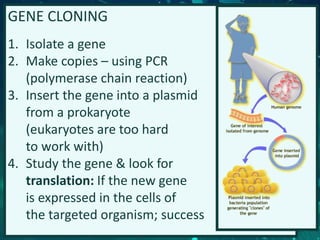
GENE CLONING
1. Isolate a gene
2. Make copies – using PCR
(polymerase chain reaction)
3. Insert the gene into a plasmid
from a prokaryote
(eukaryotes are too hard
to work with)
4. Study the gene & look for
translation: If the new gene
is expressed in the cells of
the targeted organism; success
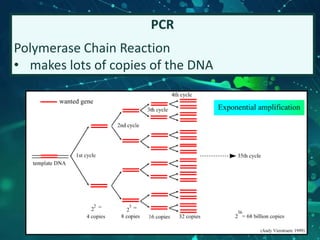
PCR
Polymerase Chain Reaction
• makes lots of copies of the DNA
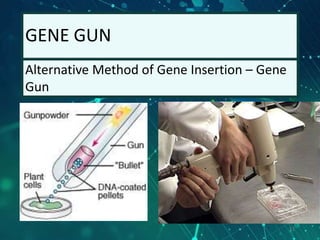
GENE GUN
Alternative Method of Gene Insertion – Gene
Gun
11
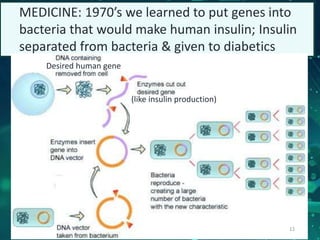
MEDICINE: 1970’s we learned to put genes into
bacteria that would make human insulin; Insulin
separated from bacteria & given to diabetics
Desired human gene
(like insulin production)
12
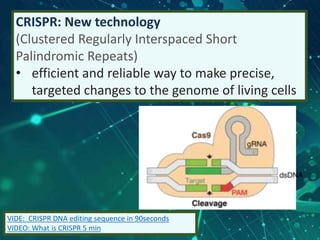
CRISPR: New technology
(Clustered Regularly Interspaced Short
Palindromic Repeats)
• efficient and reliable way to make precise,
targeted changes to the genome of living cells
VIDE: CRISPR DNA editing sequence in 90seconds
VIDEO: What is CRISPR 5 min
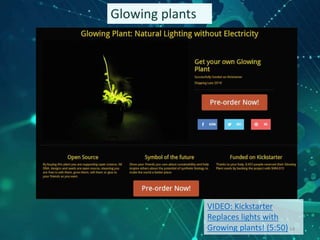
Glowing plants
VIDEO: Kickstarter
Replaces lights with
Growing plants! (5:50) 14
Are GMOs Good or Bad? GMOs & Our Food
VIDEO: (9 min) VIDEO
16
GMO’s & FOOD
Two major categories of GMO crops:
1. Crops to resist pests= turning plant into its
own pesticide
2. Crops resistant to herbicide, Roundup=
farmers spray crops with Roundup & all
plants/weeds are killed except the crop
VIDEO: What is a GMO? (3 min)
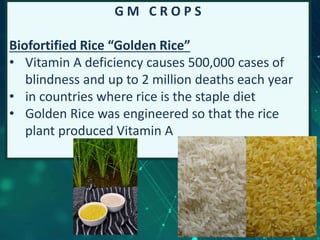
G M C R O P S
Biofortified Rice “Golden Rice”
• Vitamin A deficiency causes 500,000 cases of
blindness and up to 2 million deaths each year
• in countries where rice is the staple diet
• Golden Rice was engineered so that the rice
plant produced Vitamin A
17
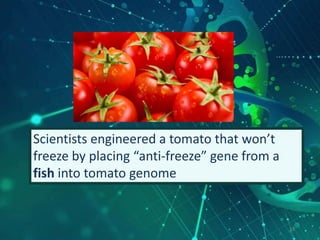
Scientists engineered a tomato that won’t
freeze by placing “anti-freeze” gene from a
fish into tomato genome
18
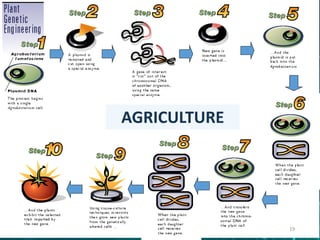
AGRICULTURE
19
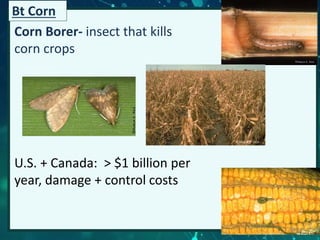
European Corn Borer
Corn Borer- insect that kills
corn crops
U.S. + Canada: > $1 billion per
year, damage + control costs
Bt Corn
20
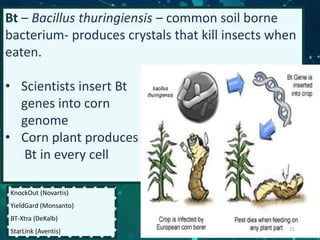
Bt – Bacillus thuringiensis – common soil borne
bacterium- produces crystals that kill insects when
eaten.
• Scientists insert Bt
genes into corn
genome
• Corn plant produces
Bt in every cell
KnockOut (Novartis)
YieldGard (Monsanto)
BT-Xtra (DeKalb)
StarLink (Aventis) 21
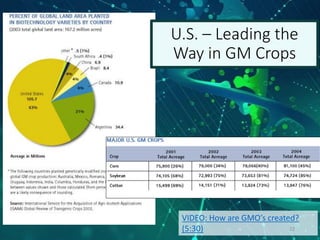
U.S. – Leading the
Way in GM Crops
VIDEO: How are GMO’s created?
(5:30) 22
How are GMO’s tested & approved?
EPA- (Environmental Protection Agency) evaluates
environmental safety
USDA- (US Department of Agriculture) evaluates
whether plant is safe to grow
FDA- (Food & Drug Administration) evaluates
whether the plant is safe to eat
23
How are GMO’s tested & approved?
1. Scientists have to perform studies on the new
product & determine it safe
2. Scientists present the data to the EPA, USDA,
FDA
3. EPA, USDA, FDA approves product
VIDEO: Eyes of Nye GM
foods (8 min) 24
QUESTIONS: Who are the scientists?
Is their data transparent to the public?
TRUTH:
25
What’s the Debate?
VIDEO: “What’s the Deal with Genetically Modified Food? (3min)
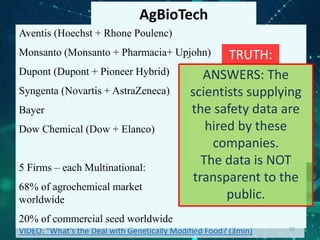
AgBioTech
Aventis (Hoechst + Rhone Poulenc)
Monsanto (Monsanto + Pharmacia+ Upjohn)
Dupont (Dupont + Pioneer Hybrid)
Syngenta (Novartis + AstraZeneca)
Bayer
Dow Chemical (Dow + Elanco)
5 Firms – each Multinational:
68% of agrochemical market
worldwide
20% of commercial seed worldwide
26
ANSWERS: The
scientists supplying
the safety data are
hired by these
companies.
The data is NOT
transparent to the
public.
TRUTH:
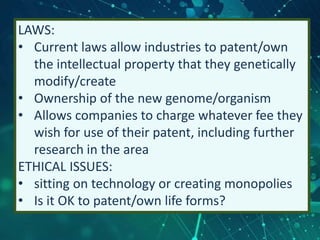
LAWS:
• Current laws allow industries to patent/own
the intellectual property that they genetically
modify/create
• Ownership of the new genome/organism
• Allows companies to charge whatever fee they
wish for use of their patent, including further
research in the area
ETHICAL ISSUES:
• sitting on technology or creating monopolies
• Is it OK to patent/own life forms?
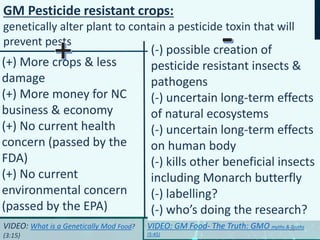
GM Pesticide resistant crops:
genetically alter plant to contain a pesticide toxin that will
prevent pests
(+) More crops & less
damage
(+) More money for NC
business & economy
(+) No current health
concern (passed by the
FDA)
(+) No current
environmental concern
(passed by the EPA)
(-) possible creation of
pesticide resistant insects &
pathogens
(-) uncertain long-term effects
of natural ecosystems
(-) uncertain long-term effects
on human body
(-) kills other beneficial insects
including Monarch butterfly
(-) labelling?
(-) who’s doing the research?
VIDEO: GM Food- The Truth: GMO myths & Truths
(5:45)
VIDEO: What is a Genetically Mod Food?
(3:15)
28
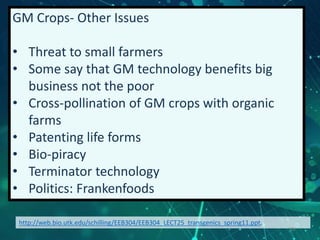
GM Crops- Other Issues
• Threat to small farmers
• Some say that GM technology benefits big
business not the poor
• Cross-pollination of GM crops with organic
farms
• Patenting life forms
• Bio-piracy
• Terminator technology
• Politics: Frankenfoods
http://web.bio.utk.edu/schilling/EEB304/EEB304_LECT25_transgenics_spring11.ppt.
29
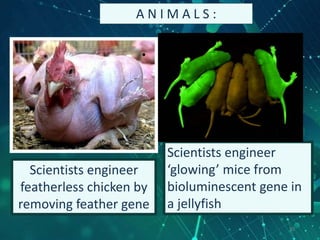
A N I M A L S :
Scientists engineer
featherless chicken by
removing feather gene
Scientists engineer
‘glowing’ mice from
bioluminescent gene in
a jellyfish
30
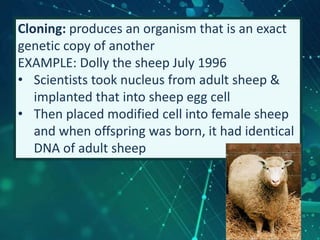
Cloning: produces an organism that is an exact
genetic copy of another
EXAMPLE: Dolly the sheep July 1996
• Scientists took nucleus from adult sheep &
implanted that into sheep egg cell
• Then placed modified cell into female sheep
and when offspring was born, it had identical
DNA of adult sheep
31
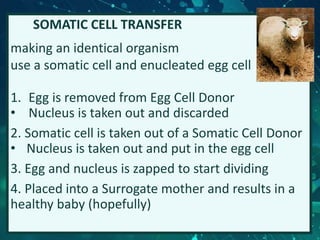
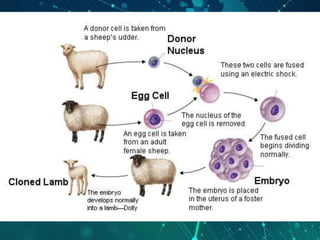
SOMATIC CELL TRANSFER
making an identical organism
use a somatic cell and enucleated egg cell
1. Egg is removed from Egg Cell Donor
• Nucleus is taken out and discarded
2. Somatic cell is taken out of a Somatic Cell Donor
• Nucleus is taken out and put in the egg cell
3. Egg and nucleus is zapped to start dividing
4. Placed into a Surrogate mother and results in a
healthy baby (hopefully)
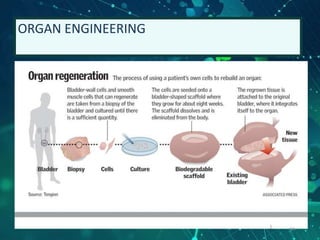
ORGAN ENGINEERING
34
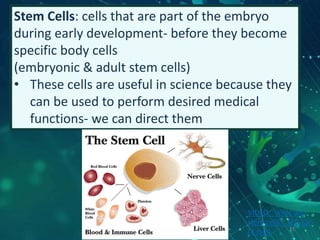
Stem Cells: cells that are part of the embryo
during early development- before they become
specific body cells
(embryonic & adult stem cells)
• These cells are useful in science because they
can be used to perform desired medical
functions- we can direct them
VIDEO: What are
stem cells? TED Ed
(4 min) 35
Genetic engineering & you:
(+) medical knowledge
in your DNA could help
prevent diseases
(+) personal medicine
for your DNA
(+) organ transplants
from your own cells
(+) birth defects can be
avoided
(-) when is it going too far?
(-) who has access to your
DNA information?
(-) whose cells will you use?
(-) how is research
conducted? Who are the
test subjects?
36
Genetic Engineering Other Issues
• What is going too far?
• STEM cells- when is a human ‘alive?’
• What if insurance companies could know
about your DNA?
• Should DNA information be kept in databases
or is it your personal information? Who will
regulate this?
http://web.bio.utk.edu/schilling/EEB304/EEB304
_LECT25_transgenics_spring11.ppt. 37
FOR THE DNA TEST:
Study all DNA notes
• DNA structure & function
• DNA replication
• Protein synthesis (from DNA to RNA to protein)
• Mutations
• DNA technology
LAB
Glow-in-the-Dark
Cat ARTICLE
39
LAB
Biotechnology
Match-up
40
41
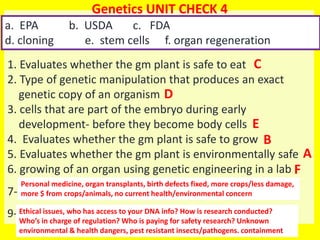
1. Evaluates whether the gm plant is safe to eat
2. Type of genetic manipulation that produces an exact
genetic copy of an organism
3. cells that are part of the embryo during early
development- before they become body cells
4. Evaluates whether the gm plant is safe to grow
5. Evaluates whether the gm plant is environmentally safe
6. growing of an organ using genetic engineering in a lab
7-8 Give 2 benefits of using genetic engineering.
9-10 Give 2 reasons not to use genetic engineering.
Genetics UNIT CHECK 4
a. EPA b. USDA c. FDA
d. cloning e. stem cells f. organ regeneration
C
D
E
B
A
F
Personal medicine, organ transplants, birth defects fixed, more crops/less damage,
more $ from crops/animals, no current health/environmental concern
Ethical issues, who has access to your DNA info? How is research conducted?
Who’s in charge of regulation? Who is paying for safety research? Unknown
environmental & health dangers, pest resistant insects/pathogens. containment
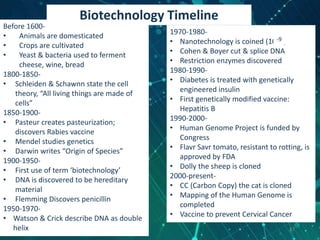
Before 1600-
• Animals are domesticated
• Crops are cultivated
• Yeast & bacteria used to ferment
cheese, wine, bread
1800-1850-
• Schleiden & Schawnn state the cell
theory, “All living things are made of
cells”
1850-1900-
• Pasteur creates pasteurization;
discovers Rabies vaccine
• Mendel studies genetics
• Darwin writes “Origin of Species”
1900-1950-
• First use of term ‘biotechnology’
• DNA is discovered to be hereditary
material
• Flemming Discovers penicillin
1950-1970-
• Watson & Crick describe DNA as double
helix
Biotechnology Timeline
1970-1980-
• Nanotechnology is coined (10 )
• Cohen & Boyer cut & splice DNA
• Restriction enzymes discovered
1980-1990-
• Diabetes is treated with genetically
engineered insulin
• First genetically modified vaccine:
Hepatitis B
1990-2000-
• Human Genome Project is funded by
Congress
• Flavr Savr tomato, resistant to rotting, is
approved by FDA
• Dolly the sheep is cloned
2000-present-
• CC (Carbon Copy) the cat is cloned
• Mapping of the Human Genome is
completed
• Vaccine to prevent Cervical Cancer
-9
42
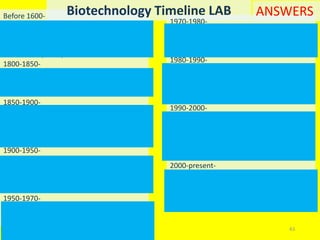
Before 1600-
• Animals are domesticated
• Crops are cultivated
• Yeast & bacteria used to ferment
cheese, wine, bread
1800-1850-
• Schleiden & Schawnn state the cell
theory, “All living things are made of
cells”
1850-1900-
• Pasteur creates pasteurization;
discovers Rabies vaccine
• Mendel studies genetics
• Darwin writes “Origin of Species”
1900-1950-
• First use of term ‘biotechnology’
• DNA is discovered to be hereditary
material
• Flemming Discovers penicillin
1950-1970-
• Watson & Crick describe DNA as double
helix
Biotechnology Timeline LAB
1970-1980-
• Nanotechnology is coined (10 )
• Cohen & Boyer cut & splice DNA
• Restriction enzymes discovered
1980-1990-
• Diabetes is treated with genetically
engineered insulin
• First genetically modified vaccine:
Hepatitis B
1990-2000-
• Human Genome Project is funded by
Congress
• Flavr Savr tomato, resistant to rotting, is
approved by FDA
• Dolly the sheep is cloned
2000-present-
• CC (Carbon Copy) the cat is cloned
• Mapping of the Human Genome is
completed
• Vaccine to prevent Cervical Cancer
-9
ANSWERS
43
LAB
Medical Ethics
44
RESOURCES:
‘Biotechnology’ presentation by Christina M. Spears, Georgia Ag Education Curriculum Office 2003
Edward Schilling presentation:
http://web.bio.utk.edu/schilling/EEB304/EEB304_LECT25_transgenics_spring11.ppt.
LABS: Beyond Benign
http://www.beyondbenign.org/K12education/biotech_ms.html
45
VIDEO: GMO A Go Go (8 min)
JUST FOR FUN…
46

DNA Technology 2 genetic engineering notes

  • 1.
    DNA Technology 2 Genetic Engineering ppt.by Robin D. Seamon HOOK VIDEO: Nova: Cracking your genetic code 55 minutes
  • 2.
    VIDEO: Genetic Engineeringwill Change Everything Forever: CRISPR (14 min) VIDEO
  • 3.
    • All livingthings use the same 4 nucleotide bases of DNA (A-T, C-G) & ribosomes • THEREFORE, DNA from different organisms can be joined or ‘spliced’ together… GENETIC ENGINEERING 3
  • 4.
    G E NE T I C E N G I N E E R I N G • Recombinant DNA technology • Gene manipulation 1. genes are engineered by scientists into organisms such as microbes or bacteria, for mass-production 2. insertion of select genes into organisms to improve their genotype 4
  • 5.
    Genetic Engineering manipulating theDNA • Quick version of selective breeding • Splice the gene into the DNA DNA 1 DNA 2 Recombinant DNA
  • 6.
    Recombinant DNA Combine DNAfrom different sources Identify a particular gene Cut out the gene with restriction enzymes Insert the gene into the DNA of another organism Example: creating E.coli bacteria that produces human insulin Transgenic organisms– inserting DNA from one species from one species into another (of another species)
  • 7.
    GENE CLONING Plasmid Foreign DNA (genefor insulin) Recombined plasmid Bacterial chromosome E. coli Insulin
  • 8.
    GENE CLONING 1. Isolatea gene 2. Make copies – using PCR (polymerase chain reaction) 3. Insert the gene into a plasmid from a prokaryote (eukaryotes are too hard to work with) 4. Study the gene & look for translation: If the new gene is expressed in the cells of the targeted organism; success
  • 9.
    PCR Polymerase Chain Reaction •makes lots of copies of the DNA
  • 11.
    GENE GUN Alternative Methodof Gene Insertion – Gene Gun 11
  • 12.
    MEDICINE: 1970’s welearned to put genes into bacteria that would make human insulin; Insulin separated from bacteria & given to diabetics Desired human gene (like insulin production) 12
  • 13.
    CRISPR: New technology (ClusteredRegularly Interspaced Short Palindromic Repeats) • efficient and reliable way to make precise, targeted changes to the genome of living cells VIDE: CRISPR DNA editing sequence in 90seconds VIDEO: What is CRISPR 5 min
  • 14.
    Glowing plants VIDEO: Kickstarter Replaceslights with Growing plants! (5:50) 14
  • 15.
    Are GMOs Goodor Bad? GMOs & Our Food VIDEO: (9 min) VIDEO
  • 16.
    16 GMO’s & FOOD Twomajor categories of GMO crops: 1. Crops to resist pests= turning plant into its own pesticide 2. Crops resistant to herbicide, Roundup= farmers spray crops with Roundup & all plants/weeds are killed except the crop VIDEO: What is a GMO? (3 min)
  • 17.
    G M CR O P S Biofortified Rice “Golden Rice” • Vitamin A deficiency causes 500,000 cases of blindness and up to 2 million deaths each year • in countries where rice is the staple diet • Golden Rice was engineered so that the rice plant produced Vitamin A 17
  • 18.
    Scientists engineered atomato that won’t freeze by placing “anti-freeze” gene from a fish into tomato genome 18
  • 19.
  • 20.
    European Corn Borer CornBorer- insect that kills corn crops U.S. + Canada: > $1 billion per year, damage + control costs Bt Corn 20
  • 21.
    Bt – Bacillusthuringiensis – common soil borne bacterium- produces crystals that kill insects when eaten. • Scientists insert Bt genes into corn genome • Corn plant produces Bt in every cell KnockOut (Novartis) YieldGard (Monsanto) BT-Xtra (DeKalb) StarLink (Aventis) 21
  • 22.
    U.S. – Leadingthe Way in GM Crops VIDEO: How are GMO’s created? (5:30) 22
  • 23.
    How are GMO’stested & approved? EPA- (Environmental Protection Agency) evaluates environmental safety USDA- (US Department of Agriculture) evaluates whether plant is safe to grow FDA- (Food & Drug Administration) evaluates whether the plant is safe to eat 23
  • 24.
    How are GMO’stested & approved? 1. Scientists have to perform studies on the new product & determine it safe 2. Scientists present the data to the EPA, USDA, FDA 3. EPA, USDA, FDA approves product VIDEO: Eyes of Nye GM foods (8 min) 24 QUESTIONS: Who are the scientists? Is their data transparent to the public? TRUTH:
  • 25.
  • 26.
    What’s the Debate? VIDEO:“What’s the Deal with Genetically Modified Food? (3min) AgBioTech Aventis (Hoechst + Rhone Poulenc) Monsanto (Monsanto + Pharmacia+ Upjohn) Dupont (Dupont + Pioneer Hybrid) Syngenta (Novartis + AstraZeneca) Bayer Dow Chemical (Dow + Elanco) 5 Firms – each Multinational: 68% of agrochemical market worldwide 20% of commercial seed worldwide 26 ANSWERS: The scientists supplying the safety data are hired by these companies. The data is NOT transparent to the public. TRUTH:
  • 27.
    LAWS: • Current lawsallow industries to patent/own the intellectual property that they genetically modify/create • Ownership of the new genome/organism • Allows companies to charge whatever fee they wish for use of their patent, including further research in the area ETHICAL ISSUES: • sitting on technology or creating monopolies • Is it OK to patent/own life forms?
  • 28.
    GM Pesticide resistantcrops: genetically alter plant to contain a pesticide toxin that will prevent pests (+) More crops & less damage (+) More money for NC business & economy (+) No current health concern (passed by the FDA) (+) No current environmental concern (passed by the EPA) (-) possible creation of pesticide resistant insects & pathogens (-) uncertain long-term effects of natural ecosystems (-) uncertain long-term effects on human body (-) kills other beneficial insects including Monarch butterfly (-) labelling? (-) who’s doing the research? VIDEO: GM Food- The Truth: GMO myths & Truths (5:45) VIDEO: What is a Genetically Mod Food? (3:15) 28
  • 29.
    GM Crops- OtherIssues • Threat to small farmers • Some say that GM technology benefits big business not the poor • Cross-pollination of GM crops with organic farms • Patenting life forms • Bio-piracy • Terminator technology • Politics: Frankenfoods http://web.bio.utk.edu/schilling/EEB304/EEB304_LECT25_transgenics_spring11.ppt. 29
  • 30.
    A N IM A L S : Scientists engineer featherless chicken by removing feather gene Scientists engineer ‘glowing’ mice from bioluminescent gene in a jellyfish 30
  • 31.
    Cloning: produces anorganism that is an exact genetic copy of another EXAMPLE: Dolly the sheep July 1996 • Scientists took nucleus from adult sheep & implanted that into sheep egg cell • Then placed modified cell into female sheep and when offspring was born, it had identical DNA of adult sheep 31
  • 32.
    SOMATIC CELL TRANSFER makingan identical organism use a somatic cell and enucleated egg cell 1. Egg is removed from Egg Cell Donor • Nucleus is taken out and discarded 2. Somatic cell is taken out of a Somatic Cell Donor • Nucleus is taken out and put in the egg cell 3. Egg and nucleus is zapped to start dividing 4. Placed into a Surrogate mother and results in a healthy baby (hopefully)
  • 34.
  • 35.
    Stem Cells: cellsthat are part of the embryo during early development- before they become specific body cells (embryonic & adult stem cells) • These cells are useful in science because they can be used to perform desired medical functions- we can direct them VIDEO: What are stem cells? TED Ed (4 min) 35
  • 36.
    Genetic engineering &you: (+) medical knowledge in your DNA could help prevent diseases (+) personal medicine for your DNA (+) organ transplants from your own cells (+) birth defects can be avoided (-) when is it going too far? (-) who has access to your DNA information? (-) whose cells will you use? (-) how is research conducted? Who are the test subjects? 36
  • 37.
    Genetic Engineering OtherIssues • What is going too far? • STEM cells- when is a human ‘alive?’ • What if insurance companies could know about your DNA? • Should DNA information be kept in databases or is it your personal information? Who will regulate this? http://web.bio.utk.edu/schilling/EEB304/EEB304 _LECT25_transgenics_spring11.ppt. 37
  • 38.
    FOR THE DNATEST: Study all DNA notes • DNA structure & function • DNA replication • Protein synthesis (from DNA to RNA to protein) • Mutations • DNA technology
  • 39.
  • 40.
  • 41.
    41 1. Evaluates whetherthe gm plant is safe to eat 2. Type of genetic manipulation that produces an exact genetic copy of an organism 3. cells that are part of the embryo during early development- before they become body cells 4. Evaluates whether the gm plant is safe to grow 5. Evaluates whether the gm plant is environmentally safe 6. growing of an organ using genetic engineering in a lab 7-8 Give 2 benefits of using genetic engineering. 9-10 Give 2 reasons not to use genetic engineering. Genetics UNIT CHECK 4 a. EPA b. USDA c. FDA d. cloning e. stem cells f. organ regeneration C D E B A F Personal medicine, organ transplants, birth defects fixed, more crops/less damage, more $ from crops/animals, no current health/environmental concern Ethical issues, who has access to your DNA info? How is research conducted? Who’s in charge of regulation? Who is paying for safety research? Unknown environmental & health dangers, pest resistant insects/pathogens. containment
  • 42.
    Before 1600- • Animalsare domesticated • Crops are cultivated • Yeast & bacteria used to ferment cheese, wine, bread 1800-1850- • Schleiden & Schawnn state the cell theory, “All living things are made of cells” 1850-1900- • Pasteur creates pasteurization; discovers Rabies vaccine • Mendel studies genetics • Darwin writes “Origin of Species” 1900-1950- • First use of term ‘biotechnology’ • DNA is discovered to be hereditary material • Flemming Discovers penicillin 1950-1970- • Watson & Crick describe DNA as double helix Biotechnology Timeline 1970-1980- • Nanotechnology is coined (10 ) • Cohen & Boyer cut & splice DNA • Restriction enzymes discovered 1980-1990- • Diabetes is treated with genetically engineered insulin • First genetically modified vaccine: Hepatitis B 1990-2000- • Human Genome Project is funded by Congress • Flavr Savr tomato, resistant to rotting, is approved by FDA • Dolly the sheep is cloned 2000-present- • CC (Carbon Copy) the cat is cloned • Mapping of the Human Genome is completed • Vaccine to prevent Cervical Cancer -9 42
  • 43.
    Before 1600- • Animalsare domesticated • Crops are cultivated • Yeast & bacteria used to ferment cheese, wine, bread 1800-1850- • Schleiden & Schawnn state the cell theory, “All living things are made of cells” 1850-1900- • Pasteur creates pasteurization; discovers Rabies vaccine • Mendel studies genetics • Darwin writes “Origin of Species” 1900-1950- • First use of term ‘biotechnology’ • DNA is discovered to be hereditary material • Flemming Discovers penicillin 1950-1970- • Watson & Crick describe DNA as double helix Biotechnology Timeline LAB 1970-1980- • Nanotechnology is coined (10 ) • Cohen & Boyer cut & splice DNA • Restriction enzymes discovered 1980-1990- • Diabetes is treated with genetically engineered insulin • First genetically modified vaccine: Hepatitis B 1990-2000- • Human Genome Project is funded by Congress • Flavr Savr tomato, resistant to rotting, is approved by FDA • Dolly the sheep is cloned 2000-present- • CC (Carbon Copy) the cat is cloned • Mapping of the Human Genome is completed • Vaccine to prevent Cervical Cancer -9 ANSWERS 43
  • 44.
  • 45.
    RESOURCES: ‘Biotechnology’ presentation byChristina M. Spears, Georgia Ag Education Curriculum Office 2003 Edward Schilling presentation: http://web.bio.utk.edu/schilling/EEB304/EEB304_LECT25_transgenics_spring11.ppt. LABS: Beyond Benign http://www.beyondbenign.org/K12education/biotech_ms.html 45
  • 46.
    VIDEO: GMO AGo Go (8 min) JUST FOR FUN… 46