

Presented by :-
Jay Khaniya (17),
Dilpesh Kachhot (18),
Anand Bambhaniya
(41).
Guided by :-
Proff. Vipul Shinde
Outline of Presentation
Introduction
Why we need SHCS?
Solar heating method
Passive heating system
Active heating system
Important Component
Advantages of SHC over conventional methods
Conclusion
Bibliography
 Solar heating and cooling technology
receive the thermal energy from sun
and utilize this energy to provide space
heating and cooling for residential,
commercial and industrial applications.
 The main function of solar system is to
convert sun light into heat.
 The primary requirement of Solar
Heating and Cooling System is to setup
the light collectors with higher
efficiency.
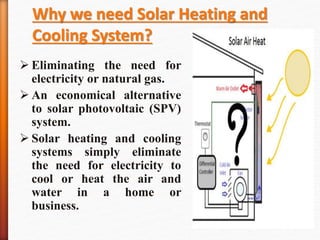
Why we need Solar Heating and
Cooling System?
 Eliminating the need for
electricity or natural gas.
 An economical alternative
to solar photovoltaic (SPV)
system.
 Solar heating and cooling
systems simply eliminate
the need for electricity to
cool or heat the air and
water in a home or
business.
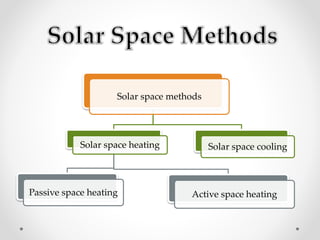
Solar space methods
Solar space heating
Passive space heating Active space heating
Solar space cooling
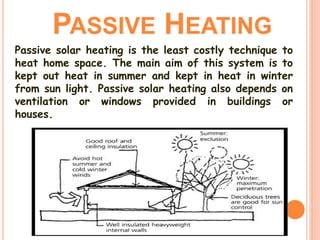
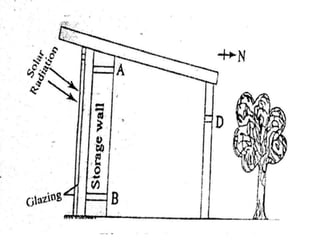
PASSIVE HEATING
Passive solar heating is the least costly technique to
heat home space. The main aim of this system is to
kept out heat in summer and kept in heat in winter
from sun light. Passive solar heating also depends on
ventilation or windows provided in buildings or
houses.
» This system can be used as commercial hot
water as well as space heat.
» A space heat application involves some
additional connecting hardware for space
heat distribution system.
» The two basic types of active solar space-
heating systems use either liquid or air as
the heat-transfer medium in their solar
energy collectors
» Liquid-based systems heat water and air-
based systems heat air in the collector.
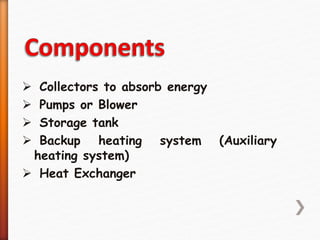
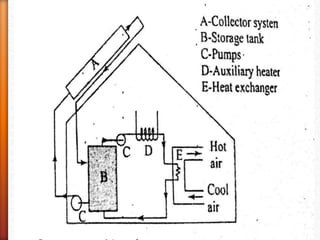
 Collectors to absorb energy
 Pumps or Blower
 Storage tank
 Backup heating system (Auxiliary
heating system)
 Heat Exchanger
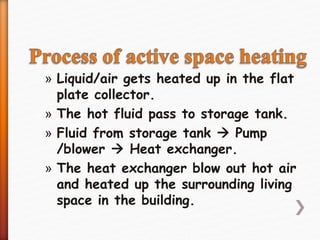
» Liquid/air gets heated up in the flat
plate collector.
» The hot fluid pass to storage tank.
» Fluid from storage tank  Pump
/blower  Heat exchanger.
» The heat exchanger blow out hot air
and heated up the surrounding living
space in the building.
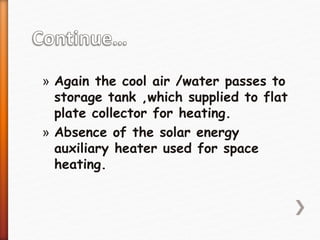
» Again the cool air /water passes to
storage tank ,which supplied to flat
plate collector for heating.
» Absence of the solar energy
auxiliary heater used for space
heating.
» The two basic types of active solar
space-heating systems use either liquid
or air as the heat-transfer medium in
their solar energy collectors
» Liquid-based systems heat water and
air-based systems heat air in the
collector.
» Both of these systems collect and
absorb solar radiation, then transfer
the solar heat directly to the interior
space or to a storage system, from
which the heat is distributed.
SHC reduced the conventional
heating and cooling cost up to 35-
40%.
 This system helps by providing
employment to establish SHC
system.
 Direct reduction can be made by
using SHC system.
 Combination of heating and
cooling easily available for all type
of back up heat source.
 Energy sourced easily available
in maximum quantity.
 Collectors are used can be
recyclable.
Conclusion :-
Solar heating and cooling system
reduce the operating cost as compare
to conventional methods.
 Efficiency of conventional method
of heating and cooling can be
increased 35-40%with the help of
solar heating and cooling system.
The main consideration will be to
reduce the initial cost of the system in
future.
 This system provide healthy
environment to the employee in
industries by heating and cooling
mechanism.
 Solarserver.com
 Solarheatcool.sustainable.com
 Slideshare.net
 Images from Google and
Subject lecture note.
Solar space heating and cooling

Solar space heating and cooling

  • 2.
    Presented by :- JayKhaniya (17), Dilpesh Kachhot (18), Anand Bambhaniya (41). Guided by :- Proff. Vipul Shinde
  • 3.
    Outline of Presentation Introduction Whywe need SHCS? Solar heating method Passive heating system Active heating system Important Component Advantages of SHC over conventional methods Conclusion Bibliography
  • 4.
     Solar heatingand cooling technology receive the thermal energy from sun and utilize this energy to provide space heating and cooling for residential, commercial and industrial applications.  The main function of solar system is to convert sun light into heat.  The primary requirement of Solar Heating and Cooling System is to setup the light collectors with higher efficiency.
  • 5.
    Why we needSolar Heating and Cooling System?  Eliminating the need for electricity or natural gas.  An economical alternative to solar photovoltaic (SPV) system.  Solar heating and cooling systems simply eliminate the need for electricity to cool or heat the air and water in a home or business.
  • 6.
    Solar space methods Solarspace heating Passive space heating Active space heating Solar space cooling
  • 7.
    PASSIVE HEATING Passive solarheating is the least costly technique to heat home space. The main aim of this system is to kept out heat in summer and kept in heat in winter from sun light. Passive solar heating also depends on ventilation or windows provided in buildings or houses.
  • 9.
    » This systemcan be used as commercial hot water as well as space heat. » A space heat application involves some additional connecting hardware for space heat distribution system. » The two basic types of active solar space- heating systems use either liquid or air as the heat-transfer medium in their solar energy collectors » Liquid-based systems heat water and air- based systems heat air in the collector.
  • 10.
     Collectors toabsorb energy  Pumps or Blower  Storage tank  Backup heating system (Auxiliary heating system)  Heat Exchanger
  • 12.
    » Liquid/air getsheated up in the flat plate collector. » The hot fluid pass to storage tank. » Fluid from storage tank  Pump /blower  Heat exchanger. » The heat exchanger blow out hot air and heated up the surrounding living space in the building.
  • 13.
    » Again thecool air /water passes to storage tank ,which supplied to flat plate collector for heating. » Absence of the solar energy auxiliary heater used for space heating.
  • 14.
    » The twobasic types of active solar space-heating systems use either liquid or air as the heat-transfer medium in their solar energy collectors » Liquid-based systems heat water and air-based systems heat air in the collector. » Both of these systems collect and absorb solar radiation, then transfer the solar heat directly to the interior space or to a storage system, from which the heat is distributed.
  • 15.
    SHC reduced theconventional heating and cooling cost up to 35- 40%.  This system helps by providing employment to establish SHC system.  Direct reduction can be made by using SHC system.
  • 16.
     Combination ofheating and cooling easily available for all type of back up heat source.  Energy sourced easily available in maximum quantity.  Collectors are used can be recyclable.
  • 17.
    Conclusion :- Solar heatingand cooling system reduce the operating cost as compare to conventional methods.  Efficiency of conventional method of heating and cooling can be increased 35-40%with the help of solar heating and cooling system.
  • 18.
    The main considerationwill be to reduce the initial cost of the system in future.  This system provide healthy environment to the employee in industries by heating and cooling mechanism.
  • 19.
     Solarserver.com  Solarheatcool.sustainable.com Slideshare.net  Images from Google and Subject lecture note.