
Large variety of organisms on this earth they are all
distinct in their form & structure ,yet they all
possess similarity in their basic structure & function
the bodies of all plants & animals are made up of
cell
Defination of cell
 The cell (from Latin cella, meaning "small room") is
the basic structural, functional, and biological unit of
all known living organisms. Acell is the smallest unit
of life that can replicate independently, and cells are
often called the "building blocks of life". The study
ofcells is called cell biology.
DISCOVERY OF THE CELL
 Cell are the basic structures of all living beings,
Yet they remained undiscovered for a long time
This is becaues the majority of the cell are too
Small to be seen by the naked eye it was only
After the advent of optical instrument in the
17th century, that the study of the cell could be made
possible
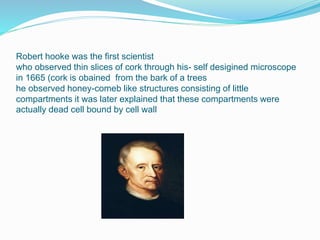
Robert hooke was the first scientist
who observed thin slices of cork through his- self desigined microscope
in 1665 (cork is obained from the bark of a trees
he observed honey-comeb like structures consisting of little
compartments it was later explained that these compartments were
actually dead cell bound by cell wall
size in living organisms
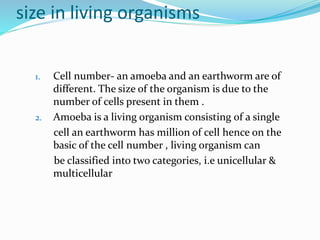
1. Cell number- an amoeba and an earthworm are of
different. The size of the organism is due to the
number of cells present in them .
2. Amoeba is a living organism consisting of a single
cell an earthworm has million of cell hence on the
basic of the cell number , living organism can
be classified into two categories, i.e unicellular &
multicellular
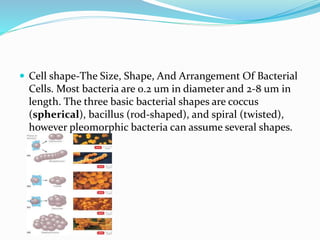
 Cell shape-The Size, Shape, And Arrangement Of Bacterial
Cells. Most bacteria are 0.2 um in diameter and 2-8 um in
length. The three basic bacterial shapes are coccus
(spherical), bacillus (rod-shaped), and spiral (twisted),
however pleomorphic bacteria can assume several shapes.
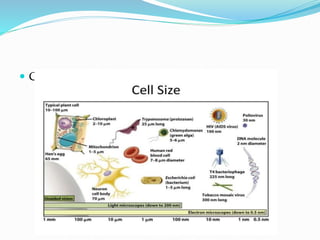
 Cell size- show on diagram
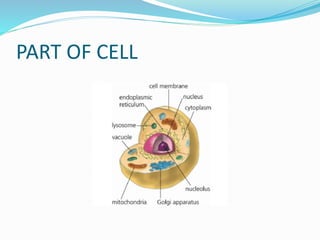
PART OF CELL
PART OF CELL
 Cell membrane- all living cell are bound by a
membrane called the plasma membrane or the cell
membrane it surround the inner gel-like material
called protoplasm the plasma membrane controls the
entry and the exit of substances according to the
requirement of the cell plants fungi and bacteria have
an additionl outer covering called the cell wall
 Cytoplasma- the portion of the protoplasm lying inner to the cell
membrane but outside the nuclear membrane is called
cytoplasm it acts as aground substance for all cell activities.it
made up of carbohydrates, proteins fats minerals vitamine along
with a large proportion of water all these compount works
together to provide a unique living nature to the protoplasm
 Nucleus-the central and most important part of an object,
movement, or group, forming the basis for its activity and
growth. The nucleus is a dense structure bound by a nuclear
membrane the protoplasm of the nucleus is called nucleoplasm
it has thread like network called chromatin
 Chromosomes-a thread-like structure of nucleic acids and
protein found in the nucleus of most living cells, carrying genetic
information in the form of genes.
CELL ORGANELLES
 Plastide-
Any of several cytoplasmic organelles, such as chloropl
asts, that contain genetic material, have a double mem
brane,and are often pigmented. Plastids are found in p
lants, algae, and certain other eukaryotic organisms an
d have variousphysiological functions, such as the synt
hesis and storage of food.
 Mitochondria-an organelle found in large numbers in
most cells, in which the biochemical processes of
respiration and energy production occur. It has a double
membrane, the inner part being folded inwards to form
layers (cristae).
 Endoplasmic reticulum (ER)-n. a network of tubular membranes within
the cytoplasm of the cell, occurring either with a smooth surface
(smooth endoplasmic reticulum) or studded with ribosomes
(rough endoplasmic reticulum), involved in the transport of materials..
 Golgi complex-The Golgi complex, also known as the Golgiapparatus or
simply the Golgi, is a cytoplasmic organelle. It is found in eukaryote cells,
as in animals, plants, and fungi. Thecomplex was discovered by
Camillo Golgi in 1898. they are also called the store houes of the cell
 Vocules-a membrane
bound cavity within a cell, often containing a watery liquidor secretion. mi
nute cavity or vesicle in organic tissue.
 Ribosomes- minute particle consisting of RNA and associated proteins
found in large numbers in the cytoplasm of living cells. They bind
messenger RNA and transfer RNA to synthesize polypeptides and proteins.
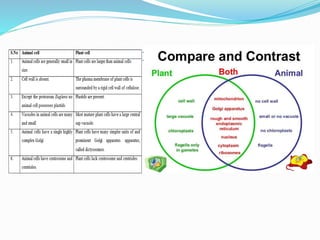
COMPARION BETWEEN PLANT AND ANIMAL CELL
 THANKYOU

Cell & its structure & function

  • 1.
    Large variety oforganisms on this earth they are all distinct in their form & structure ,yet they all possess similarity in their basic structure & function the bodies of all plants & animals are made up of cell
  • 2.
    Defination of cell The cell (from Latin cella, meaning "small room") is the basic structural, functional, and biological unit of all known living organisms. Acell is the smallest unit of life that can replicate independently, and cells are often called the "building blocks of life". The study ofcells is called cell biology.
  • 3.
    DISCOVERY OF THECELL  Cell are the basic structures of all living beings, Yet they remained undiscovered for a long time This is becaues the majority of the cell are too Small to be seen by the naked eye it was only After the advent of optical instrument in the 17th century, that the study of the cell could be made possible
  • 4.
    Robert hooke wasthe first scientist who observed thin slices of cork through his- self desigined microscope in 1665 (cork is obained from the bark of a trees he observed honey-comeb like structures consisting of little compartments it was later explained that these compartments were actually dead cell bound by cell wall
  • 5.
    size in livingorganisms 1. Cell number- an amoeba and an earthworm are of different. The size of the organism is due to the number of cells present in them . 2. Amoeba is a living organism consisting of a single cell an earthworm has million of cell hence on the basic of the cell number , living organism can be classified into two categories, i.e unicellular & multicellular
  • 6.
     Cell shape-TheSize, Shape, And Arrangement Of Bacterial Cells. Most bacteria are 0.2 um in diameter and 2-8 um in length. The three basic bacterial shapes are coccus (spherical), bacillus (rod-shaped), and spiral (twisted), however pleomorphic bacteria can assume several shapes.
  • 7.
     Cell size-show on diagram
  • 8.
  • 9.
    PART OF CELL Cell membrane- all living cell are bound by a membrane called the plasma membrane or the cell membrane it surround the inner gel-like material called protoplasm the plasma membrane controls the entry and the exit of substances according to the requirement of the cell plants fungi and bacteria have an additionl outer covering called the cell wall
  • 10.
     Cytoplasma- theportion of the protoplasm lying inner to the cell membrane but outside the nuclear membrane is called cytoplasm it acts as aground substance for all cell activities.it made up of carbohydrates, proteins fats minerals vitamine along with a large proportion of water all these compount works together to provide a unique living nature to the protoplasm  Nucleus-the central and most important part of an object, movement, or group, forming the basis for its activity and growth. The nucleus is a dense structure bound by a nuclear membrane the protoplasm of the nucleus is called nucleoplasm it has thread like network called chromatin  Chromosomes-a thread-like structure of nucleic acids and protein found in the nucleus of most living cells, carrying genetic information in the form of genes.
  • 11.
    CELL ORGANELLES  Plastide- Anyof several cytoplasmic organelles, such as chloropl asts, that contain genetic material, have a double mem brane,and are often pigmented. Plastids are found in p lants, algae, and certain other eukaryotic organisms an d have variousphysiological functions, such as the synt hesis and storage of food.  Mitochondria-an organelle found in large numbers in most cells, in which the biochemical processes of respiration and energy production occur. It has a double membrane, the inner part being folded inwards to form layers (cristae).
  • 12.
     Endoplasmic reticulum(ER)-n. a network of tubular membranes within the cytoplasm of the cell, occurring either with a smooth surface (smooth endoplasmic reticulum) or studded with ribosomes (rough endoplasmic reticulum), involved in the transport of materials..  Golgi complex-The Golgi complex, also known as the Golgiapparatus or simply the Golgi, is a cytoplasmic organelle. It is found in eukaryote cells, as in animals, plants, and fungi. Thecomplex was discovered by Camillo Golgi in 1898. they are also called the store houes of the cell  Vocules-a membrane bound cavity within a cell, often containing a watery liquidor secretion. mi nute cavity or vesicle in organic tissue.  Ribosomes- minute particle consisting of RNA and associated proteins found in large numbers in the cytoplasm of living cells. They bind messenger RNA and transfer RNA to synthesize polypeptides and proteins.
  • 13.
    COMPARION BETWEEN PLANTAND ANIMAL CELL
  • 14.