Scientific Method The scientific method is a series of steps taken during an experiment in order to solve a problem.
Why is the Scientific Method Important? Continuity Communication within the scientific community 1
Steps of the Scientific Method Observation State the problem Form a hypothesis Experiment Results/Data Analysis 2
Observations Qualitative observation Focus on the qualities of an object. Ex. Color of an object Quantitative observation Characteristics of an object that can be measured. Ex.  Mass, Length 3
State the Problem This problem or question is formed from your observations. This is the question you as the scientist want answered. Also called the “purpose”. 4
Form a Hypothesis The hypothesis is a testable explanation to your problem. “ Educated Guess” is not enough.  You must be able to test your explanation. 5
Experiment Design an experiment that tests your hypothesis.  Control Group:   test variables are kept constant “ Normal Conditions” Experimental Group:   variables are changed  6
Variables Variables – anything that changes throughout the experiment. There are two types of variables: Independent variable – the change that the experimenter controls. Dependent variable – the change that is measured.
Results/Analysis Results This section includes all of the data and information  collected. How do you present your data? Analysis The data is explained and the process is wrapped up. 7
OBSERVATIONS:  Flies land on meat that is left uncovered.  Later, maggots appear on the meat. HYPOTHESIS: Flies produce maggots. PROCEDURE Controlled Variables: jars, type of meat, location, temperature, time Manipulated Variables: gauze covering that keeps flies away from  meat Uncovered jars Covered jars Several  days pass Maggots   appear No maggots appear Responding Variable:  whether maggots  appear CONCLUSION:  Maggots form only when flies come in contact with meat. Spontaneous generation of maggots did not occur. Redi’s experiment Spontaneous Generation – Life arises from non- living things
06/08/09 Gravy is boiled . Flask is open. Gravy is teeming  with microorganisms. Gravy is boiled . Flask is sealed. Gravy is free of  microorganisms . Section 1-2 Figure 1-10 Spallanzani’s Experiment Spallanzani’s Experiment Theory not supported “vital force in air was killed”
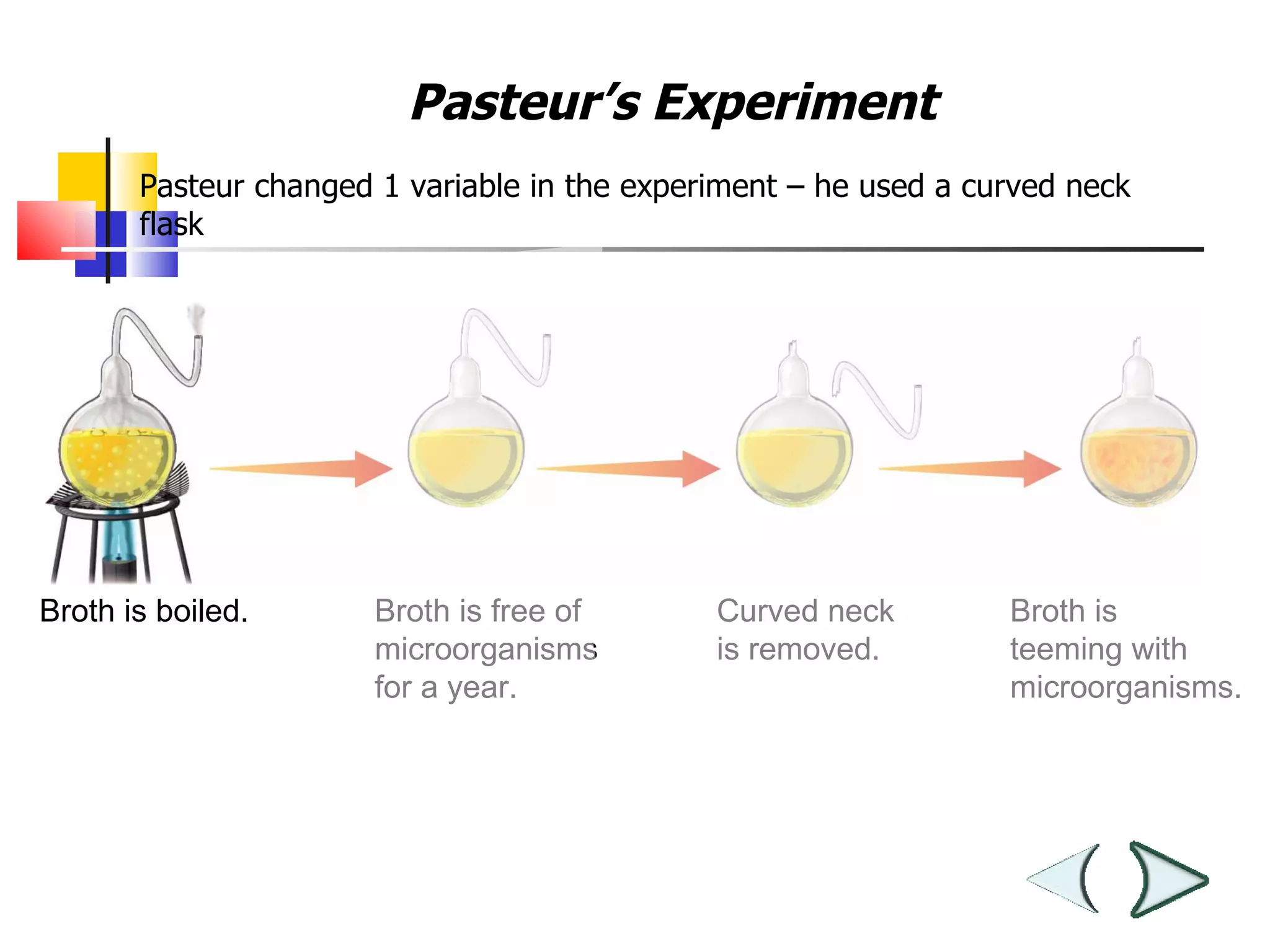
Broth is boiled. Broth is free of microorganisms for a year. Curved neck is removed. Broth is  teeming with microorganisms. Pasteur intro Figure 1-11  Pasteur’s Experiment Pasteur’s Experiment Pasteur changed 1 variable in the experiment – he used a curved neck flask
Broth is boiled. Broth is free of microorganisms for a year. Curved neck is removed. Broth is  teeming with microorganisms. Section 1-2 Figure 1-11  Pasteur’s Experiment The curved neck of the flask allowed air to mix in the jar but not bacteria
Broth is boiled. Broth is free of microorganisms for a year. Curved neck is removed. Broth is  teeming with microorganisms. Section 1-2 Figure 1-11  Pasteur’s Experiment
Broth is boiled. Broth is free of microorganisms for a year. Curved neck is removed. Broth is  teeming with microorganisms. Section 1-2 Figure 1-11  Pasteur’s Experiment Once the neck was removed bacteria entered and spoiled the broth
Assessment Active Art Redi and Pasteur Assesment

Biology Scientific Method

  • 1.
    Scientific Method Thescientific method is a series of steps taken during an experiment in order to solve a problem.
  • 2.
    Why is theScientific Method Important? Continuity Communication within the scientific community 1
  • 3.
    Steps of theScientific Method Observation State the problem Form a hypothesis Experiment Results/Data Analysis 2
  • 4.
    Observations Qualitative observationFocus on the qualities of an object. Ex. Color of an object Quantitative observation Characteristics of an object that can be measured. Ex. Mass, Length 3
  • 5.
    State the ProblemThis problem or question is formed from your observations. This is the question you as the scientist want answered. Also called the “purpose”. 4
  • 6.
    Form a HypothesisThe hypothesis is a testable explanation to your problem. “ Educated Guess” is not enough. You must be able to test your explanation. 5
  • 7.
    Experiment Design anexperiment that tests your hypothesis. Control Group: test variables are kept constant “ Normal Conditions” Experimental Group: variables are changed 6
  • 8.
    Variables Variables –anything that changes throughout the experiment. There are two types of variables: Independent variable – the change that the experimenter controls. Dependent variable – the change that is measured.
  • 9.
    Results/Analysis Results Thissection includes all of the data and information collected. How do you present your data? Analysis The data is explained and the process is wrapped up. 7
  • 10.
    OBSERVATIONS: Fliesland on meat that is left uncovered. Later, maggots appear on the meat. HYPOTHESIS: Flies produce maggots. PROCEDURE Controlled Variables: jars, type of meat, location, temperature, time Manipulated Variables: gauze covering that keeps flies away from meat Uncovered jars Covered jars Several days pass Maggots appear No maggots appear Responding Variable: whether maggots appear CONCLUSION: Maggots form only when flies come in contact with meat. Spontaneous generation of maggots did not occur. Redi’s experiment Spontaneous Generation – Life arises from non- living things
  • 11.
    06/08/09 Gravy isboiled . Flask is open. Gravy is teeming with microorganisms. Gravy is boiled . Flask is sealed. Gravy is free of microorganisms . Section 1-2 Figure 1-10 Spallanzani’s Experiment Spallanzani’s Experiment Theory not supported “vital force in air was killed”
  • 12.
    Broth is boiled.Broth is free of microorganisms for a year. Curved neck is removed. Broth is teeming with microorganisms. Pasteur intro Figure 1-11 Pasteur’s Experiment Pasteur’s Experiment Pasteur changed 1 variable in the experiment – he used a curved neck flask
  • 13.
    Broth is boiled.Broth is free of microorganisms for a year. Curved neck is removed. Broth is teeming with microorganisms. Section 1-2 Figure 1-11 Pasteur’s Experiment The curved neck of the flask allowed air to mix in the jar but not bacteria
  • 14.
    Broth is boiled.Broth is free of microorganisms for a year. Curved neck is removed. Broth is teeming with microorganisms. Section 1-2 Figure 1-11 Pasteur’s Experiment
  • 15.
    Broth is boiled.Broth is free of microorganisms for a year. Curved neck is removed. Broth is teeming with microorganisms. Section 1-2 Figure 1-11 Pasteur’s Experiment Once the neck was removed bacteria entered and spoiled the broth
  • 16.
    Assessment Active ArtRedi and Pasteur Assesment