HOW  do biologists ‘do’ biology?
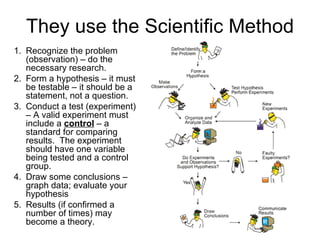
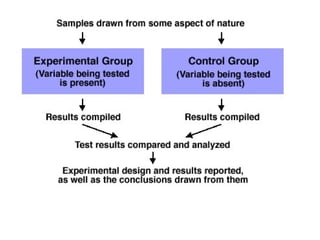
They use the Scientific Method Recognize the problem (observation) – do the necessary research. Form a hypothesis – it must be testable – it should be a statement, not a question. Conduct a test (experiment) – A valid experiment must include a  control  – a standard for comparing results.  The experiment should have one variable being tested and a control group. Draw some conclusions – graph data; evaluate your hypothesis Results (if confirmed a number of times) may become a theory.
 
The Scientific Method – A Historical Application For centuries it was believed that living things could come from non-living material.  For many years, observations seemed to indicate that some living things could just suddenly appear: ( spontaneous generation ) maggots on meat mice in grain beetles on cow dung About 2000 years ago, a Roman poet wrote these directions for producing bees. 1.  Kill a bull during the first thaw of winter. 2.  Build a shed 3.  Place the dead bull on branches and herbs inside the shed. 4.  Wait for summer.  The decaying body of the bull will produce bees.
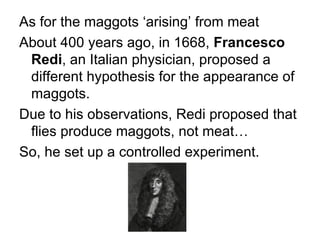
As for the maggots ‘arising’ from meat About 400 years ago, in 1668,  Francesco   Redi , an Italian physician, proposed a different hypothesis for the appearance of maggots. Due to his observations, Redi proposed that flies produce maggots, not meat… So, he set up a controlled experiment.
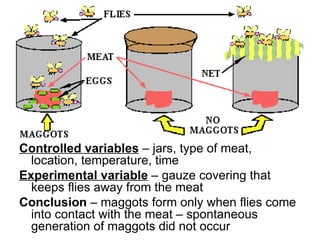
Controlled variables  – jars, type of meat, location, temperature, time Experimental variable  – gauze covering that keeps flies away from the meat Conclusion  – maggots form only when flies come into contact with the meat – spontaneous generation of maggots did not occur
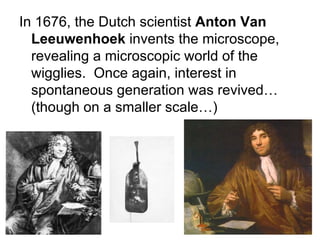
In 1676, the Dutch scientist  Anton Van   Leeuwenhoek  invents the microscope, revealing a microscopic world of the wigglies.  Once again, interest in spontaneous generation was revived…(though on a smaller scale…)
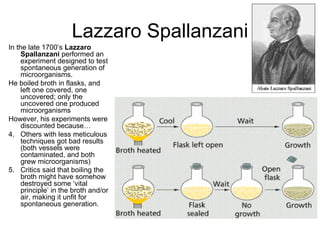
Lazzaro Spallanzani In the late 1700’s  Lazzaro   Spallanzani  performed an experiment designed to test spontaneous generation of microorganisms. He boiled broth in flasks, and left one covered, one uncovered; only the uncovered one produced microorganisms However, his experiments were discounted because… Others with less meticulous techniques got bad results (both vessels were contaminated, and both grew microorganisms) Critics said that boiling the broth might have somehow destroyed some ‘vital principle’ in the broth and/or air, making it unfit for spontaneous generation.
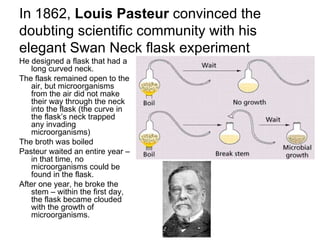
In 1862,  Louis Pasteur  convinced the doubting scientific community with his elegant Swan Neck flask experiment He designed a flask that had a long curved neck. The flask remained open to the air, but microorganisms from the air did not make their way through the neck into the flask (the curve in the flask’s neck trapped any invading microorganisms) The broth was boiled  Pasteur waited an entire year – in that time, no microorganisms could be found in the flask. After one year, he broke the stem – within the first day, the flask became clouded with the growth of microorganisms.
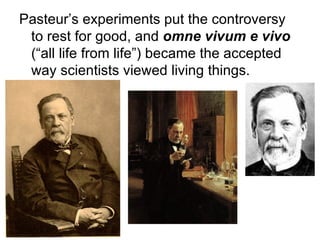
Pasteur’s experiments put the controversy to rest for good, and  omne vivum e vivo  (“all life from life”) became the accepted way scientists viewed living things.

How Does Biology Work

  • 1.
    HOW dobiologists ‘do’ biology?
  • 2.
    They use theScientific Method Recognize the problem (observation) – do the necessary research. Form a hypothesis – it must be testable – it should be a statement, not a question. Conduct a test (experiment) – A valid experiment must include a control – a standard for comparing results. The experiment should have one variable being tested and a control group. Draw some conclusions – graph data; evaluate your hypothesis Results (if confirmed a number of times) may become a theory.
  • 3.
  • 4.
    The Scientific Method– A Historical Application For centuries it was believed that living things could come from non-living material. For many years, observations seemed to indicate that some living things could just suddenly appear: ( spontaneous generation ) maggots on meat mice in grain beetles on cow dung About 2000 years ago, a Roman poet wrote these directions for producing bees. 1. Kill a bull during the first thaw of winter. 2. Build a shed 3. Place the dead bull on branches and herbs inside the shed. 4. Wait for summer. The decaying body of the bull will produce bees.
  • 5.
    As for themaggots ‘arising’ from meat About 400 years ago, in 1668, Francesco Redi , an Italian physician, proposed a different hypothesis for the appearance of maggots. Due to his observations, Redi proposed that flies produce maggots, not meat… So, he set up a controlled experiment.
  • 6.
    Controlled variables – jars, type of meat, location, temperature, time Experimental variable – gauze covering that keeps flies away from the meat Conclusion – maggots form only when flies come into contact with the meat – spontaneous generation of maggots did not occur
  • 7.
    In 1676, theDutch scientist Anton Van Leeuwenhoek invents the microscope, revealing a microscopic world of the wigglies. Once again, interest in spontaneous generation was revived…(though on a smaller scale…)
  • 8.
    Lazzaro Spallanzani Inthe late 1700’s Lazzaro Spallanzani performed an experiment designed to test spontaneous generation of microorganisms. He boiled broth in flasks, and left one covered, one uncovered; only the uncovered one produced microorganisms However, his experiments were discounted because… Others with less meticulous techniques got bad results (both vessels were contaminated, and both grew microorganisms) Critics said that boiling the broth might have somehow destroyed some ‘vital principle’ in the broth and/or air, making it unfit for spontaneous generation.
  • 9.
    In 1862, Louis Pasteur convinced the doubting scientific community with his elegant Swan Neck flask experiment He designed a flask that had a long curved neck. The flask remained open to the air, but microorganisms from the air did not make their way through the neck into the flask (the curve in the flask’s neck trapped any invading microorganisms) The broth was boiled Pasteur waited an entire year – in that time, no microorganisms could be found in the flask. After one year, he broke the stem – within the first day, the flask became clouded with the growth of microorganisms.
  • 10.
    Pasteur’s experiments putthe controversy to rest for good, and omne vivum e vivo (“all life from life”) became the accepted way scientists viewed living things.