The Scientific Method
`Awareness Test
http://youtu.be/Ahg6qcgoay4
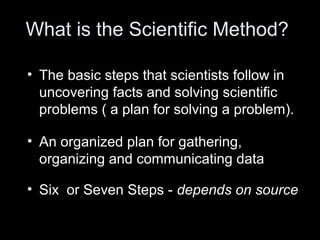
What is the Scientific Method?
• An organized plan for gathering,
organizing and communicating data
• The basic steps that scientists follow in
uncovering facts and solving scientific
problems ( a plan for solving a problem).
• Six or Seven Steps - depends on source
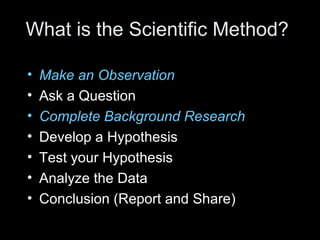
What is the Scientific Method?
• Make an Observation
• Ask a Question
• Complete Background Research
• Develop a Hypothesis
• Test your Hypothesis
• Analyze the Data
• Conclusion (Report and Share)
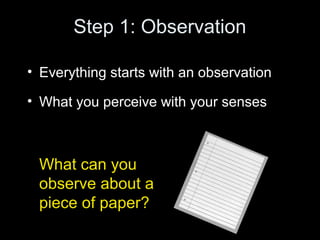
Step 1: Observation
• Everything starts with an observation
• What you perceive with your senses
What can you
observe about a
piece of paper?
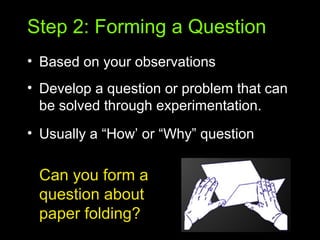
Step 2: Forming a Question
• Based on your observations
• Develop a question or problem that can
be solved through experimentation.
Can you form a
question about
paper folding?
• Usually a “How’ or “Why” question
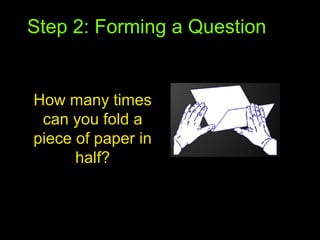
Step 2: Forming a Question
How many times
can you fold a
piece of paper in
half?
Step 3: Complete Background
Research
• Collect knowledge needed to know
about the subject of the experiment
• It will be used to form a
hypothesis
Step 4: Develop a Hypothesis
• Hypothesis = an educated prediction to
the answer of the stated problem
• Based on research and prior knowledge
Not a W.U.G. !
(Wild
Uneducated
Guess)
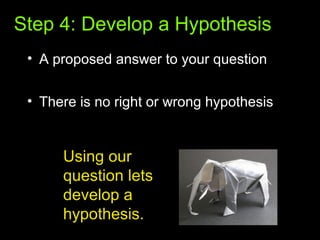
Step 4: Develop a Hypothesis
• A proposed answer to your question
• There is no right or wrong hypothesis
Using our
question lets
develop a
hypothesis.
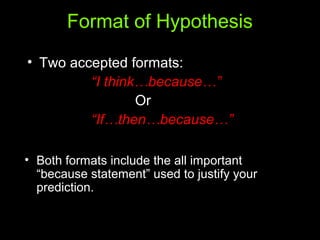
Format of Hypothesis
• Two accepted formats:
“I think…because…”
Or
“If…then…because…”
• Both formats include the all important
“because statement” used to justify your
prediction.
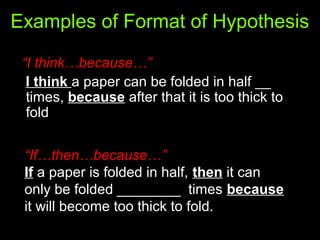
Examples of Format of Hypothesis
“I think…because…”
I think a paper can be folded in half __
times, because after that it is too thick to
fold
“If…then…because…”
If a paper is folded in half, then it can
only be folded ________ times because
it will become too thick to fold.
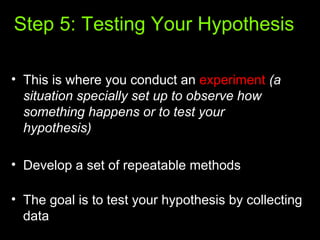
Step 5: Testing Your Hypothesis
• This is where you conduct an experiment (a
situation specially set up to observe how
something happens or to test your
hypothesis)
• Develop a set of repeatable methods
• The goal is to test your hypothesis by collecting
data
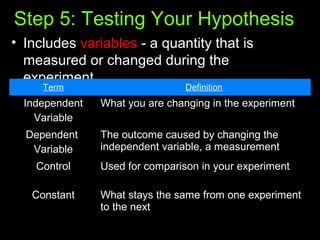
Step 5: Testing Your Hypothesis
• Includes variables - a quantity that is
measured or changed during the
experiment
Term Definition
Independent
Variable
What you are changing in the experiment
Dependent
Variable
The outcome caused by changing the
independent variable, a measurement
Control Used for comparison in your experiment
Constant What stays the same from one experiment
to the next
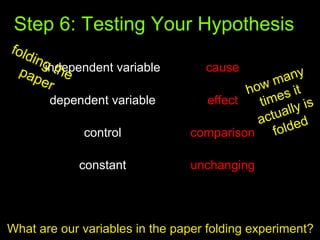
Step 6: Testing Your Hypothesis
What are our variables in the paper folding experiment?
independent variable cause
dependent variable effect
control comparison
constant unchanging
folding thepaper how many
times it
actually is
folded
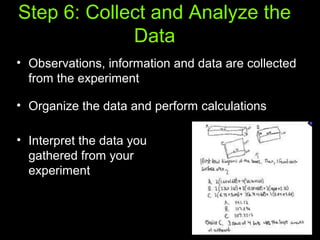
Step 6: Collect and Analyze the
Data
• Interpret the data you
gathered from your
experiment
• Observations, information and data are collected
from the experiment
• Organize the data and perform calculations
Step 6: Collect and Analyze the
Data
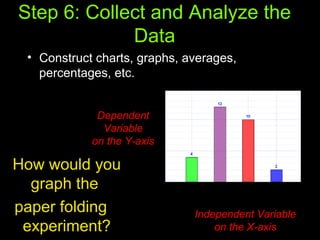
• Construct charts, graphs, averages,
percentages, etc.
Dependent
Variable
on the Y-axis
Independent Variable
on the X-axis
How would you
graph the
paper folding
experiment?
Step 7: Conclusion
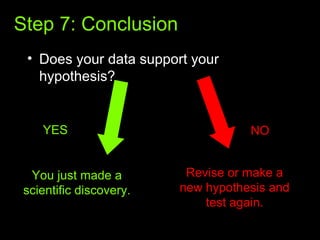
• Does your data support your
hypothesis?
You just made a
scientific discovery.
YES
Revise or make a
new hypothesis and
test again.
NO
Step 6: Conclusion (Sharing)
• A summary of results,
the answer to your
question.
• What were the possible
sources of error?
• Does your data (answer)
support your hypothesis?
Why or why not?
What conclusion can you make about paper folding?
We conclude that our hypothesis was supported or not
supported based on our data.
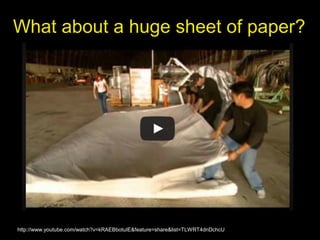
What about a huge sheet of paper?
http://www.youtube.com/watch?v=kRAEBbotuIE&feature=share&list=TLWRT4dnDchcU
Why use the Scientific Method?
• A logical way to problem solve - in all
aspects of life.
• A way to share information that can be
proved or disproved.
• A way to find new information

Scientific method notes 2013

  • 1.
  • 2.
  • 3.
    What is theScientific Method? • An organized plan for gathering, organizing and communicating data • The basic steps that scientists follow in uncovering facts and solving scientific problems ( a plan for solving a problem). • Six or Seven Steps - depends on source
  • 4.
    What is theScientific Method? • Make an Observation • Ask a Question • Complete Background Research • Develop a Hypothesis • Test your Hypothesis • Analyze the Data • Conclusion (Report and Share)
  • 5.
    Step 1: Observation •Everything starts with an observation • What you perceive with your senses What can you observe about a piece of paper?
  • 6.
    Step 2: Forminga Question • Based on your observations • Develop a question or problem that can be solved through experimentation. Can you form a question about paper folding? • Usually a “How’ or “Why” question
  • 7.
    Step 2: Forminga Question How many times can you fold a piece of paper in half?
  • 8.
    Step 3: CompleteBackground Research • Collect knowledge needed to know about the subject of the experiment • It will be used to form a hypothesis
  • 9.
    Step 4: Developa Hypothesis • Hypothesis = an educated prediction to the answer of the stated problem • Based on research and prior knowledge Not a W.U.G. ! (Wild Uneducated Guess)
  • 10.
    Step 4: Developa Hypothesis • A proposed answer to your question • There is no right or wrong hypothesis Using our question lets develop a hypothesis.
  • 11.
    Format of Hypothesis •Two accepted formats: “I think…because…” Or “If…then…because…” • Both formats include the all important “because statement” used to justify your prediction.
  • 12.
    Examples of Formatof Hypothesis “I think…because…” I think a paper can be folded in half __ times, because after that it is too thick to fold “If…then…because…” If a paper is folded in half, then it can only be folded ________ times because it will become too thick to fold.
  • 13.
    Step 5: TestingYour Hypothesis • This is where you conduct an experiment (a situation specially set up to observe how something happens or to test your hypothesis) • Develop a set of repeatable methods • The goal is to test your hypothesis by collecting data
  • 14.
    Step 5: TestingYour Hypothesis • Includes variables - a quantity that is measured or changed during the experiment Term Definition Independent Variable What you are changing in the experiment Dependent Variable The outcome caused by changing the independent variable, a measurement Control Used for comparison in your experiment Constant What stays the same from one experiment to the next
  • 15.
    Step 6: TestingYour Hypothesis What are our variables in the paper folding experiment? independent variable cause dependent variable effect control comparison constant unchanging folding thepaper how many times it actually is folded
  • 16.
    Step 6: Collectand Analyze the Data • Interpret the data you gathered from your experiment • Observations, information and data are collected from the experiment • Organize the data and perform calculations
  • 17.
    Step 6: Collectand Analyze the Data • Construct charts, graphs, averages, percentages, etc. Dependent Variable on the Y-axis Independent Variable on the X-axis How would you graph the paper folding experiment?
  • 18.
    Step 7: Conclusion •Does your data support your hypothesis? You just made a scientific discovery. YES Revise or make a new hypothesis and test again. NO
  • 19.
    Step 6: Conclusion(Sharing) • A summary of results, the answer to your question. • What were the possible sources of error? • Does your data (answer) support your hypothesis? Why or why not? What conclusion can you make about paper folding? We conclude that our hypothesis was supported or not supported based on our data.
  • 20.
    What about ahuge sheet of paper? http://www.youtube.com/watch?v=kRAEBbotuIE&feature=share&list=TLWRT4dnDchcU
  • 21.
    Why use theScientific Method? • A logical way to problem solve - in all aspects of life. • A way to share information that can be proved or disproved. • A way to find new information

Editor's Notes

  • #12 If a paper is folded in half, then it can only be folded ________ times because it will become too thick to fold.
  • #13 If a paper is folded in half, then it can only be folded ________ times because it will become too thick to fold.
  • #16 Independent - folding the paper Dependent - how many times it actually is folded
  • #20 We conclude that our hypothesis was supported or not supported based on our data.