Table of Contents Section 1   The World of Biology Section 2   Themes in Biology Section 3   The Study of Biology Section 4   Tools and Techniques The Science of Life Chapter  1
Objectives Relate   the relevance of biology to a person’s daily life. Describe   the importance of biology in human society. List   the characteristics of living things. Summarize   the hierarchy of organization within complex multicellular organisms . Distinguish   between homeostasis and metabolism and between growth, development, and reproduction. Section 1  The World of Biology Chapter  1
Biology and You Biology and Society Biology   is the study of life and can be used to both solve societal problems and explain aspects of our daily lives. Section 1  The World of Biology Chapter  1
Chapter  1 Click below to watch the Visual Concept. Visual Concept Biology Section 1  The World of Biology
Characteristics of Life Living things share the same 7 characteristics: organization and cells, response to stimuli, homeostasis, metabolism, growth and development, reproduction, and evolution. Section 1  The World of Biology Chapter  1
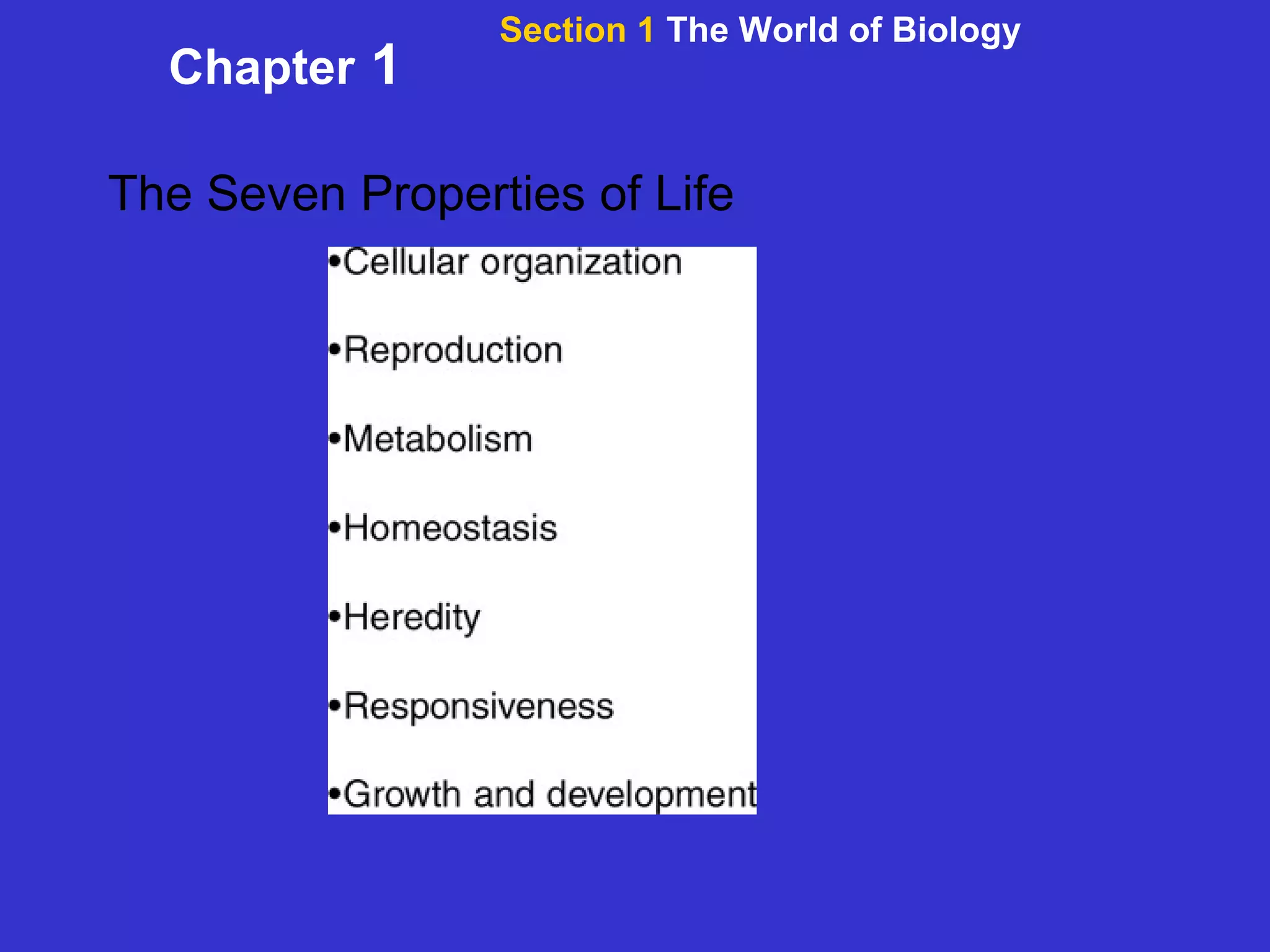
Chapter  1 The Seven Properties of Life Section 1  The World of Biology
Characteristics of Life,  continued Organization and Cells Organization  is the high degree of order within an organism’s internal and external parts and in its interactions with the living world. A  cell  is the smallest unit of an organism that can perform all life’s processes. Section 1  The World of Biology Chapter  1
Characteristics of Life,  continued Organization and Cells Multicellular   organisms are made up of many cells and show a hierarchy of organization going from the organism to the atom. Section 1  The World of Biology Chapter  1
Section 1  The World of Biology Chapter  1 Characteristics of Life,  continued Response to Stimuli Another characteristic of life is that an organism can respond to a  stimulus —a physical or chemical change in the internal or external environment.
Section 1  The World of Biology Chapter  1 Characteristics of Life,  continued Homeostasis All living things have mechanisms that allow them to maintain stable internal conditions.  Homeostasis  is the maintenance of a stable level of internal conditions even though environmental conditions are constantly changing.
Section 1  The World of Biology Chapter  1 Characteristics of Life,  continued Metabolism Metabolism   is the sum of all the chemical reactions that take in and transform energy and materials from the environment.
Section 1  The World of Biology Chapter  1 Characteristics of Life,  continued Growth and Development The growth of living things results from the division and enlargement of cells. Development   is the process by which an organism becomes a mature adult.
Section 1  The World of Biology Chapter  1 Characteristics of Life,  continued Reproduction Living organisms pass on hereditary information from parents to offspring, also called   reproduction .
Section 1  The World of Biology Chapter  1 Characteristics of Life,  continued Change Through Time Populations of living organisms  evolve  or change through time.
Chapter  1 Click below to watch the Visual Concept. Visual Concept Evolution Section 1  The World of Biology
Section 2  Themes in Biology Chapter  1 Objectives Identify   three important themes that help explain the living world. Explain   how life can be diverse, yet unified. Describe   how living organisms are interdependent. Summarize   why evolution is an important theme in biology.
Section 2  Themes in Biology Chapter  1 Diversity and Unity of Life Unity in the Diversity of Life Life is so  diverse ,or full of variety. Yet, life is also characterized by  unity , or features that all living things have in common.
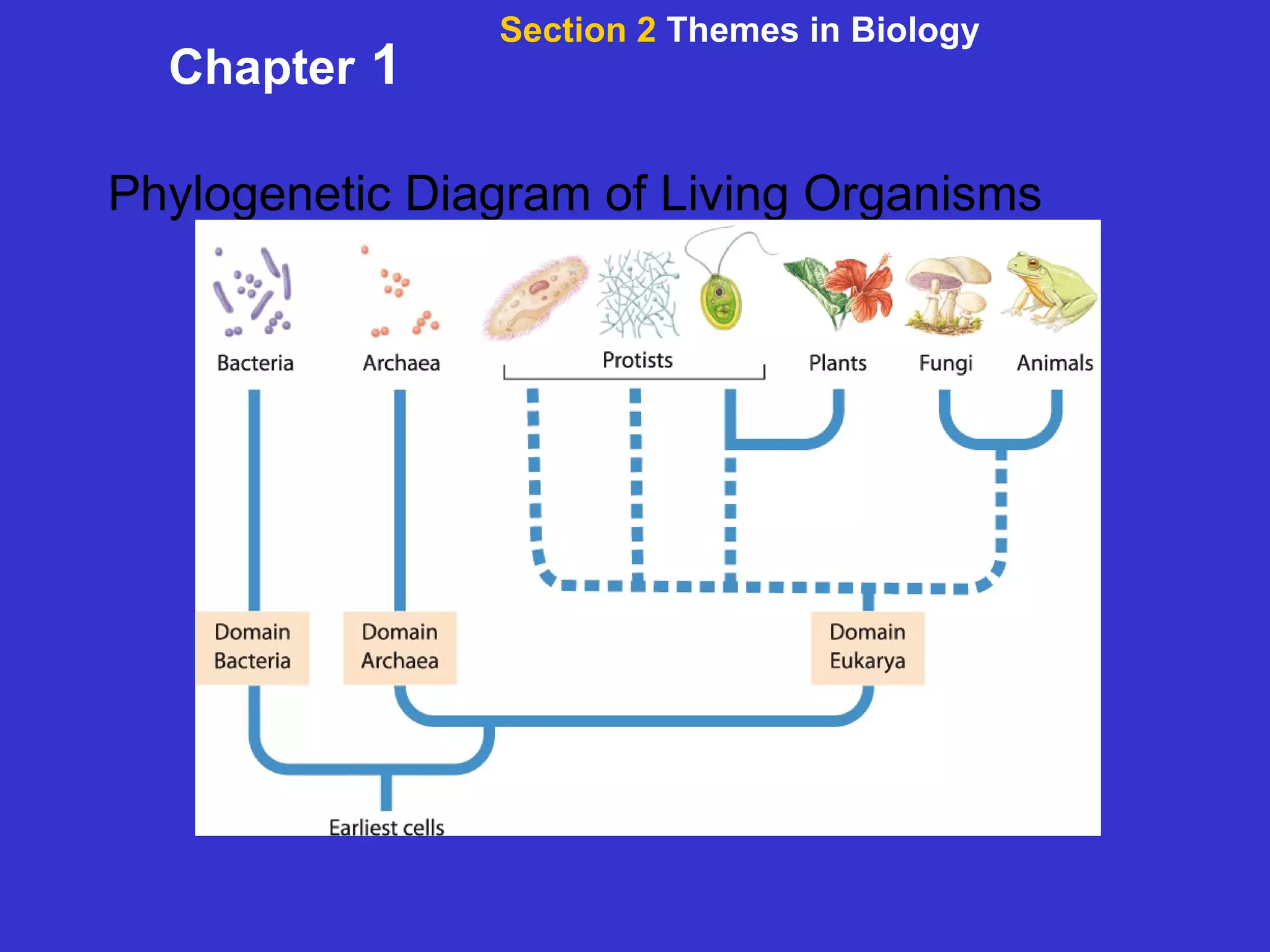
Section 2  Themes in Biology Chapter  1 Diversity and Unity of Life,  continued Unity in the Diversity of Life The tree of life shows that all living things have descended with modification from a single common ancestor. Yet, there are many different  lineages , or branches, representing different species.
Chapter  1 Phylogenetic Diagram of Living Organisms Section 2  Themes in Biology
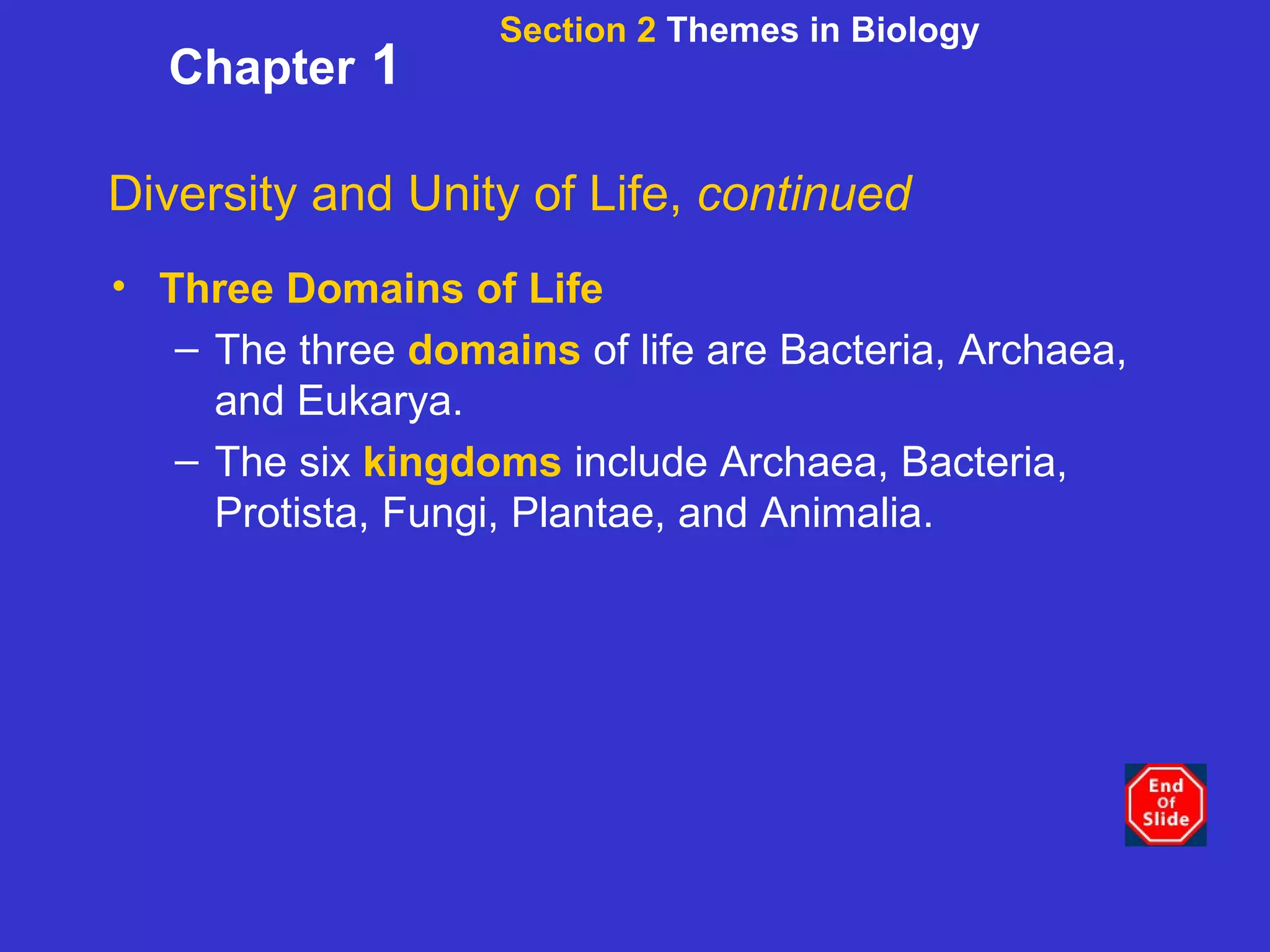
Section 2  Themes in Biology Chapter  1 Diversity and Unity of Life,  continued Three Domains of Life The three  domains  of life are Bacteria, Archaea, and Eukarya. The six  kingdoms  include Archaea, Bacteria, Protista, Fungi, Plantae, and Animalia.
Interdependence of Organisms Organisms live in interdependent communities and interact with both organisms and the environment. Section 2  Themes in Biology Chapter  1
Evolution of Life Evolution ,  or descent with modification, is the process in which the inherited characteristics within populations change over generations. Evolution helps to explain how species came to exist, have changed over time, and adapt to their environment. Section 2  Themes in Biology Chapter  1
Section 2  Themes in Biology Chapter  1 Evolution of Life,  continued Natural Selection Natural selection   is a process by which organisms that have certain favorable traits are better able to survive and reproduce successfully than organisms that lack these traits. Natural selection can lead to the evolution of populations.
Chapter  1 Click below to watch the Visual Concept. Visual Concept Natural Selection Section 2  Themes in Biology
Section 3  The Study of Biology Chapter  1 Objectives Outline   the main steps in the scientific method. Summarize   how observations are used to form hypotheses. List   the elements of a controlled experiment. Describe   how scientists use data to draw conclusions. Compare   a scientific hypothesis and a scientific theory. State   how communication in science helps prevent  dishonesty and bias.
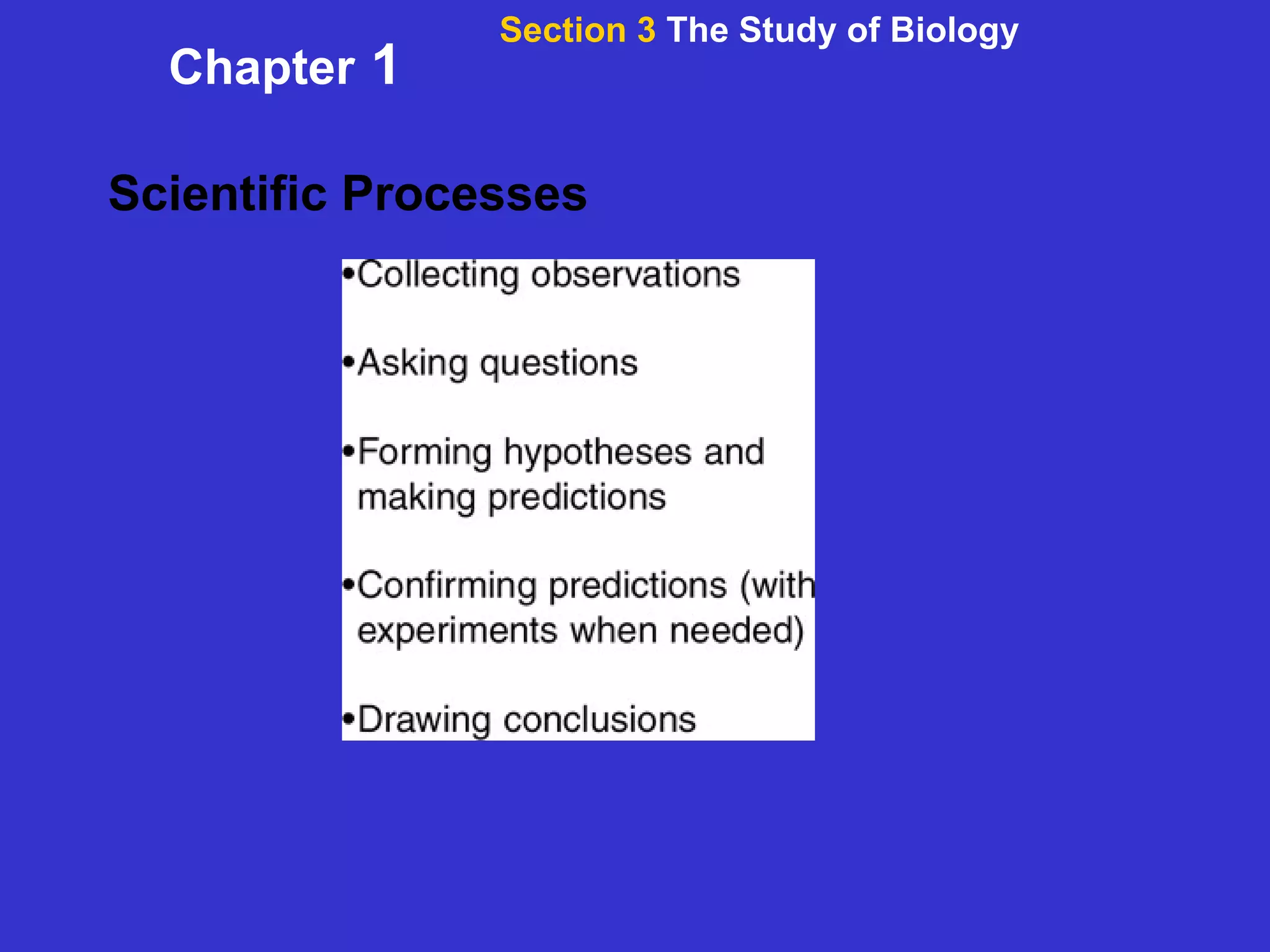
Science as a Process Section 3  The Study of Biology Chapter  1 Steps of the Scientific Method The  scientific method  involves making observations, asking questions, forming hypotheses, making predictions, designing experiments, analyzing data, and drawing conclusions.
Scientific Processes Section 3  The Study of Biology Chapter  1
Chapter  1 Click below to watch the Visual Concept. Visual Concept Scientific Method Section 3  The Study of Biology
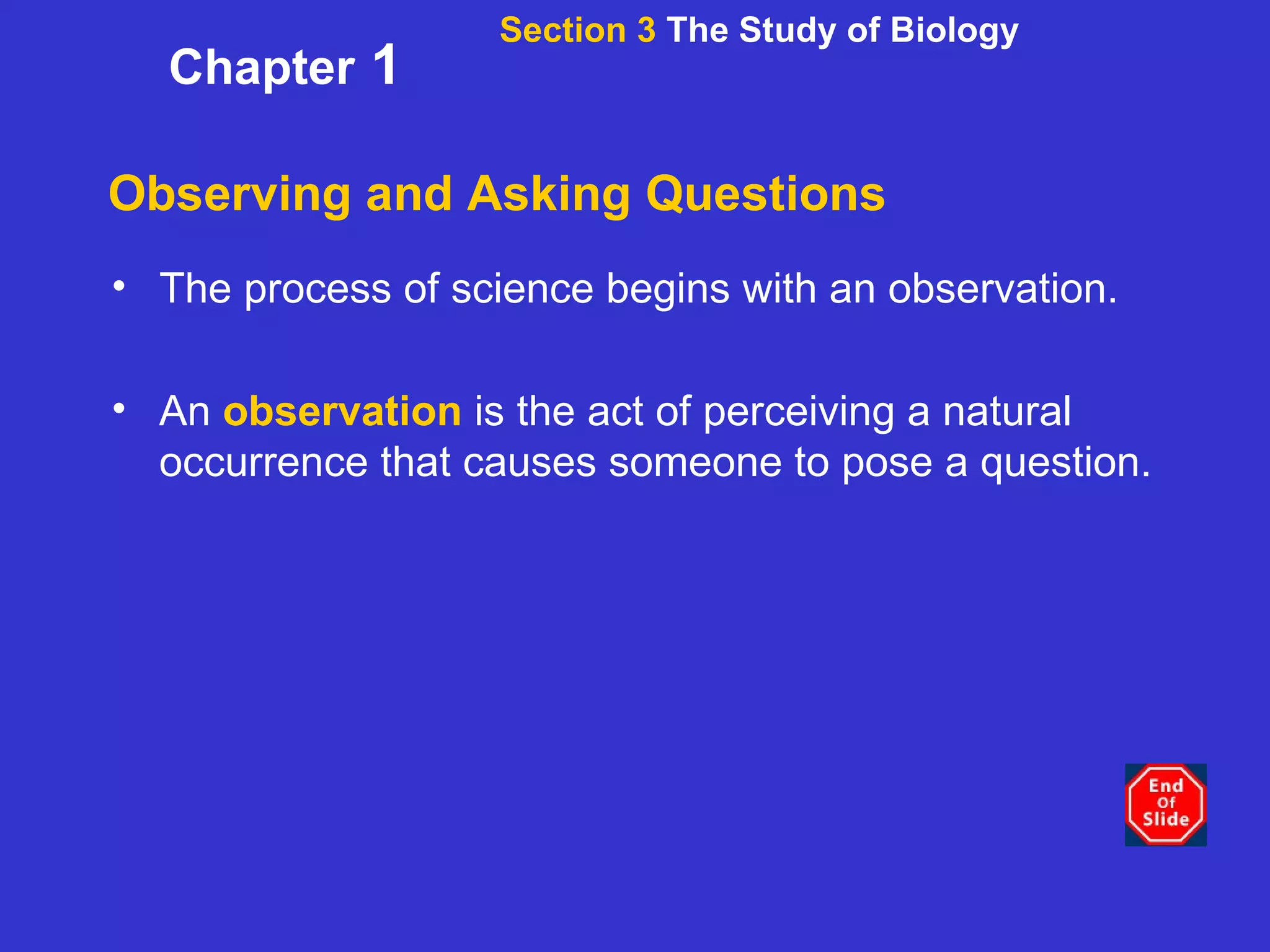
Observing and Asking Questions The process of science begins with an observation.  An  observation  is the act of perceiving a natural occurrence that causes someone to pose a question. Section 3  The Study of Biology Chapter  1
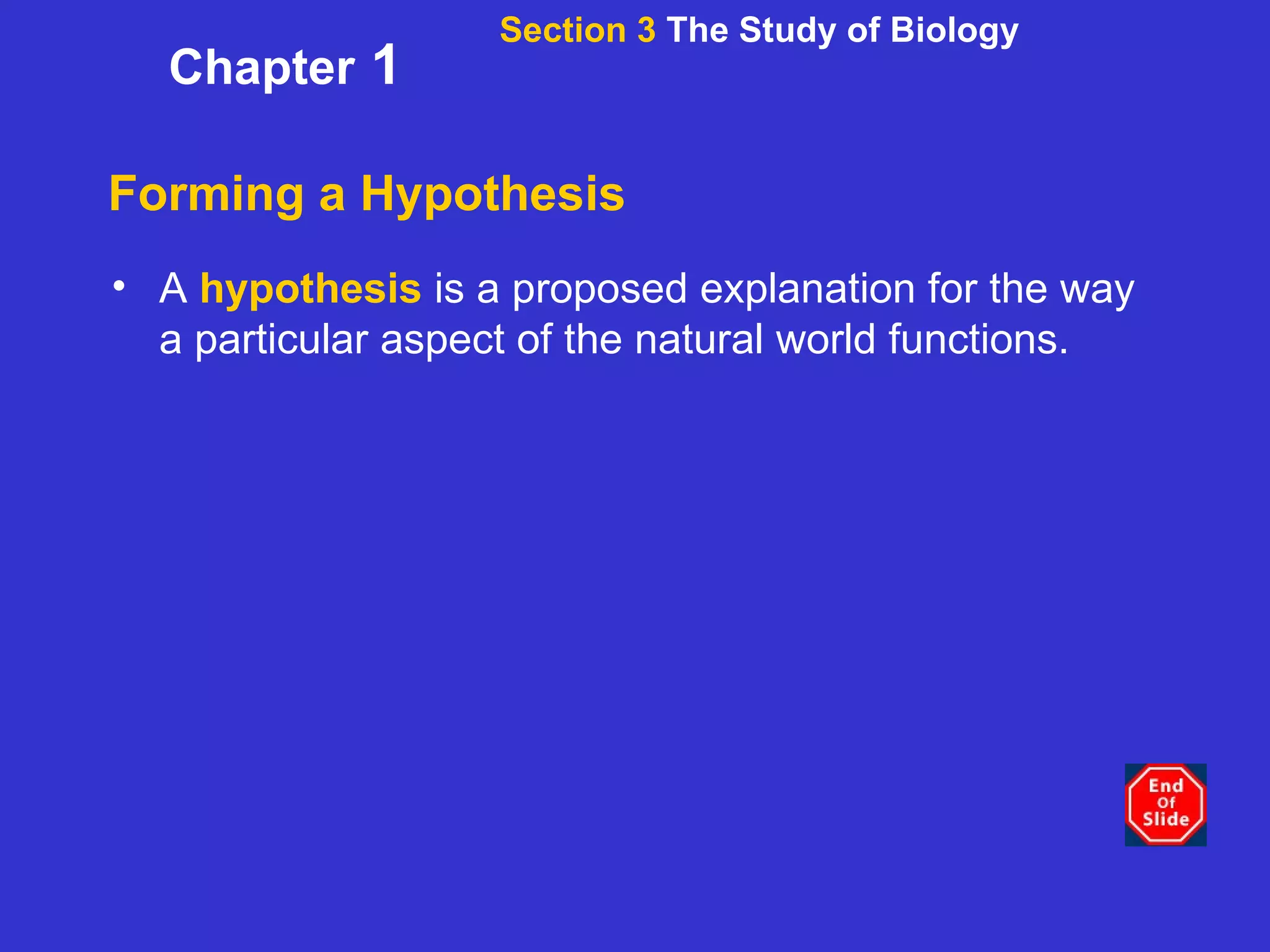
Forming a Hypothesis A  hypothesis  is a proposed explanation for the way a particular aspect of the natural world functions. Section 3  The Study of Biology Chapter  1
Forming a Hypothesis,  continued Predicting To test a hypothesis, scientists make a  prediction  that logically follows from the hypothesis.   Section 3  The Study of Biology Chapter  1
Designing an Experiment Performing the Experiment A  controlled experiment  compares an experimental group and a control group and only has one variable.   Section 3  The Study of Biology Chapter  1
Chapter  1 Click below to watch the Visual Concept. Visual Concept Controlled Experiment and Variable Section 3  The Study of Biology
Section 3  The Study of Biology Chapter  1 Designing an Experiment,  continued Performing the Experiment The  control group  provides a normal standard against which the biologist can compare results of the experimental group.  The  experimental group  is identical to the control group except for one factor .
Section 3  The Study of Biology Chapter  1 Designing an Experiment,  continued Performing the Experiment The experimenter manipulates the   independent variable. The experimenter measures the  dependent variable  because it is affected by the independent variable.
Chapter  1 Click below to watch the Visual Concept. Visual Concept Independent and Dependent Variables Section 3  The Study of Biology
Section 3  The Study of Biology Chapter  1 Designing an Experiment,  continued Testing the Experiment Experiments should be conducted without bias and they should be repeated.
Section 3  The Study of Biology Chapter  1 Collecting and Analyzing Data Analyzing and Comparing Data Scientists analyze data to draw conclusions about the experiment performed.
Section 3  The Study of Biology Chapter  1 Drawing Conclusions Making Inferences An  inference  is a conclusion made on the basis of facts and previous knowledge rather than on direct observations.
Section 3  The Study of Biology Chapter  1 Drawing Conclusions,  continued Applying Results and Building Models Scientists often apply their findings about the natural world to solve practical problems.
Section 3  The Study of Biology Chapter  1 Constructing a Theory A  theory  is a set of related hypotheses confirmed to be true many times, and it can explain a great amount of data.
Section 3  The Study of Biology Chapter  1 Communicating Ideas Publishing a Paper Scientists submit research papers to scientific journals for publication. In  peer review , the editors of a journal will send submitted papers out to experts in the field who anonymously read and critique the paper.
Section 3  The Study of Biology Chapter  1 Honesty and Bias Communication between scientists about their methods and results helps prevent dishonesty and bias in science.
Section 3  The Study of Biology Chapter  1 Honesty and Bias Conflict of Interest The threat of a potential scandal based on misleading data or conclusions is a powerful force in science that helps keep scientists honest and fair.
Section 4  Tools and Techniques Chapter  1 Objectives List   the function of each of the major parts of a compound microscope. Compare   two kinds of electron microscopes. Describe   the importance of having the SI system of measurement. State  some examples of good laboratory practice.
Microscopes as Tools Light Microscopes A  compound light microscope  is a microscope that shines light through a specimen and has two lenses to magnify an image.   Four major parts of a compound light microscope are the ocular lens, objective lens, stage, and light source. Section 4  Tools and Techniques Chapter  1
Microscopes as Tools Light Microscopes The  eyepiece  magnifies the image. The  objective lens  enlarges the specimen. The  stage  is a platform that supports slides with specimens. The  light source  is a light bulb that provides light for viewing images. Section 4  Tools and Techniques Chapter  1
Microscopes as Tools,  continued Magnification and Resolution Magnification  is the increase of an object’s apparent size. Resolution   is the power to show details clearly in an image.   Section 4  Tools and Techniques Chapter  1
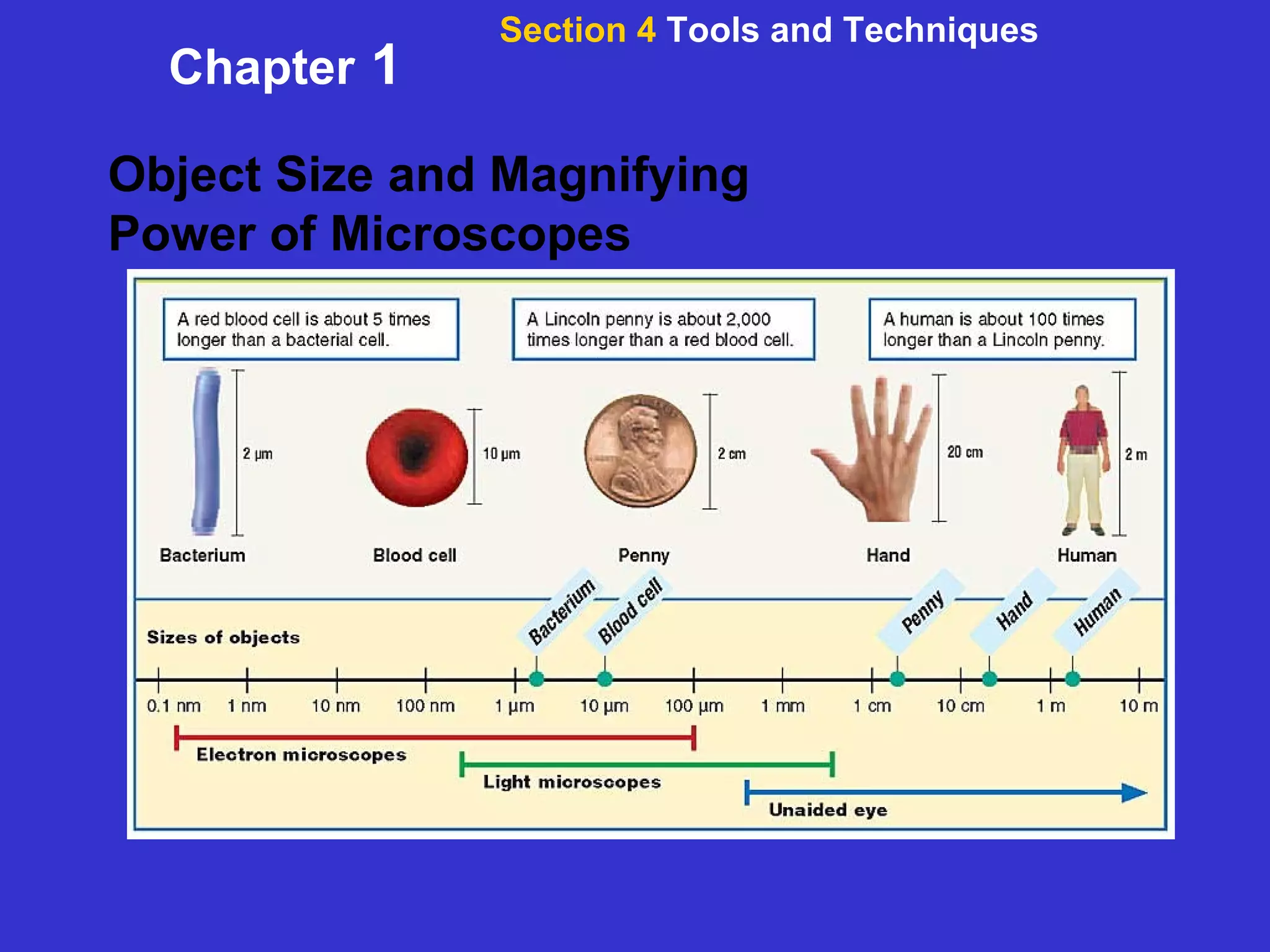
Object Size and Magnifying  Power of Microscopes Section 4  Tools and Techniques Chapter  1
Section 4  Tools and Techniques Chapter  1 Microscopes as Tools,  continued Electron Microscopes In an  electron microscope , a beam of electrons produces an enlarged image of the specimen.  Electron microscopes provide greater magnification and resolution than light microscopes.
Section 4  Tools and Techniques Chapter  1 Microscopes as Tools,  continued Electron Microscopes Scanning electron microscopes   pass a beam of electrons over the specimen’s surface for better viewing the external surface of a specimen.  Transmission electron microscopes  transmit a beam of electrons through a thinly sliced specimen for better viewing the internal structures of a specimen.
Section 4  Tools and Techniques Chapter  1 Units of Measurement Base and Other Units Scientists use a single, standard system of measurement, called the  metric system.  The official name of the metric system is  Système International d’Unités   or  SI .
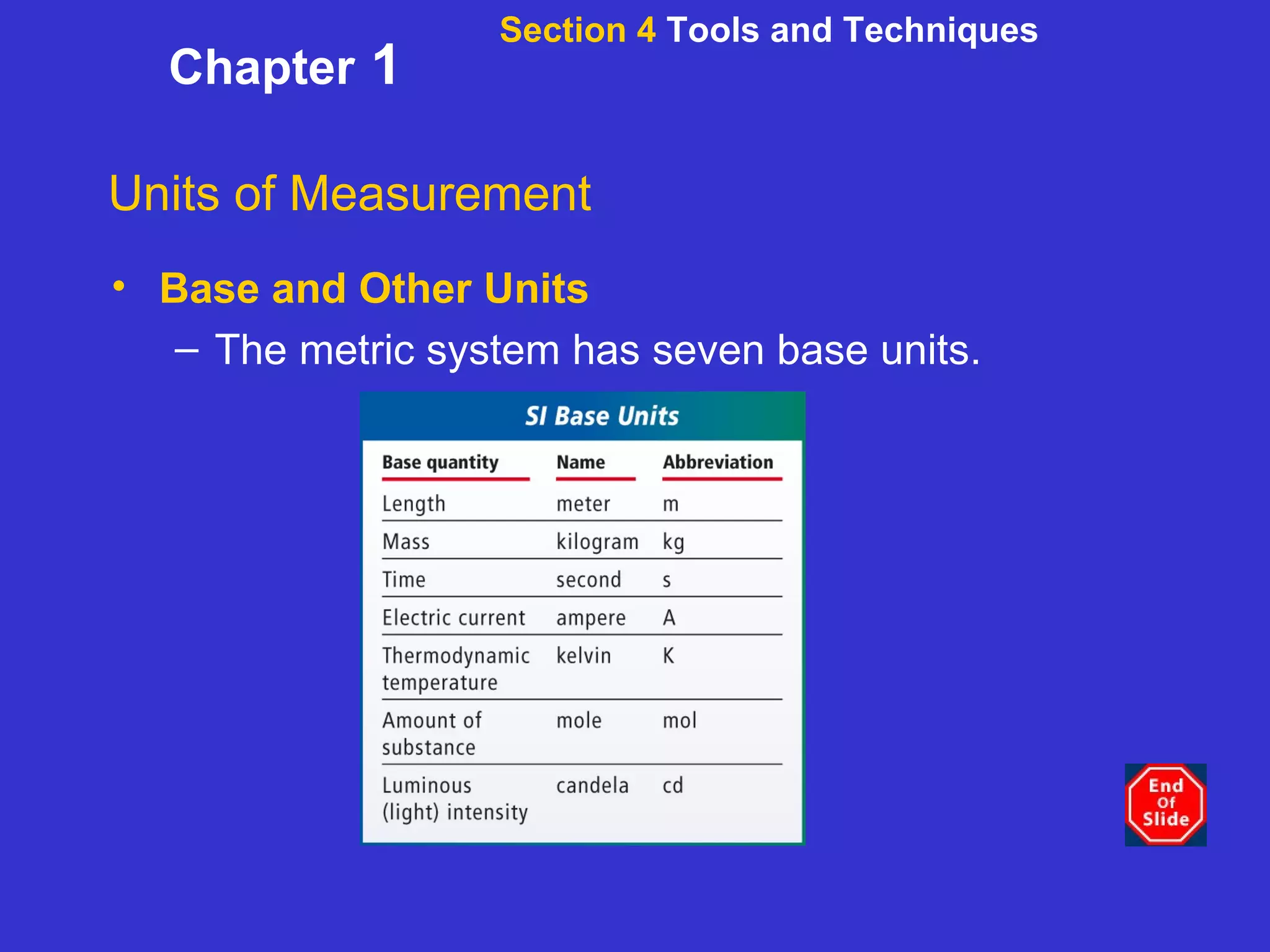
Section 4  Tools and Techniques Chapter  1 Units of Measurement Base and Other Units The metric system has seven base units.
Section 4  Tools and Techniques Chapter  1 Safety Good Laboratory Practice Lab safety involves safe and common-sense habits such as never working alone in a lab or without proper supervision by the teacher.

Introduction To Biology Notes

  • 1.
    Table of ContentsSection 1 The World of Biology Section 2 Themes in Biology Section 3 The Study of Biology Section 4 Tools and Techniques The Science of Life Chapter 1
  • 2.
    Objectives Relate the relevance of biology to a person’s daily life. Describe the importance of biology in human society. List the characteristics of living things. Summarize the hierarchy of organization within complex multicellular organisms . Distinguish between homeostasis and metabolism and between growth, development, and reproduction. Section 1 The World of Biology Chapter 1
  • 3.
    Biology and YouBiology and Society Biology is the study of life and can be used to both solve societal problems and explain aspects of our daily lives. Section 1 The World of Biology Chapter 1
  • 4.
    Chapter 1Click below to watch the Visual Concept. Visual Concept Biology Section 1 The World of Biology
  • 5.
    Characteristics of LifeLiving things share the same 7 characteristics: organization and cells, response to stimuli, homeostasis, metabolism, growth and development, reproduction, and evolution. Section 1 The World of Biology Chapter 1
  • 6.
    Chapter 1The Seven Properties of Life Section 1 The World of Biology
  • 7.
    Characteristics of Life, continued Organization and Cells Organization is the high degree of order within an organism’s internal and external parts and in its interactions with the living world. A cell is the smallest unit of an organism that can perform all life’s processes. Section 1 The World of Biology Chapter 1
  • 8.
    Characteristics of Life, continued Organization and Cells Multicellular organisms are made up of many cells and show a hierarchy of organization going from the organism to the atom. Section 1 The World of Biology Chapter 1
  • 9.
    Section 1 The World of Biology Chapter 1 Characteristics of Life, continued Response to Stimuli Another characteristic of life is that an organism can respond to a stimulus —a physical or chemical change in the internal or external environment.
  • 10.
    Section 1 The World of Biology Chapter 1 Characteristics of Life, continued Homeostasis All living things have mechanisms that allow them to maintain stable internal conditions. Homeostasis is the maintenance of a stable level of internal conditions even though environmental conditions are constantly changing.
  • 11.
    Section 1 The World of Biology Chapter 1 Characteristics of Life, continued Metabolism Metabolism is the sum of all the chemical reactions that take in and transform energy and materials from the environment.
  • 12.
    Section 1 The World of Biology Chapter 1 Characteristics of Life, continued Growth and Development The growth of living things results from the division and enlargement of cells. Development is the process by which an organism becomes a mature adult.
  • 13.
    Section 1 The World of Biology Chapter 1 Characteristics of Life, continued Reproduction Living organisms pass on hereditary information from parents to offspring, also called reproduction .
  • 14.
    Section 1 The World of Biology Chapter 1 Characteristics of Life, continued Change Through Time Populations of living organisms evolve or change through time.
  • 15.
    Chapter 1Click below to watch the Visual Concept. Visual Concept Evolution Section 1 The World of Biology
  • 16.
    Section 2 Themes in Biology Chapter 1 Objectives Identify three important themes that help explain the living world. Explain how life can be diverse, yet unified. Describe how living organisms are interdependent. Summarize why evolution is an important theme in biology.
  • 17.
    Section 2 Themes in Biology Chapter 1 Diversity and Unity of Life Unity in the Diversity of Life Life is so diverse ,or full of variety. Yet, life is also characterized by unity , or features that all living things have in common.
  • 18.
    Section 2 Themes in Biology Chapter 1 Diversity and Unity of Life, continued Unity in the Diversity of Life The tree of life shows that all living things have descended with modification from a single common ancestor. Yet, there are many different lineages , or branches, representing different species.
  • 19.
    Chapter 1Phylogenetic Diagram of Living Organisms Section 2 Themes in Biology
  • 20.
    Section 2 Themes in Biology Chapter 1 Diversity and Unity of Life, continued Three Domains of Life The three domains of life are Bacteria, Archaea, and Eukarya. The six kingdoms include Archaea, Bacteria, Protista, Fungi, Plantae, and Animalia.
  • 21.
    Interdependence of OrganismsOrganisms live in interdependent communities and interact with both organisms and the environment. Section 2 Themes in Biology Chapter 1
  • 22.
    Evolution of LifeEvolution , or descent with modification, is the process in which the inherited characteristics within populations change over generations. Evolution helps to explain how species came to exist, have changed over time, and adapt to their environment. Section 2 Themes in Biology Chapter 1
  • 23.
    Section 2 Themes in Biology Chapter 1 Evolution of Life, continued Natural Selection Natural selection is a process by which organisms that have certain favorable traits are better able to survive and reproduce successfully than organisms that lack these traits. Natural selection can lead to the evolution of populations.
  • 24.
    Chapter 1Click below to watch the Visual Concept. Visual Concept Natural Selection Section 2 Themes in Biology
  • 25.
    Section 3 The Study of Biology Chapter 1 Objectives Outline the main steps in the scientific method. Summarize how observations are used to form hypotheses. List the elements of a controlled experiment. Describe how scientists use data to draw conclusions. Compare a scientific hypothesis and a scientific theory. State how communication in science helps prevent dishonesty and bias.
  • 26.
    Science as aProcess Section 3 The Study of Biology Chapter 1 Steps of the Scientific Method The scientific method involves making observations, asking questions, forming hypotheses, making predictions, designing experiments, analyzing data, and drawing conclusions.
  • 27.
    Scientific Processes Section3 The Study of Biology Chapter 1
  • 28.
    Chapter 1Click below to watch the Visual Concept. Visual Concept Scientific Method Section 3 The Study of Biology
  • 29.
    Observing and AskingQuestions The process of science begins with an observation. An observation is the act of perceiving a natural occurrence that causes someone to pose a question. Section 3 The Study of Biology Chapter 1
  • 30.
    Forming a HypothesisA hypothesis is a proposed explanation for the way a particular aspect of the natural world functions. Section 3 The Study of Biology Chapter 1
  • 31.
    Forming a Hypothesis, continued Predicting To test a hypothesis, scientists make a prediction that logically follows from the hypothesis. Section 3 The Study of Biology Chapter 1
  • 32.
    Designing an ExperimentPerforming the Experiment A controlled experiment compares an experimental group and a control group and only has one variable. Section 3 The Study of Biology Chapter 1
  • 33.
    Chapter 1Click below to watch the Visual Concept. Visual Concept Controlled Experiment and Variable Section 3 The Study of Biology
  • 34.
    Section 3 The Study of Biology Chapter 1 Designing an Experiment, continued Performing the Experiment The control group provides a normal standard against which the biologist can compare results of the experimental group. The experimental group is identical to the control group except for one factor .
  • 35.
    Section 3 The Study of Biology Chapter 1 Designing an Experiment, continued Performing the Experiment The experimenter manipulates the independent variable. The experimenter measures the dependent variable because it is affected by the independent variable.
  • 36.
    Chapter 1Click below to watch the Visual Concept. Visual Concept Independent and Dependent Variables Section 3 The Study of Biology
  • 37.
    Section 3 The Study of Biology Chapter 1 Designing an Experiment, continued Testing the Experiment Experiments should be conducted without bias and they should be repeated.
  • 38.
    Section 3 The Study of Biology Chapter 1 Collecting and Analyzing Data Analyzing and Comparing Data Scientists analyze data to draw conclusions about the experiment performed.
  • 39.
    Section 3 The Study of Biology Chapter 1 Drawing Conclusions Making Inferences An inference is a conclusion made on the basis of facts and previous knowledge rather than on direct observations.
  • 40.
    Section 3 The Study of Biology Chapter 1 Drawing Conclusions, continued Applying Results and Building Models Scientists often apply their findings about the natural world to solve practical problems.
  • 41.
    Section 3 The Study of Biology Chapter 1 Constructing a Theory A theory is a set of related hypotheses confirmed to be true many times, and it can explain a great amount of data.
  • 42.
    Section 3 The Study of Biology Chapter 1 Communicating Ideas Publishing a Paper Scientists submit research papers to scientific journals for publication. In peer review , the editors of a journal will send submitted papers out to experts in the field who anonymously read and critique the paper.
  • 43.
    Section 3 The Study of Biology Chapter 1 Honesty and Bias Communication between scientists about their methods and results helps prevent dishonesty and bias in science.
  • 44.
    Section 3 The Study of Biology Chapter 1 Honesty and Bias Conflict of Interest The threat of a potential scandal based on misleading data or conclusions is a powerful force in science that helps keep scientists honest and fair.
  • 45.
    Section 4 Tools and Techniques Chapter 1 Objectives List the function of each of the major parts of a compound microscope. Compare two kinds of electron microscopes. Describe the importance of having the SI system of measurement. State some examples of good laboratory practice.
  • 46.
    Microscopes as ToolsLight Microscopes A compound light microscope is a microscope that shines light through a specimen and has two lenses to magnify an image. Four major parts of a compound light microscope are the ocular lens, objective lens, stage, and light source. Section 4 Tools and Techniques Chapter 1
  • 47.
    Microscopes as ToolsLight Microscopes The eyepiece magnifies the image. The objective lens enlarges the specimen. The stage is a platform that supports slides with specimens. The light source is a light bulb that provides light for viewing images. Section 4 Tools and Techniques Chapter 1
  • 48.
    Microscopes as Tools, continued Magnification and Resolution Magnification is the increase of an object’s apparent size. Resolution is the power to show details clearly in an image. Section 4 Tools and Techniques Chapter 1
  • 49.
    Object Size andMagnifying Power of Microscopes Section 4 Tools and Techniques Chapter 1
  • 50.
    Section 4 Tools and Techniques Chapter 1 Microscopes as Tools, continued Electron Microscopes In an electron microscope , a beam of electrons produces an enlarged image of the specimen. Electron microscopes provide greater magnification and resolution than light microscopes.
  • 51.
    Section 4 Tools and Techniques Chapter 1 Microscopes as Tools, continued Electron Microscopes Scanning electron microscopes pass a beam of electrons over the specimen’s surface for better viewing the external surface of a specimen. Transmission electron microscopes transmit a beam of electrons through a thinly sliced specimen for better viewing the internal structures of a specimen.
  • 52.
    Section 4 Tools and Techniques Chapter 1 Units of Measurement Base and Other Units Scientists use a single, standard system of measurement, called the metric system. The official name of the metric system is Système International d’Unités or SI .
  • 53.
    Section 4 Tools and Techniques Chapter 1 Units of Measurement Base and Other Units The metric system has seven base units.
  • 54.
    Section 4 Tools and Techniques Chapter 1 Safety Good Laboratory Practice Lab safety involves safe and common-sense habits such as never working alone in a lab or without proper supervision by the teacher.