THE PROCESS OF SCIENCE
Using the Scientific Method
The Scientific Method
A logical, organized way of solving problems.
• Define the Problem
• Collect Background
Information
• Form a Hypothesis
• Test the Hypothesis
• Make and Record
Observations
• Draw a Conclusion
Defining the Problem & Collecting
Background Information
• Identify the problem.
• Example: What are
the effects of acid rain
on salamanders?
• Collect information
about the problem.
• Example: We should
know the normal
development of
salamanders as well as
the characteristics of
areas that are affected
by acid rain.
FORMULATE A HYPOTHESIS
• An educated guess
• A proposed answer to
the question or
problem.
• A statement that can
be tested
TESTING THE HYPOTHESIS
p.1/2
• An experiment is a controlled procedure
designed to test a hypothesis.
• In an experiment, one variable, or condition,
is changed and the response of another
variable is measured.
THE EXPERIMENT p.2/2
• Independent variable:
the condition that is
varied (or changed).
• Dependent variable:
the condition that
responds to the
changes in the I.V.
• To be a controlled
experiment, it must have
two identical groups:
• Experimental group-
the group that is
exposed to the changes
in the I.V.
• Control group- the
group that is not
exposed to changes.
MAKING & RECORDING
OBSERVATIONS p. 1/4
• Must keep careful records.
• Must state how the experiment was planned,
carried out, materials & equipment used, and
how long it took.
• Must record all observations made.
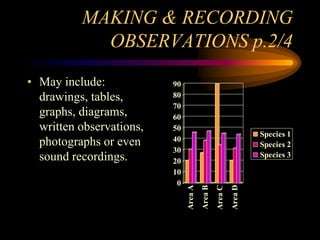
MAKING & RECORDING
OBSERVATIONS p.2/4
• May include:
drawings, tables,
graphs, diagrams,
written observations,
photographs or even
sound recordings.
0
10
20
30
40
50
60
70
80
90
Area
A
Area
B
Area
C
Area
D
Species 1
Species 2
Species 3
OBSERVATIONS VS.
INFERENCES p.3/4
• Observation- an
examination of
something in
nature. Detected
by any of the five
senses.
• Inference- a
judgement based
on your
observation. It is
a personal
opinion.
DRAWING CONCLUSIONS
p.1/2
• The answer to a
scientific question is
formulated by drawing
a conclusion based on
data (scientific facts
collected during the
experiment)
• Statistics help form
the conclusion.
CONCLUSIONS p.2/2
• Before accepting conclusions, scientists
retest their hypotheses several times. Later
other scientists repeat the experiment until
the hypothesis and the conclusion are
supported or rejected.
LAW/THEORY p.1/2
• When a hypothesis explains how “facts of
nature” occurs, it becomes scientific
principle or law. Example: Law of Gravity
• When a hypothesis explains why “natural”
events occur through observations and
investigations over a long period of time, it
becomes a theory. Example: Theory of
Evolution
THE PROCESS OF SCIENCE
Be ready for a quiz

Science and Hypothesis.ppt

  • 1.
    THE PROCESS OFSCIENCE Using the Scientific Method
  • 2.
    The Scientific Method Alogical, organized way of solving problems. • Define the Problem • Collect Background Information • Form a Hypothesis • Test the Hypothesis • Make and Record Observations • Draw a Conclusion
  • 3.
    Defining the Problem& Collecting Background Information • Identify the problem. • Example: What are the effects of acid rain on salamanders? • Collect information about the problem. • Example: We should know the normal development of salamanders as well as the characteristics of areas that are affected by acid rain.
  • 4.
    FORMULATE A HYPOTHESIS •An educated guess • A proposed answer to the question or problem. • A statement that can be tested
  • 5.
    TESTING THE HYPOTHESIS p.1/2 •An experiment is a controlled procedure designed to test a hypothesis. • In an experiment, one variable, or condition, is changed and the response of another variable is measured.
  • 6.
    THE EXPERIMENT p.2/2 •Independent variable: the condition that is varied (or changed). • Dependent variable: the condition that responds to the changes in the I.V. • To be a controlled experiment, it must have two identical groups: • Experimental group- the group that is exposed to the changes in the I.V. • Control group- the group that is not exposed to changes.
  • 7.
    MAKING & RECORDING OBSERVATIONSp. 1/4 • Must keep careful records. • Must state how the experiment was planned, carried out, materials & equipment used, and how long it took. • Must record all observations made.
  • 8.
    MAKING & RECORDING OBSERVATIONSp.2/4 • May include: drawings, tables, graphs, diagrams, written observations, photographs or even sound recordings. 0 10 20 30 40 50 60 70 80 90 Area A Area B Area C Area D Species 1 Species 2 Species 3
  • 9.
    OBSERVATIONS VS. INFERENCES p.3/4 •Observation- an examination of something in nature. Detected by any of the five senses. • Inference- a judgement based on your observation. It is a personal opinion.
  • 10.
    DRAWING CONCLUSIONS p.1/2 • Theanswer to a scientific question is formulated by drawing a conclusion based on data (scientific facts collected during the experiment) • Statistics help form the conclusion.
  • 11.
    CONCLUSIONS p.2/2 • Beforeaccepting conclusions, scientists retest their hypotheses several times. Later other scientists repeat the experiment until the hypothesis and the conclusion are supported or rejected.
  • 12.
    LAW/THEORY p.1/2 • Whena hypothesis explains how “facts of nature” occurs, it becomes scientific principle or law. Example: Law of Gravity • When a hypothesis explains why “natural” events occur through observations and investigations over a long period of time, it becomes a theory. Example: Theory of Evolution
  • 13.
    THE PROCESS OFSCIENCE Be ready for a quiz