SKILLS IN
HSC BIOLOGY
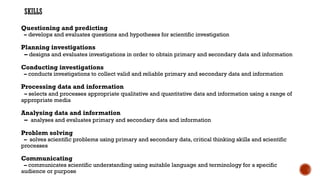
SKILLS
Questioning and predicting
– develops and evaluates questions and hypotheses for scientific investigation
Planning investigations
– designs and evaluates investigations in order to obtain primary and secondary data and information
Conducting investigations
– conducts investigations to collect valid and reliable primary and secondary data and information
Processing data and information
– selects and processes appropriate qualitative and quantitative data and information using a range of
appropriate media
Analysing data and information
– analyses and evaluates primary and secondary data and information
Problem solving
– solves scientific problems using primary and secondary data, critical thinking skills and scientific
processes
Communicating
– communicates scientific understanding using suitable language and terminology for a specific
audience or purpose
PRIMARY VS SECONDARY DATA
Definitions of what is primary or secondary data differs across the disciplines. For
the sciences, this is how we would define them:
Primary scientific data - measurements collected by the experimenter during a
laboratory practical – i.e. number and types of microbial colonies grown from
different water sources in the school.
Secondary scientific data - accessed by a student from websites, textbooks and
other reliable sources – i.e. numerical data on the incidence of
diabetes/melanoma in Australian population in a defined time period.
QUALITATIVE VS QUANTITATIVE DATA
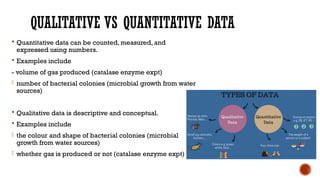
 Quantitative data can be counted, measured, and
expressed using numbers.
 Examples include
- volume of gas produced (catalase enzyme expt)
- number of bacterial colonies (microbial growth from water
sources)
 Qualitative data is descriptive and conceptual.
 Examples include
- the colour and shape of bacterial colonies (microbial
growth from water sources)
- whether gas is produced or not (catalase enzyme expt)
SCIENTIFIC THEORIES
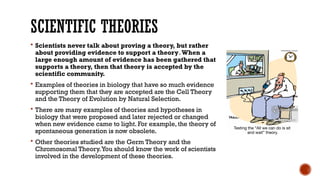
 Scientists never talk about proving a theory, but rather
about providing evidence to support a theory. When a
large enough amount of evidence has been gathered that
supports a theory, then that theory is accepted by the
scientific community.
 Examples of theories in biology that have so much evidence
supporting them that they are accepted are the Cell Theory
and the Theory of Evolution by Natural Selection.
 There are many examples of theories and hypotheses in
biology that were proposed and later rejected or changed
when new evidence came to light. For example, the theory of
spontaneous generation is now obsolete.
 Other theories studied are the Germ Theory and the
Chromosomal Theory.You should know the work of scientists
involved in the development of these theories.
MODELS IN BIOLOGY
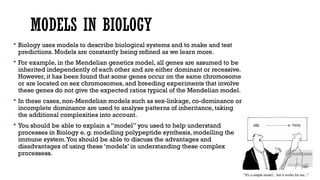
 Biology uses models to describe biological systems and to make and test
predictions. Models are constantly being refined as we learn more.
 For example, in the Mendelian genetics model, all genes are assumed to be
inherited independently of each other and are either dominant or recessive.
However, it has been found that some genes occur on the same chromosome
or are located on sex chromosomes, and breeding experiments that involve
these genes do not give the expected ratios typical of the Mendelian model.
 In these cases, non-Mendelian models such as sex-linkage, co-dominance or
incomplete dominance are used to analyse patterns of inheritance, taking
the additional complexities into account.
 You should be able to explain a “model” you used to help understand
processes in Biology e. g. modelling polypeptide synthesis, modelling the
immune system.You should be able to discuss the advantages and
disadvantages of using these ‘models’ in understanding these complex
processess.
THE SCIENTIFIC METHOD
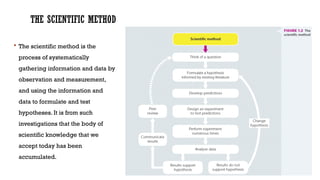
 The scientific method is the
process of systematically
gathering information and data by
observation and measurement,
and using the information and
data to formulate and test
hypotheses. It is from such
investigations that the body of
scientific knowledge that we
accept today has been
accumulated.
FORMULATING A HYPOTHESES
 The scientific method begins with asking questions (sometimes called
research questions). Based on these questions, you formulate a
hypothesis, which is a tentative answer to your question.This also
involves reading the literature to research your question.
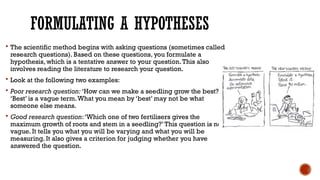
 Look at the following two examples:
 Poor research question: ‘How can we make a seedling grow the best?’
‘Best’ is a vague term.What you mean by ‘best’ may not be what
someone else means.
 Good research question:‘Which one of two fertilisers gives the
maximum growth of roots and stem in a seedling?’This question is not
vague. It tells you what you will be varying and what you will be
measuring. It also gives a criterion for judging whether you have
answered the question.
FORMULATING A HYPOTHESIS
 A hypothesis is a predictive statement about the relationship between the variables
and is an ‘expected’ answer to your question. It is often written as an ‘If … then …’
statement, to explain an expected relationship, such as: ‘If x is
introduced/increased/decreased, then y will increase/decrease/stay the
same.’
 An example of a hypothesis is:
 If the amount of nitrogen in the fertiliser provided to a seedling in the soil is
increased, then the height of the stem and/or length of the roots of the seedling will
increase.
 Your hypothesis should give a prediction that you can test, ideally quantitatively
(that is, by taking measurements).
EXPERIMENT DESIGN AND VALIDITY OF RESULTS
 An experiment is designed and performed to test a prediction, and the results are
then analysed. If the results of the experiment agree with the prediction, then the
hypothesis is supported(never proved).
 Experiments are considered valid when scientists test the hypothesis that they
intended to test and get consistent and accurate results when repeated.
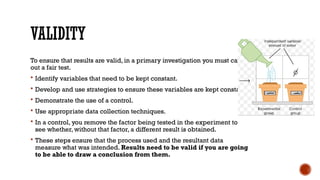
 A valid experiment involves setting up controls and making sure that the only thing
that changes in the experiment is the variable being tested. All other conditions
must be controlled to remain the same.
 Experiments are considered reliable when they can be repeated to give the same
results and random error is eliminated or minimised.
 An experiment is considered accurate when its measurements are close to the
true value – for this to be achieved.
VARIABLES
 When doing experiments, you need to decide which variable you will
change, what you will measure and which variables you will control.
Consider which variables you can control, and which you cannot.
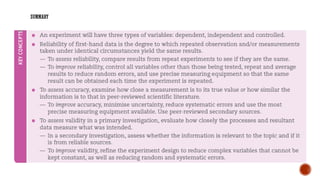
Typically, an experiment will have three types of variable:
- one independent variable, which we are testing and we therefore
purposefully change, some experiments can have two independent.
variables
- one dependent variable, which is the result that we measure – this
changes as a result of changing the independent variable.We assume
that the dependent variable is in some way dependent on the
independent variable,
- many controlled variables, which are kept constant so that they do not
interfere with our results.
RELIABILITY
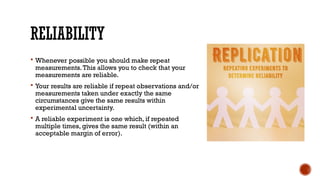
 Whenever possible you should make repeat
measurements.This allows you to check that your
measurements are reliable.
 Your results are reliable if repeat observations and/or
measurements taken under exactly the same
circumstances give the same results within
experimental uncertainty.
 A reliable experiment is one which, if repeated
multiple times, gives the same result (within an
acceptable margin of error).
ACCURACY
 Accuracy may refer to a result or to an experimental procedure. Accuracy
of a result (data) is a measure of how close it is to an expected value given
in scientific literature.
 To improve accuracy in experiments, we use the most precise measuring
instruments available, avoid human error (for example, measuring
errors), carry out repeat trials, and find an average to smooth out random
errors.
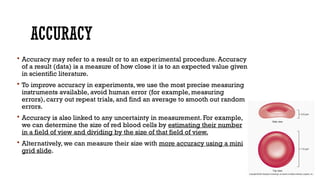
 Accuracy is also linked to any uncertainty in measurement. For example,
we can determine the size of red blood cells by estimating their number
in a field of view and dividing by the size of that field of view.
 Alternatively, we can measure their size with more accuracy using a mini
grid slide.
VALIDITY
To ensure that results are valid, in a primary investigation you must carry
out a fair test.
 Identify variables that need to be kept constant.
 Develop and use strategies to ensure these variables are kept constant.
 Demonstrate the use of a control.
 Use appropriate data collection techniques.
 In a control, you remove the factor being tested in the experiment to
see whether, without that factor, a different result is obtained.
 These steps ensure that the process used and the resultant data
measure what was intended. Results need to be valid if you are going
to be able to draw a conclusion from them.
SUMMARY
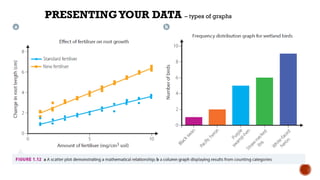
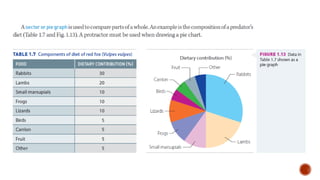
PRESENTINGYOUR DATA – types of graphs
ANALYSING DATA
 You have developed many skills in analysing data when carrying out your depth
study on diseases.They involve –
- explaining results – graphs
- making conclusions from data
- using data to solve problems
- doing further research to help support conclusions
COMMUNICATION AND PEER REVIEW
 Scientists communicate their work to each other to share
new ideas and information and as a way of contributing to
the ongoing development of science.
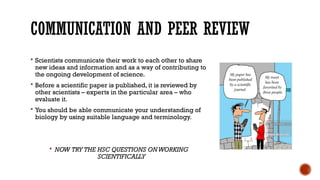
 Before a scientific paper is published, it is reviewed by
other scientists – experts in the particular area – who
evaluate it.
 You should be able communicate your understanding of
biology by using suitable language and terminology.
 NOW TRY THE HSC QUESTIONS ONWORKING
SCIENTIFICALLY