The document provides a comprehensive overview of sericulture, detailing its history, types of silk, production statistics, and economic significance in India. It outlines the life cycle of the silkworm, the different types of silk produced, and the challenges faced by the sericulture industry, including high production costs and quality issues compared to international standards. Additionally, it highlights the role of sericulture in rural employment and development, along with various governmental support schemes.

Dr. T. RAMESH
AssistantProfessor of Zoology
Vivekananda College, Tiruvedakam
IGNOU - Academic Counsellor
faunaldiversity@gmail.com
online counselling session
on
2.
CONTENT
• Introduction
• Historyof Silk
• Silk production in India
• Life cycle of Silkworm
• Types of Silk
• Quality of Cocoons
• Sericulture and rural development
• Economics for Sericulture development
• Funding schemes in India
2
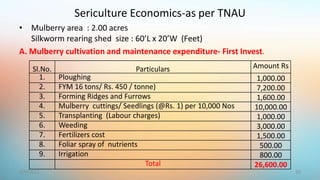
6/9/2021
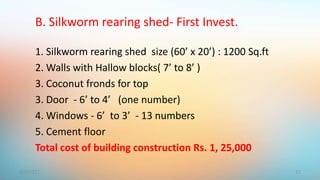
3.
Introduction
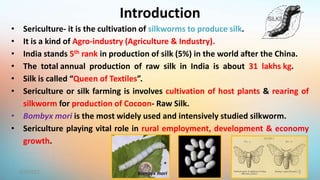
• Sericulture- itis the cultivation of silkworms to produce silk.
• It is a kind of Agro-industry (Agriculture & Industry).
• India stands 5th rank in production of silk (5%) in the world after the China.
• The total annual production of raw silk in India is about 31 lakhs kg.
• Silk is called “Queen of Textiles”.
• Sericulture or silk farming is involves cultivation of host plants & rearing of
silkworm for production of Cocoon- Raw Silk.
• Bombyx mori is the most widely used and intensively studied silkworm.
• Sericulture playing vital role in rural employment, development & economy
growth.
Bombyx mori 3
6/9/2021
4.
History of Silk
Silk was discovered by Xilingji (Hsi-ling-chi), wife of China’s 3rd Emperor,
Huangdi (Hoang-Ti), in 2640 B.C. While making tea, Xilingji accidentally
dropped a silkworm cocoon into a cup of hot water and found that the silk
fibre could be loosened and unwound.
After 1200 B.C. Chinese immigrants who had settled in Korea helped in the
emergence of silk industry in Korea.
3rd century B.C. Semiramus establishment silk industries in Japan
Chinese Princess married an Indian Prince- Silk production spread in India
550 A.D. Smuggled from China to other countries.
7th century it spread middle east and Africa.
19th centaury almost machinery in all countries.
First mill was established by “East India Company”
at Howrah in 1832. 4
6/9/2021
5.
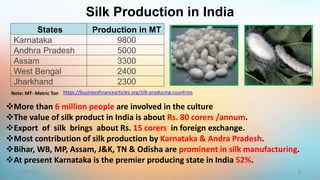
Silk Production inIndia
States Production in MT
Karnataka 9800
Andhra Pradesh 5000
Assam 3300
West Bengal 2400
Jharkhand 2300
https://businessfinancearticles.org/silk-producing-countries
Note: MT- Metric Ton
More than 6 million people are involved in the culture
The value of silk product in India is about Rs. 80 corers /annum.
Export of silk brings about Rs. 15 corers in foreign exchange.
Most contribution of silk production by Karnataka & Andra Pradesh.
Bihar, WB, MP, Assam, J&K, TN & Odisha are prominent in silk manufacturing.
At present Karnataka is the premier producing state in India 52%.
5
6/9/2021
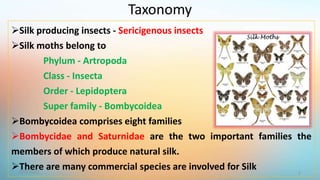
Taxonomy
Silk producing insects- Sericigenous insects
Silk moths belong to
Phylum - Artropoda
Class - Insecta
Order - Lepidoptera
Super family - Bombycoidea
Bombycoidea comprises eight families
Bombycidae and Saturnidae are the two important families the
members of which produce natural silk.
There are many commercial species are involved for Silk
7
6/9/2021
8.
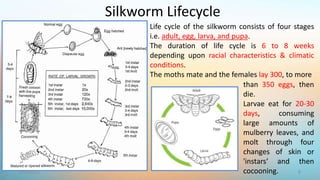
Silkworm Lifecycle
Life cycleof the silkworm consists of four stages
i.e. adult, egg, larva, and pupa.
The duration of life cycle is 6 to 8 weeks
depending upon racial characteristics & climatic
conditions.
The moths mate and the females lay 300, to more
than 350 eggs, then
die.
Larvae eat for 20-30
days, consuming
large amounts of
mulberry leaves, and
molt through four
changes of skin or
'instars‘ and then
cocooning. 8
6/9/2021
9.
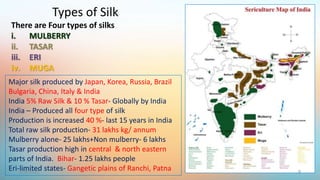
There are Fourtypes of silks
i. MULBERRY
ii. TASAR
iii. ERI
iv. MUGA
Types of Silk
9
6/9/2021
Major silk produced by Japan, Korea, Russia, Brazil
Bulgaria, China, Italy & India
India 5% Raw Silk & 10 % Tasar- Globally by India
India – Produced all four type of silk
Production is increased 40 %- last 15 years in India
Total raw silk production- 31 lakhs kg/ annum
Mulberry alone- 25 lakhs+Non mulberry- 6 lakhs
Tasar production high in central & north eastern
parts of India. Bihar- 1.25 lakhs people
Eri-limited states- Gangetic plains of Ranchi, Patna
10.
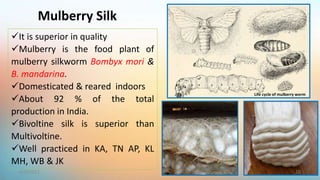
Mulberry Silk
It issuperior in quality
Mulberry is the food plant of
mulberry silkworm Bombyx mori &
B. mandarina.
Domesticated & reared indoors
About 92 % of the total
production in India.
Bivoltine silk is superior than
Multivoltine.
Well practiced in KA, TN AP, KL
MH, WB & JK
10
6/9/2021
Life cycle of mulberry worm
11.
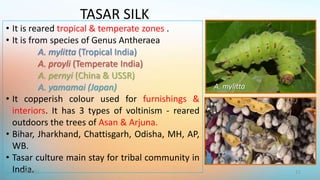
• It isreared tropical & temperate zones .
• It is from species of Genus Antheraea
A. mylitta (Tropical India)
A. proyli (Temperate India)
A. pernyi (China & USSR)
A. yamamai (Japan)
• It copperish colour used for furnishings &
interiors. It has 3 types of voltinism - reared
outdoors the trees of Asan & Arjuna.
• Bihar, Jharkhand, Chattisgarh, Odisha, MH, AP,
WB.
• Tasar culture main stay for tribal community in
India.
TASAR SILK
A. mylitta
11
6/9/2021
12.
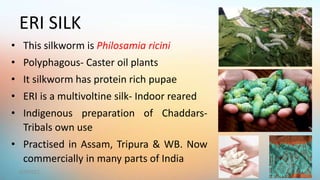
• This silkwormis Philosamia ricini
• Polyphagous- Caster oil plants
• It silkworm has protein rich pupae
• ERI is a multivoltine silk- Indoor reared
• Indigenous preparation of Chaddars-
Tribals own use
• Practised in Assam, Tripura & WB. Now
commercially in many parts of India
ERI SILK
12
6/9/2021
13.
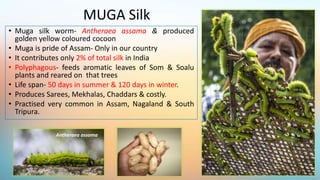
• Muga silkworm- Antheraea assama & produced
golden yellow coloured cocoon
• Muga is pride of Assam- Only in our country
• It contributes only 2% of total silk in India
• Polyphagous- feeds aromatic leaves of Som & Soalu
plants and reared on that trees
• Life span- 50 days in summer & 120 days in winter.
• Produces Sarees, Mekhalas, Chaddars & costly.
• Practised very common in Assam, Nagaland & South
Tripura.
MUGA Silk
13
6/9/2021
Antheraea assama
14.
Lifecycle Silkworm
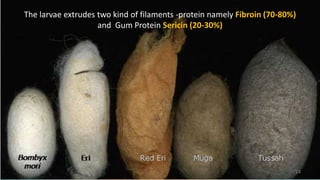
The larvaeextrudes two kind of filaments -protein namely Fibroin (70-80%)
and Gum Protein Sericin (20-30%)
14
6/9/2021
15.
• Globalization- Qualityis playing vital role in Sericulture
• Stockholders focusing to produced better quality-International Silk
Standards.
• Quality of Cocoon- Uniform Shape, Size, Colour, less defective
cocoon and good reelability.
• Visual cocoon examination- Melted, Double, Stained, Thin end,
Filmsy and Malformed.
• Quality parameters of Silk- Non breakable filament, evenness,
neatness, elongation, Cohesion, Cleanliness
• The cocoons are priced on the basis Rendita and reeling
parameters. Rendita may be defined as number of kg of cocoon
producing 1 kg of raw silk.
Quality of Cocoon and Silk
15
6/9/2021
16.
• One layingcontains 450-500 eggs/12-15kg of mulberry leaves for its
rearing.
• Average 70 – 80 kg of cocoon yield can be obtained from 100 DFLs.
• Production of 1 kg of cocoon needs 18-20 kg of mulberry leaves
• It is purely depends on variety, quality of leaves and season of rearing.
• To rear 100 DFL a bed space required of 700-750 sq.ft. for Multivoltine
and 800-900 sq.ft. for Bivoltine silkworm races.
• Proper systematic planning of silkworm rearing to meet day to day
requirements it should be necessary to asses the leaf production, supply
of in time Chawki worms and labour requirement in addition to
disinfectants to the rearing house.
DFL- Diseases Free Layings
16
6/9/2021
17.
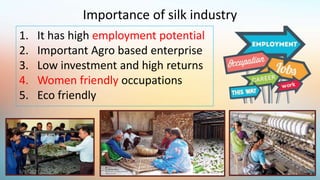
1. It hashigh employment potential
2. Important Agro based enterprise
3. Low investment and high returns
4. Women friendly occupations
5. Eco friendly
Importance of silk industry
17
6/9/2021
18.
India has achievedsignificantly in silk production and productivity, but still facing
certain problems
• Bulk of production achieved only viz Multi or Bivoltine breeds- Silk quality is low by
International Silk Standards.
• Culture practice is very difficult to introduce in many states. National Sericulture
Project (NSP) Since 1990 still limited production.
• Indian Silk Cost is much higher than China. So Indian weavers are imported from China
in cheaper price.
• Production system of China much better than ours. It is essential to improve the quality
and productivity of Indian Silk
• Many places are uprooted mulberry garden- Urbanization & Improper rainfall
• Reeling sector is unorganised in India
• Current productivity of raw silk is low & not fulfil our demand- Import from other
countries .
Constraints of Sericulture Industry in India
18
6/9/2021
19.
Mulberry area :2.00 acres
Silkworm rearing shed size : 60’L x 20’W (Feet)
A. Mulberry cultivation & maintenance expenditure- First Invest.
B. Silkworm rearing shed- First Invest.
C. Expenditure on Silkworm Rearing Materials- First Invest
D. Silkworm Rearing Expenses
E. Income
Sericulture Economics-as per TNAU
19
6/9/2021
20.
• Mulberry area: 2.00 acres
Silkworm rearing shed size : 60’L x 20’W (Feet)
A. Mulberry cultivation and maintenance expenditure- First Invest.
Sericulture Economics-as per TNAU
Sl.No. Particulars Amount Rs
1. Ploughing 1,000.00
2. FYM 16 tons/ Rs. 450 / tonne) 7,200.00
3. Forming Ridges and Furrows 1,600.00
4. Mulberry cuttings/ Seedlings (@Rs. 1) per 10,000 Nos 10,000.00
5. Transplanting (Labour charges) 1,000.00
6. Weeding 3,000.00
7. Fertilizers cost 1,500.00
8. Foliar spray of nutrients 500.00
9. Irrigation 800.00
Total 26,600.00
20
6/9/2021
21.
1. Silkworm rearingshed size (60’ x 20’) : 1200 Sq.ft
2. Walls with Hallow blocks( 7’ to 8’ )
3. Coconut fronds for top
3. Door - 6’ to 4’ (one number)
4. Windows - 6’ to 3’ - 13 numbers
5. Cement floor
Total cost of building construction Rs. 1, 25,000
B. Silkworm rearing shed- First Invest.
21
6/9/2021
22.
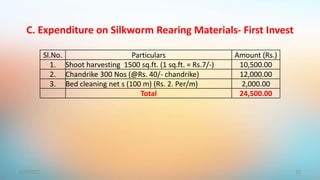
C. Expenditure onSilkworm Rearing Materials- First Invest
Sl.No. Particulars Amount (Rs.)
1. Shoot harvesting 1500 sq.ft. (1 sq.ft. = Rs.7/-) 10,500.00
2. Chandrike 300 Nos (@Rs. 40/- chandrike) 12,000.00
3. Bed cleaning net s (100 m) (Rs. 2. Per/m) 2,000.00
Total 24,500.00
22
6/9/2021
23.
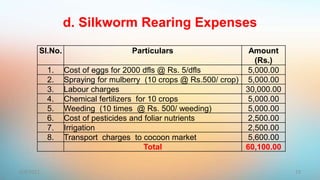
d. Silkworm RearingExpenses
Sl.No. Particulars Amount
(Rs.)
1. Cost of eggs for 2000 dfls @ Rs. 5/dfls 5,000.00
2. Spraying for mulberry (10 crops @ Rs.500/ crop) 5,000.00
3. Labour charges 30,000.00
4. Chemical fertilizers for 10 crops 5,000.00
5. Weeding (10 times @ Rs. 500/ weeding) 5,000.00
6. Cost of pesticides and foliar nutrients 2,500.00
7. Irrigation 2,500.00
8. Transport charges to cocoon market 5,600.00
Total 60,100.00
23
6/9/2021
24.
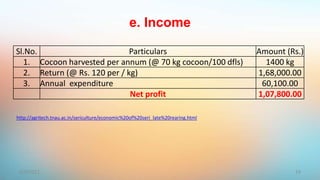
e. Income
Sl.No. ParticularsAmount (Rs.)
1. Cocoon harvested per annum (@ 70 kg cocoon/100 dfls) 1400 kg
2. Return (@ Rs. 120 per / kg) 1,68,000.00
3. Annual expenditure 60,100.00
Net profit 1,07,800.00
http://agritech.tnau.ac.in/sericulture/economic%20of%20seri_late%20rearing.html
24
6/9/2021
25.
It is playingvital role on rural economy & employment
1. Raising of Mulberry saplings- Nursery
2. Raising of mulberry garden and silkworm rearing
3. Silkworm egg production/DFLs
4. Reeling and Spinning of Cocoons
5. Twisting of Reeled Silk
6. Weaving
7. Dyeing and Printing
8. Miscellaneous activities
Sericulture and Rural Economy
25
6/9/2021
26.
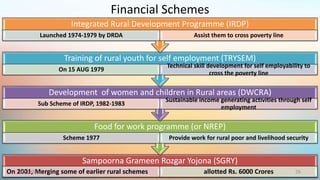
Sampoorna Grameen RozgarYojona (SGRY)
On 2001, Merging some of earlier rural schemes allotted Rs. 6000 Crores
Food for work programme (or NREP)
Scheme 1977 Provide work for rural poor and livelihood security
Development of women and children in Rural areas (DWCRA)
Sub Scheme of IRDP, 1982-1983
Sustainable income generating activities through self
employment
Training of rural youth for self employment (TRYSEM)
On 15 AUG 1979
Technical skill development for self employability to
cross the poverty line
Integrated Rural Development Programme (IRDP)
Launched 1974-1979 by DRDA Assist them to cross poverty line
Financial Schemes
26
6/9/2021
27.
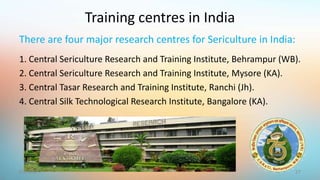
1. Central SericultureResearch and Training Institute, Behrampur (WB).
2. Central Sericulture Research and Training Institute, Mysore (KA).
3. Central Tasar Research and Training Institute, Ranchi (Jh).
4. Central Silk Technological Research Institute, Bangalore (KA).
Training centres in India
There are four major research centres for Sericulture in India:
27
6/9/2021
28.
Introduction to sericulture(2008) published by School of Agriculture, IGNOU, ISBN-978-81-266-3341-8.
http://agritech.tnau.ac.in/sericulture/economic%20of%20seri_late%20rearing.html
https://www.aplustopper.com/sericulture-process-of-silk-production/
Reference
28
6/9/2021