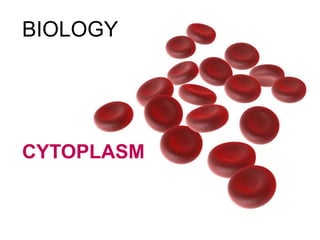
CYTOPLASMBIOLOGY
What is cytoplasm ?The cytoplasm is a jelly like material which is mostly made out of watersite where most cell activities are carried outa mandatory part of the cells attached between the plasma membrane and the nucleus, divided into :cytosol(the main substance of the cytoplasm), organelles(the permanent component of the cytoplasm) and inclusion(the time components of the cytoplasm).
Consists of :		-Cytosol (Hyaloplasm)  the main substance of the cytoplasm colorless, slimy, thick and transparent colloidal solutiona) 90% of water and solutes eg : Sugar, amino acids, enzymes, fatty acids, 	    	       nucleotides, ATP and dissolved gases.	b) large molecules eg : Proteins which form colloidsc) microfilament and microtubulesd) site for many biochemical reactions
Organells the permanent component of the cytoplasm  Structure in the cell that carry out specialised functionseg : mitochondrian, lysosomes, chloroplast, endoplasmic 	   reticulum
Inclusions (Cytoplasmic) non-living substances that may or may not be present in a cell, depending on the cell type.  are stored nutrients, secretory products, and pigment granules. eg : glycogen granules in the liver and muscle cells,  	       lipid droplets in fat cells, pigment granules in 	       certain cells of skin and hair, water containing 	       vacuoles

Biology, cytoplasm

  • 1.
  • 2.
    What is cytoplasm?The cytoplasm is a jelly like material which is mostly made out of watersite where most cell activities are carried outa mandatory part of the cells attached between the plasma membrane and the nucleus, divided into :cytosol(the main substance of the cytoplasm), organelles(the permanent component of the cytoplasm) and inclusion(the time components of the cytoplasm).
  • 3.
    Consists of : -Cytosol(Hyaloplasm)  the main substance of the cytoplasm colorless, slimy, thick and transparent colloidal solutiona) 90% of water and solutes eg : Sugar, amino acids, enzymes, fatty acids, nucleotides, ATP and dissolved gases. b) large molecules eg : Proteins which form colloidsc) microfilament and microtubulesd) site for many biochemical reactions
  • 4.
    Organells the permanentcomponent of the cytoplasm Structure in the cell that carry out specialised functionseg : mitochondrian, lysosomes, chloroplast, endoplasmic reticulum
  • 5.
    Inclusions (Cytoplasmic) non-livingsubstances that may or may not be present in a cell, depending on the cell type.  are stored nutrients, secretory products, and pigment granules. eg : glycogen granules in the liver and muscle cells, lipid droplets in fat cells, pigment granules in certain cells of skin and hair, water containing vacuoles