CELL: STRUCTURE AND FUNCTION
Presented By: Mr. SHUBHAM
Assistant Professor
College of Pharmacy
RIMT University
HAP-I
Ist SEMESTER
INTRODUCTION
 Fundamental unit of life.
 Self replicating structure
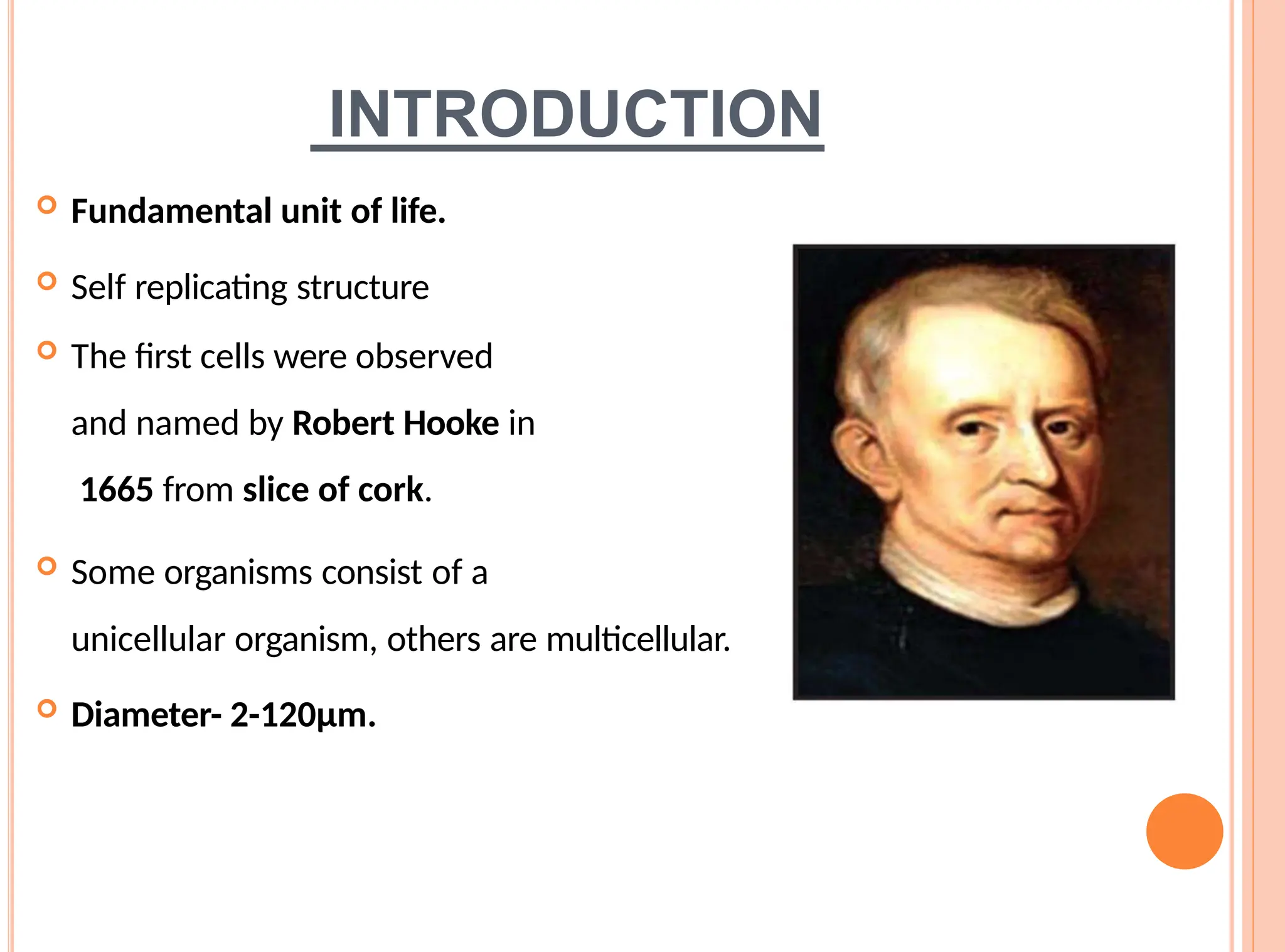
 The first cells were observed
and named by Robert Hooke in
1665 from slice of cork.
 Some organisms consist of a
unicellular organism, others are multicellular.
single cells =
 Diameter- 2-120µm.
CONSTITUENTS
 Different substances that make a cell are collectively called
Protoplasm.
 Protoplasm is composed of :-
1)Water - 70-80% Water is present in cell.
2)Carbohydrates
3)Lipids
4)Protein
s
5)Electrolyte - Sodium (Na+), Potassium (K+), Magnesium (Mg2+),
Calcium (Ca2+), Phosphate , Chloride (Cl-), and Bicarbonate (HC03 - ).
CELL MEMBRANE
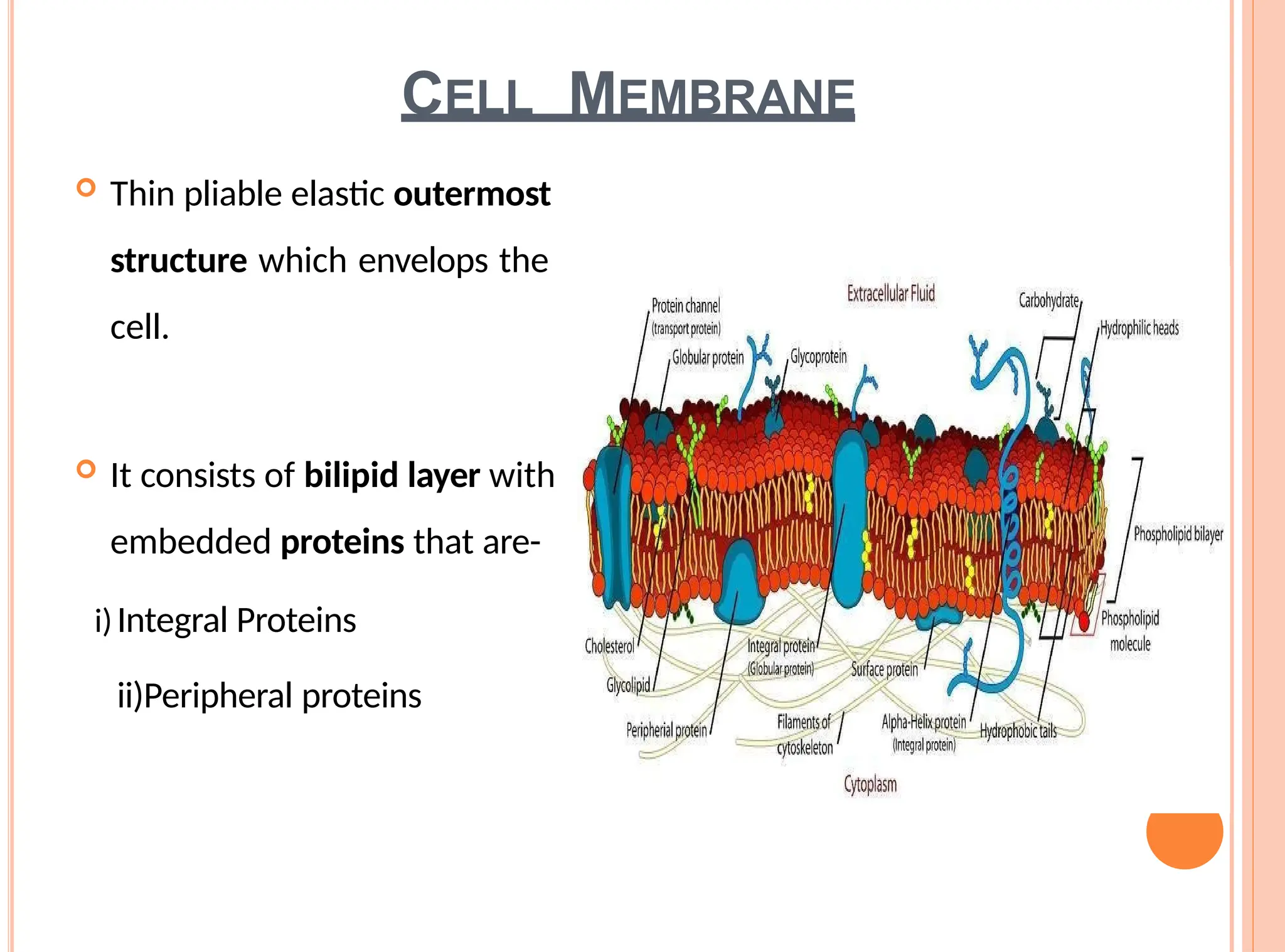
 Thin pliable elastic outermost
structure which envelops the
cell.
 It consists of bilipid layer with
embedded proteins that are-
i)Integral Proteins
ii)Peripheral proteins
FUNCTIONS OF CELL MEMBRANE
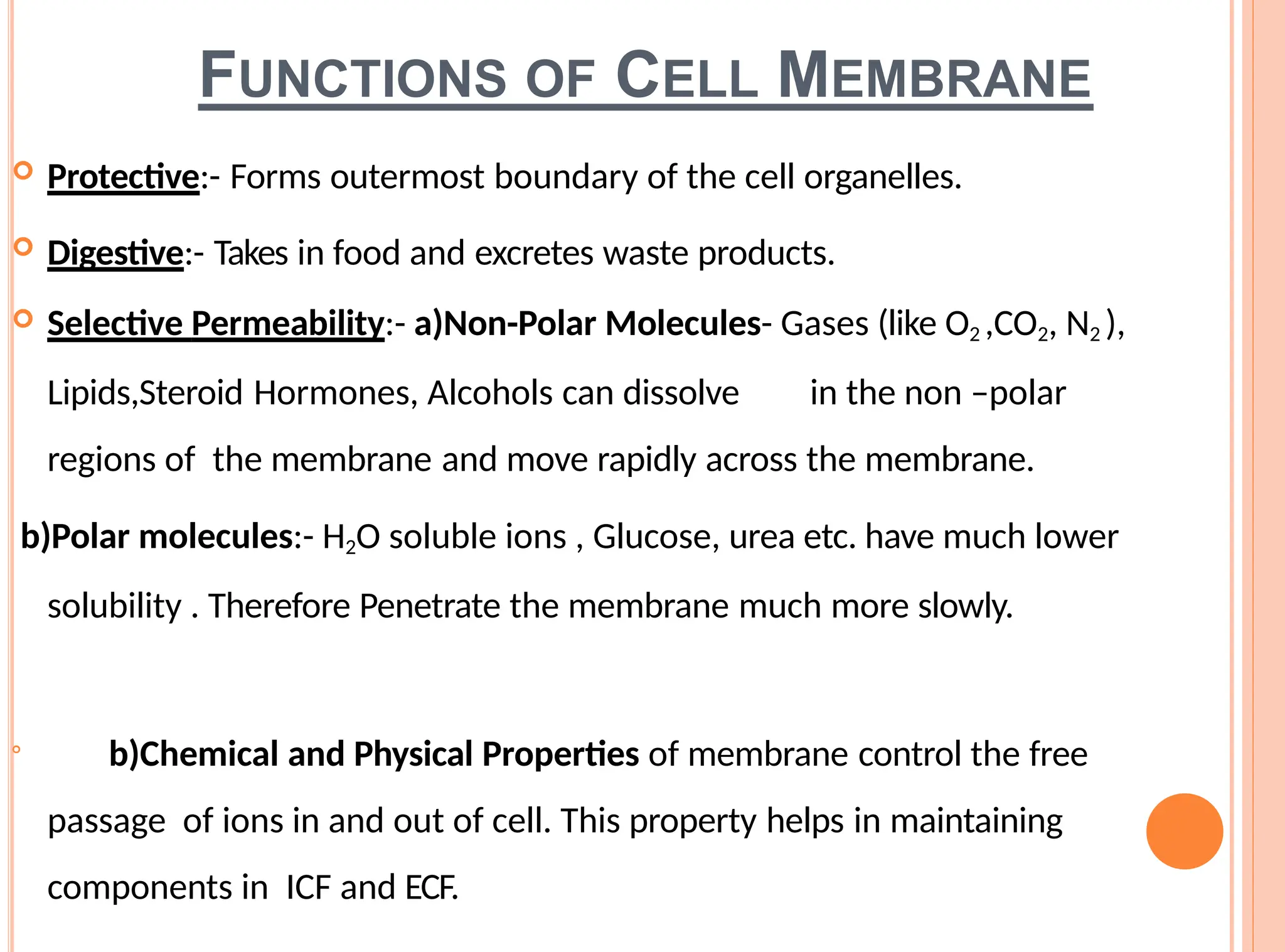
 Protective:- Forms outermost boundary of the cell organelles.
 Digestive:- Takes in food and excretes waste products.
 Selective Permeability:- a)Non-Polar Molecules- Gases (like O2 ,CO2, N2 ),
Lipids,Steroid Hormones, Alcohols can dissolve in the non –polar
regions of the membrane and move rapidly across the membrane.
b)Polar molecules:- H2O soluble ions , Glucose, urea etc. have much lower
solubility . Therefore Penetrate the membrane much more slowly.

b)Chemical and Physical Properties of membrane control the free
passage of ions in and out of cell. This property helps in maintaining
components in ICF and ECF.
CYTOPLASM
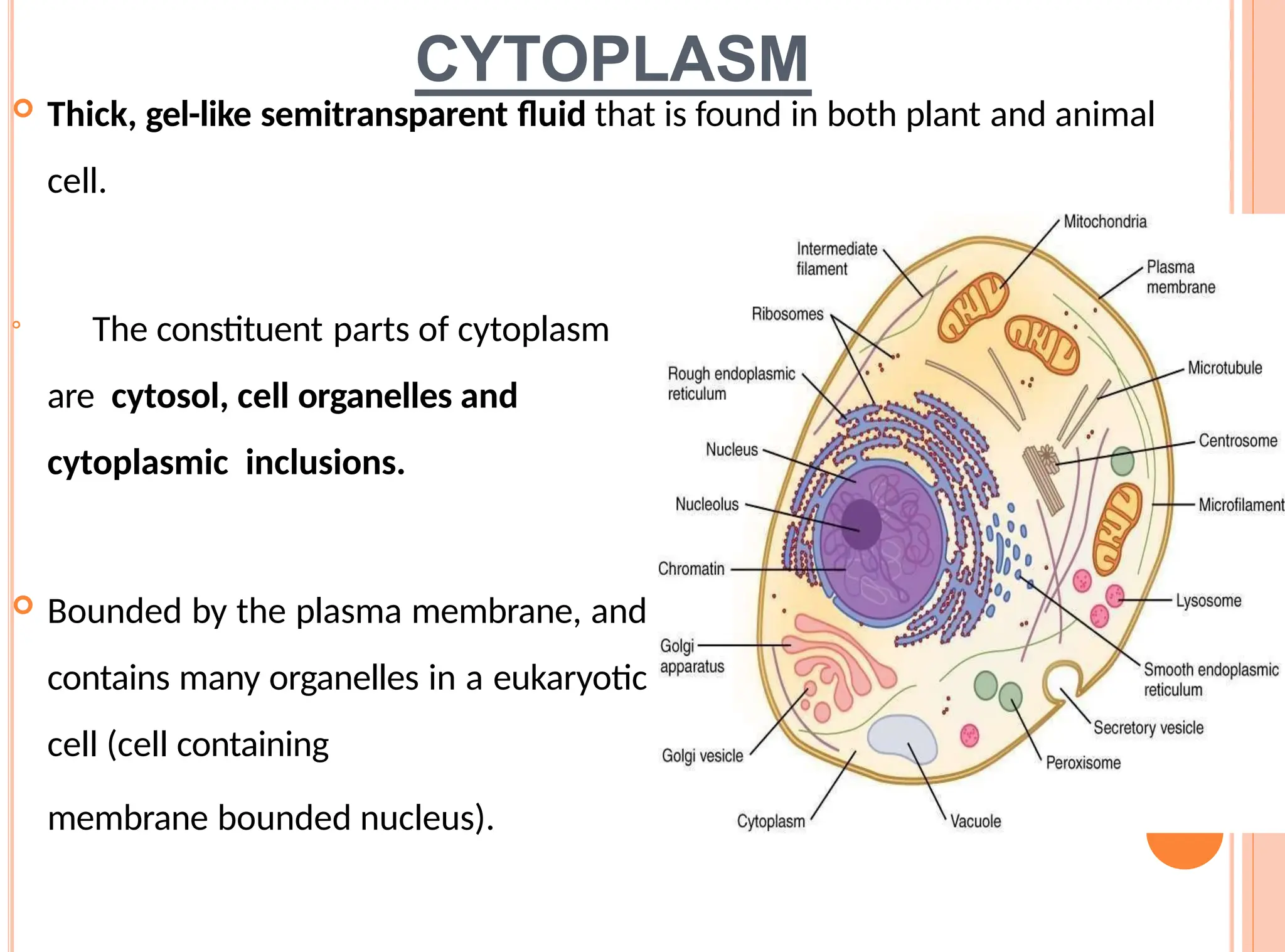
 Thick, gel-like semitransparent fluid that is found in both plant and animal
cell.

The constituent parts of cytoplasm
are cytosol, cell organelles and
cytoplasmic inclusions.
 Bounded by the plasma membrane, and
contains many organelles in a eukaryotic
cell (cell containing
membrane bounded nucleus).
CYTOSOL

The cytosol, the aqueous part of the cytoplasm outside all of the
organelles, also contains its own distinctive proteins.
 It accounts for almost 70% of the total cell volume.
 Gelatinous substance consisting mainly of cytoskeleton filaments, organic
molecules, salt and water.

Chemically, the cytoplasmic matrix is composed of many chemical
elements in the form of atoms, ions and molecules.
ORGANELLES
 Following organelles are present in the
Cytoplasm:-
i)Mitochondri
a
iii)Lysosomes
v)Peroxisome
s
ii)Endoplasmic
Reticulum iv)Golgi
Appartus
vi)Vacuol
e
 Each organelle is bounded by a lipid membrane, and has
specific functions.
MITOCHONDRIA
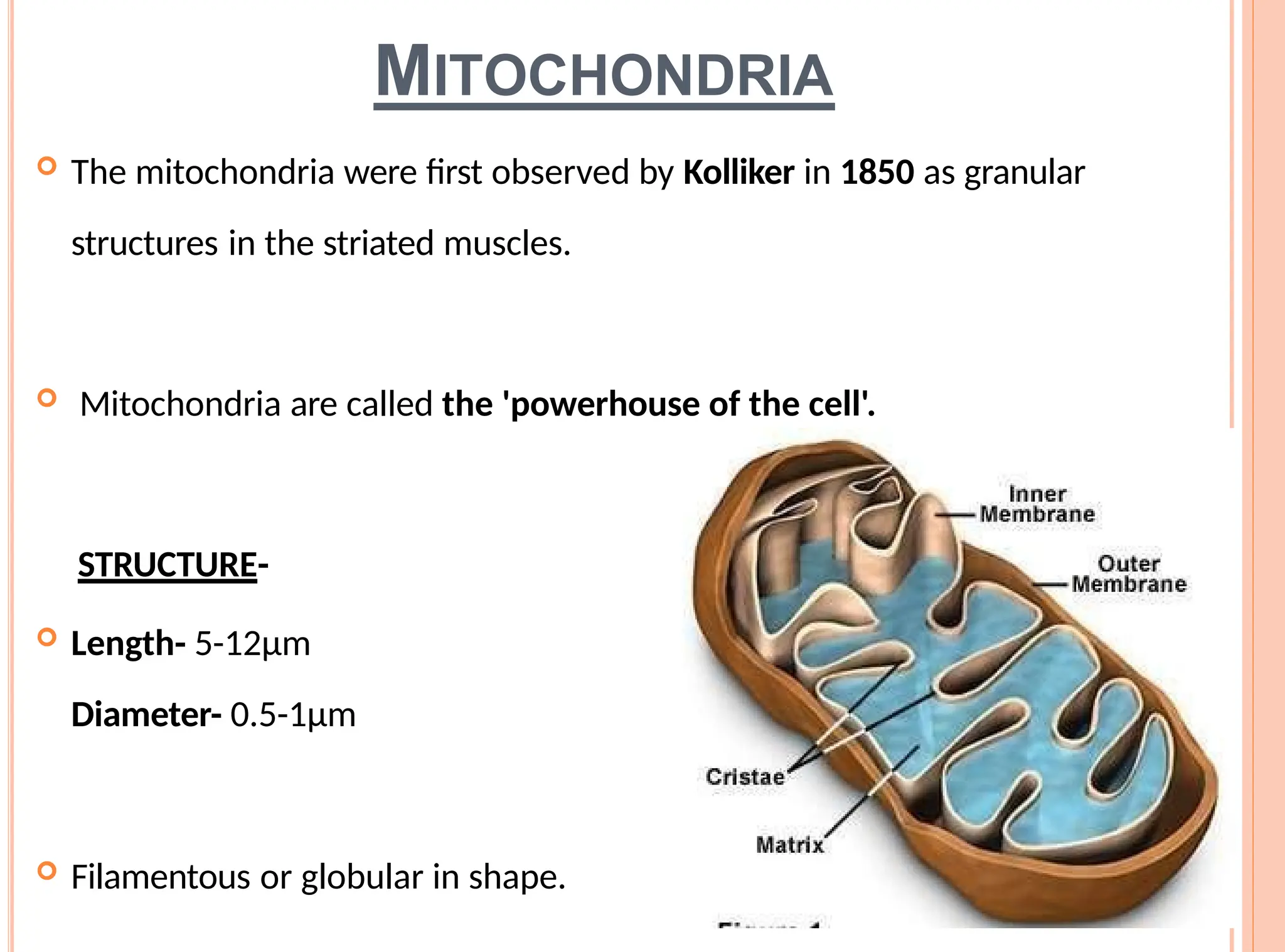
 The mitochondria were first observed by Kolliker in 1850 as granular
structures in the striated muscles.
 Mitochondria are called the 'powerhouse of the cell'.
STRUCTURE-
 Length- 5-12µm
Diameter- 0.5-1µm
 Filamentous or globular in shape.
ENDOPLASMIC RETICULUM
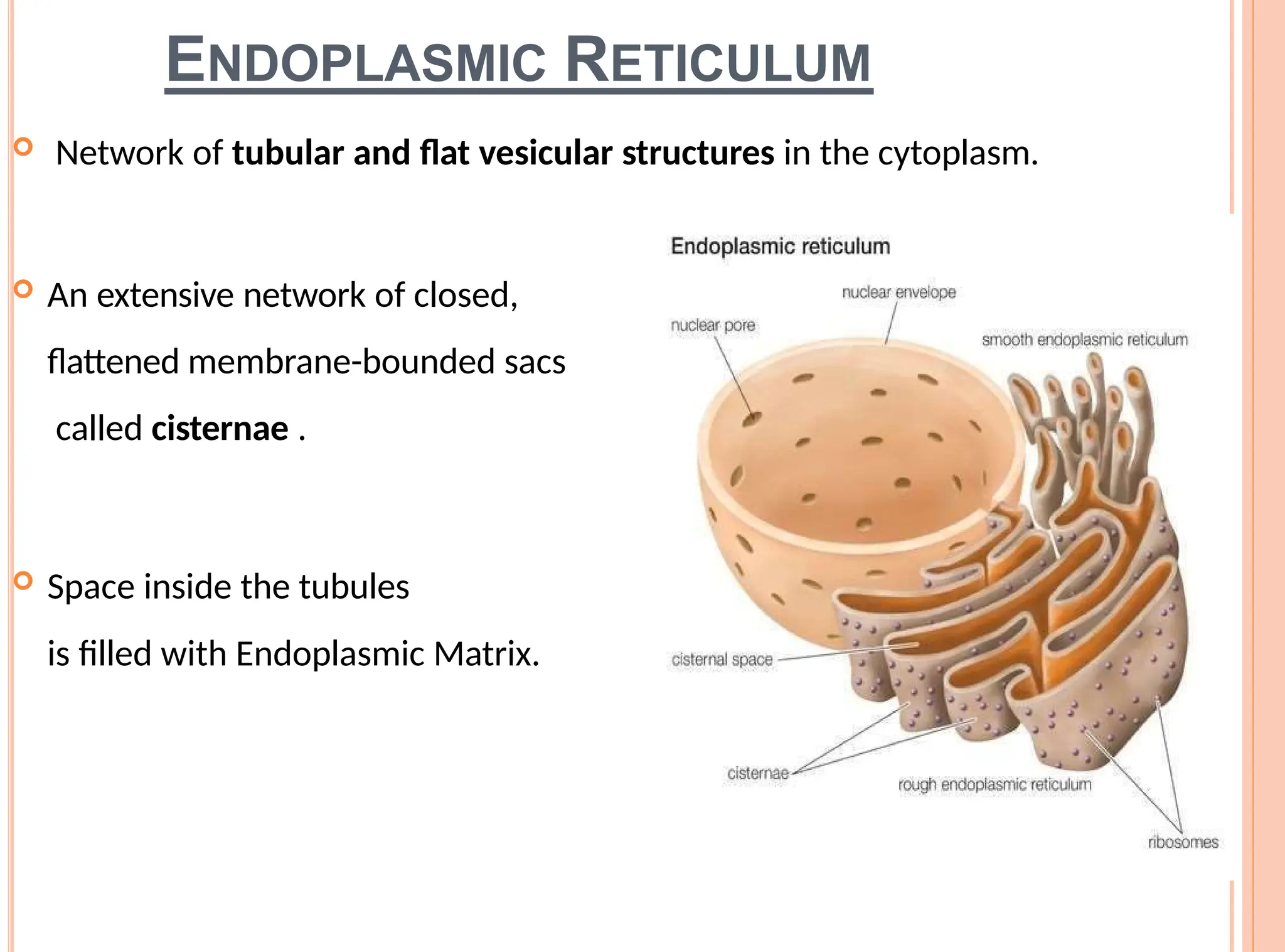
 Network of tubular and flat vesicular structures in the cytoplasm.
 An extensive network of closed,
flattened membrane-bounded sacs
called cisternae .
 Space inside the tubules
is filled with Endoplasmic Matrix.
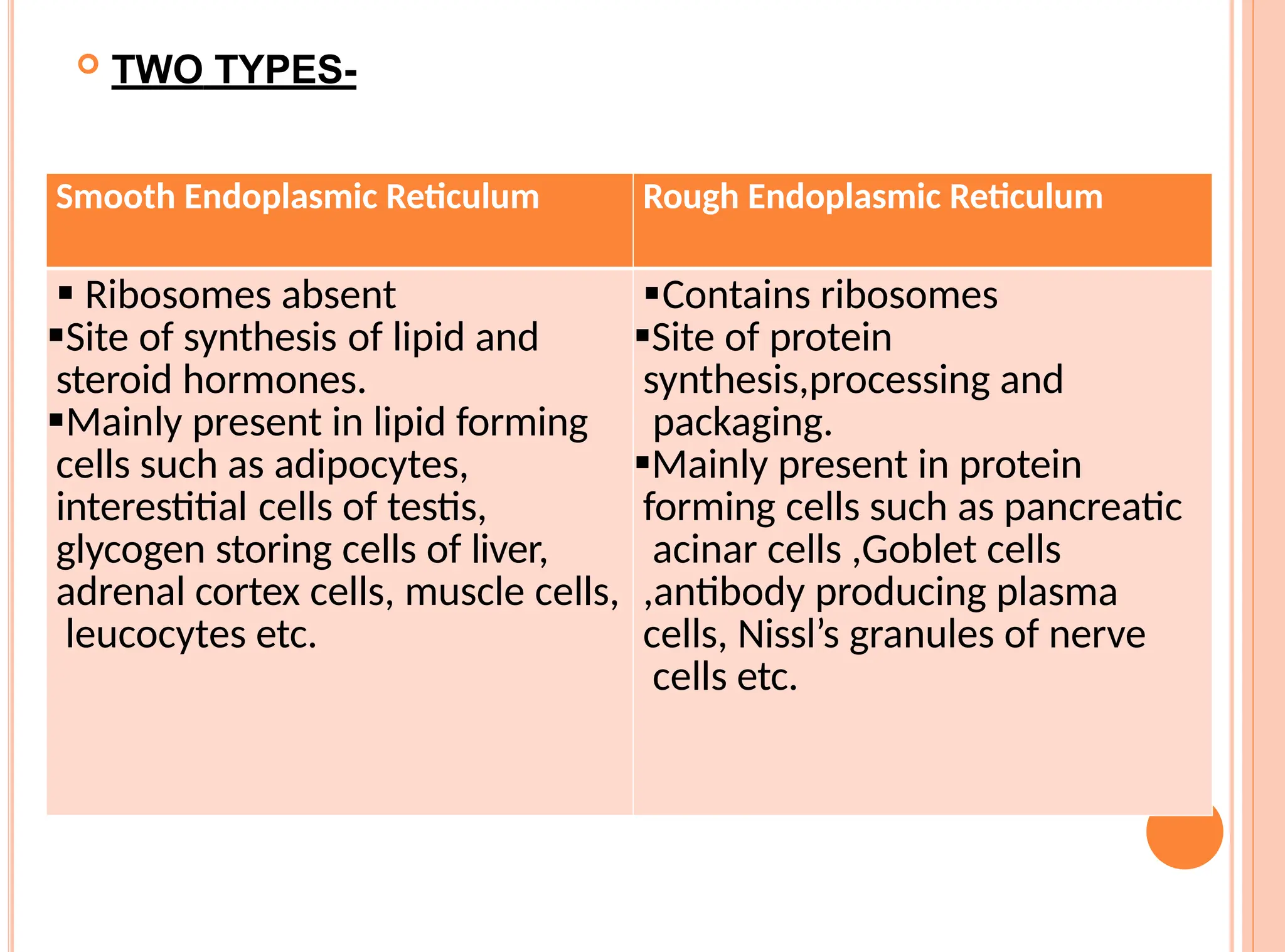
 TWO TYPES-
Smooth Endoplasmic Reticulum Rough Endoplasmic Reticulum
 Ribosomes absent
Site of synthesis of lipid and
steroid hormones.
Mainly present in lipid forming
cells such as adipocytes,
interestitial cells of testis,
glycogen storing cells of liver,
adrenal cortex cells, muscle cells,
leucocytes etc.
Contains ribosomes
Site of protein
synthesis,processing and
packaging.
Mainly present in protein
forming cells such as pancreatic
acinar cells ,Goblet cells
,antibody producing plasma
cells, Nissl’s granules of nerve
cells etc.
GOLGI BODIES
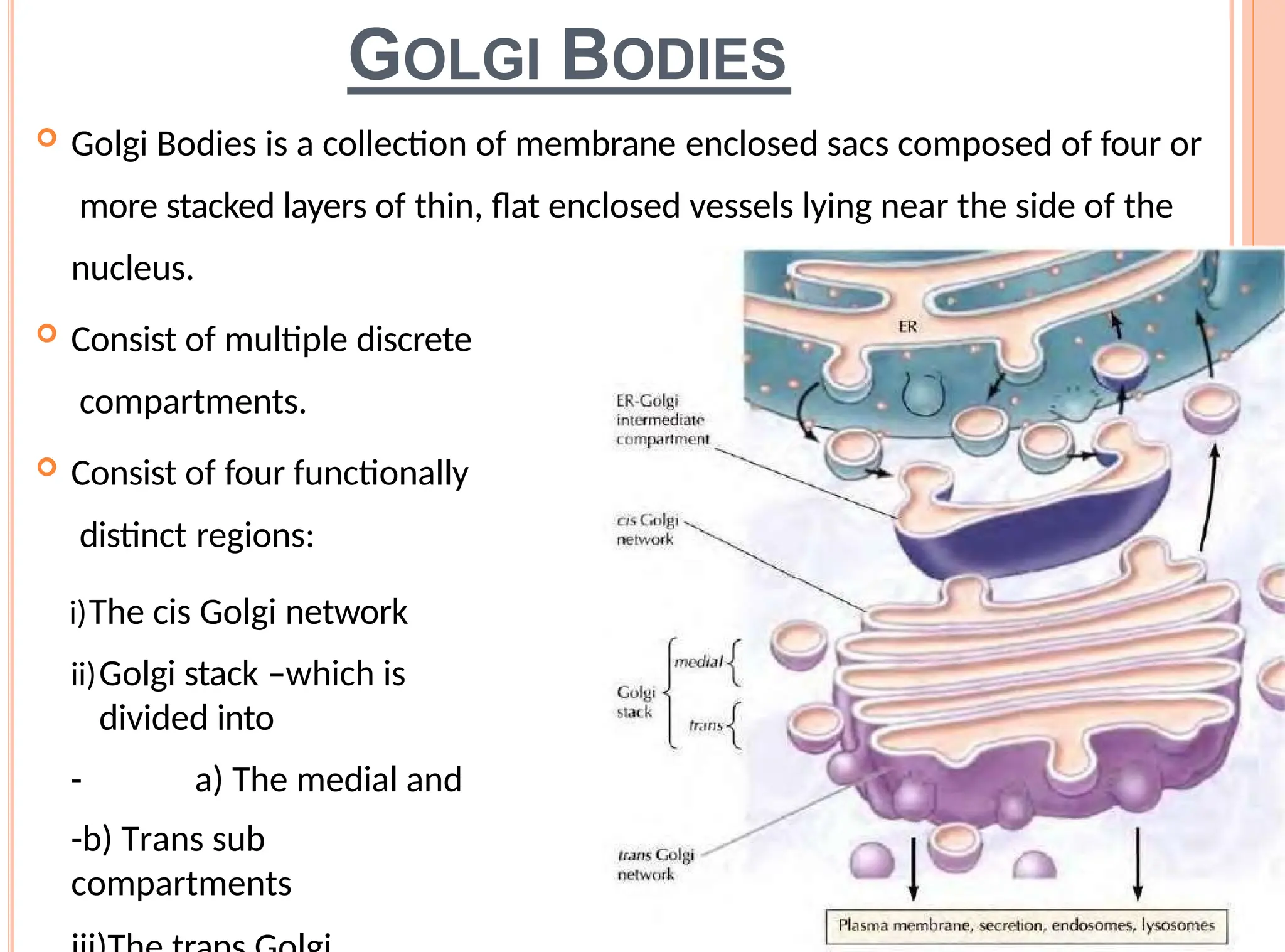
 Golgi Bodies is a collection of membrane enclosed sacs composed of four or
more stacked layers of thin, flat enclosed vessels lying near the side of the
nucleus.
 Consist of multiple discrete
compartments.
 Consist of four functionally
distinct regions:
i)The cis Golgi network
ii)Golgi stack –which is
divided into
- a) The medial and
-b) Trans sub
compartments
LYSOSOMES
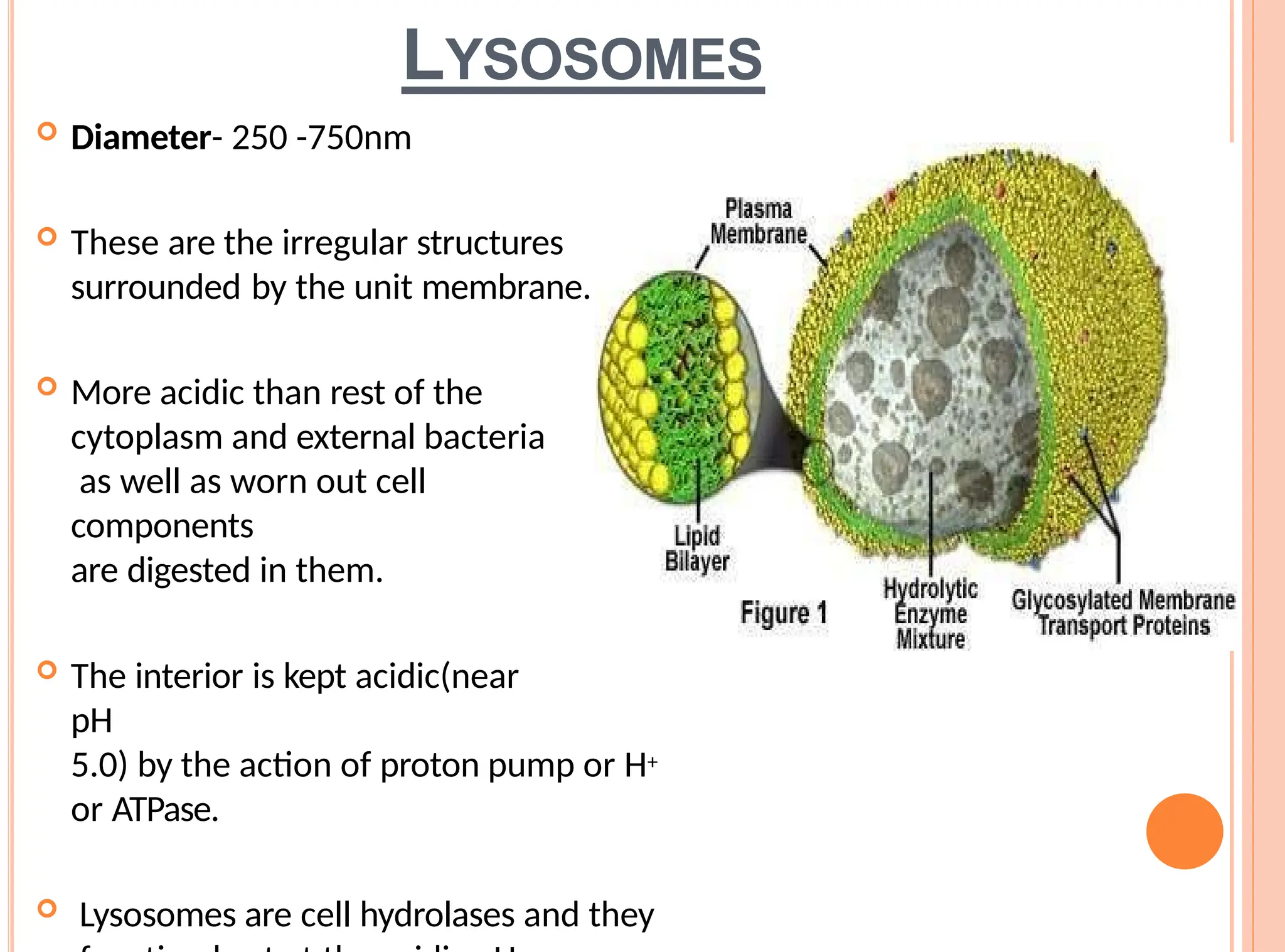
 Diameter- 250 -750nm
 These are the irregular structures
surrounded by the unit membrane.
 More acidic than rest of the
cytoplasm and external bacteria
as well as worn out cell
components
are digested in them.
 The interior is kept acidic(near
pH
5.0) by the action of proton pump or H+
or ATPase.
 Lysosomes are cell hydrolases and they
PEROXISOMES
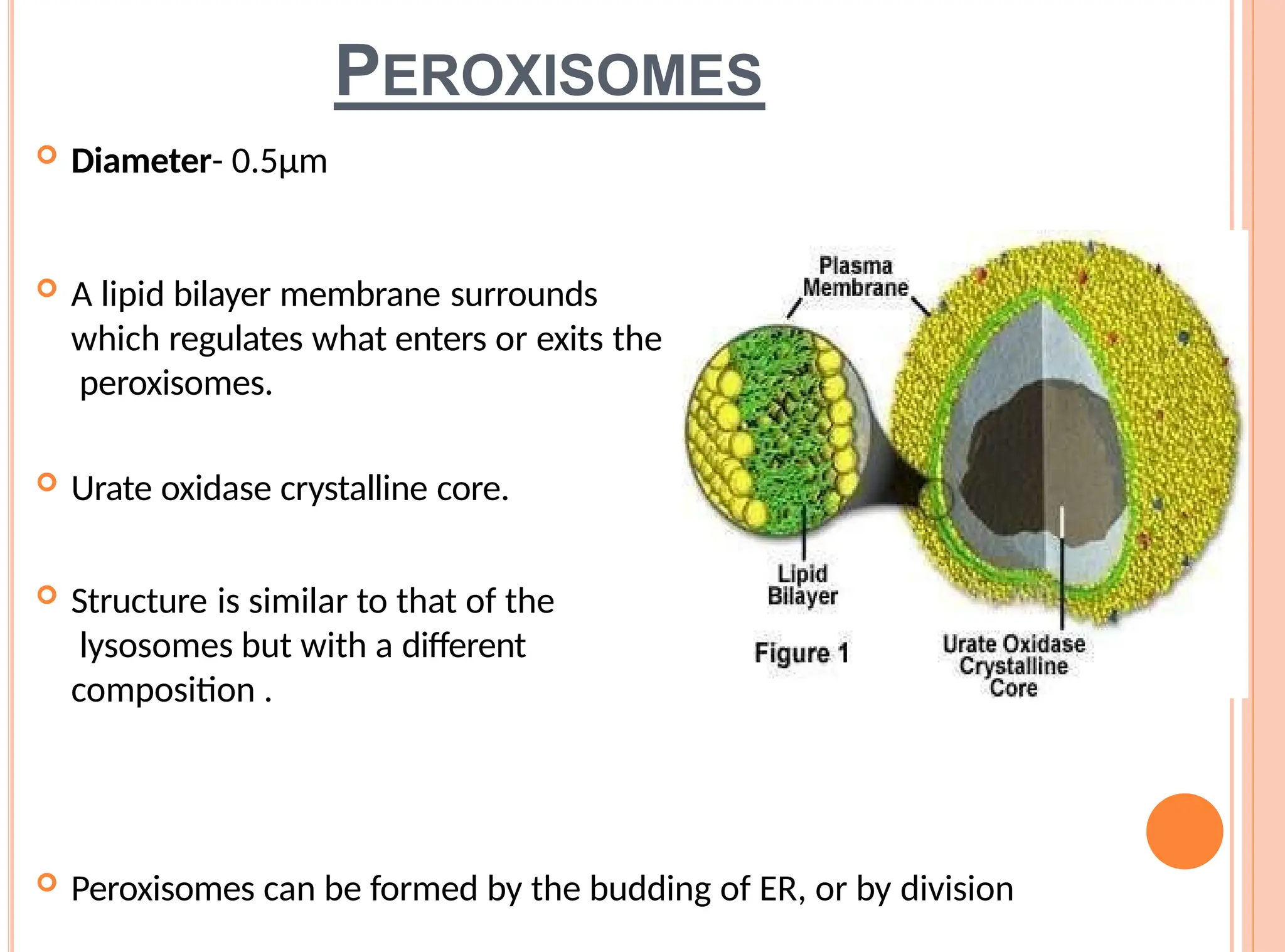
 Diameter- 0.5µm
 A lipid bilayer membrane surrounds
which regulates what enters or exits the
peroxisomes.
 Urate oxidase crystalline core.
 Structure is similar to that of the
lysosomes but with a different
composition .
chemical
 Peroxisomes can be formed by the budding of ER, or by division
CYTOSKELETON
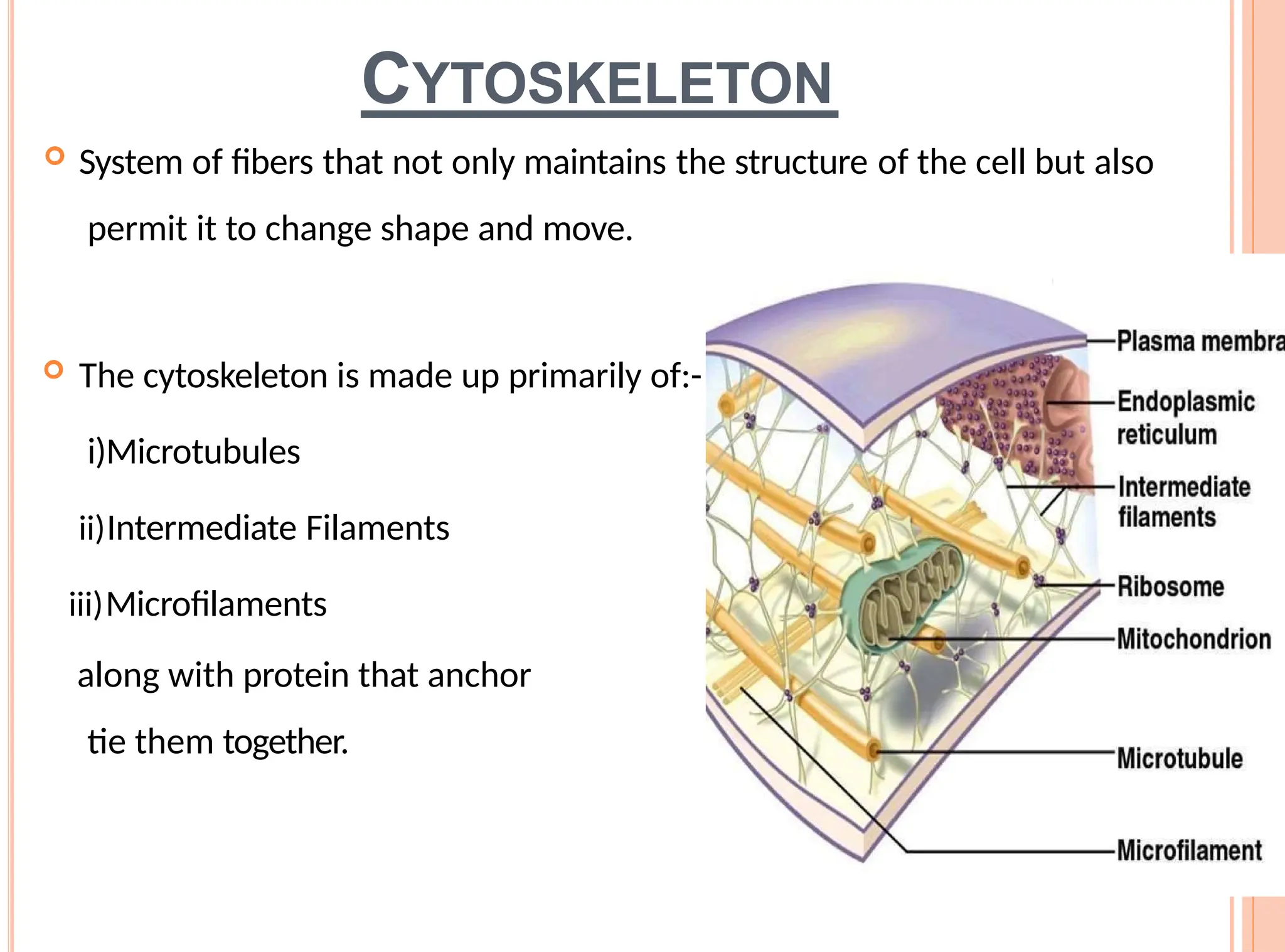
 System of fibers that not only maintains the structure of the cell but also
permit it to change shape and move.
 The cytoskeleton is made up primarily of:-
i)Microtubules
ii)Intermediate Filaments
iii)Microfilaments
along with protein that anchor
tie them together.
and
THE NUCLEUS
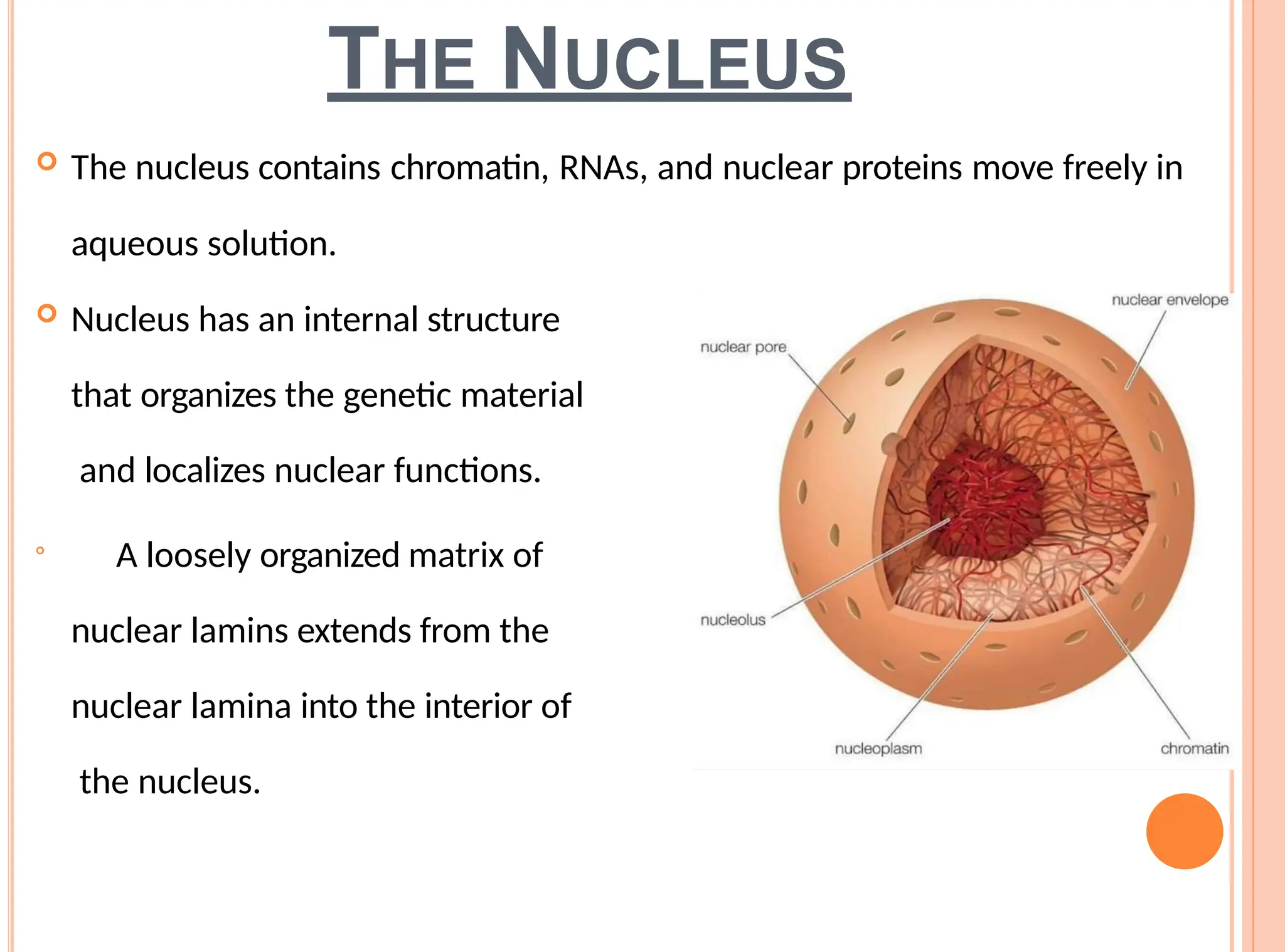
 The nucleus contains chromatin, RNAs, and nuclear proteins move freely in
aqueous solution.
 Nucleus has an internal structure
that organizes the genetic material
and localizes nuclear functions.

A loosely organized matrix of
nuclear lamins extends from the
nuclear lamina into the interior of
the nucleus.
NUCLEAR ENVELOPE
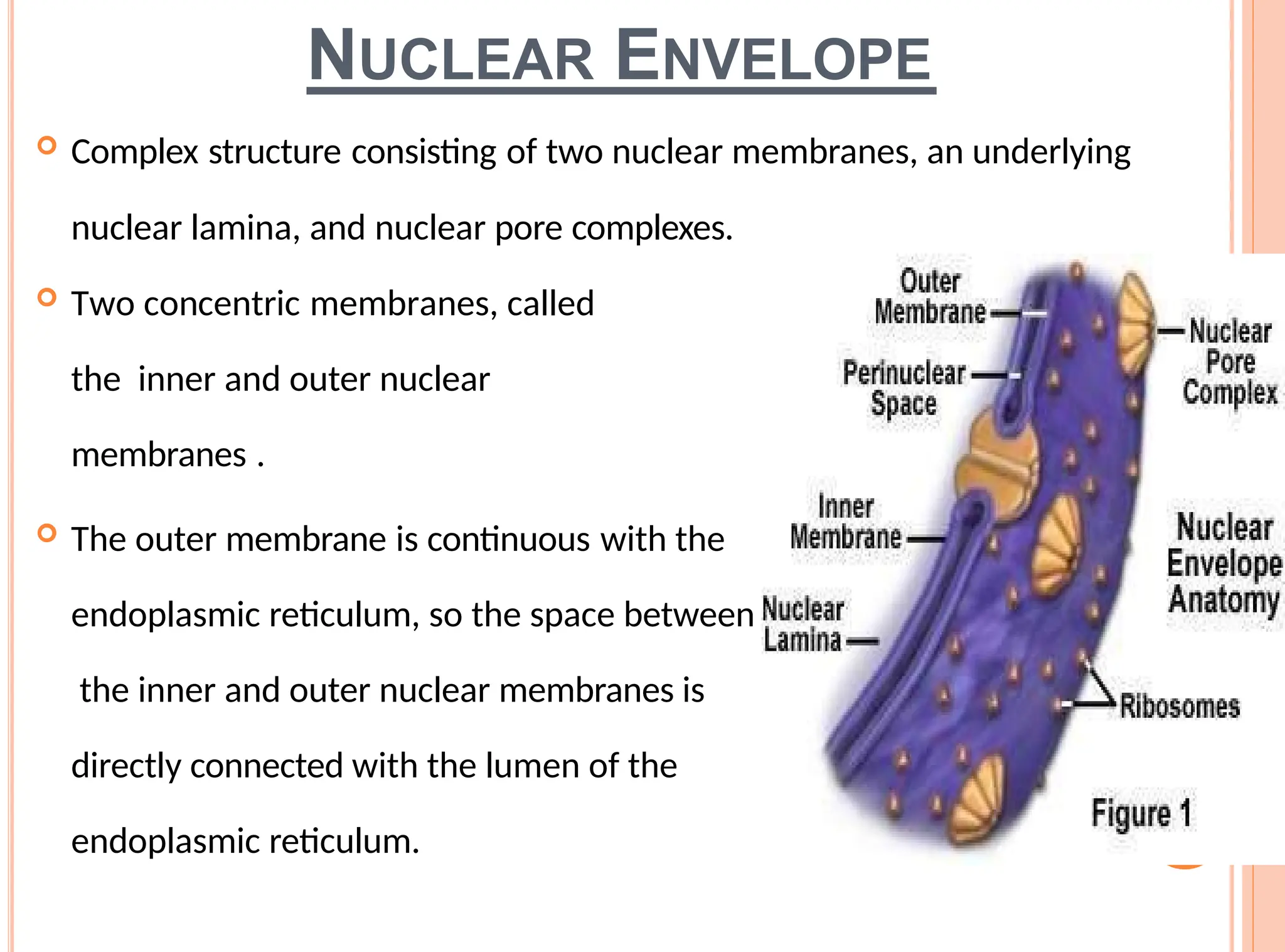
 Complex structure consisting of two nuclear membranes, an underlying
nuclear lamina, and nuclear pore complexes.
 Two concentric membranes, called
the inner and outer nuclear
membranes .
 The outer membrane is continuous with the
endoplasmic reticulum, so the space between
the inner and outer nuclear membranes is
directly connected with the lumen of the
endoplasmic reticulum.
SUMMAR
Y
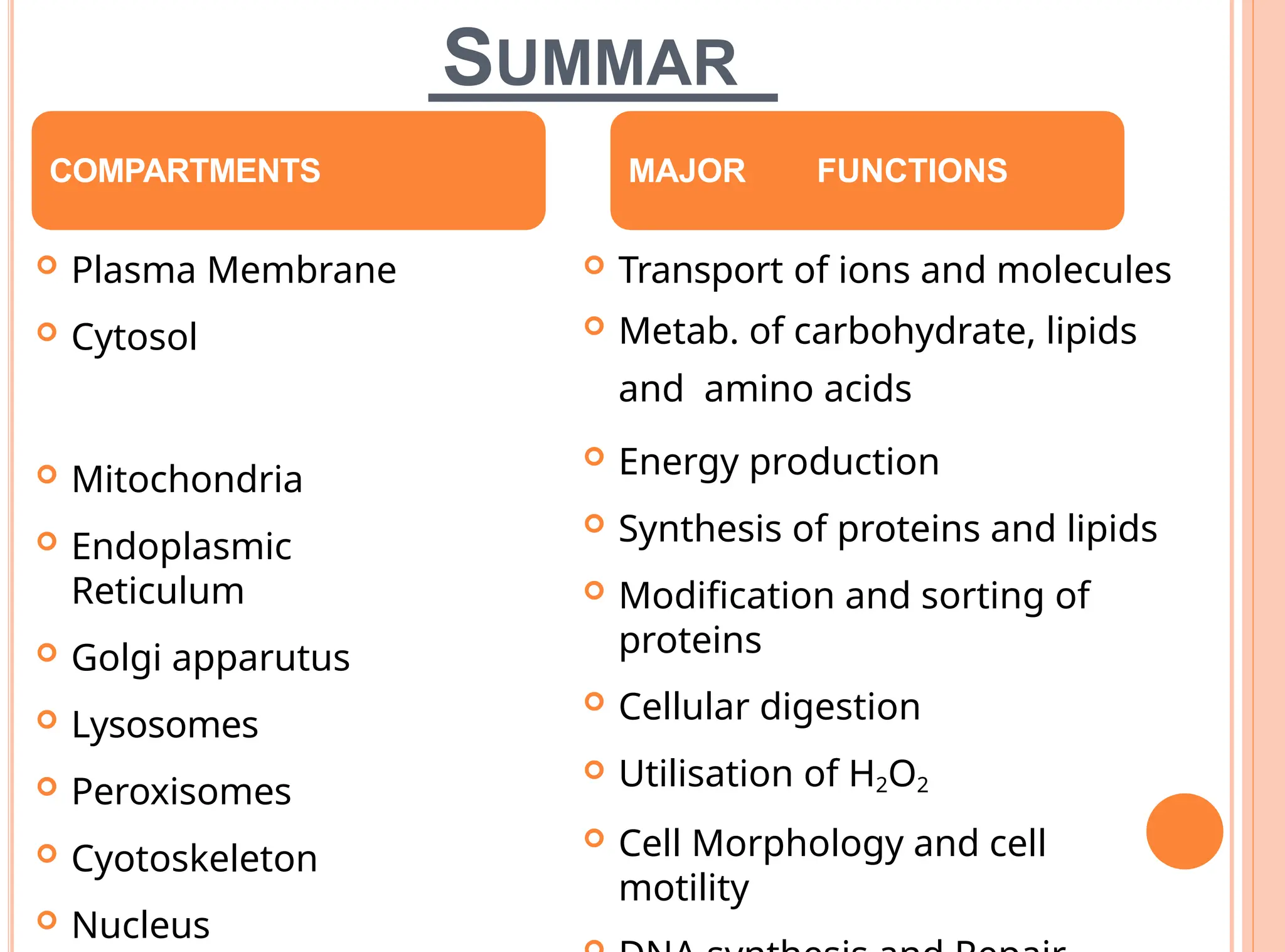
COMPARTMENTS
 Plasma Membrane
 Cytosol
 Mitochondria
 Endoplasmic
Reticulum
 Golgi apparutus
 Lysosomes
 Peroxisomes
 Cyotoskeleton
 Nucleus
MAJOR FUNCTIONS
 Transport of ions and molecules
 Metab. of carbohydrate, lipids
and amino acids
 Energy production
 Synthesis of proteins and lipids
 Modification and sorting of
proteins
 Cellular digestion
 Utilisation of H2O2
 Cell Morphology and cell
motility
THANK YOU

Structure of cell WITH THEIR FUNCTIONS .pptx

  • 1.
    CELL: STRUCTURE ANDFUNCTION Presented By: Mr. SHUBHAM Assistant Professor College of Pharmacy RIMT University HAP-I Ist SEMESTER
  • 2.
    INTRODUCTION  Fundamental unitof life.  Self replicating structure  The first cells were observed and named by Robert Hooke in 1665 from slice of cork.  Some organisms consist of a unicellular organism, others are multicellular. single cells =  Diameter- 2-120µm.
  • 4.
    CONSTITUENTS  Different substancesthat make a cell are collectively called Protoplasm.  Protoplasm is composed of :- 1)Water - 70-80% Water is present in cell. 2)Carbohydrates 3)Lipids 4)Protein s 5)Electrolyte - Sodium (Na+), Potassium (K+), Magnesium (Mg2+), Calcium (Ca2+), Phosphate , Chloride (Cl-), and Bicarbonate (HC03 - ).
  • 5.
    CELL MEMBRANE  Thinpliable elastic outermost structure which envelops the cell.  It consists of bilipid layer with embedded proteins that are- i)Integral Proteins ii)Peripheral proteins
  • 6.
    FUNCTIONS OF CELLMEMBRANE  Protective:- Forms outermost boundary of the cell organelles.  Digestive:- Takes in food and excretes waste products.  Selective Permeability:- a)Non-Polar Molecules- Gases (like O2 ,CO2, N2 ), Lipids,Steroid Hormones, Alcohols can dissolve in the non –polar regions of the membrane and move rapidly across the membrane. b)Polar molecules:- H2O soluble ions , Glucose, urea etc. have much lower solubility . Therefore Penetrate the membrane much more slowly.  b)Chemical and Physical Properties of membrane control the free passage of ions in and out of cell. This property helps in maintaining components in ICF and ECF.
  • 7.
    CYTOPLASM  Thick, gel-likesemitransparent fluid that is found in both plant and animal cell.  The constituent parts of cytoplasm are cytosol, cell organelles and cytoplasmic inclusions.  Bounded by the plasma membrane, and contains many organelles in a eukaryotic cell (cell containing membrane bounded nucleus).
  • 8.
    CYTOSOL  The cytosol, theaqueous part of the cytoplasm outside all of the organelles, also contains its own distinctive proteins.  It accounts for almost 70% of the total cell volume.  Gelatinous substance consisting mainly of cytoskeleton filaments, organic molecules, salt and water.  Chemically, the cytoplasmic matrix is composed of many chemical elements in the form of atoms, ions and molecules.
  • 9.
    ORGANELLES  Following organellesare present in the Cytoplasm:- i)Mitochondri a iii)Lysosomes v)Peroxisome s ii)Endoplasmic Reticulum iv)Golgi Appartus vi)Vacuol e  Each organelle is bounded by a lipid membrane, and has specific functions.
  • 10.
    MITOCHONDRIA  The mitochondriawere first observed by Kolliker in 1850 as granular structures in the striated muscles.  Mitochondria are called the 'powerhouse of the cell'. STRUCTURE-  Length- 5-12µm Diameter- 0.5-1µm  Filamentous or globular in shape.
  • 11.
    ENDOPLASMIC RETICULUM  Networkof tubular and flat vesicular structures in the cytoplasm.  An extensive network of closed, flattened membrane-bounded sacs called cisternae .  Space inside the tubules is filled with Endoplasmic Matrix.
  • 12.
     TWO TYPES- SmoothEndoplasmic Reticulum Rough Endoplasmic Reticulum  Ribosomes absent Site of synthesis of lipid and steroid hormones. Mainly present in lipid forming cells such as adipocytes, interestitial cells of testis, glycogen storing cells of liver, adrenal cortex cells, muscle cells, leucocytes etc. Contains ribosomes Site of protein synthesis,processing and packaging. Mainly present in protein forming cells such as pancreatic acinar cells ,Goblet cells ,antibody producing plasma cells, Nissl’s granules of nerve cells etc.
  • 13.
    GOLGI BODIES  GolgiBodies is a collection of membrane enclosed sacs composed of four or more stacked layers of thin, flat enclosed vessels lying near the side of the nucleus.  Consist of multiple discrete compartments.  Consist of four functionally distinct regions: i)The cis Golgi network ii)Golgi stack –which is divided into - a) The medial and -b) Trans sub compartments
  • 14.
    LYSOSOMES  Diameter- 250-750nm  These are the irregular structures surrounded by the unit membrane.  More acidic than rest of the cytoplasm and external bacteria as well as worn out cell components are digested in them.  The interior is kept acidic(near pH 5.0) by the action of proton pump or H+ or ATPase.  Lysosomes are cell hydrolases and they
  • 15.
    PEROXISOMES  Diameter- 0.5µm A lipid bilayer membrane surrounds which regulates what enters or exits the peroxisomes.  Urate oxidase crystalline core.  Structure is similar to that of the lysosomes but with a different composition . chemical  Peroxisomes can be formed by the budding of ER, or by division
  • 16.
    CYTOSKELETON  System offibers that not only maintains the structure of the cell but also permit it to change shape and move.  The cytoskeleton is made up primarily of:- i)Microtubules ii)Intermediate Filaments iii)Microfilaments along with protein that anchor tie them together. and
  • 17.
    THE NUCLEUS  Thenucleus contains chromatin, RNAs, and nuclear proteins move freely in aqueous solution.  Nucleus has an internal structure that organizes the genetic material and localizes nuclear functions.  A loosely organized matrix of nuclear lamins extends from the nuclear lamina into the interior of the nucleus.
  • 18.
    NUCLEAR ENVELOPE  Complexstructure consisting of two nuclear membranes, an underlying nuclear lamina, and nuclear pore complexes.  Two concentric membranes, called the inner and outer nuclear membranes .  The outer membrane is continuous with the endoplasmic reticulum, so the space between the inner and outer nuclear membranes is directly connected with the lumen of the endoplasmic reticulum.
  • 19.
    SUMMAR Y COMPARTMENTS  Plasma Membrane Cytosol  Mitochondria  Endoplasmic Reticulum  Golgi apparutus  Lysosomes  Peroxisomes  Cyotoskeleton  Nucleus MAJOR FUNCTIONS  Transport of ions and molecules  Metab. of carbohydrate, lipids and amino acids  Energy production  Synthesis of proteins and lipids  Modification and sorting of proteins  Cellular digestion  Utilisation of H2O2  Cell Morphology and cell motility
  • 20.